
Mixed-Cabin Award Pricing Rules: Prorated Distance vs. Flat Highest Overcharges
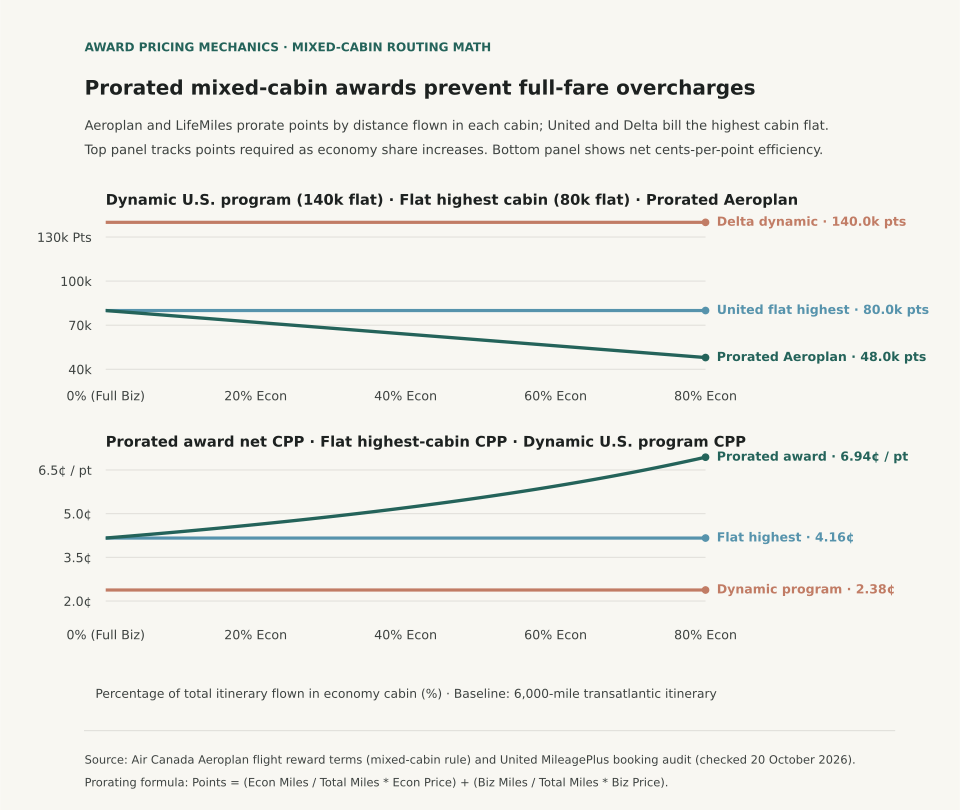
When an award itinerary combines a short domestic feeder flight in economy with a long-haul international flight in business class, frequent flyer programs charge either a prorated point cost based on distance flown or bill the entire journey at the full business class rate. In programs that support distance proration, such as Air Canada Aeroplan and Avianca LifeMiles, an itinerary with a 680-mile domestic economy flight and a 5,360-mile transatlantic business class flight charges approximately 68,400 points—saving 11,600 points compared to the flat 80,000-point business rate. By contrast, legacy U.S. programs like United MileagePlus and Delta SkyMiles charge the full business class mileage cost even when 70% or more of the flight distance is spent in an economy seat.
Award travelers looking for premium cabin seats from non-hub airports (such as Portland, Denver, Raleigh, or Columbus) frequently encounter mixed-cabin itineraries during online searches. Because partner award availability is scarce on domestic connecting legs, an airline search engine might pair a domestic economy feeder with a lie-flat business class seat on the transatlantic or transpacific crossing. Understanding how your loyalty currency prices mixed cabins prevents you from spending tens of thousands of extra bank points on seats that airlines price disproportionately.
The Mathematics of Prorated Mixed-Cabin Pricing
Under Air Canada Aeroplan's mixed-cabin pricing framework, points are calculated using an exact weighted distance formula: Points Charged = (Economy Flight Miles / Total Miles * Full Economy Price) + (Business Flight Miles / Total Miles * Full Business Price). If you book an 8,000-mile itinerary where 2,000 miles (25%) are in economy and 6,000 miles (75%) are in business class, Aeroplan charges exactly 25% of the economy mileage price plus 75% of the business mileage price.
This proration creates substantial point savings on itineraries where premium cabin availability is unavailable on regional legs. The table below compares mixed-cabin pricing rules across major loyalty programs for representative connecting itineraries:
| Itinerary Example | Economy Segment | Business Segment | Aeroplan Prorated Points | United Flat Highest Rate | Delta Dynamic Rate | Prorated Advantage |
|---|---|---|---|---|---|---|
| Seattle (SEA) – SFO – London (LHR) | 680 mi (11.3%) | 5,360 mi (88.7%) | 68,400 pts | 80,000 pts | 145,000 pts | 11,600 pts saved |
| Denver (DEN) – ORD – Frankfurt (FRA) | 880 mi (16.9%) | 4,340 mi (83.1%) | 63,200 pts | 75,000 pts | 130,000 pts | 11,800 pts saved |
| Los Angeles (LAX) – HNL – Kahului (OGG) | 2,550 mi (96.2%) | 100 mi (3.8%) | 16,500 pts | 45,000 pts | 65,000 pts | 28,500 pts saved |
| Manchester (MAN) – LHR – Tokyo (HND) | 150 mi (2.5%) | 5,950 mi (97.5%) | 83,500 pts | 88,000 pts | 160,000 pts | 4,500 pts saved |
The third row—a flight from Los Angeles to Kahului via Honolulu where the five-hour ocean crossing is in economy and only the 25-minute island hop is in business class—illustrates the danger of flat-rate pricing. United and Delta price this booking as a full business class award (45,000 to 65,000 miles), effectively charging you a 30,000-mile premium for a domestic economy ticket simply because a connecting regional flight had first class open.
How to Protect Your Points on Connecting Routes
Before confirming an award booking that contains multiple cabin classes, apply three verification steps:
First, inspect the percentage of flight miles in each cabin. Most modern search interfaces display a small "Mixed Cabin" tag with a percentage icon (e.g., "85% in Business"). If the premium segment comprises less than 70% of the total journey distance, consider booking the domestic feeder as a separate cheap cash ticket or using a program that prorates mileage.
Second, check whether the operating airline permits same-day standby or upgrades on the economy leg. If you book an Aeroplan mixed-cabin award where the transatlantic leg is in business and the domestic leg is in economy, your Star Alliance business class ticket frequently grants lounge access and priority baggage handling at the origin airport even while seated in economy for the initial hop.
Third, examine fifth-freedom routes that eliminate domestic connections altogether. For nonstop international alternatives, read Fifth-Freedom Flight Award Sweet Spots, and see Short-Haul Distance Bands vs. Dynamic Pricing to leverage partner award distance sweet spots.
Pointsuno models mixed-cabin redemption rates, computes net cents-per-point efficiency across itinerary segments, and tracks transfer bonuses across airline loyalty programs. Open Pointsuno in your browser, Download Pointsuno for iPhone, or Get Pointsuno on Android.