
The X-Name Boom Peaked in 2018. What Changed?
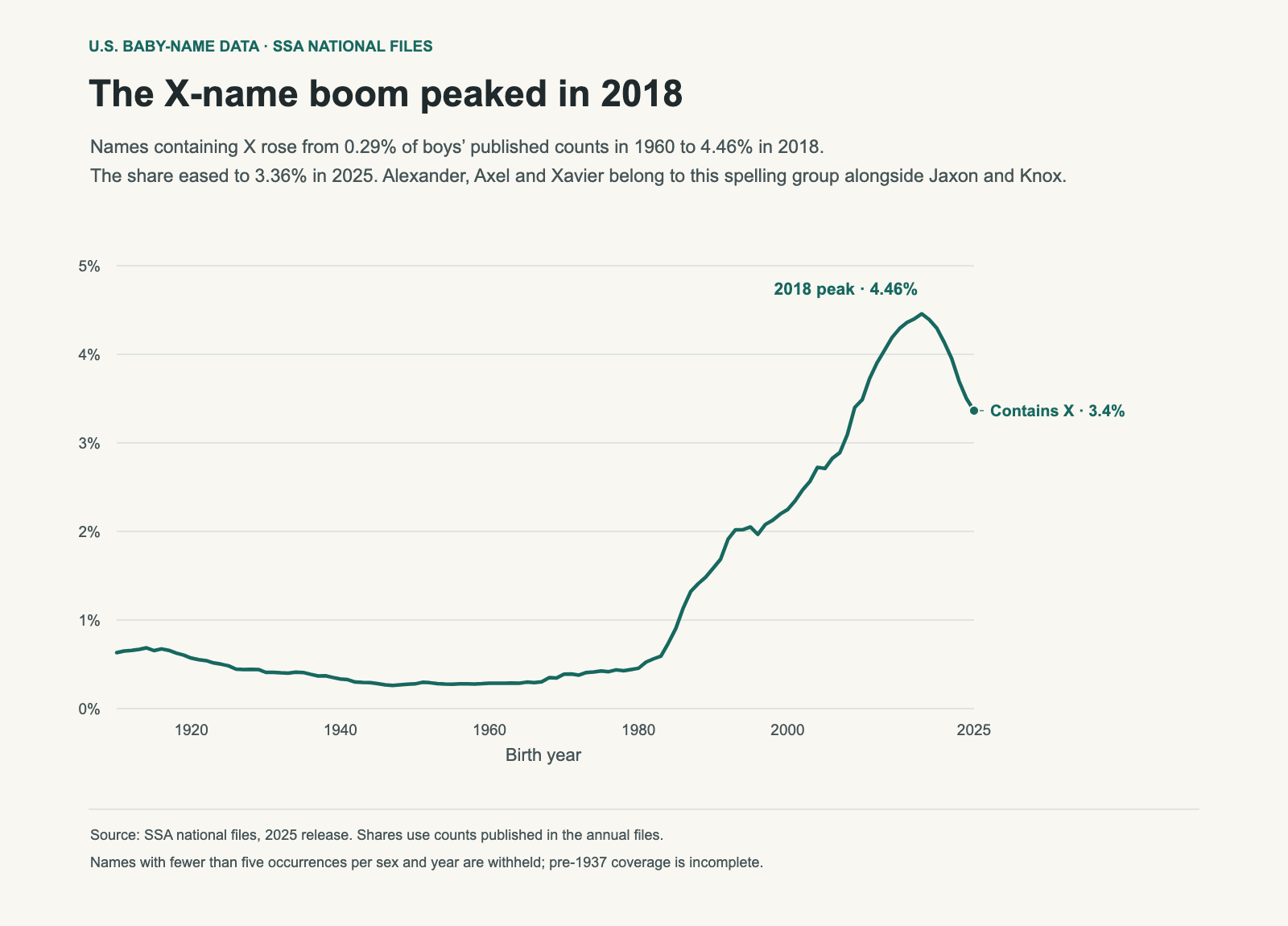
Names containing X grew from a small part of boys’ recorded names to a group representing about one in twenty-two published counts at its 2018 peak. In 1960 the share was 0.29%. By 2018 it was 4.46%, before easing to 3.36% in 2025.
Jaxon, Jaxson, Axel and Knox are easy examples to notice. But the group also includes Alexander, Alex, Max, Felix and Xavier. The X trend is a mixture of name histories, rather than a single new style arriving all at once.
The rise began before the most visible new spellings
The 1960 share was small, but the group was not absent. The files record 6,124 boys with an X-containing name that year. Rex, Alex and Alexander each accounted for more than 1,000 of them. Max and Felix were also established contributors.
By 1985 the share had already reached 0.91%, with Alexander accounting for 8,295 boys and Alex for 3,909. A story that treats the whole period before the 1990s as flat would overlook that growth. Later names added to a group that was already expanding.
| Year | Published X-name count | Share of boys’ count |
|---|---|---|
| 1960 | 6,124 | 0.29% |
| 1985 | 16,736 | 0.91% |
| 1990 | 32,527 | 1.58% |
| 2000 | 44,145 | 2.25% |
| 2010 | 66,905 | 3.49% |
| 2018 | 80,951 | 4.46% |
| 2025 | 57,456 | 3.36% |
A shared letter can hide different trends
Alexander is the largest individual X-containing boys’ name in 2025, with 7,230 published occurrences. Axel follows with 4,140, then Xavier with 3,232 and Jaxon with 3,073. These names need not have the same origin, sound or cultural association to contribute to the same line.
The table compares the same spellings across two years. “Not published” means no entry appears in that year’s file; it does not prove there were zero births, because small counts are suppressed.
| Spelling | 1960 boys | 2025 boys |
|---|---|---|
| Alexander | 1,199 | 7,230 |
| Rex | 1,314 | 281 |
| Alex | 1,230 | 1,515 |
| Max | 669 | 2,025 |
| Felix | 655 | 2,064 |
| Xavier | 126 | 3,232 |
| Axel | 13 | 4,140 |
| Jaxon | Not published | 3,073 |
| Jaxson | Not published | 2,365 |
| Knox | Not published | 1,836 |
Cooling off does not mean returning to the old baseline
The X share fell by 1.09 percentage points between its 2018 maximum and 2025. That is a decline of about a quarter relative to the peak share. It still remains more than eleven times the 1960 share.
Counts and shares answer different questions. A count tells us how many occurrences are published; a share adjusts for the size of that year’s published boys’ total. The chart uses the share so a change in the overall cohort does not, by itself, look like a change in preference for the group.
What would explain the rise?
Names can be influenced by family traditions, public figures, media and spelling preferences. This series does not measure those influences. The fact that a television programme or celebrity name appears near a turning point cannot establish that it caused the group’s growth.
To test a specific explanation, we would need to isolate the names concerned, compare their timing with an event, and examine competing explanations. The aggregate X line is a useful starting point for that work, but it does not identify one cultural cause.
For a shortlist, compare the individual name as well as the letter group. A name can be falling while its group is rising, and vice versa. See the guide to ranks, counts and decades, or compare changes in final letters.
Data and method
These calculations use the SSA’s pinned 2025 national release. “Published counts” means the sum of the name counts available for that year and sex. Names with fewer than five occurrences are withheld, so this denominator is not a complete count of all births. Historical records before 1937 are also incomplete. Names are selected if the stored spelling contains X, case-insensitively. All their published male counts contribute, including spellings outside the top 100. No pronunciation filter is applied.
Download the chart data (CSV). The SSA download page provides the original files, and its background notes describe coverage and spelling conventions.