
How the Final Letters of Boys’ Names Changed, 1910–2025
Names ending in N grew to more than one-third of boys’ published counts before losing some of that share. Ryan, Brandon, Justin, Aiden, Logan and Mason belong to that group. Its annual share reached 36.4% in 2011 and fell to 28.0% in 2025.
Another group moved in the opposite long-term direction: names ending in T, D, K, G, P or B fell from 29.7% in 1930 to 8.8% in 2025. Robert, Richard and Jack illustrate those written endings. These figures describe spelling. They do not measure how names sound.
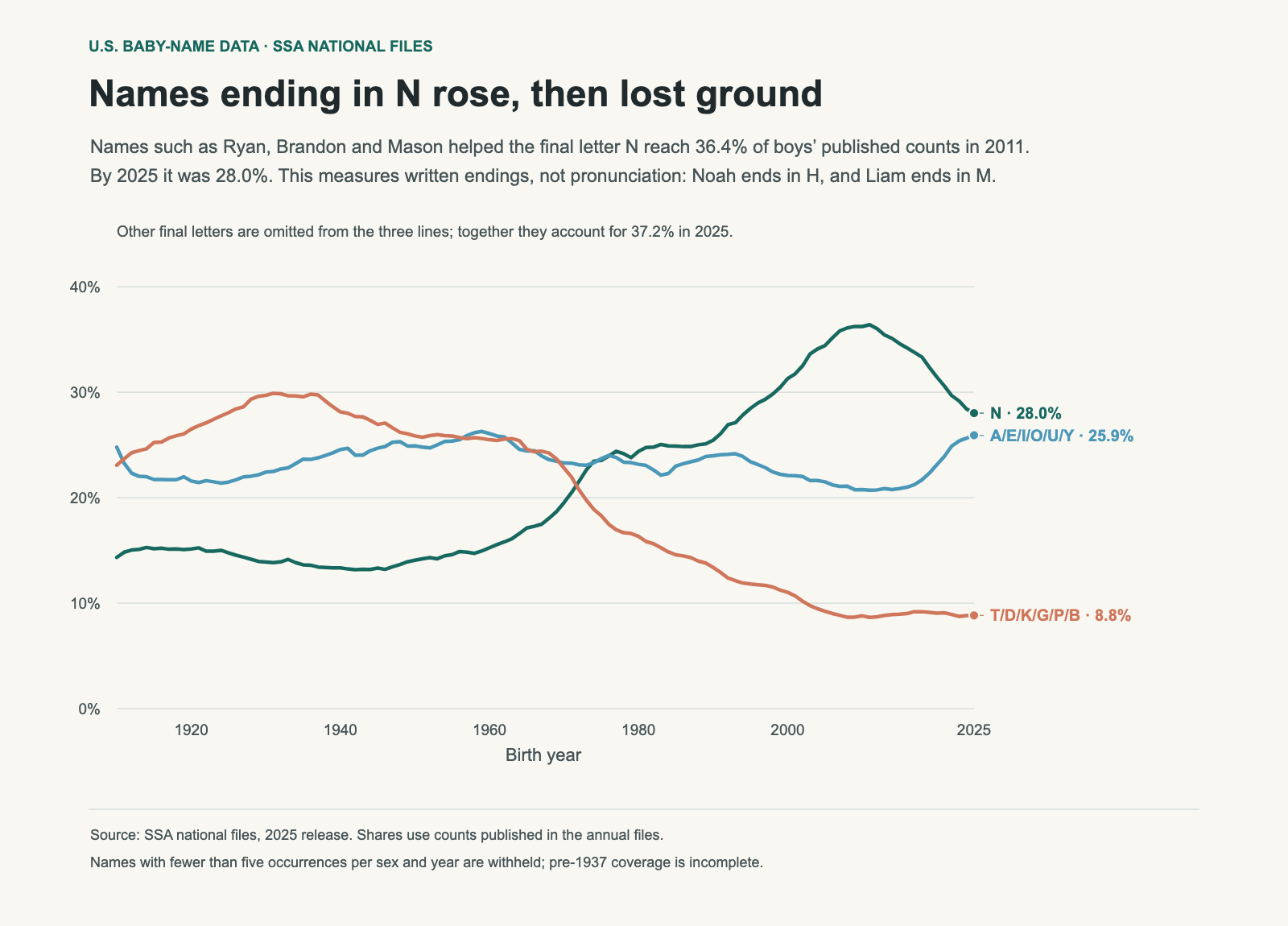
The N wave has a rise and a decline
The N group accounted for 13.9% of the published boys’ total in 1930 and 25.4% in 1990. It reached 36.2% in 2010, just before its 2011 maximum. Looking only at those dates would suggest a continuing climb. The latest years show why the endpoint matters: by 2025 the share was 28.0%.
A falling group share does not require every name in it to fall. Mason and Logan can remain familiar while other names enter the list or gain share. Grouping names by a letter reveals a broad pattern, while the individual histories explain which names contribute to it.
| Year | Final N | Final A/E/I/O/U/Y | Final T/D/K/G/P/B |
|---|---|---|---|
| 1930 | 13.9% | 22.4% | 29.7% |
| 1950 | 14.1% | 24.9% | 25.9% |
| 1970 | 19.5% | 23.3% | 22.8% |
| 1990 | 25.4% | 24.0% | 13.4% |
| 2010 | 36.2% | 20.8% | 8.8% |
| 2025 | 28.0% | 25.9% | 8.8% |
The other letters are a large part of the story
The three plotted groups account for 62.8% of the 2025 published boys’ total. The remaining 37.2% ends in other letters, including H, M, R, L and S. Omitting that remainder from a line chart makes comparisons easier to read, but it must not be mistaken for a complete breakdown.
This is particularly relevant to current names. Noah ends in H; Liam ends in M; Oliver ends in R. A description of today’s names as simply “more vowel-ending” would miss all three. The A/E/I/O/U/Y group’s share rose from 20.8% in 2010 to 25.9% in 2025, but it remains only one part of the mix.
Why spelling is not a sound classification
The last letter can be silent, can form part of a larger spelling pattern, or can be pronounced differently across languages. A final E does not necessarily indicate an audible vowel ending. A final N tells us the written form, rather than the name’s full pronunciation or rhythm. Grouping Y with vowel letters is also a calculation convention, not a linguistic conclusion.
To study sound, we would need pronunciation data, rules for variants and a clear treatment of names used in more than one language. The SSA files supply spellings and counts. They support the chart shown here without those additional assumptions.
A useful way to compare favourite names
Read the spelling trend beside the names themselves, then say your shortlist aloud with the intended surname. Names that share a final letter can have very different syllable counts and rhythms. The chart can explain why a written pattern looks familiar; it cannot decide how your child’s full name will sound.
For a separate spelling measure, see the changing lengths of girls’ and boys’ top-100 names. The X-name analysis shows why a letter inside a name can also hide a varied group.
Data and method
These calculations use the SSA’s pinned 2025 national release. “Published counts” means the sum of the name counts available for that year and sex. Names with fewer than five occurrences are withheld, so this denominator is not a complete count of all births. Historical records before 1937 are also incomplete. Each boys’ name is assigned by its final stored letter, case-insensitively. Counts are summed within each group before division by the published boys’ total. Other final letters are retained in the denominator.
Download the chart data (CSV). The SSA download page provides the original files, and its background notes describe coverage and spelling conventions.