
Why Does Garlic Turn Blue or Green When Pickled or Cooked in Acid?
Deglaze a pan of sautéed garlic with lemon juice or white wine—or seal peeled cloves in a jar of rice vinegar—and within hours the ivory cloves can turn startling shades of turquoise blue, teal, or jade green. First-time picklers often worry that the cloves have spoiled or absorbed copper from the cookware. In reality, blue-green garlic is 100% safe to eat and requires zero trace metals: the color comes from carbon-nitrogen ring molecules called polypyrroles—structural cousins of plant chlorophyll—formed when the garlic enzyme alliinase reacts with sulfur precursors and amino acids in a mildly acidic environment (Laba garlic - Wikipedia; PubMed - J. Agric. Food Chem. 2005).
In northern China, cooks intentionally maximize this reaction every winter on the eighth day of the twelfth lunar month to make Laba garlic (腊八蒜), transforming pungent raw cloves into crisp, emerald-green pickled condiments (Laba garlic - Wikipedia). Whether you want to prevent blue garlic in a lemon-butter pasta sauce or check how cold storage shifts bulb chemistry alongside sprouted garlic flavor changes, you can Check peak produce ripeness and storage rules in Redberi.
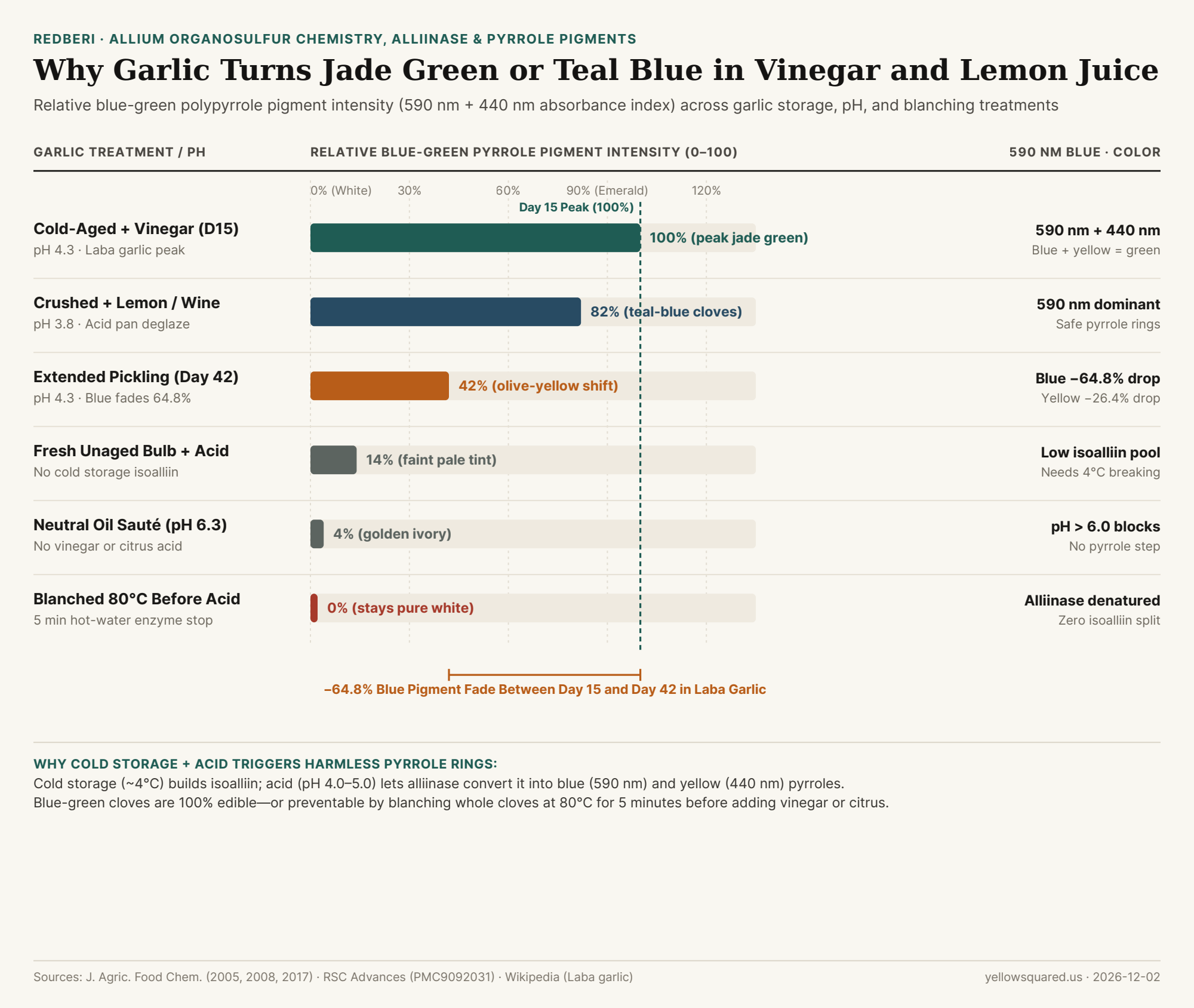
The Four-Step Biochemical Pathway: Isoalliin to Blue and Yellow Pyrroles
High-performance liquid chromatography and UV-visible spectrophotometry studies published in the Journal of Agricultural and Food Chemistry and RSC Advances have mapped the exact four-stage reaction that turns white garlic green (ACS - J. Agric. Food Chem. 2008; PMC9092031):
- Cold Dormancy Breaking Accumulates Isoalliin: Freshly harvested, dormant garlic bulbs contain very little S-(1-propenyl)-L-cysteine sulfoxide (isoalliin, the positional isomer of alliin that also makes cut onions sting your eyes). Storing garlic bulbs in cold temperatures (around 4°C / 39°F for 2 to 4 weeks) breaks dormancy and triggers a sharp rise in cellular isoalliin (PubMed - J. Agric. Food Chem. 2005).
- Acid or Slicing Ruptures Vacuolar Membranes: In an intact clove, the enzyme alliinase sits isolated inside the vacuole while isoalliin and alliin sit in the cytoplasm. Slicing the clove—or soaking intact cloves in acetic acid (vinegar) or citric acid (lemon juice)—permeabilizes the tonoplast membrane so alliinase mixes with isoalliin (Laba garlic - Wikipedia).
- Thiosulfinate & Pyrrole Precursor Formation: Alliinase cleaves isoalliin and alliin into reactive 1-propenyl-containing thiosulfinates ("color developers"), which condense with free amino acids (such as valine, alanine, and glycine) to form 2-(3,4-dimethyl-1H-pyrrolyl)carboxylic acid precursors (ACS - J. Agric. Food Chem. 2008).
- 590 nm Blue + 440 nm Yellow = Emerald Green: Those pyrrole precursors polymerize into two distinct multi-ring chromophores: blue tetrapyrrole species (absorbing strongly at
λmax = 565–590 nm) and yellow dipyrrole species (absorbing atλmax = 440 nm). When both pigments accumulate simultaneously inside the clove, human eyes perceive their optical mixture as vivid jade green (PMC9092031).
"Green garlic contains zero chlorophyll: its emerald color is an optical blend of 590 nm blue tetrapyrroles and 440 nm yellow dipyrroles formed when alliinase cleaves cold-accumulated isoalliin in acid."
Why pH 4.0–5.0 Is the Sweet Spot—and Why Laba Garlic Turns Yellow After Day 15
Why does garlic turn blue-green in vinegar or lemon juice, but stay ivory when sautéed in neutral olive oil? The two halves of the pathway have opposite pH preferences (PubMed - J. Agric. Food Chem. 2005):
- Step 1 (Enzymatic Alliinase Cleavage) Prefers pH >= 6.0: Alliinase works fastest near neutral pH and slows down in extreme acid below
pH 3.0. - Step 2 (Non-Enzymatic Pyrrole Ring Condensation) Requires pH 2.0–4.5: Without hydrogen ions from an acid (vinegar, wine, tomato sauce, or lemon juice), the intermediate thiosulfinates and amino acids cannot condense into conjugated pyrrole rings.
- The pH 4.0–5.0 Compromise: A mildly acidic brine around pH 4.0 to 5.0 balances both steps, allowing alliinase to generate pigment precursors while providing enough acidity to lock them into blue and yellow polypyrroles (PubMed - J. Agric. Food Chem. 2005).
- Day 15 Peak vs. Day 42 Yellowing: Spectrophotometric tracking of Laba garlic shows that both
590 nm(blue) and440 nm(yellow) pigments peak at Day 15. Between Day 15 and Day 42, the less stable590 nmblue pigment degrades by 64.8% while the440 nmyellow pigment drops by only 26.4%—explaining why older jars of pickled garlic gradually shift from emerald green to golden yellow (PMC9092031).
| Garlic Treatment / Condition | Acidity & Temp | Alliinase State | Blue (590 nm) | Yellow (440 nm) | Visual Outcome |
|---|---|---|---|---|---|
| 1. Cold-Aged + Vinegar (Day 15) | pH 4.3 at 20–25°C |
100% active + high isoalliin | Peak 590 nm |
High 440 nm |
100% (Deep jade Laba green) |
| 2. Crushed + Lemon Juice / Wine | pH 3.8 at 22°C |
Active cell rupture | Dominant 590 nm |
Low 440 nm |
82% (Teal-blue cloves) |
| 3. Laba Garlic Extended (Day 42) | pH 4.3 at 20°C |
Substrate depleted | −64.8% vs Day 15 |
−26.4% vs Day 15 |
42% (Fades to olive-yellow) |
| 4. Fresh Newly Harvested Bulb | pH 4.3 (0 wk cold) |
Low initial isoalliin | Minimal 590 nm |
Minimal 440 nm |
14% (Pale ivory tint) |
| 5. Neutral Oil Sauté (No Acid) | pH 6.3 at 120°C |
No acid condensation | Zero 590 nm |
Maillard only | 4% (Golden-ivory cloves) |
| 6. Blanched Cloves (80°C, 5 min) | pH 4.3 post-blanch |
Denatured (0%) | Zero 590 nm |
Zero 440 nm |
0% (Stays pure white) |
How to Stop Garlic Turning Blue—or Make Crisp Emerald Laba Garlic on Purpose
If you want pure ivory garlic in a pickled jar or lemon sauce, you have two kitchen controls: either store whole bulbs in a dry pantry at room temperature (18°C–22°C / 65°F–72°F) out of the refrigerator so they never accumulate cold-induced isoalliin, or blanch whole peeled cloves in 80°C (176°F) water for 5 minutes (or sauté minced garlic thoroughly in oil above 85°C) before adding vinegar, wine, or lemon juice so heat denatures alliinase before the cell walls rupture (PubMed - J. Agric. Food Chem. 2005). Conversely, to make traditional emerald Laba garlic for dumplings, chill peeled cloves in the fridge for two weeks, slice 1 millimeter off the root tip to speed vinegar penetration, submerge them in rice vinegar (pH ~4.3) at 20°C, and enjoy them at their Day 15 emerald peak. For more produce storage temperatures and kitchen chemistry guides, Check peak produce ripeness and storage rules in Redberi.