
Why Does Newfoundland Have a 30-Minute Time Zone?
Why Does Newfoundland Have a 30-Minute Time Zone?
Newfoundland observes UTC-3:30 (NST) and UTC-2:30 (NDT) because St. John's sits at 52.71 degrees West longitude—nearly aligned with the 52.5-degree meridian located 3.5 hours west of Greenwich.
Anyone who grew up watching Canadian national television knows the iconic broadcast cadence by heart: a program airs at 8:00 PM, or 8:30 in Newfoundland. While 22 of North America's 23 time zone jurisdictions increment in clean 60-minute hours from Coordinated Universal Time, the island of Newfoundland stands alone in the Western Hemisphere with a 30-minute fractional clock offset.
That half-hour difference is neither a broadcasting gimmick nor an arbitrary provincial quirk. Newfoundland Standard Time (IANA key America/St_Johns, UTC-3:30) is the direct mathematical product of St. John's easternmost geography combined with the island's pre-1949 constitutional sovereignty as an independent British Dominion.
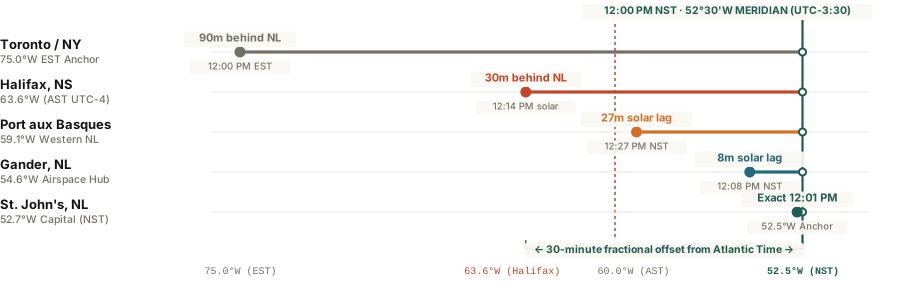
The 52.5-Degree Meridian and the 1935 Dominion Act
Standard time zones divide Earth's 360-degree circumference into 24 bands of 15 degrees longitude each, with every degree of longitude representing exactly 4 minutes of solar rotation. Under that global convention, Eastern Standard Time (UTC-5:00) anchors to the 75th meridian west, and Atlantic Standard Time (UTC-4:00) anchors to the 60th meridian west passing near Cape Breton Island, Nova Scotia.
However, the island of Newfoundland juts far into the North Atlantic east of the 60th meridian. Signal Hill in St. John's sits at 52°42' West longitude (52.71°W). Multiplying 52.5 degrees by 4 minutes per degree yields exactly 210 minutes—or 3 hours and 30 minutes west of the Greenwich Prime Meridian.
Because Newfoundland governed its own maritime and telegraph infrastructure as a separate Dominion until 1949, it anchored its clock to the local solar meridian of St. John's rather than rounding back to Halifax.
In 1935, the Dominion of Newfoundland formally codified Newfoundland Standard Time at 3.5 hours behind Greenwich Mean Time. When Newfoundland joined Canadian Confederation on March 31, 1949, provincial lawmakers retained the 30-minute offset under the Newfoundland Standard Time Act. In 1963, the provincial government briefly attempted to harmonize the province with Atlantic Time, but intense public opposition forced the bill's withdrawal before it ever took effect.
How Labrador Splits the Province Across Two Clocks
Although the provincial statute legally assigns the entire province of Newfoundland and Labrador to the Newfoundland Time Zone, daily practice across mainland Labrador follows geography and commerce:
- Mainland Labrador (Atlantic Time, UTC-4:00): Communities from Happy Valley-Goose Bay and Labrador City north to Nain lie between 60°W and 67°W longitude. To coordinate flights, rail links, and hydro-electric operations with neighboring Quebec and the Maritimes, most of Labrador observes Atlantic Standard Time (UTC-4:00) and Atlantic Daylight Time (UTC-3:00).
- Southeastern Coastal Labrador (Newfoundland Time, UTC-3:30): The coastal strip along the Strait of Belle Isle—from L'Anse-au-Clair to Red Bay and Charlottetown—sits closer to the 56°W corridor and maintains tight ferry and fishing ties with the island of Newfoundland, observing UTC-3:30 alongside St. John's.
- Cross-Ocean Workday Overlaps: During summer Daylight Saving Time, St. John's shifts to Newfoundland Daylight Time (NDT, UTC-2:30). That places eastern Newfoundland only 3.5 hours behind London (BST, UTC+1:00), creating a 4.5-hour transatlantic morning overlap from 9:00 AM to 1:30 PM local time while still preserving 6.5 hours of afternoon overlap with New York and Toronto.
When coordinating meetings across St. John's, Halifax, Toronto, and London—or checking how fractional time zones compare with Nepal's 45-minute time zone—you can Open Tempo in your browser to inspect live half-hour overlap bands without calendar conversion errors.