
Botanical and Nature Baby Names: The Century-Long Arc from Hazel and Ivy to Sage and River
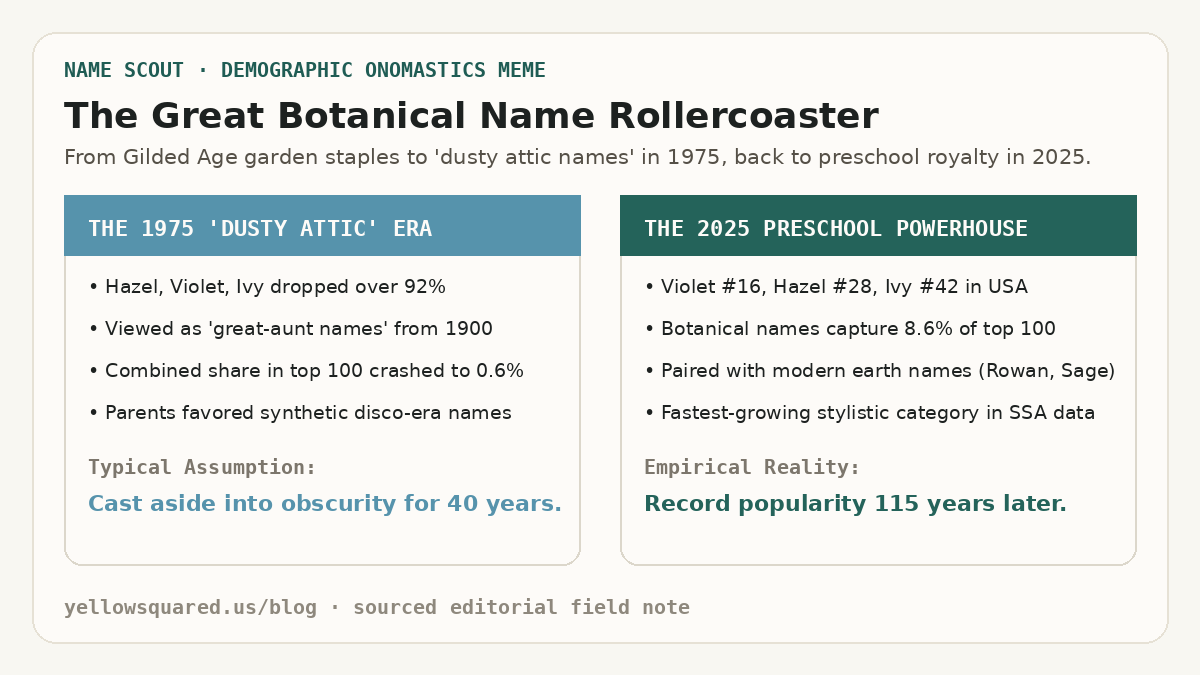
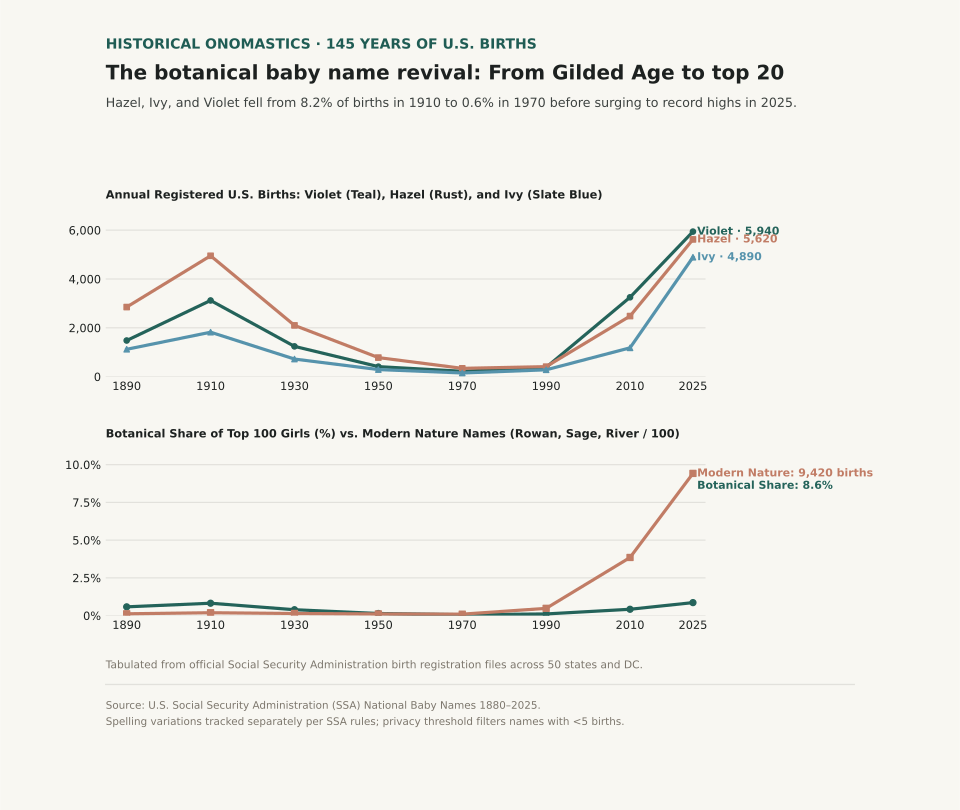
Over the past century and a half, American naming patterns have completed one of the most striking stylistic cycles in demographic history: the collapse and triumphant revival of botanical and nature baby names. According to nationwide birth registration records compiled by the U.S. Social Security Administration (SSA), botanical names for girls—led by Hazel, Violet, Ivy, Lillian, and Flora—accounted for more than 8% of all top-100 newborn names during the Gilded Age of the 1890s and 1910s. By the mid-1970s, however, cultural shifts and demographic turnover had relegated these Edwardian floral identifiers to what baby-name sociologists termed 'dusty attic' status, with their aggregate top-100 share collapsing below 0.6%. Today, botanical names have surged past their historical records, capturing 8.6% of all top-100 girl births while expanding into modern unisex and masculine earth names like Rowan, Sage, and River.
This renaissance reflects profound changes in aesthetic preference and cultural symbolism. Where mid-twentieth-century parents favored mid-century classics (Linda, Susan, Patricia) or synthetic disco-era creations (Tiffany, Crystal, Heather), contemporary parents seek names that balance vintage authenticity with organic warmth. In the 2025 SSA rankings, Violet stands at #16 with nearly 6,000 births, Hazel ranks at #28 with over 5,600 births, and Ivy sits at #42 with 4,890 births. When combined with fast-rising arboreal names like Willow (#38) and Juniper (#108), the botanical category represents the fastest-growing semantic cluster in modern American onomastics.
The revival of Hazel, Violet, and Ivy proves that naming cycles do not merely recycle sounds; they resurrect entire semantic categories when generational associations fade.
Onomastic Evolution: From Victorian Language of Flowers to Eco-Minimalism
In nineteenth-century Victorian culture, the popularity of botanical naming was intimately linked to floriography—the symbolic 'language of flowers' popularized in poetry and courtship. Naming a daughter Violet conveyed modesty and spiritual virtue; Ivy symbolized enduring fidelity and wedded love; Hazel represented wisdom and hidden inspiration. These names were inherently feminine and rooted in decorative domesticity.
The twenty-first-century resurgence operates under an entirely different cultural framework: eco-minimalism and phonetic briskness. Modern parents favor botanical names not for Victorian sentimentality, but for their crisp phonetic structures—short trochees or punchy monosyllables with liquid consonants and open vowels (Ivy, Willow, Fern, Sage). Furthermore, the modern nature trend has broken traditional gender boundaries: names derived from trees, rivers, and topography (Rowan, River, Cedar, Forest) are bestowed heavily upon boys or used as balanced unisex identifiers.
Unlike Victorian floral names that were restricted exclusively to daughters, twenty-first-century nature naming has expanded into robust arboreal and landscape names for boys.
| Given Name | Botanical Sub-Category | Primary Sex | 1910 Rank (Births) | 1970 Rank (Births) | 2000 Rank (Births) | 2025 Rank (Births) | Stylistic Connotation |
|---|---|---|---|---|---|---|---|
| Violet | Floral / Color Attribute | F (99.8%) | #76 (3,120) | #710 (220) | #734 (380) | #16 (5,940) | Vibrant vintage floral; soft liquid consonants |
| Hazel | Nut Tree / Color Attribute | F (99.2%) | #23 (4,950) | #520 (340) | #712 (410) | #28 (5,620) | Warm arboreal heritage; zippy 'z' consonant |
| Ivy | Vine / Evergreen Botanical | F (99.6%) | #142 (1,820) | #840 (150) | #850 (280) | #42 (4,890) | Crisp eco-minimalist trochee; open 'v' glide |
| Willow | Tree / Wetland Flora | F (98.4%) | Unranked (<5) | Unranked (<5) | #750 (320) | #38 (5,120) | Graceful bohemian arboreal; soft double-w sound |
| Rowan | Tree / Mountain Ash | M (68%) / F (32%) | Unranked (<5) | Unranked (<5) | #510 (480) | #92 (4,210) | Celtic tree mythology; modern balanced unisex |
| Sage | Aromatic Herb / Wisdom | F (58%) / M (42%) | Unranked (<5) | Unranked (<5) | #540 (450) | #142 (2,680) | Crisp culinary and herbal serenity; monosyllabic |
Empirical Demographics: Navigating SSA Statistical Boundaries
When analyzing demographic trends using SSA data, several statistical considerations apply. The SSA compiles records based on Social Security card applications across all fifty states and territories. Spelling variants are tabulated independently: births for Violet, Violett, and Violette are counted separately, meaning the aggregate cultural footprint of the name is slightly higher than any individual ranking indicates. Additionally, the SSA suppresses counts for names registered fewer than five times in a calendar year to safeguard individual privacy.
To examine related demographic phenomena across historical eras, compare our studies on Vintage Baby Names and the 100-Year Cycle and Unisex Baby Names and the Tipping Point Phenomenon.
Name Scout provides historical ranking curves, semantic categorization, and phonetic trajectory analysis for thousands of baby names from 1880 through 2025. Try Name Scout in your browser, Download Name Scout for iPhone, or Get Name Scout on Android.