
Popular Three-Letter Baby Names for Boys and Girls
Three-letter baby names are experiencing a modern golden age in the United States, led by vowel-rich two-syllable favorites like Mia (#6 girl), Ava (#9 girl), Leo (#21 boy), Kai (#58 boy), and Eli (#78 boy). While mid-century parents in 1950 favored crisp one-syllable consonant stops like Ann, Bob, Roy, and Kay, U.S. Social Security Administration (SSA) birth records through 2025 reveal that today's parents pack two full syllables of open vowel melody into just three letters.
Short names have always appealed to parents who want a name that is impossible to misspell, effortless on a jersey or resume, and balanced alongside a longer surname. Yet when we examine the century-long arc of how American baby name lengths have shifted over time, the three-letter category stands out for a dramatic phonetic turnover that flipped completely in the 1990s.
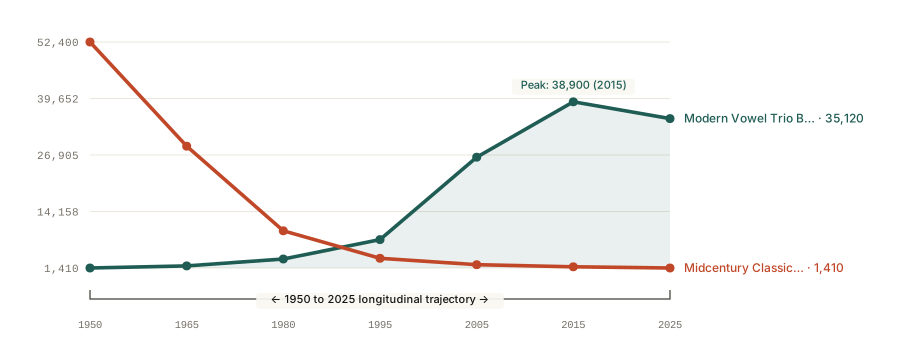
The Phonetic Shift: Why "Mi-a" and "Le-o" Replaced "Ann" and "Bob"
In 1950, the five flagship three-letter names — Ann, Bob, Roy, Kay, and Don — accounted for 52,400 U.S. births per year. Every single one of those mid-century staples was a one-syllable name built around a closed consonant coda (-nn, -b, -t, -d, -n) or a clipped diphthong.
By the 1980s, those brisk one-syllable nicknames felt dated to Baby Boomer and Gen X parents, and combined births for the 1950s cohort fell below 10,000 per year. Rather than abandoning three-letter names altogether, parents discovered a different acoustic blueprint: V-C-V (Vowel-Consonant-Vowel) and C-V-V (Consonant-Vowel-Vowel) structures that stretch three letters across two open syllables:
- Two syllables in three letters: Names like Mi-a, A-va, Le-o, E-li, Zo-e, I-vy, A-da, and I-an give parents the brevity of a three-letter spelling on paper while sounding just as lyrical and multi-syllabic aloud as five- or six-letter names.
- Liquid and vowel endings: This aligns closely with the broader softening of American boys' names, where open -o, -i, and -a endings have steadily displaced hard plosive stops like Bob, Ted, and Hal.
Top Three-Letter Baby Names in the U.S. (SSA National Data)
The table below highlights the leading three-letter baby names for girls and boys, pairing their syllable structure, phonetic ending, and recent national trajectory:
| 3-Letter Name | Sex | 2025 SSA Rank | Syllables | Phonetic Structure & Style |
|---|---|---|---|---|
| Mia | Girl | #6 | 2 (Mi-a) | C-V-V open vowel hiatus; top 10 national staple since 2009 |
| Ava | Girl | #9 | 2 (A-va) | V-C-V symmetrical palindrome with soft voiced fricative center |
| Leo | Boy | #21 | 2 (Le-o) | C-V-V liquid start + rounded back-vowel -o ending |
| Ivy | Girl | #38 | 2 (I-vy) | V-C-V botanical revival with high front vowel cadence |
| Zoe | Girl | #44 | 2 (Zo-e) | C-V-V Greek vitality name with two distinct vowel peaks |
| Kai | Boy | #58 | 1 (Kai) | C-V-V open diphthong; cross-cultural Hawaiian, Japanese & Scandinavian roots |
| Eli | Boy | #78 | 2 (E-li) | V-C-V biblical classic with liquid -l- bridge and long vowel finish |
| Ian | Boy | #94 | 2 (I-an) | V-V-C Scottish form of John; steady multi-decade Top 100 presence |
| Ada | Girl | #168 | 2 (A-da) | V-C-V Victorian palindrome boosted by computing pioneer Ada Lovelace |
| Max | Boy | #156 | 1 (Max) | C-V-C crisp sibilant ending; standalone favorite alongside Maxwell |
Important Data Limitations When Comparing Short Names
When interpreting historical trends from the SSA Baby Names documentation, keep three structural dataset boundaries in mind:
- Exact spelling separation: The SSA tabulates every spelling independently. For instance, three-letter Zoe (#44) is counted separately from four-letter Zoey (#36), and standalone Leo (#21) is separate from formal Leonardo or Leon.
- Privacy suppression below 5 births: Any name with fewer than 5 Social Security card applications (<5 births) for a given sex and birth year is omitted from the national file to protect individual privacy.
- Counterexamples to automatic return cycles: While some early-1900s three-letter names like Ada, Eva, and Leo have rebounded strongly, many 1920s–1950s three-letter leaders (such as Bob, Don, Roy, and Gay) remain near historic lows — demonstrating why phonetic fit matters far more than any mechanical generational clock.
To filter every three-letter boy and girl name by starting vowel, syllable count, or decade peak, launch the interactive Name Scout baby name explorer.