
Radiation Fog vs. Advection Fog: Sounding Profiles and Clearance Times
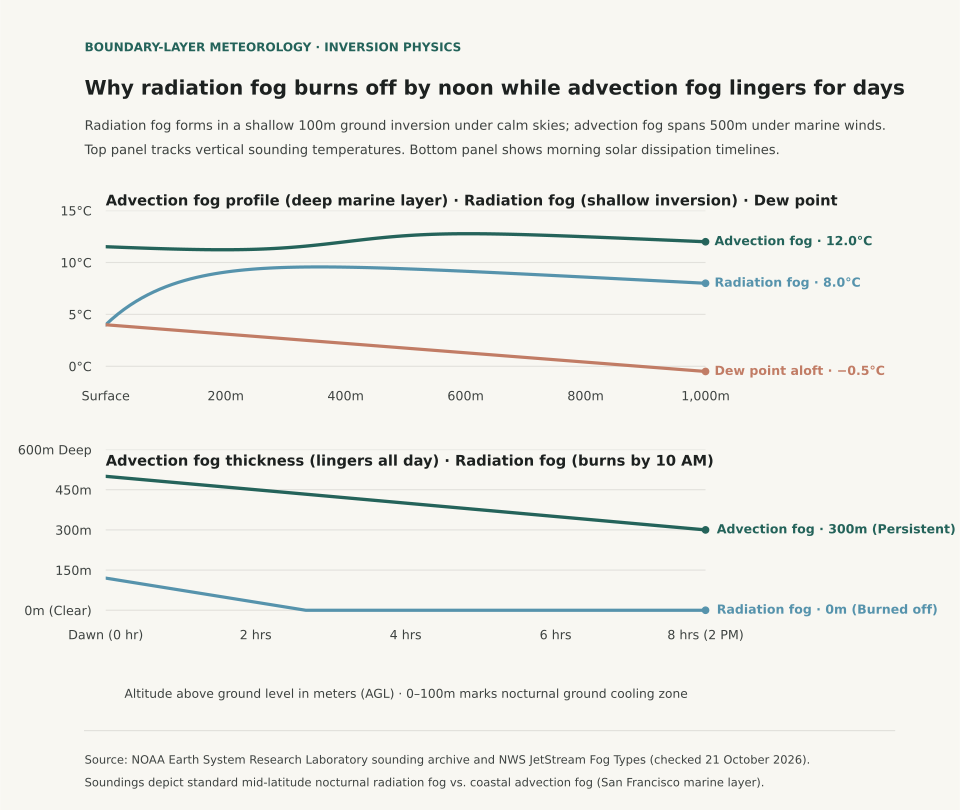
Radiation fog burns off within two to three hours of sunrise because it forms within a shallow surface inversion rarely deeper than one hundred meters, while advection fog frequently persists for days because horizontal marine winds transport a dense, five-hundred-meter moisture layer beneath an elevated marine capping inversion. According to boundary-layer sounding archives cataloged by the NOAA Earth System Research Laboratory and educational guides from the National Weather Service (NWS) JetStream School, the two fog types operate through fundamentally different thermodynamic mechanisms. Radiation fog requires calm, cloudless nocturnal conditions where the ground radiates heat directly into space, chilling the immediate contact air to its dew point. Advection fog, by contrast, requires horizontal wind (typically eight to twenty knots) blowing warm, moist air over cold ocean upwelling currents or snowpack, cooling the air mass from below across hundreds of square miles.
Morning commuters and pilots often check surface visibility observations without inspecting upper-air sounding structures. If valley fog forms under clear autumn skies with light winds of two to four knots, solar radiation penetrates the thin cloud deck within hours, warming the soil and evaporating fog droplets from the ground upward. When coastal advection fog rolls inland across San Francisco, Puget Sound, or Maine, the fog layer is capped by a warm, dry subsidence inversion at three hundred to six hundred meters altitude. That inversion acts as a physical lid that traps marine moisture and reflects incoming solar radiation, keeping surface temperatures cool and preserving overcast fog decks through mid-afternoon.
Thermodynamic Formation Criteria: Calm Radiative vs. Dynamic Transport
The meteorological conditions that produce radiation fog and advection fog rarely overlap. The table below compares the physical parameters, boundary-layer sounding dynamics, and dissipation mechanisms between the two regimes:
| Meteorological Parameter | Radiation Fog (Valley / Ground) | Advection Fog (Sea Fog / Marine Layer) | Physical Significance |
|---|---|---|---|
| Primary Cooling Trigger | Nocturnal terrestrial longwave infrared radiation | Horizontal transport over colder surface | Ground cooling vs. horizontal air mass advection |
| Optimal Wind Speed | Light (1 to 5 knots / 1 to 6 mph) | Moderate (8 to 20 knots / 9 to 23 mph) | Calm preserves microclimate; wind transports air mass |
| Inversion Base Altitude | Surface (0 meters AGL) | Elevated base (200 to 500 meters AGL) | Surface cold pool vs. marine capping lid |
| Vertical Fog Depth | Shallow (30 to 120 meters / 100 to 400 ft) | Deep (300 to 600 meters / 1,000 to 2,000 ft) | Solar penetration rate depends on optical depth |
| Dissipation Mechanism | Surface solar heating & convective mixing | Air mass displacement, wind reversal, or dry front | Sun burns radiation fog; wind clears advection fog |
| Typical Persistence | 3 to 5 hours after sunrise | 12 to 72 hours (multi-day marine stratus) | Rapid morning clearance vs. persistent low ceiling |
Because radiation fog requires light air movement to gently stir moisture across the lowest few meters without mixing in drier air aloft, winds exceeding six to eight knots prevent radiation fog from forming, turning moisture into low fractus clouds instead. Advection fog, by contrast, relies on continuous horizontal wind to sustain the supply of moisture; if winds calm completely, the marine conveyor belt stalls.
Predicting Visibility Clearance for Commutes and Aviation
Aviation meteorologists predict clearance times by calculating solar flux and boundary-layer depth from dawn soundings. For radiation fog, when the dew point depression at sunrise is 0°C and the inversion top sits below one hundred meters, clearance occurs rapidly once the solar zenith angle exceeds thirty degrees (typically around 9:30 to 10:30 AM local solar time). If the morning sounding reveals an advection fog profile with an inversion top above four hundred meters, surface heating is insufficient to overcome the marine boundary layer, and airport visual flight rules (VFR) will not return until an inland thermal trough draws dry continental air westward.
To follow how regional atmospheric moisture shifts across seasons, read Dew Point vs. Relative Humidity and explore Lake-Effect Snow Instability Thresholds for cold-air overrunning physics.
Eranorms displays historical weather observations, upper-air soundings, and seasonal climate normal comparisons across first-order weather stations nationwide. Open Eranorms in your browser, Download Eranorms for iPhone, or Get Eranorms on Android.