
Vintage Baby Names Making a Comeback for Boys and Girls
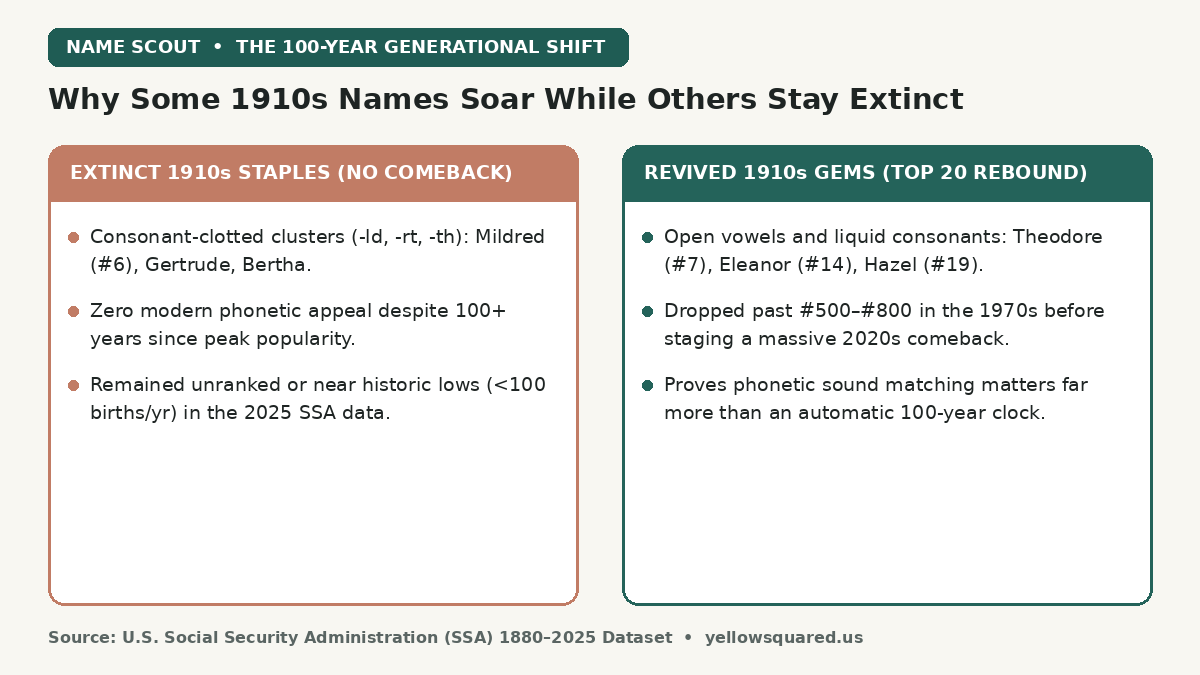
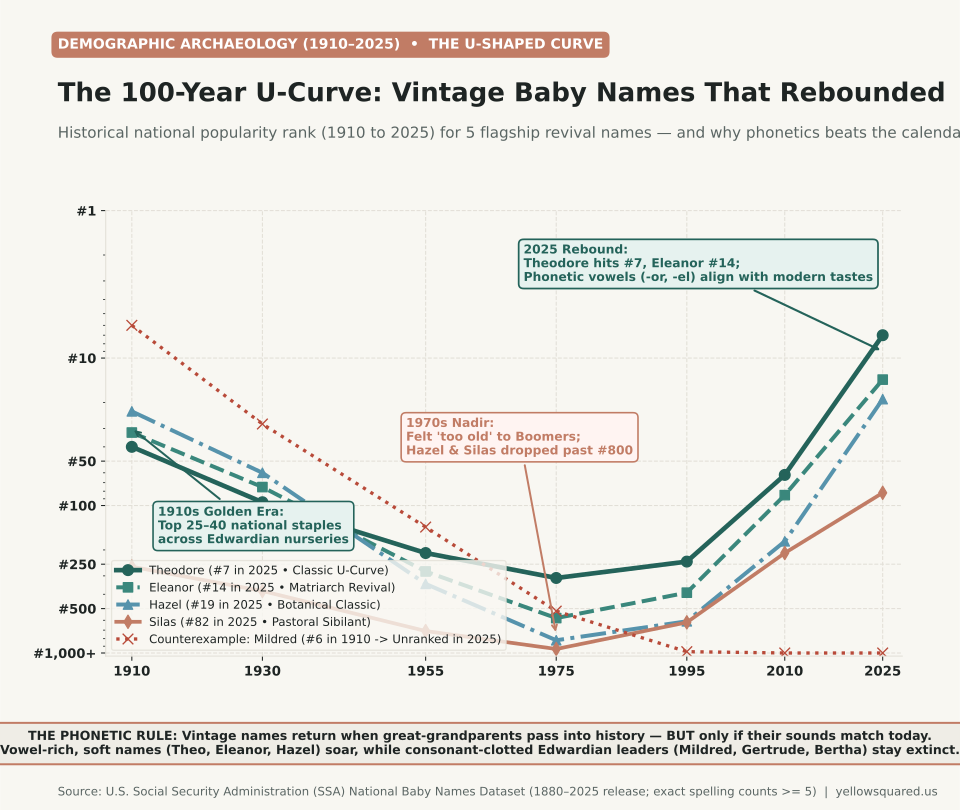
Historic U.S. Social Security Administration (SSA) birth data from 1910 through 2025 demonstrates that popular baby names follow a clear U-shaped generational curve, with vintage favorites like Theodore (#7 boy), Eleanor (#14 girl), and Hazel (#19 girl) staging massive Top 20 comebacks after hitting nadirs in the 1970s. However, the folk idea of an automatic "100-year rule" is incomplete: vintage names return only when their phonetic structure matches modern acoustic preferences for soft vowels and liquid consonants, while consonant-clotted Edwardian leaders like Mildred, Gertrude, and Bertha remain near total extinction.
Parents searching for baby names often gravitate toward vintage rosters from their great-grandparents' generation. Names that felt dowdy or elderly to Baby Boomers in the 1970s suddenly feel fresh, dignified, and heirloom-quality to millennial and Gen Z parents today. Yet demographic history reveals that time alone does not guarantee a revival; phonetic sound engineering dictates which vintage names return to glory.
A vintage name rebounds when the generation that wore it passes into history, but only if its vowels and syllables match the acoustic taste of today.
Why the "100-Year Rule" Works — And Where It Fails
Sociologists and onomastic researchers have long observed a three-to-four generation cycle in baby naming. Parents typically avoid names associated with their parents' or grandparents' peers, which feel dated and middle-aged. Once a name recedes into great-grandparent territory (~80 to 100 years), it loses its living association and transforms into a historical classic.
However, treating this generational gap as an automatic forecasting clock fails empirical testing. In 1910, the top ten names for American girls included Mildred (#6), Ruth (#5), Gladys (#11), and Bertha (#15). As documented in our broader study of the 100-year baby name cycle, not one of those four names has staged a Top 100 comeback in the 2025 SSA release. Instead, comebacks are strictly governed by phonetic compatibility:
- The Modern Revival Acoustic Profile: Names like Eleanor, Theodore, Hazel, Clara, Silas, Felix, and Iris feature open vowels (-a, -o, -el, -is) and smooth liquid/sibilant consonants (-l-, -r-, -s-, -z-). They align with the modern softening of American naming tastes.
- The Extinct Cluster Profile: Names with heavy, closed consonant codas (-ld in Mildred, -rt in Gertrude, -rth in Bertha, -dm in Edmund) remain unranked or below 100 births per year because modern parents perceive them as harsh or phonetically clunky.
12 Flagship Vintage Comeback Names (SSA 1910 vs. 2025)
The table below highlights leading vintage names that completed the U-shaped recovery curve in the SSA national birth records:
| Vintage Name | Sex | 1910 Peak Rank | 1975 Nadir Rank | 2025 SSA Rank | Phonetic Anchor & Modern Appeal |
|---|---|---|---|---|---|
| Theodore | Boy | #40 | #310 | #7 | Gentle 3-syllable flow with accessible nicknames Theo and Teddy |
| Eleanor | Girl | #32 | #580 | #14 | Regal matriarch name with soft liquid vowels and Nora / Ellie options |
| Hazel | Girl | #23 | #820 | #19 | Botanical warmth with a zesty voiced fricative (-z-) center |
| Silas | Boy | #260 | #940 | #82 | Pastoral New England classic with open -as cadence |
| Clara | Girl | #17 | #640 | #98 | Luminous Latin classic meaning clear and bright; vintage European charm |
| Arthur | Boy | #14 | #360 | #118 | Noble legendary king name surging on mid-century British appeal |
| Iris | Girl | #150 | #780 | #72 | Greek rainbow goddess and vintage botanical staple |
| Felix | Boy | #180 | #620 | #178 | Latin name meaning happy and fortunate with crisp energetic -x ending |
Important SSA Data Limits to Keep in Mind
When analyzing historical name cycles in the SSA Dataset Guidelines, note three key methodological boundaries:
- Exact spelling tracking: SSA records every spelling independently. For example, Clara (#98) is tabulated separately from French Claire (#64), and Theodore (#7) is counted separately from standalone Theo (#68).
- Small-count privacy suppression (<5 births): Names with fewer than 5 registered births (<5 Social Security applications) in a given sex and year are suppressed from the national file.
- Regional timing differences: Vintage revivals typically appear first in coastal metropolitan birth records before spreading nationally over a five-to-ten year wave.
To explore thousands of historical baby names by era peak, syllable rhythm, or popularity trajectory, launch the interactive Name Scout baby name explorer.