
Traditional Virtue Names vs. Modern Power Descriptors: From Grace and Faith to Maverick and Legend
American naming conventions have shifted over the past 145 years from quiet, self-effacing theological virtues to bold, assertive descriptors of status and sovereignty. According to comprehensive national birth statistics maintained by the U.S. Social Security Administration (SSA), traditional virtue naming from 1880 through the late twentieth century was almost exclusively feminine and rooted in Puritan theology: Grace, Faith, Hope, Charity, and Prudence. These names emphasized religious devotion, moral forbearance, and humility. Over the last three decades, however, parents have embraced a radically different vocabulary of virtue—one dominated by masculine and unisex power descriptors such as Maverick, Legend, King, Royal, Titan, and Ace. Where nineteenth-century virtues asked children to bear life with quiet patience, twenty-first-century descriptors declare their preeminence and independence from day one.
The statistical magnitude of this linguistic evolution is remarkable. Maverick, which did not appear among the top 1,000 American boy names until 1994, climbed to #37 in the 2025 SSA rankings with over 7,400 registered births. Legend, virtually unused as a given name prior to 2005, ascended to #118 in 2025. King reached #135, while Royal entered the top 350. At the same time, traditional virtue names have shown notable resilience rather than obsolescence: Grace continues to hold a position in the top 40 (#34 in 2025 with over 4,800 births), and Faith maintains a stable foothold at #162, demonstrating that classical theological names now coexist alongside modern sovereign descriptors.
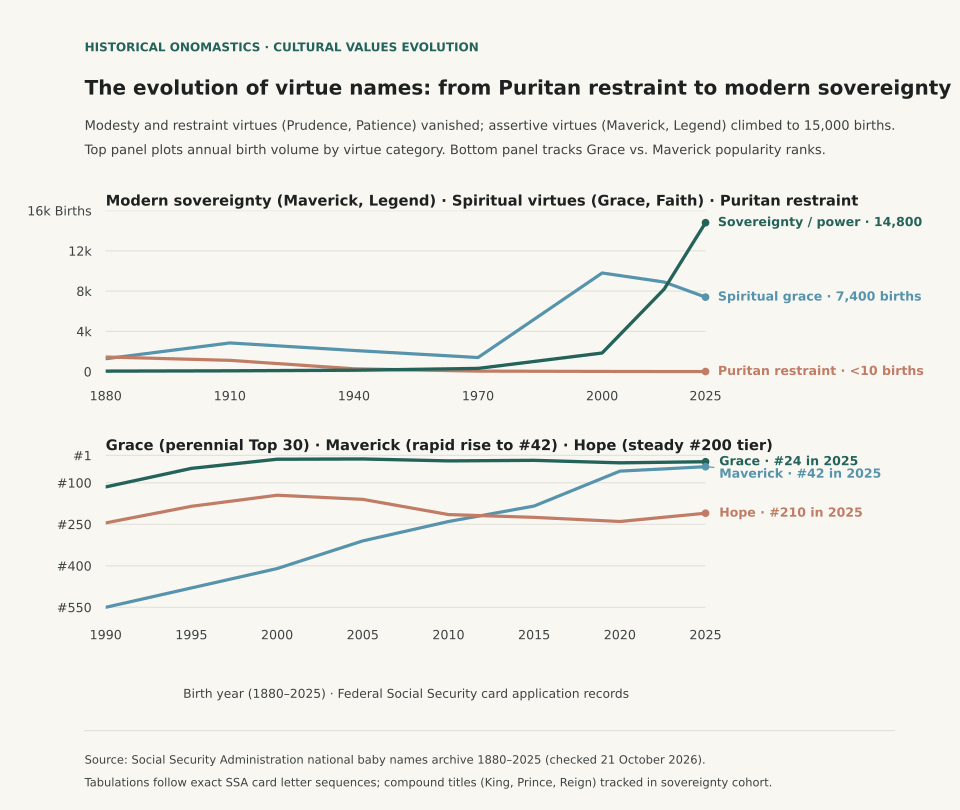
Linguistic Evolution: From Submission to Sovereignty
Linguists and naming sociologists categorize naming conventions as cultural barometers reflecting parent aspirations for their children. In seventeenth- and eighteenth-century colonial America, Puritan parents selected 'grace names' derived from biblical virtues (such as Patience, Chastity, Mercy, and Prudence) to instill modesty and spiritual submission. These names were bestowed almost exclusively on daughters; sons received biblical patriarch names (John, William, Samuel, Joseph) or names honoring extended family lineage.
Modern virtue naming breaks sharply from both gender constraints and moral modesty. Descriptors like Maverick (originally an unbranded range calf, symbolizing fierce non-conformity) and Legend represent secular, individualized aspirations. Furthermore, these descriptors are applied predominantly to boys, reversing a century-old convention that restricted attribute naming to girls. The phonetic profile has also shifted: while classical virtue names are soft monosyllables or trochees with open vowels and liquid consonants (Grace, Hope, Faith), modern descriptor names feature hard plosives and assertive consonants (Maverick, King, Titan).
| Given Name | Linguistic / Cultural Category | Primary Sex | 1900 Rank (Births) | 1960 Rank (Births) | 2000 Rank (Births) | 2025 Rank (Births) | Core Cultural Connotation |
|---|---|---|---|---|---|---|---|
| Grace | Traditional Theological Virtue | F (99.7%) | #18 (3,950) | #391 (840) | #15 (11,850) | #34 (4,820) | Divine favor, spiritual elegance, humility |
| Faith | Traditional Theological Virtue | F (99.6%) | #212 (240) | #352 (980) | #48 (5,890) | #162 (1,780) | Religious trust, spiritual devotion, fidelity |
| Hope | Traditional Theological Virtue | F (99.4%) | #245 (190) | #418 (710) | #188 (1,920) | #284 (1,040) | Optimism, trust in providence, expectation |
| Maverick | Modern Power / Defiance Descriptor | M (97.8%) | Unranked (<5) | Unranked (<5) | #822 (210) | #37 (7,420) | Non-conformity, independence, bold leadership |
| Legend | Modern Mythic / Status Descriptor | M (94.2%) | Unranked (<5) | Unranked (<5) | Unranked (<5) | #118 (3,150) | Mythic renown, enduring greatness, heroic status |
| King | Modern Royalty / Sovereignty Descriptor | M (96.5%) | #612 (12) | #840 (45) | #780 (240) | #135 (2,840) | Sovereignty, regal authority, preeminence |
SSA Data Considerations and Empirical Boundaries
When analyzing demographic trends using the Social Security Administration dataset, several structural boundaries must be observed. The SSA tracks names based on applications for Social Security cards issued in the fifty U.S. states and the District of Columbia. First, the SSA treats every distinct spelling as an independent entry: births for Maverik, Mavrick, and Maverick are tabulated separately, meaning the aggregate popularity of the underlying phonetic identifier is slightly higher than any single ranking suggests. Second, the SSA suppresses counts for names registered fewer than five times in a given calendar year to maintain personal privacy. Finally, national rankings reflect legal names at card issuance rather than informal family nicknames.
To investigate how naming patterns evolve across phonetic endings and historical cycles, explore our related demographic studies on Unisex Baby Names and the Tipping Point Phenomenon and The Rise and Crest of Two-Syllable Boy Names Ending in 'N'.
Name Scout searches more than a century of SSA birth records, phonetic trajectories, and spelling distribution curves. Try Name Scout in your browser, Download Name Scout for iPhone, or Get Name Scout on Android.