
Why the Viral Avocado Water Hack Is Unsafe and How to Stop Browning
Submerging cut or whole avocados in a container of water to keep them green—a technique popularized on social media platforms—is an unsafe food storage practice that creates an incubator for foodborne bacterial pathogens. In May 2022, the U.S. Food and Drug Administration (FDA) issued a formal food safety advisory warning consumers against the practice after microbiological research demonstrated that human pathogens—principally Listeria monocytogenes and Salmonella—residing on the outer textured avocado rind can survive in water, infiltrate through the stem scar, and internalize into the edible green pulp within fifteen days of refrigeration. While water submersion excludes oxygen to prevent enzymatic browning, it creates a severe food safety hazard that cannot be eliminated by washing or peeling.
Avocados turn brown after cutting because the enzyme polyphenol oxidase (PPO) mixes with natural polyphenols in the presence of atmospheric oxygen, oxidizing phenolic compounds into dark melanin pigments. Home cooks searching for ways to keep leftover avocado halves fresh often turn to viral storage tricks without evaluating microbial risks. Because Listeria monocytogenes is a psychrotrophic bacterium capable of replicating at normal refrigerator temperatures (4°C / 40°F), submerging avocados in water provides moisture and shelter for pathogens to multiply past infectious dose thresholds.
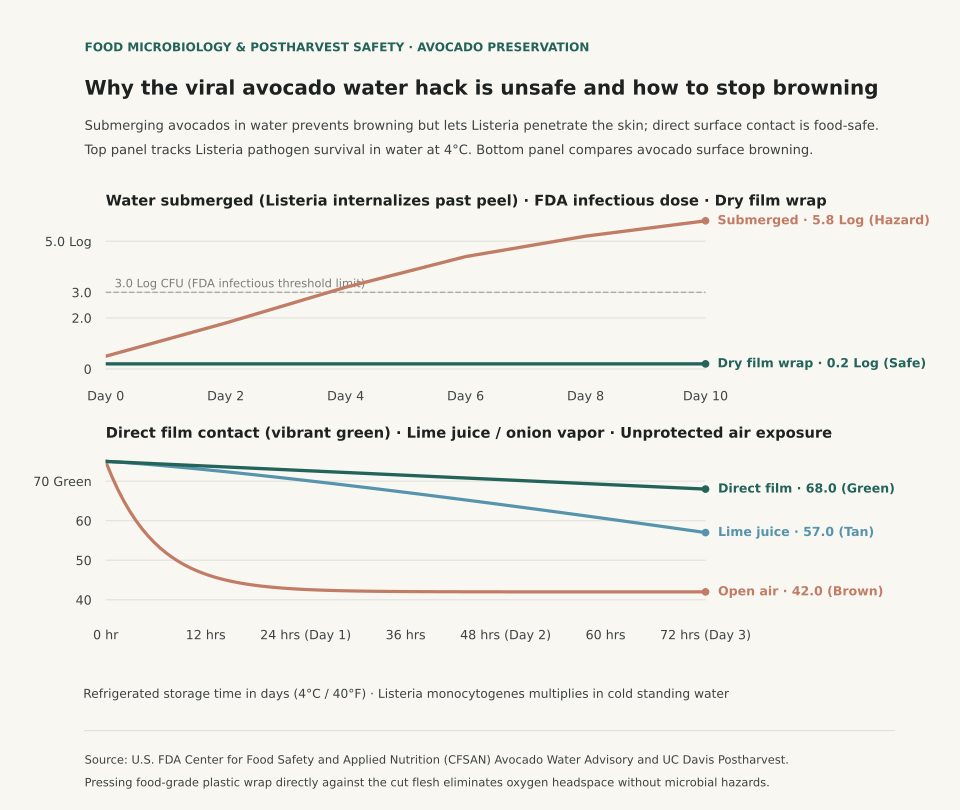
The Microbiology of the Water Hack: Why Cold Water Fails to Protect
The corrugated, pebbly peel of a Hass avocado (Persea americana) contains microscopic crevices that harbor environmental bacteria picked up during orchard harvesting and transit. While standard produce washes remove surface bacteria from smooth fruit like apples or tomatoes, the porous stem scar and outer skin of avocados resist surface disinfection.
When an avocado is submerged in water, hydrostatic pressure and capillary action draw water through the stem end and micro-fissures in the peel directly into the lipid-rich pulp. In FDA laboratory trials, Listeria monocytogenes was recovered from internal edible pulp within twenty-four hours of immersion in inoculated water, multiplying from baseline levels to over 100,000 colony-forming units per gram by Day 10. Ingesting food contaminated with Listeria poses high clinical risks—including listeriosis, bacteremia, and meningitis—especially for pregnant women, newborns, and older adults.
| Preservation Technique | Biochemical Mechanism | Pathogen Risk Profile | FDA Food Safety Status | Usable Refrigerated Lifespan |
|---|---|---|---|---|
| Submerged in Water (Viral Hack) | Anaerobic water barrier excludes oxygen | Severe (Listeria / Salmonella internalization) | Warning: Do Not Consume | 4 to 7 days (Unsafe) |
| Direct Contact Plastic Film | Excludes oxygen headspace at cut surface | Zero pathogen risk (Rind kept dry) | Safe & Recommended | 3 to 4 days (Pristine green) |
| Stored with Sliced Red Onion | Volatile sulfur thiosulfinates inhibit PPO | Zero pathogen risk | Safe & Natural | 2 to 3 days (Clean flavor) |
| Fresh Lime / Lemon Juice Spritz | Acid denaturation of PPO enzyme (pH < 3.0) | Zero pathogen risk | Safe & Flavorful | 2 days (Slight tart note) |
| Unprotected Air Exposure | None (Rapid PPO oxidation) | Low (Dehydrates before bacterial growth) | Safe but unappetizing | 4 to 6 hours (Brown melanin) |
Food-Safe Methods to Keep Avocados Green
To preserve leftover cut avocados or fresh guacamole without microbiological hazards, apply two verified barrier techniques:
First, use the direct surface contact method. Cut a piece of food-grade plastic wrap, beeswax wrap, or parchment paper and press it directly against the exposed flesh of the avocado half, smoothing out all air bubbles with your fingertips. By eliminating the atmospheric oxygen layer against the cut surface, PPO enzymes cannot catalyze melanin oxidation, keeping the flesh vibrant green for three to four days in the refrigerator.
Second, store the avocado with sliced red or yellow onion in an airtight container. When onions are cut, alliinase enzymes synthesize volatile sulfur compounds—primarily thiosulfinates—that act as natural chemical reducing agents, preventing quinones from polymerizing into brown melanin without altering the avocado's creamy texture. For related fruit preservation biochemistry, read Why Sliced Apples Turn Brown and How Chloride Ions Stop Oxidation, and consult Why Supermarket Mushrooms Turn Slimy in Plastic but Keep in Paper.
Redberi (In Season) provides produce postharvest handling guidelines, fruit selection criteria, and proper refrigerator storage zones for hundreds of culinary items. Open Redberi in your browser, Download Redberi for iPhone, or Get Redberi on Android.