
Why Citrus Never Ripens on the Counter and Green Skin Is Not Sour
Citrus fruits cease accumulating sugars the instant they are clipped from the orchard tree because they are non-climacteric and contain zero starch reserves to convert into sucrose, glucose, or fructose post-harvest. According to postharvest standards established by the University of Florida IFAS Citrus Research and Education Center and mandatory maturity thresholds in the Florida Citrus Code (Chapter 20-61), citrus ripens fully on the branch. While leaving oranges, grapefruits, or lemons on the counter at room temperature can cause their rinds to soften or turn from green to orange, that color change reflects chlorophyll degradation, not an increase in internal sweetness.
Shoppers frequently evaluate citrus using stone fruit or banana assumptions, placing green-tinged oranges or pale grapefruits on kitchen counters in hopes they will sweeten over several days. The internal chemistry of citrus is fixed at harvest: total soluble solids (measured in degrees Brix) remain flat throughout commercial storage, while citric acid gradually breaks down through respiration at approximately 0.5% to 1.0% per week. A tart lemon or sour orange will never become sweet on your counter; it simply becomes slightly less acidic as moisture evaporates from the peel.
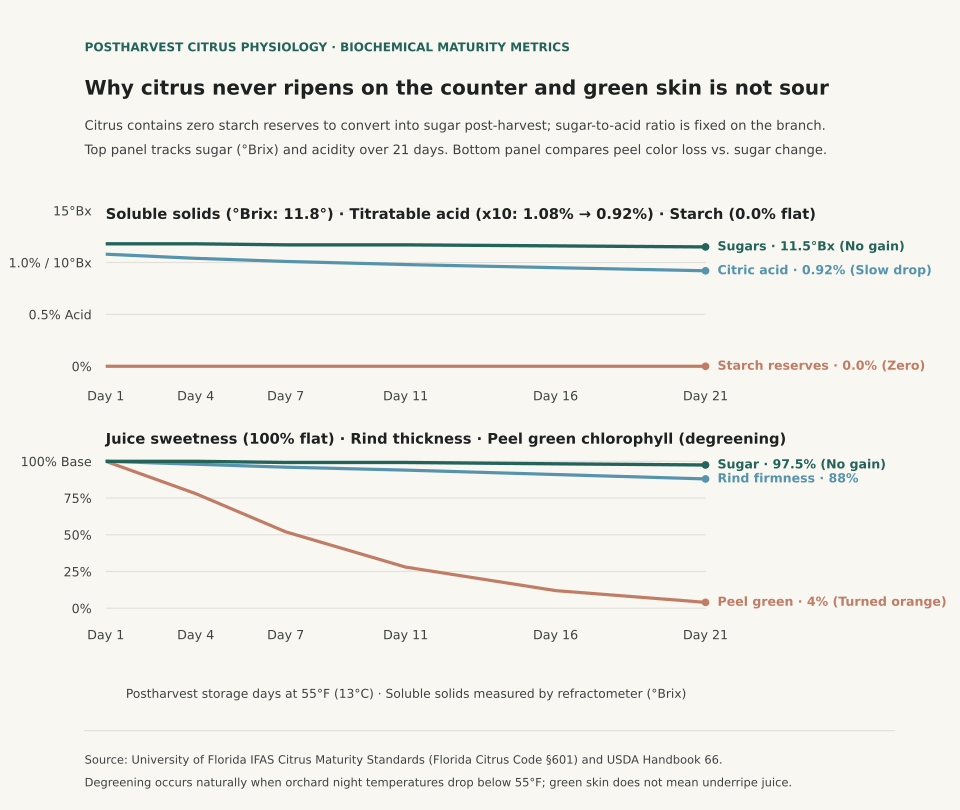
The Biochemistry of Citrus: The Missing Starch Reserve
Climacteric fruits like bananas, apples, and pears store large reserves of insoluble starch (often 10% to 15% of fruit weight) during development on the plant. Upon harvesting, a surge of ethylene gas stimulates amylase enzymes that hydrolyze starch into soluble sugars, transforming a starchy green banana into a sweet yellow fruit. Citrus fruit stores no starch: all sugar delivered to the juice vesicles is synthesized via tree photosynthesis and transported through the phloem during growth. Once severed from the branch, the juice sac has no internal mechanism to generate additional carbohydrates.
Commercial maturity regulations in Florida and California set minimum Brix-to-acid ratios for citrus harvest. For Florida oranges, the minimum ratio is typically 10.0:1 (or 10.5:1 for early-season Hamlin varieties). The table below traces postharvest compositional changes in fresh navel oranges over three weeks of typical household storage:
| Storage Duration | Soluble Solids (°Brix) | Titratable Acidity (%) | Brix / Acid Ratio | Starch Reserves (%) | Peel Chlorophyll Content | Physical Quality Status |
|---|---|---|---|---|---|---|
| Day 1 (Harvest) | 11.8° Bx | 1.08% | 10.9 : 1 | 0.0% | 100% (Greenish-yellow) | Crisp, firm, peak internal juice volume |
| Day 4 | 11.8° Bx | 1.04% | 11.3 : 1 | 0.0% | 78% (Mottled green) | Taut rind; no measurable sugar change |
| Day 7 | 11.7° Bx | 1.01% | 11.6 : 1 | 0.0% | 52% (Yellow-orange) | Degreening underway; slight acidity decline |
| Day 11 | 11.7° Bx | 0.98% | 11.9 : 1 | 0.0% | 28% (Pale orange) | Peel loses firmness; interior remains sweet |
| Day 16 | 11.6° Bx | 0.95% | 12.2 : 1 | 0.0% | 12% (Full orange) | Transpirational moisture loss in outer rind |
| Day 21 | 11.5° Bx | 0.92% | 12.5 : 1 | 0.0% | 4% (Deep orange) | Mildly flat taste; risk of mold development |
Why Green Skin Does Not Indicate Underripe Citrus
The familiar bright orange color of supermarket citrus is a temperature response, not a maturity signal. In commercial orchards, peel chlorophyll degrades when autumn night temperatures dip below 55°F (13°C), unmasking underlying carotenoid pigments (orange and yellow). In tropical or warm subtropical regions like Florida or South Texas where early autumn nights remain warm, fully mature, sweet oranges and grapefruits retain a greenish peel. Commercial packinghouses expose early-season fruit to low concentrations of ethylene gas (1 to 5 ppm) in warm "degreening" rooms solely to break down exterior chlorophyll without altering juice quality.
When selecting citrus in the produce aisle, prioritize specific gravity and skin texture over exterior color. Pick up multiple fruits of identical diameter and select the one that feels noticeably heavy in your hand; heavy density indicates swollen, juice-filled vesicles rather than thick, spongy pith. For complementary produce storage guidelines, read Why Ethylene Producers Accelerate Spoilage in Sensitive Crops and consult How to Read Fruit PLU Codes: 4-Digit vs. 9-Digit Organic Stickers.
Redberi (In Season) catalogs produce maturity standards, seasonal harvest calendars, and proper refrigerator storage zones for hundreds of fruits and vegetables. Open Redberi in your browser, Download Redberi for iPhone, or Get Redberi on Android.