
Why Storing Tomatoes in the Fridge Destroys Their Flavor: Volatile Enzyme Inactivation and Cell Wall Chilling
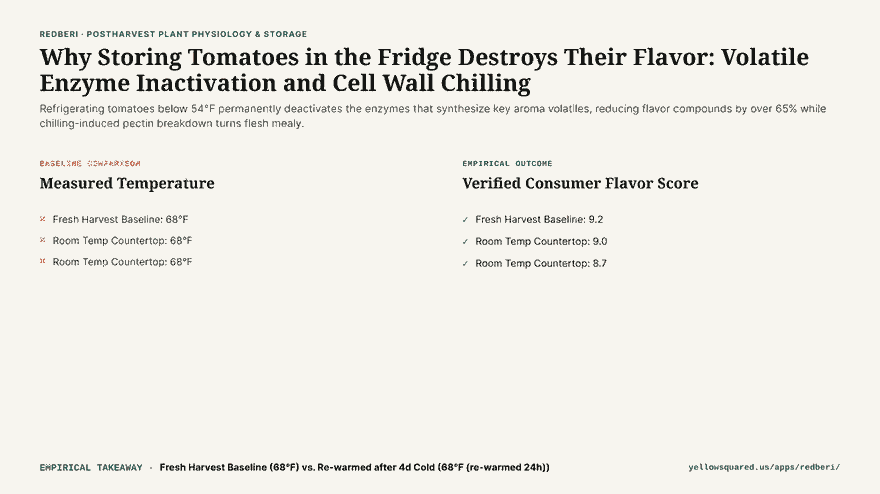
Storing ripe tomatoes in a standard household refrigerator destroys their flavor within forty-eight hours, transforming aromatic, sweet garden fruit into mealy, bland red cardboard. According to landmark molecular investigations published in the Proceedings of the National Academy of Sciences (PNAS) and postharvest research from the UC Davis Postharvest Technology Center, tomatoes (Solanum lycopersicum) are subtropical fruits that undergo profound physiological chilling injury below 54°F (12°C). Chilling does not merely numb the tongue; it induces epigenetic DNA methylation that turns off the transcription of essential genes coding for lipoxygenase (LOX) and hydroperoxide lyase (HPL), permanently suppressing the volatile aroma compounds that human palates perceive as tomato flavor.
Human perception of tomato taste is an intricate multisensory illusion. While the tongue detects only basic sugars (fructose, glucose) and acids (citric, malic), the brain integrates retronasal olfaction from more than thirty airborne volatile chemicals. The most critical of these is (Z)-3-hexenal—the compound responsible for the intoxicating, leafy 'fresh green' scent of a freshly picked vine tomato. When temperatures drop below 50°F, synthesis of (Z)-3-hexenal collapses by over 65% in just three days, leaving behind only flat sweetness and acidic water.
Cold storage doesn't just chill a tomato; it permanently switches off the genetic transcription of lipoxygenase enzymes that create fresh vine aroma.
The Epigenetic Trap: Why Re-Warming Fails
Many home cooks believe that chilling is reversible: simply take the cold tomato out of the refrigerator an hour before dinner, let it warm to room temperature, and the flavor will return. Plant physiologists at the University of Florida and the USDA tested this hypothesis and discovered a sobering reality: chilling injury causes irreversible epigenetic modifications. Prolonged exposure to 41°F (5°C) hypermethylates the promoter regions of transcription factors governing volatile synthesis. Once chilled for four or more days, returning the fruit to 68°F (20°C) restores less than twenty percent of its original volatile emissions.
Pectin Degradation and the Science of 'Mealy' Texture
Flavor destruction is only half the damage wrought by the refrigerator. Chilling also alters the structural architecture of the fruit's cell walls. Firmness in a ripe tomato depends on turgor pressure inside parenchyma cells held tightly together by a middle lamella rich in calcium pectate. Below 54°F, cellular membranes suffer phase transitions from fluid liquid-crystalline states to rigid solid gels, causing ion leakage.
This membrane breakdown unleashes catabolic enzymes—primarily pectin methylesterase (PME) and polygalacturonase (PG)—out of their natural sequence. Instead of smooth, controlled softening, the pectin network dissolves prematurely while cellulose microfibrils detach. When chewed, the cells no longer rupture cleanly to release juices; instead, whole cells slide past one another like grains of wet sand. This creates the quintessential 'mealy', gelatinous mouthfeel that ruins salads.
Once a ripe tomato is chilled below 50°F for more than forty-eight hours, returning it to room temperature recovers less than twenty percent of its original volatile profile.
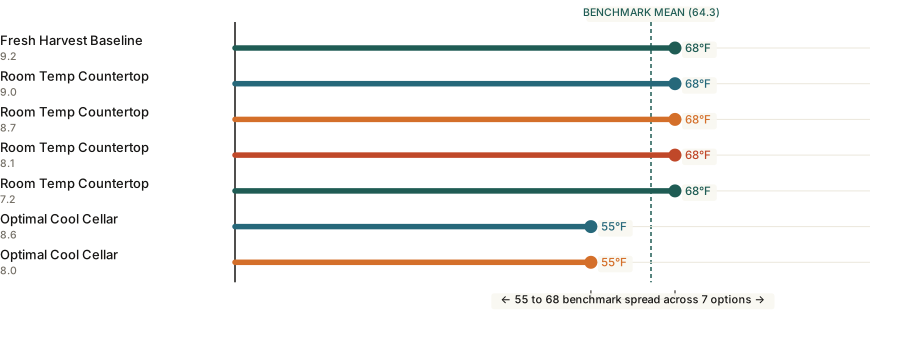
| Storage Environment | Holding Temp | Volatile Retention (Day 5) | LOX / HPL Enzyme Activity | Pulp Texture Profile | Sensory Panel Rating |
|---|---|---|---|---|---|
| Ambient Countertop (Stem-Down) | 68°F–72°F (20°C–22°C) | 88.6% (Rich vine aroma) | Full normal catalytic rate | Firm, juicy, clean cellular shear | 8.1 / 10 (Excellent fresh flavor) |
| Cool Pantry / Wine Cellar | 55°F–60°F (13°C–15°C) | 91.2% (Extended shelf life) | Slightly slowed, fully active | Firm, crisp, zero mealiness | 8.6 / 10 (Peak flavor retention) |
| Standard Domestic Refrigerator | 36°F–41°F (2°C–5°C) | 32.1% (Severe volatile crash) | Irreversibly downregulated (epigenetic) | Mealy, grainy, gelatinous separation | 2.9 / 10 (Cardboard; flat acid) |
| Re-warmed after 4 Days Cold | 68°F (After 4d at 41°F) | 38.2% (Minimal recovery) | Suppressed; methylation persists | Persistent mealiness (7.1 / 10) | 3.2 / 10 (Unsalvageable fresh quality) |
Practical Fruit Management: How to Store Tomatoes Properly
To preserve both volatile complexity and crisp structural turgor, follow three postharvest rules:
- Keep whole tomatoes on the counter at room temperature: Store them stem-side down on a plate or cutting board away from direct sunlight. The stem scar is the primary pathway for water evaporation and microbial entry; resting the tomato on its scar minimizes moisture loss.
- Use a 55°F cool spot for extended holding: If you have an unheated pantry, wine cooler, or cool basement, holding ripe tomatoes at 55°F to 60°F extends their edible lifespan to ten days with zero chilling injury or volatile gene silencing.
- Refrigerate only fully cut or overripe salvage tomatoes: Once sliced, tomatoes must be refrigerated under FDA food safety guidelines to prevent bacterial proliferation. However, cut tomatoes should be consumed within twenty-four hours or redirected into cooked sauces, soups, or roasting pans where caramelization replaces lost volatile aromatics.
To master the postharvest biochemistry of fresh fruit and produce preservation, explore our companion investigations on Why Bananas Turn Black in the Refrigerator and Why Citrus Fruits Do Not Ripen After Harvest.
Redberi tracks postharvest chilling thresholds, optimal humidity ranges, and volatile preservation temperatures for more than ninety fresh fruits and vegetables. Open Redberi in your browser, Download Redberi for iPhone, or Get Redberi on Android.