YellowSquared  /  Field notes

Notes from the workshop

47 posts, newest first. Choose an app to narrow the feed.

041 / 47

How Cash Taxes and Carrier Surcharges Change Your Cents-Per-Point Redemption Value

To measure what your points actually save on an award flight or hotel stay, subtract the mandatory cash taxes and carrier surcharges on the award booking from the cash fare of the same trip before dividing by the points required: Net Cents Per Point (CPP) equals (Cash Fare minus Award Cash Fees) divided by Bank Points Used, multiplied by 100. In an illustrative comparison for a $1,200 round-trip ticket costing 60,000 points, paying the statutory U.S. domestic security fee of $11.20 saves $1,188.80 and yields 1.98 cents per point, whereas paying $700 in transatlantic carrier surcharges reduces the cash saved to $500 and cuts the redemption value to 0.83 cents per point.

A traveller comparing two transfer partners with three browser tabs open often divides the $1,200 cash ticket price straight by 60,000 points and sees 2.00 cents per point in both windows. That headline ratio treats an $11.20 government security fee and a $700 carrier surcharge as if both cost zero cash. Checking the net figure before moving points from Chase Ultimate Rewards, American Express, Citi, or Capital One shows when a high-copay award drops below the 1.0-cent-per-point floor you could get from cash back.
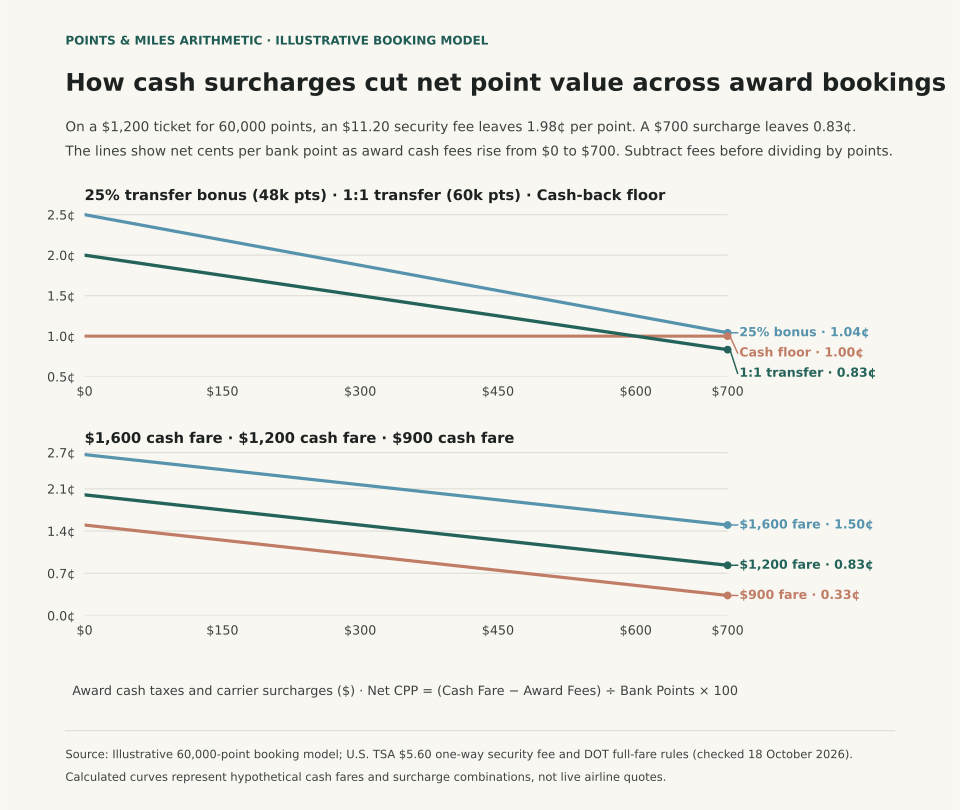
Horizontal bar chart comparing headline cents per point versus net cents per point after cash fees across five illustrative 1200 dollar flight scenarios, showing erosion from 1.98 cents per point with an 11 dollar 20 cent TSA fee down to 0.83 cents per point with a 700 dollar carrier surcharge.
Illustrative comparison of a $1,200 round-trip flight booked for 60,000 award points across five cash-fee and transfer-bonus scenarios. Gray bars show the headline ratio when cash copays are ignored; colored bars show net cents per bank point after subtracting the award's cash charges. Reproducible table inputs: award-surcharge-cpp-scenarios.csv.

Why Cash Tickets Include Surcharges That Award Tickets Bill Separately

When you shop for a paid airline ticket in the United States, U.S. Department of Transportation (DOT) full-fare advertising rules require airlines and travel agencies to include all mandatory government taxes, airport fees, and carrier-imposed surcharges in the prominent total price. When you redeem miles for an award seat, however, the points cover only the base fare while the checkout screen bills government taxes and any carrier-imposed charges in cash.

Government fees follow statutory schedules that apply no matter which airline program issues your ticket. On flights originating in the United States, the Transportation Security Administration (TSA) September 11 Security Fee is $5.60 per one-way trip, or $11.20 for a round trip (TSA Passenger Fees FAQ). International itineraries add customs, immigration, and foreign departure taxes such as the UK Air Passenger Duty. Carrier-imposed surcharges - often labeled YQ or YR on the tax breakdown - work differently: programmes such as The British Airways Club pass along hundreds of dollars in carrier charges on long-haul redemptions, while another alliance partner may price the same route with government taxes alone.

Worked Comparison: One $1,200 Ticket Across Five Fee Structures

The table below holds the illustrative $1,200 round-trip cash price and 60,000-mile award price constant while varying the cash copay from $11.20 to $700. One row adds a 25% bank transfer bonus (1:1.25 ratio), which lowers the bank points required for a 60,000-mile award to 48,000 points (see How to Judge a Points Transfer Bonus Before Moving Points). These rows are calculated examples rather than live route quotes:

Illustrative cents-per-point calculations for a $1,200 cash ticket across five award fee structures (CSV source).
Illustrative Booking Scenario Cash Fare Award Cash Fees Net Cash Saved Bank Points Used Headline CPP (No Fee Deducted) Net CPP (After Fees)
U.S. Domestic Round Trip ($11.20 TSA fee) $1,200.00 $11.20 $1,188.80 60,000 2.00¢ 1.98¢
International Low-Fee Partner ($85 government taxes) $1,200.00 $85.00 $1,115.00 60,000 2.00¢ 1.86¢
Moderate Carrier Charge ($300 taxes + surcharges) $1,200.00 $300.00 $900.00 60,000 2.00¢ 1.50¢
Moderate Charge + 25% Transfer Bonus (1:1.25 ratio) $1,200.00 $300.00 $900.00 48,000 2.50¢ 1.88¢
High Carrier Surcharge ($700 taxes + surcharges) $1,200.00 $700.00 $500.00 60,000 2.00¢ 0.83¢

Keeping the Cash Benchmark Honest Before You Transfer

The net formula is only as realistic as the cash price you put in the numerator. On transatlantic and transpacific routes, full-service airlines frequently price a one-way cash ticket higher than a round trip; if a round trip costs $1,100 ($550 each way) while a standalone one-way ticket lists for $1,800, using $1,800 inflates the apparent point value beyond what you would actually spend in cash. Check whether two programmes sharing the same bank currency price the route differently (as shown in Avios Transfers: Compare the Booking, Not Just the Bonus), and include optional fees such as checked bags or seat selection under DOT optional-service rules only when the award ticket covers a fee you would otherwise pay out of pocket. If you are short a few thousand miles after checking transfer increments, compare the out-of-pocket surcharge against the cost of topping up your balance in Buying Points to Top Up an Award.

Pointsuno calculates net cents-per-point values after subtracting taxes and carrier fees, applies transfer ratios and active bonuses side by side, and lets you compare airline and hotel partners before moving bank points. Open Pointsuno in your browser, Download Pointsuno for iPhone, or Get Pointsuno on Android.
042 / 47

Should You Buy Points to Top Up an Award? A Break-Even Worksheet

A small points purchase can lower the cash needed for an award, but the purchase price and the award's cash charges must be counted together. Start with an available booking, subtract the points you already hold, and price the amount you would actually need to buy.

The worksheet below uses a fictional 40,000-point award, a 30,000-point existing balance, $80 in award charges and a $450 cash alternative. It is a calculation example, not a current promotion, quoted fare or recommendation to buy a particular currency.

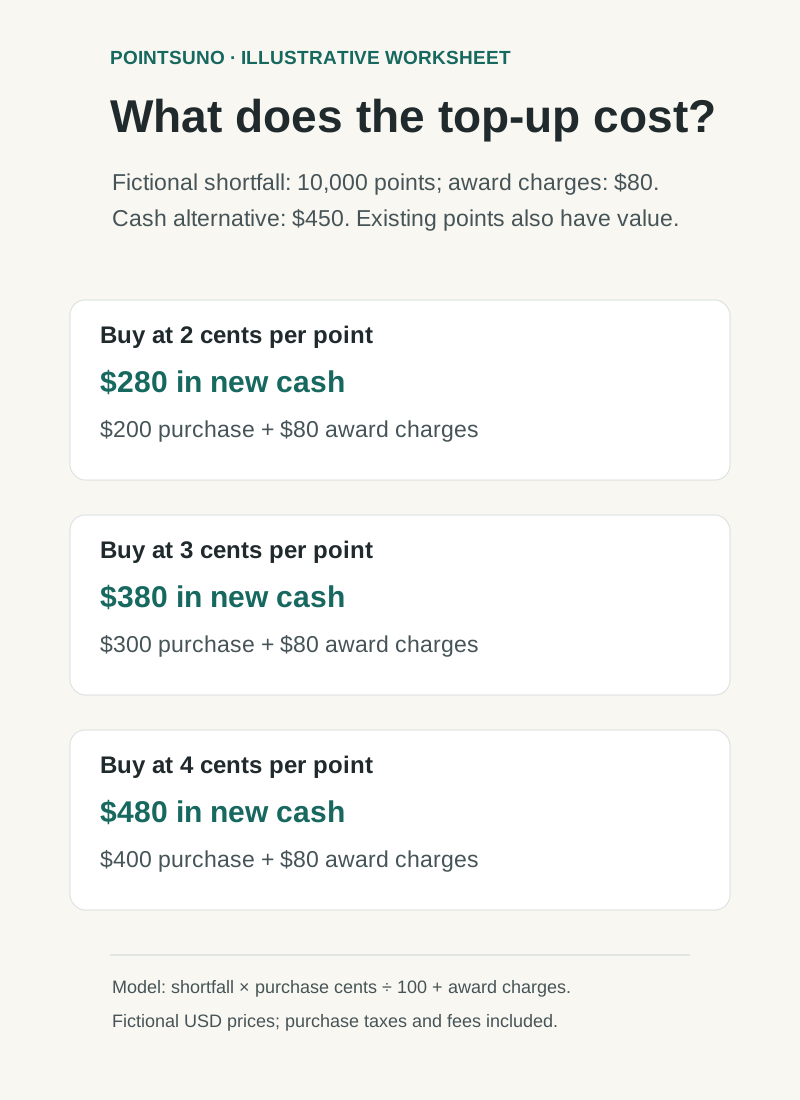
For a fictional 10000-point shortfall and 80-dollar award charges, buying at 2 cents per point requires 280 dollars new cash; at 3 cents it requires 380 dollars; at 4 cents it requires 480 dollars.
Illustrative new-cash comparison only. The points already held also have an opportunity cost. Every purchase price shown is assumed to include purchase taxes and fees. Download the calculations (CSV).

Price the shortfall, including purchase charges

The fictional shortfall is 40,000 − 30,000 = 10,000 points. At an all-in purchase price of two cents per point, buying that amount costs $200. Adding the $80 award payment gives $280 in new cash.

At three cents, the purchase costs $300 and the new cash total is $380. At four cents, the total becomes $480, already above the $450 cash alternative before assigning any value to the existing points.

Use the checkout total rather than an advertised per-point headline. If the programme sells only fixed blocks, price the whole block you must buy, including surplus points. A promotional bonus can change the number received; it does not remove purchase taxes or award charges.

Find the new-cash ceiling

For this example, the purchase can consume at most $450 − $80 = $370 before the new cash equals the alternative. Dividing by the 10,000-point shortfall gives $370 ÷ 10,000 × 100 = 3.7 cents per purchased point.

That is a cash-only ceiling. A purchase below 3.7 cents does not establish that the award is the better overall use of your resources.

Existing points still have an alternative use

Suppose, solely for illustration, you assign the 30,000 existing points an alternative-use value of one cent each: $300. The two-cent top-up then uses $200 for the purchase, $80 for award charges and $300 of assumed existing-point value, totalling $580.

The result depends on the assumption. A balance with another useful redemption is different from one with few realistic uses. Keep that judgement separate from the cash arithmetic rather than treating already-earned points as universally worthless.

Check availability and cancellation before buying

Purchased points do not guarantee a seat. Delta's Buy Miles terms explicitly warn that award availability is limited, require cash payment of award taxes and fees, and describe purchase fees as non-refundable. These are examples from that programme's terms, not universal rules for every currency. Read the programme's own purchase terms.

Check the programme you intend to use for posting time, purchase limits, minimum blocks, eligibility and what happens after cancelling the award. A return of miles to an account is different from a refund of the cash spent buying them. Compare matching dates, room or cabin, baggage and flexibility.

Keep purchase and redemption calculations distinct

Pointsuno includes a buy-points calculation for the cost per point received and a redemption calculation that subtracts award cash charges. Use each for its own question: acquisition price first, then the booking comparison. The app's programme metadata is a reference; confirm your actual offer and award at checkout.

For flexible bank points, the transfer-bonus guide explains a separate calculation. Before committing to a destination balance, check the applicable expiry model.

All worksheet prices and valuations are fictional; the calculation excludes travel earnings and assumes comparable bookings.

043 / 47

Avios Transfers: Compare the Booking, Not Just the Bonus

Two programmes that use Avios can still ask for different amounts for the journey you want. A transfer bonus changes how many Avios you receive. It does not guarantee that each programme offers the same flight, price, fee or cancellation rule.

Imagine one available award priced at 60,000 Avios plus $100 and another at 45,000 Avios plus $350. The second requires fewer Avios, but $250 more cash. Whether it is preferable depends on your available balance, transfer ratio and realistic cash alternative.

These are invented prices for explaining the comparison. This article replaces the original August promotion roundup; no percentage below is a current offer or an archived promotion.

Compare the complete booking

Start with a flight you can actually book in each programme. Keep route, date, cabin and number of travellers together. A headline award price that has no seats for your dates is a poor basis for transferring a balance.

Illustrative awardAviosCash chargeBank points at 1:1 plus 30%, in 1,000-point blocks
Option A60,000$10047,000
Option B45,000$35035,000

If the equivalent cash flight is $900, A avoids $800 and returns about 1.70 cents per bank point. B avoids $550 and returns about 1.57 cents. B uses fewer points; A produces a higher return per point in this particular example.

A common currency does not erase programme rules

Avios can be used within several programmes, but the account rules still matter. British Airways provides conditions for Combine My Avios, including eligibility and matching account information. Check the programme's own process before relying on a move between accounts.

A bank-to-programme transfer and a programme-to-programme move are separate actions. Availability, processing time and restrictions should be checked for each step. A bonus on the first action does not establish the rules of the second.

Moving Avios may not reset an expiry clock

British Airways states that collecting, spending, buying or sharing Avios at least once every 36 months prevents its activity-based expiry. Its conditions also state that Combine My Avios movements do not count as earning or redemption for that purpose. See the Avios overview and the programme conditions above.

Do not assume a transfer between two balances is qualifying activity merely because a transaction appears in the account. Read the expiry rule for the balance you are trying to protect.

Compare cancellation outcomes too

Check the fee, deadline and form of any refund before booking. If an award is cancelled, receiving Avios back in a programme account is different from recovering flexible bank points. The remaining programme balance may have a narrower range of uses.

For a trip that may change, a cash fare with suitable flexibility can be a better practical option than an apparently high-value award. Keep the actual terms beside the price rather than comparing a flexible cash fare with a restrictive award as though they were identical.

A useful order of operations

  1. Find the flight and confirm the seats for everyone travelling.
  2. Write down Avios, cash charges and cancellation rules in each programme.
  3. Confirm the bank's base ratio, bonus terms and account eligibility.
  4. Check any additional Avios movement required, including expiry treatment.
  5. Calculate the bank points needed, including increments and an existing balance.
  6. Recheck availability and current terms before making the transaction.

Chase's transfer guide is one primary reference for bank transfer mechanics. For the calculation itself, read how to judge a transfer bonus; for the underlying balance rules, see why points expire.

044 / 47

What a Change in Point Valuation Actually Means

A point valuation is an estimate of what a point may help you avoid paying. It is not a cash balance. If an estimated value falls from 0.5 cents to 0.4 cents, the estimate falls 20%; that alone does not prove an award programme raised every price by 20%.

For a balance of 100,000 points, those assumptions produce estimated values of $500 and $400. You still hold 100,000 points. To establish that the balance buys less, inspect the awards it could book before and after the change.

This guide replaces the original quarterly “devaluation index.” The earlier article did not provide a reproducible booking basket for its claimed results. The numbers here are illustrative calculations, not measured programme changes.

Separate three kinds of change

ChangeWhat to measureWhat it establishes
An author's valuation changesOld and new estimates, plus assumptionsA revised judgement of likely value
An award price risesPoints for a matched bookingThe booking requires more points
Availability or terms changeBookable dates, inventory, fees and rulesThe practical options may change even at the same price

A cash fare can fall while the award price stays fixed. The calculated cents per point then falls because the cash saving is smaller. That is different from the programme increasing the number of points required.

A 20% price rise reduces buying power by 16.7%

Suppose a matched award rises from 50,000 to 60,000 points. The price increases by (60,000 − 50,000) ÷ 50,000 = 20%.

A fixed balance can now buy 50,000 ÷ 60,000 = 83.3% as many of those awards in a continuous comparison. Its buying power falls about 16.7%. Real trips are indivisible, so a particular balance may cross a booking threshold and feel a sharper change.

The distinction matters when a headline uses “devaluation” without saying whether it measures a price increase or a loss of buying power. State the formula beside the percentage.

How to build an index readers can inspect

Choose a basket before checking the result, and record route or property, travel dates, cabin or room type, points, cash charges, cash alternative and cancellation terms. Keep the search date too.

Match those items as closely as possible in the later sample. Include unavailable awards explicitly rather than silently replacing them with easier examples. If availability is part of the measure, explain how it affects the score.

  • Fixed basket: avoids changing the examples to obtain a desired result.
  • Matched dates and conditions: reduces seasonal and product differences.
  • Published weighting: explains whether a costly premium award dominates the index.
  • Raw observations: lets a reader reproduce the arithmetic.
  • Separate fees and availability: makes the source of a change visible.

Why a single cents-per-point number is limited

A point may produce very different returns on different dates. A flexible traveller who can use a rare premium award has different options from someone booking a family trip during school holidays. An average or selected high return may not describe either person's next booking.

Published valuations can be a reference for screening options. Keep their date, method and assumptions attached. For a decision, calculate (realistic cash alternative − award cash charges) ÷ points used × 100 for the booking you can obtain.

What to do with a balance you already hold

List one or two realistic uses and check their current prices and availability. Compare them with cash alternatives and note any expiry deadline. A useful booking can matter more than an estimated value that assumes travel you do not want.

For flexible bank points, inspect the options before choosing a programme. Chase and Capital One publish their own transfer guidance. See the transfer-bonus example for a calculation that keeps bank points and programme points distinct.

045 / 47

Why Points Expire: Four Rules to Check Before You Transfer

“Use your points once in a while” is not a complete expiry plan. Some programmes reset an inactivity clock when you complete qualifying activity. Others expire each batch a set time after it was earned. Some do not expire points, while bank rewards can depend on account conditions.

Imagine earning miles in January and again in June. Under a batch-based rule, the January miles can expire first even if the account has recent activity. Under an inactivity rule, a qualifying transaction may extend the whole balance. The same account history can therefore produce different outcomes.

The four models

ModelWhat starts the clock?What to check
Activity-based expiryLast qualifying earning or redemptionWhich activities qualify and when they post
Batch-based expiryWhen each group of points was earnedExpiry date for each batch and any extension rules
No scheduled expiryNo ordinary expiry clockAccount closure and other programme conditions
Bank-account conditionsRules attached to the rewards accountClosure, standing, product changes and redemption terms

Activity-based: qualifying is the key word

Marriott Bonvoy's guidance calls for qualifying activity within 24 consecutive months and lists eligible activities. An action that appears in an account is not necessarily one that extends the balance.

British Airways' Avios overview describes collecting, spending, buying or sharing Avios at least once every 36 months. Its programme conditions specify that Combine My Avios movements do not prevent expiry. Moving a balance is therefore not a universal reset.

Check the qualifying-activity definition, member-status exceptions and posting deadline. Record the new expiry date after an action posts rather than assuming the transaction worked.

Batch-based: recent activity may not protect old miles

Singapore Airlines' KrisFlyer conditions give ordinary Basic, Silver and Gold members' miles a three-year validity period, with expiry at the end of the corresponding month in Singapore time. The conditions include exceptions, including different treatment for PPS Club members.

Under this model, a new earning transaction does not generally turn old miles into newly earned miles. Check the account's batch expiry schedule and the programme's extension or redemption rules before relying on activity.

No scheduled expiry still has account conditions

Delta states that SkyMiles do not expire. That removes an ordinary inactivity deadline. It does not promise permanent account access regardless of conduct or account conditions; its programme terms describe circumstances affecting membership and balances.

Keep account access and contact information current. A “no expiry” rule also says nothing about future award prices or availability.

Bank rewards: read the agreement for your product

Flexible bank rewards have their own rules. Account closure, standing and product changes can affect access or redemption. Do not copy an airline's expiry rule onto a bank balance, or assume every card from a bank has the same conditions.

Read the agreement and rewards terms for your exact card before closing or changing it. If moving points is part of the plan, check the destination programme's expiry rules too. A transfer can exchange broad options for a narrower balance with a new deadline.

Make an expiry note that is specific enough to use

  1. Record programme, balance and the expiry date shown in the account.
  2. Identify whether the rule follows inactivity or individual earning batches.
  3. Choose an action explicitly listed as qualifying, if the model permits a reset.
  4. Allow for posting time and the programme's time zone.
  5. Confirm the updated date or completed redemption in the account.

For an available award, start with the booking and work back to the transfer amount. The bonus calculation guide explains that sequence, and the Avios guide separates bank transfers from moves between programmes.

Source check: The programme rules linked above are examples of distinct models; consult the current terms and your account's displayed dates before acting.

046 / 47

Why a Bigger Hotel Transfer Bonus Can Still Cost More

A 100% transfer bonus can require more bank points for a room than a 30% bonus elsewhere. The result depends on the base ratio and the programme's award price. Different currencies have different price scales.

Imagine two award options for a trip. Programme A asks for 120,000 hotel points and offers a 1:1 base transfer with a 100% bonus. Programme B asks for 50,000 hotel points and offers a 1:1 base transfer with a 30% bonus. A requires 60,000 bank points; B requires about 38,462 before rounding.

All programmes, prices and bonuses in this example are fictional. This guide replaces the original July offer roundup; it does not document a live promotion or a historical bank offer.

Put everything back into the currency you spend

Illustrative optionAward priceBase plus bonusBank points, rounded to 1,000
Hotel A120,0001:1 plus 100%60,000
Hotel B50,0001:1 plus 30%39,000
Hotel C120,0001:2 plus 30%47,000

Hotel C shows why the base ratio matters. One bank point receives two hotel points before the bonus, so the effective ratio is 2.6. Programme currencies cannot be compared by the bonus percentage alone.

Different rooms are not interchangeable

The least expensive award is only useful if you want the room. Match location, dates, occupancy, bed type and cancellation terms. A property far from your plans can add transport costs; a prepaid award may have different flexibility from the cash option.

Check mandatory charges on the award checkout screen. A resort fee, tax or other charge can change the comparison. Programme rules differ, so do not assume a fee waiver at one brand applies to another.

Use the cash price you would actually pay

Suppose Hotel B's equivalent cash booking is $450 and its award charges $30. Using 39,000 bank points avoids $420: about 1.08 cents per bank point. If you would choose a different $300 hotel, the practical comparison may be less favourable.

The calculation is (cash alternative − award cash charges) ÷ bank points × 100. Keep the word “cents” beside the answer. A result of 1.08 cents is $0.0108 per point, not $1.08.

Where published valuations help

A cents-per-point estimate can be a screening reference. It cannot tell you what a particular room will cost or whether it is available. Estimates often reflect selected bookings, assumptions about flexibility and the author's preferences.

Compute the return for your own dates before deciding. If the exact stay is unavailable, a high theoretical valuation cannot make that award bookable.

Check the terms before transferring

Use the transfer page for the card and account you hold. A partner listed for one product may have different eligibility or ratios for another. Capital One's partner guide and Chase's transfer guide describe their respective systems.

Confirm award availability, bonus-credit timing, minimum transfer and increments. Look up what happens if the stay is cancelled: a programme credit is different from returning points to the original bank account.

A comparison you can keep on one note

  1. Write the room and date beside each option.
  2. Convert the award price into bank points using the base ratio and bonus.
  3. Round to the allowed transfer increment after subtracting an existing balance.
  4. Add the award's cash charges and compare with a realistic cash booking.
  5. Choose the room and terms you want, then confirm the transaction's current rules.

The transfer-bonus math guide shows why a 30% bonus means roughly 23% fewer points for a fixed award. For balances you already hold, read the four expiry models.

047 / 47

How to Judge a Points Transfer Bonus Before Moving Points

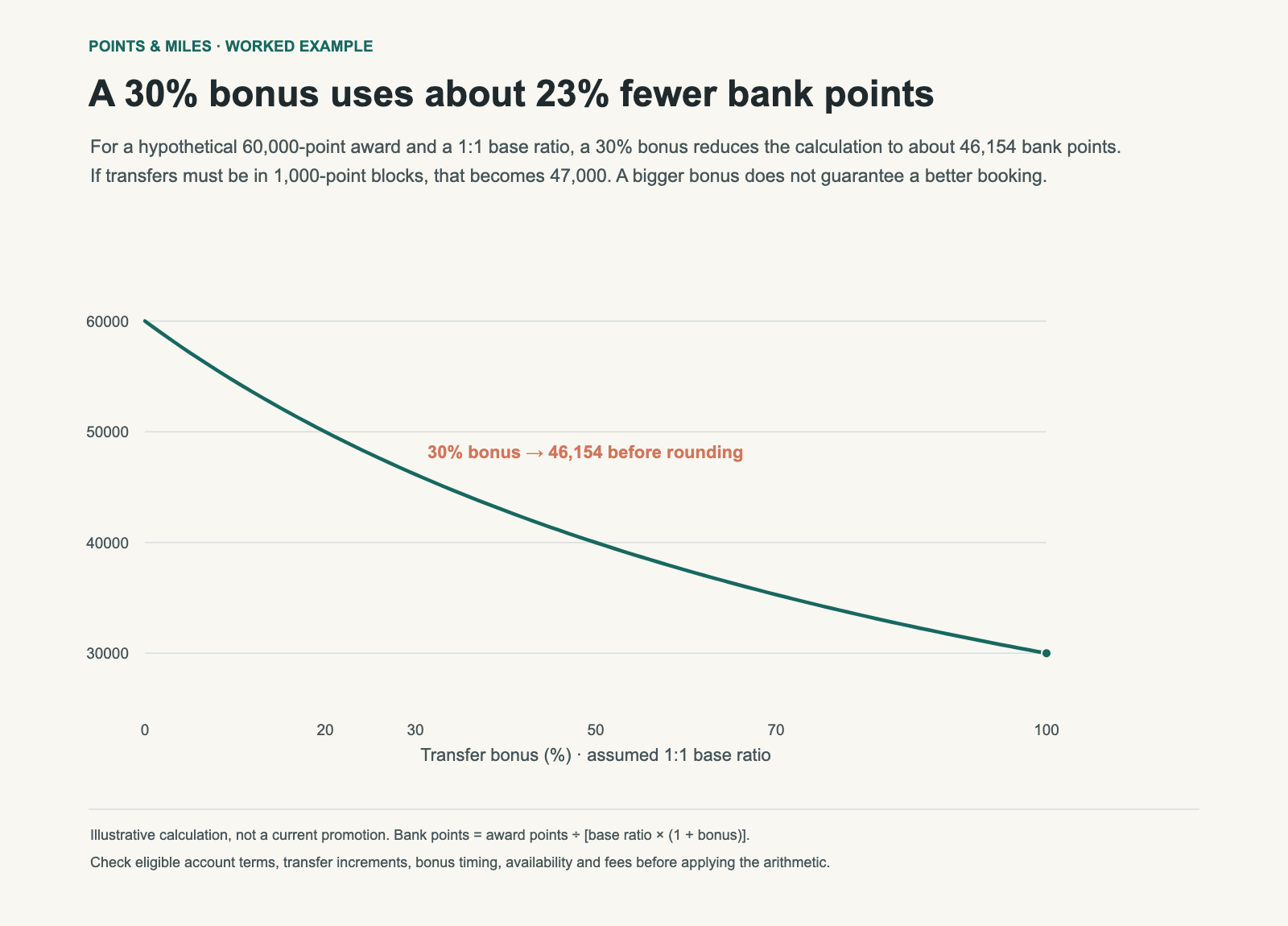
A 30% transfer bonus does not make a fixed award cost 30% fewer bank points. At a base ratio of 1:1, it turns each bank point into 1.3 programme points. Divide the award price by 1.3: a 60,000-point award needs about 46,154 bank points before transfer increments.

That is about 23.1% fewer than 60,000. The difference comes from the denominator: the bonus increases what you receive, while the saving measures what you no longer need to spend.

This article replaces the original June promotion roundup with a reusable calculation. All offer percentages and award prices below are illustrative; they are not live promotions or historical offer records.

For a hypothetical 60,000-point award at a 1:1 base ratio, required bank points decline as the bonus increases; a 30% bonus requires about 46,154.
Illustrative calculation, not a live offer. The award price stays fixed at 60,000 programme points. At a 30% bonus, 46,154 is the unrounded requirement; transfers in 1,000-point blocks would require 47,000 bank points.

Start with the booking

Suppose a flight you would otherwise buy costs $700. An available award for the same journey asks for 60,000 programme points plus $100. The amount you avoid paying is $600, not $700. With a 30% bonus and 1,000-point transfer blocks, the award requires 47,000 bank points.

The illustrative return is ($700 − $100) ÷ 47,000 × 100 = 1.28 cents per bank point. This is a comparison for that booking. A different flight, fee or cash fare changes it.

Write the base ratio into the formula

bank points needed = programme points needed ÷ [base ratio × (1 + bonus)]

Here, “base ratio” means programme points received for one bank point. A 1:1 ratio is 1; a 1:2 ratio is 2. For a 30% bonus, use 0.30 in the formula. Partner ratios vary; Capital One's transfer guide lists its programme-specific ratios and minimums.

Illustrative termsEffective ratioUnrounded bank points for 60,000
1:1, no bonus1.0060,000
1:1, 30% bonus1.3046,154
1:2, 30% bonus2.6023,077

The final row is not automatically the better programme. It only shows the conversion for a fixed 60,000-point price. Different currencies can require very different numbers for the same stay or flight.

Round up to an allowed transfer amount

If you need 46,154 and transfers occur in 1,000-point blocks, 46,000 would leave you short. You would transfer 47,000, receiving 61,100 at the illustrative 1.3 ratio. The 1,100 left over has a different practical value from points already used for a booking.

Account for an existing programme balance before transferring. Also check whether the bonus is credited immediately or later, whether registration is required, and whether its deadline uses your local time zone. Those details belong in the actual offer's terms.

Compare the alternative you would really choose

A published fare you would never pay can exaggerate the apparent return. Compare the award with a cash itinerary or room you would realistically book, including baggage, cancellation rules and mandatory fees. Then compare the bank points with their other available uses under your card's current terms.

A bonus is useful when it improves a booking you want. Moving points first can leave you with a balance in a programme whose availability or pricing does not suit the trip.

Keep a short booking worksheet

  • Actual award availability and programme price.
  • Cash alternative and award cash charges.
  • Base transfer ratio, bonus and eligible account.
  • Minimum, increments and bonus-credit timing.
  • Existing balance, cancellation terms and treatment of returned miles.

Chase's transfer guide explains eligibility and the transfer process. Use the bank's and programme's own terms for your transaction. Download the example calculations, or read how to compare different hotel currencies.