YellowSquared  /  Field notes

Notes from the workshop

47 posts, newest first. Choose an app to narrow the feed.

001 / 47

What Are Airline Fuel Surcharges (YQ and YR Fees) on Award Flights, and Which Airlines Charge Them?

Few experiences surprise points travelers more than searching for a transatlantic business-class award, spotting a tempting 57,500-mile or 60,000-point price tag, and then clicking through to checkout only to see $750 to $970 in cash due for a single one-way ticket. Travelers often assume those cash fees are government airport taxes—but in reality, genuine U.S. and European departure taxes usually make up less than $120 of that bill. The rest is a carrier-imposed surcharge, labeled on airline fare breakdowns with the two-letter IATA ticketing codes YQ or YR.

As documented in award fee analyses from FlightPoints, AwardLocker's YQ/YR glossary, and RewardExpert's surcharge guide, airlines introduced YQ/YR "fuel surcharges" during 2004–2008 oil spikes and kept them permanently as discretionary revenue fees even when jet fuel fell. Compare airline award fees and transfer partners in Pointsuno before transferring flexible bank points to any carrier program.
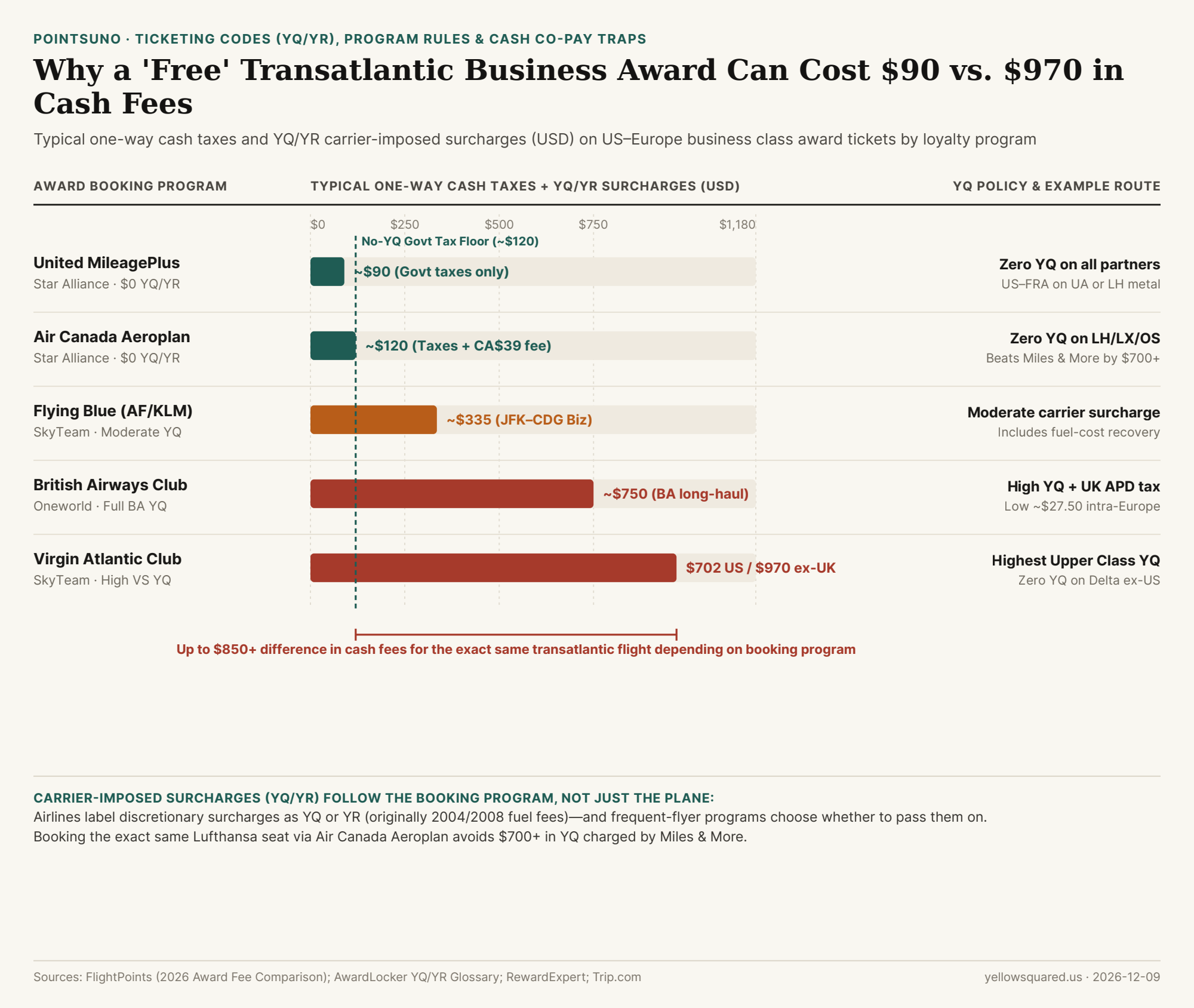
Horizontal comparison chart showing typical one-way cash taxes and YQ/YR carrier surcharges on US-to-Europe business class award flights across United MileagePlus ($90), Air Canada Aeroplan ($120), Flying Blue ($335), British Airways Club ($750), and Virgin Atlantic ($970 ex-UK).
Figure 1: Typical one-way cash taxes and YQ/YR carrier-imposed surcharges (USD) on U.S.–Europe business class award tickets across five major frequent-flyer programs. Sources: FlightPoints, AwardLocker, and RewardExpert · Download CSV dataset.

The Core Rule: Booking Program Controls Whether You Pay YQ

When you redeem miles, your points cover only the base fare—leaving you to pay mandatory government taxes plus any YQ/YR surcharge the issuing loyalty program chooses to collect. Crucially, the exact same airplane seat can carry wildly different cash fees depending on which partner program issues the ticket:

  • Zero-YQ Programs (United MileagePlus, Air Canada Aeroplan, American AAdvantage on most partners): As noted in FlightPoints' fee comparison, booking a Lufthansa Business Class seat from the U.S. to Frankfurt through Lufthansa's own Miles & More program can trigger nearly $980+ in carrier surcharges, whereas booking that exact same Lufthansa seat through Air Canada Aeroplan ($0 YQ + flat CAD $39 partner booking fee) or United MileagePlus ($0 YQ) drops total cash fees to roughly $75–$180!
  • High-YQ Programs (British Airways Club, Virgin Atlantic Flying Club, Lufthansa Miles & More): British Airways passes through steep YQ on its own long-haul flights ($650–$1,000+ round-trip in business), though it replaces long-haul surcharges with a low flat fee (~$27.50) on intra-European short-haul routes. Virgin Atlantic passes through roughly $702 one-way ex-U.S. and $970 ex-London on Virgin-operated Upper Class awards, while charging $0 YQ on Delta-operated flights from the U.S.

"Carrier-imposed surcharges (YQ/YR) are determined by the loyalty program issuing your award ticket, not just the airline flying the plane—which is why booking Lufthansa via Air Canada Aeroplan saves $700+ in cash on the exact same seat."

Award Program YQ/YR Surcharge Comparison Table

The table below summarizes typical U.S.–Europe business-class cash co-pays and carrier-surcharge policies across six major programs (download the raw CSV dataset):

Loyalty Program Alliance Typical 1-Way Cash (US–EU Biz) YQ/YR Surcharge Policy Key Exception or Sweet Spot
United MileagePlus Star Alliance $60 to $120 $0 YQ/YR on all awards Never passes carrier surcharges on UA or partner metal
Air Canada Aeroplan Star Alliance $75 to $180 $0 YQ/YR (+CA$39 partner fee) Eliminates Lufthansa/Swiss/Austrian transatlantic YQ
American AAdvantage Oneworld $5.60 to $120 $0 YQ on AA, Iberia, JAL, Qantas Avoid British Airways metal to dodge $750+ BA YQ
Air France–KLM Flying Blue SkyTeam $250 to $350 Moderate YQ/YR (~$335 JFK–CDG) Look for Promo Rewards (25% fewer miles) to offset cash
British Airways Club Oneworld $650 to $1,000+ Full YQ/YR on BA long-haul Low flat ~$27.50 fee on intra-Europe; $0 YQ on AA US domestic
Virgin Atlantic Flying Club SkyTeam $702 (US) / $970 (UK) High YQ/YR on VS Upper Class $0 YQ on Delta flights originating in the U.S.

How to Check for Hidden YQ Before You Transfer Points

As U.S. DOT all-in fare rules require cash tickets to display taxes and carrier charges upfront, always run a quick cash-fare breakdown or check the award checkout screen before transferring credit card points—since point transfers to airline programs are irreversible. Compare airline award fees and transfer partners in Pointsuno to calculate your true cents-per-point value after subtracting YQ/YR cash fees.
002 / 47

What Is the Difference Between a Codeshare Flight and an Interline Flight for Bags, Miles, and Delays?

When you book a multi-leg itinerary that combines two different airlines on a single confirmation code (a single Passenger Name Record, or PNR), your ticket falls into one of three commercial aviation cooperation tiers: a basic interline agreement, a codeshare agreement, or an immunized joint venture. As documented across carrier network histories for American Airlines, China Southern Airlines, JetBlue, and Southwest Airlines' historical interline partnerships, confusing an interline ticket with a codeshare ticket—or misunderstanding how alliances credit codeshares—can cost you thousands of redeemable miles and elite status credits.

What actually changes between an interline connection and a codeshare flight when it comes to checked bags, missed connections, and frequent-flyer miles? Compare airline alliance earning rules and transfer partners in Pointsuno before you book a partner itinerary.

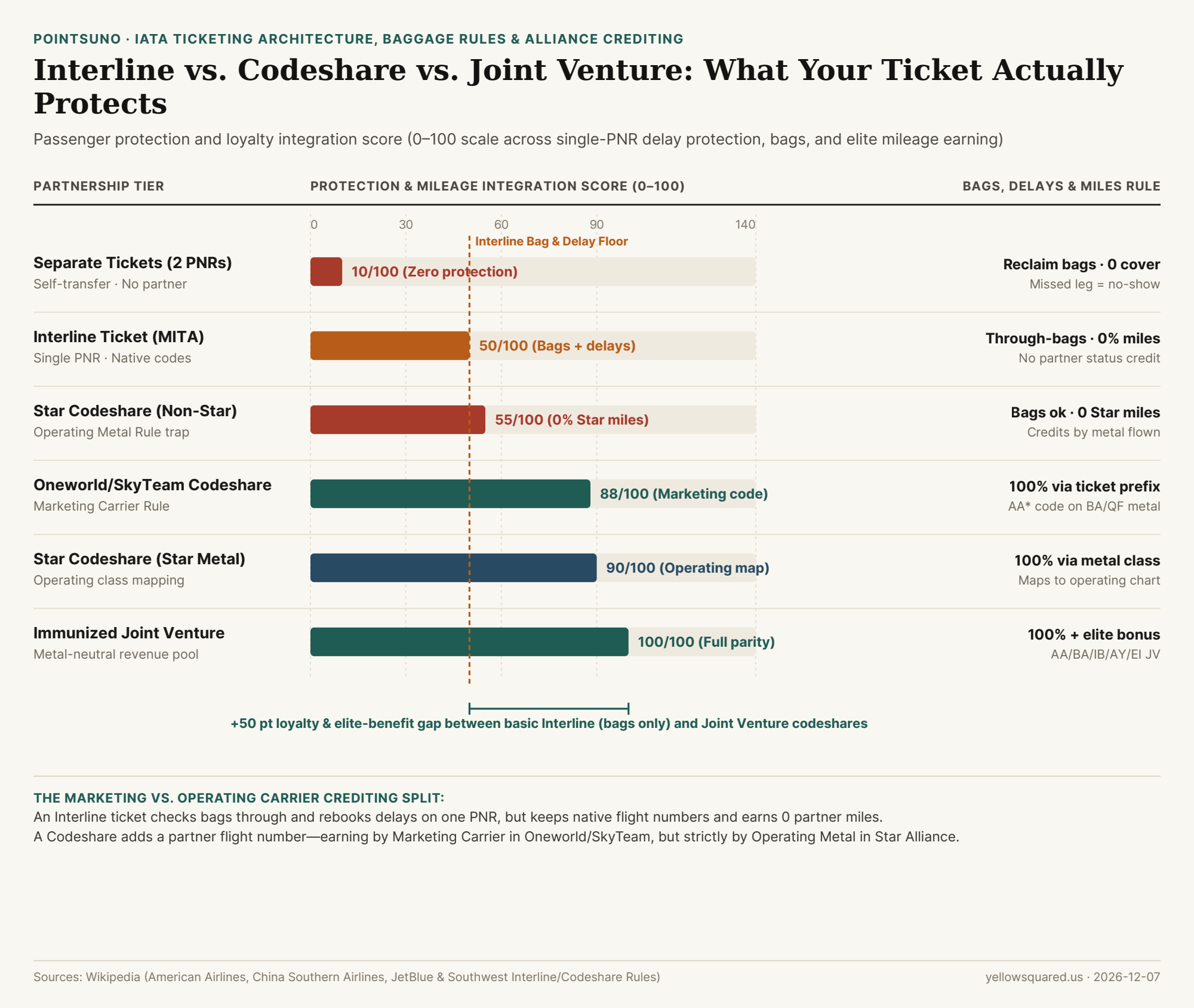
Horizontal comparison chart scoring passenger protection and loyalty mileage integration from 10/100 on separate tickets and 50/100 on IATA interline tickets up to 88-100/100 on alliance codeshares and immunized joint ventures.
Figure 1: Passenger protection and loyalty integration score (0–100 composite across single-PNR delay protection, through-checked baggage, and elite mileage earning) across six multi-carrier ticketing structures. Sources: American Airlines, China Southern Airlines, JetBlue, and Southwest Airlines History · Download CSV dataset.

Tier 1: Interline Agreements (Bags & Delays, Zero Partner Miles)

An interline agreement (governed globally by the IATA Multilateral Interline Traffic Agreement, or MITA) is the foundational commercial treaty between two airlines. For example, JetBlue maintains dozens of interline agreements (such as with South African Airways and Virgin Atlantic), and as recorded in the History of Southwest Airlines, Southwest's first international interline pact with Icelandair in 1997 explicitly linked ticketing, baggage handling, and gate transfers in Baltimore while excluding reciprocal frequent-flyer earning:

  • What Interline Gives You: Both flights are issued on a single ticket (single PNR), your checked bags are tagged and transferred end-to-end to your final destination (through-checked baggage), and if the first airline is delayed and causes you to miss your connection, the carriers are contractually obligated to rebook you at no extra fare during irregular operations (IRROPs).
  • What Interline Does NOT Give You: Each segment displays its own native operating carrier flight number (e.g., a B6 flight connecting to an SA flight), and you earn 0% partner miles or elite status credits on the interline partner leg unless the two airlines also have a separate frequent-flyer agreement.

Tier 2: Codeshare Agreements & The Alliance "Metal Trap"

In a codeshare agreement (such as American Airlines' codeshares with British Airways, Qantas, and China Southern Airlines), the airline that physically flies the airplane and crew (the Operating Carrier, or "metal") lets a partner airline (the Marketing Carrier) put its own two-letter IATA code and flight number on that seat (shown on your receipt as "Flight AA 6180 operated by British Airways").

"In Oneworld and SkyTeam, the flight number printed on your ticket (the Marketing Carrier) dictates how many miles you earn. In Star Alliance, the physical airplane you board (the Operating Carrier 'metal') dictates your miles—and booking a Star Alliance codeshare operated by a non-alliance carrier can earn zero miles."

This creates the single most important rule divide in frequent-flyer strategy:

  1. Oneworld & SkyTeam ("Marketing Carrier Rule"): Mileage and status earning follow the 2-letter prefix on your ticket. If you buy an American Airlines (AA) codeshare flight number operated by British Airways or Qantas, your AAdvantage miles and Loyalty Points are calculated using American's chart (provided both carriers are Oneworld members or eligible partners).
  2. Star Alliance ("Operating Carrier / Metal Rule"): Star Alliance credits miles strictly according to the Operating Carrier that physically flies the plane, translating your marketing fare class into an internal booking class on the operating carrier's chart. Worse yet, if you buy a Lufthansa (LH) codeshare flight number that is physically operated by a non-Star Alliance airline, third-party Star Alliance programs like United MileagePlus or Air Canada Aeroplan will award 0 miles and 0 status points!

Tier 3: Immunized Joint Ventures (Metal-Neutral Parity)

At the top of the pyramid sit antitrust-immunized joint ventures (JVs)—such as the Atlantic Joint Business between American Airlines, British Airways, Iberia, Finnair, and Aer Lingus. Inside a joint venture, the airlines pool revenue and share profits "metal-neutrally" on transoceanic routes, meaning they do not care whose airplane you board. As a result, JV partners align their fare classes, elite status bonuses, and proactive delay rebooking so that booking either the marketing or operating flight number yields near-identical earning and lounge privileges.

Complete Comparison: Separate Tickets vs. Interline vs. Codeshare vs. Joint Venture

Use the reference table below to audit any multi-airline itinerary before ticketing (download the raw CSV dataset):

Ticketing & Partnership Tier Flight Number on Ticket Through-Checked Bags & IRROPs Alliance Crediting Rule Miles & Status Earned Real-World Carrier Example
Separate Tickets (Self-Transfer) 2 separate native PNRs No (Reclaim bags; 0 delay protection) Separate native charts 0% connection protection Booking a standalone budget flight to meet an international long-haul
Standard Interline (IATA MITA) Operating carrier native code Yes (Single PNR + bag transfer) No reciprocal loyalty credit 0% partner miles Southwest + Icelandair (1997) or JetBlue + SAA single-ticket interline
Star Alliance Codeshare (Non-Star Metal) Marketing code (e.g., LH*) Yes (Single PNR + bag transfer) Operating Carrier (Metal) Rule 0% in 3rd-party Star programs Lufthansa (LH) codeshare operated by non-Star partner earns 0 UA/AC miles
Oneworld / SkyTeam Codeshare Marketing code (e.g., AA*, DL*) Yes (Single PNR + priority tags) Marketing Carrier Prefix Rule 100% per marketing chart American (AA) flight number operated by British Airways or Qantas
Star Alliance Codeshare (Star Metal) Marketing or operating Star code Yes (Single PNR + Star Gold bags) Operating Carrier Class Map 100% per operating chart United (UA) codeshare operated by ANA or Lufthansa (maps fare class)
Immunized Joint Venture (JV) Either JV partner code Yes (Seamless rebooking + lounges) Aligned metal-neutral table 100% + full elite bonus Atlantic Joint Business (AA, BA, IB, AY, EI)

How to Audit Your Ticket Before the 24-Hour Cancellation Window Closes

Whenever you book a partner flight, check the fine print right beneath the flight number for the words "Operated by..." inside your 24-hour free cancellation window. If you are crediting to a Star Alliance program, always verify that the physical operating carrier is a full Star Alliance member and check the operating fare class mapping; if you are flying on an interline segment with a non-alliance partner, keep your boarding pass to credit that single leg to the operating airline's own loyalty program. Compare airline alliance earning rules and transfer partners in Pointsuno to maximize every multi-carrier itinerary.

003 / 47

What Is Primary vs. Secondary Credit Card Rental Car Insurance, and How Does Collision Damage Waiver (CDW) Work?

Step up to an airport rental car counter after a long flight and the agent will inevitably slide a tablet across the desk asking whether you want the optional Collision Damage Waiver (CDW) or Loss Damage Waiver (LDW) for $25 to $35 per day. Over a seven-day trip, saying yes adds $175 to $245 to a rental that may have only cost $250 in the first place. Yet declining that waiver with the wrong credit card in your wallet can cost you over a thousand dollars in personal auto insurance surcharges if someone scrapes your bumper in a hotel parking lot.

As detailed in cardholder benefit guides analyzed by NerdWallet, CNBC Select, and The Points Guy, credit card rental car protections are split into two radically different tiers: Primary CDW and Secondary CDW. Before paying for your next rental reservation or booking with points, you can Compare airline transfer ratios and point valuations in Pointsuno alongside your travel card portfolio.

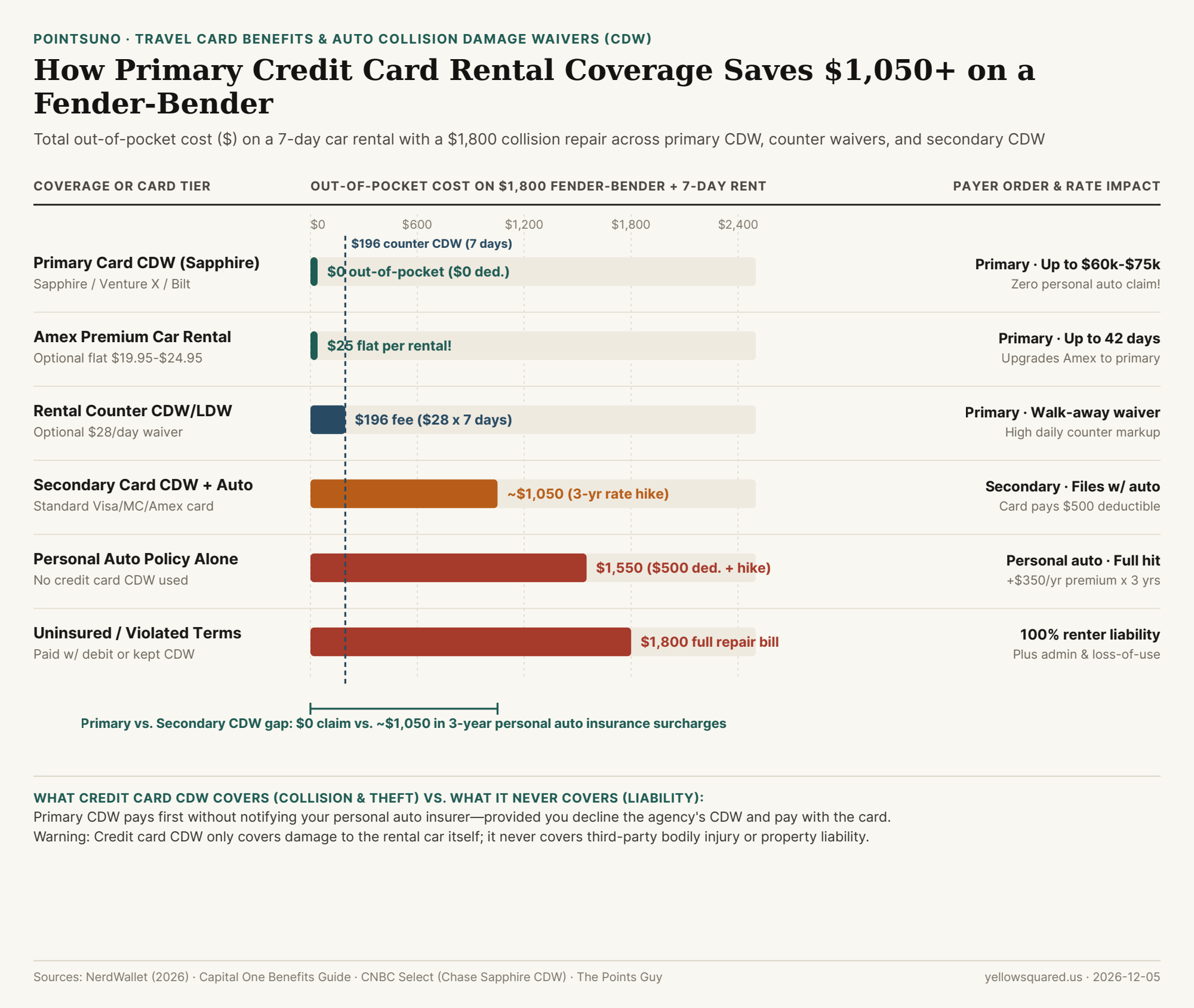
Horizontal bar chart comparing total out-of-pocket cost on a 7-day rental with an $1,800 collision claim across Primary Card CDW ($0), Amex Premium Protection ($25), Rental Counter CDW ($196), Secondary Card CDW (~$1,050 in rate hikes), Personal Auto Alone ($1,550), and Uninsured ($1,800).
Figure 1: Total out-of-pocket financial impact on a 7-day car rental involving an $1,800 collision repair across six coverage paths. Source: NerdWallet, Capital One, CNBC Select, and The Points Guy.

Primary CDW vs. Secondary CDW: Why Payment Order Matters

When a credit card provides an Auto Rental Collision Damage Waiver (CDW), the word Primary or Secondary dictates whether your personal auto insurance company is dragged into the claim:

  • Secondary Credit Card CDW (Most Standard Travel Cards): As explained by Capital One's rental insurance guide, secondary coverage only kicks in after your personal auto insurance policy pays out. If a rock cracks your windshield or you back into a bollard causing $1,800 in bodywork damage, you must file a comprehensive or collision claim with your own GEICO, State Farm, or Progressive policy. The credit card benefit administrator then reimburses your $500 or $1,000 deductible—but because your personal insurer paid a $1,300 claim, your personal auto premium typically jumps by 20% to 35% (~$300 to $400/year) for the next three years (~$1,050 hidden cost)! (Note: If you rent outside the United States where your U.S. personal auto policy does not apply, or if you do not own a car and have no personal auto policy, secondary card coverage automatically becomes primary.)
  • Primary Credit Card CDW (Select Travel & Visa Infinite Cards): With primary coverage, the credit card benefit administrator stands first in line. You file the claim directly with the card benefit administrator, pay $0 deductible up to the policy cap (typically $60,000 on Chase Sapphire Preferred and up to $75,000 on Chase Sapphire Reserve and Capital One Venture X), and never notify or file a claim with your personal auto insurance company.

"Secondary credit card CDW reimburses your $500 deductible after you file a claim with your personal auto insurer—leaving you with three years of higher auto premiums; Primary credit card CDW pays the rental agency from dollar one so your personal insurer never even hears about the dent."

Which Major Cards Offer Built-In Primary CDW (and the Amex $24.95 Workaround)

Only a select roster of personal consumer credit cards include built-in primary rental car CDW inside the United States (alongside most small-business cards when renting for business purposes):

  1. Chase Sapphire Preferred ($95/yr) & Chase Sapphire Reserve ($550/yr): As documented by CNBC Select, both Sapphire cards provide built-in primary CDW worldwide (up to $60,000 vehicle value on Preferred and $75,000 on Reserve) for rentals up to 31 consecutive days.
  2. Capital One Venture X Rewards ($395/yr): Includes Visa Infinite primary Auto Rental CDW covering physical damage and theft up to $75,000 for rentals up to 15 days domestically and 31 days internationally.
  3. Bilt Mastercard ($0/yr, outside New York residents) & United Club / Explorer Cards: Provide primary CDW on eligible rentals up to $50,000–$60,000.
  4. The American Express "Premium Car Rental Protection" Workaround ($19.95–$24.95 per rental): Standard Amex cards (including Amex Gold, Amex Green, and Amex Platinum) only include secondary CDW by default. However, any Amex cardholder can enroll online in Amex Premium Car Rental Protection: once enrolled, every time you charge a rental car to that Amex card, Amex automatically bills a single flat fee of $19.95 to $24.95 for the entire rental period (up to 42 consecutive days, not per day!), upgrading your coverage to Primary CDW up to $75,000 or $100,000 with zero deductible.
Coverage Path / Card Tier Payer Priority Cost on 7-Day Rental Out-of-Pocket on $1,800 Claim Impacts Personal Auto Rate?
Primary Card CDW (Sapphire / Venture X / Bilt) Primary (1st Payer) $0.00 (Included) $0.00 ($0 deductible) No (Zero auto insurer contact)
Amex Premium Protection (Enrolled) Primary (1st Payer) $19.95 – $24.95 flat $24.95 (Flat fee only) No (Covers up to 42 days)
Rental Agency Counter CDW/LDW Primary Waiver ~$196.00 ($28/day) $196.00 (Waiver fee only) No (Walk-away counter waiver)
Secondary Card CDW + Personal Auto Secondary (2nd Payer) $0.00 (Included) ~$1,050.00 (3-yr rate hike) Yes (Card only pays deductible)
Personal Auto Policy Alone Personal Insurer $0.00 upfront ~$1,550.00 ($500 ded. + hike) Yes (Full claim on CLUE report)
Uninsured / Violated Terms Renter Liable $0.00 upfront $1,800.00+ (Full bill + fees) 100% out-of-pocket liability

Three Traps That Void Credit Card CDW Instantly

To keep your credit card's primary CDW valid, follow three strict underwriting rules: (1) explicitly decline the rental company's CDW/LDW at the counter (accepting the agency's waiver voids your credit card coverage); (2) pay for the entire rental transaction with that exact credit card (and list all additional drivers on the rental agreement); and (3) remember that CDW is not liability insurance—credit card CDW covers damage or theft of the rental vehicle itself (plus valid loss-of-use and towing fees), but it never covers third-party bodily injury or damage you cause to another driver's car, which remains covered by your personal auto liability policy or a non-owner liability policy. To optimize which card in your wallet earns the highest points multiplier on travel and car rentals, Compare airline transfer ratios and point valuations in Pointsuno.

004 / 47

How Do Airline Alliances (Star Alliance, Oneworld, and SkyTeam) Work for Booking Partner Award Flights?

Search for a summer business-class award ticket from New York or Chicago to Paris directly on Delta.com or United.com, and you will routinely see dynamic pricing quotes of 155,000 to 295,000 miles one way. Yet on that exact same departure, another passenger sitting in the very next lie-flat pod booked the exact same flight for 50,000 to 60,000 points—without holding airline elite status or waiting for a flash sale.

The mechanism that makes this 60% discount possible is the global airline alliance system. Over 61% of all scheduled global air traffic is operated by three coalitions—Star Alliance, Oneworld, and SkyTeam. Under reciprocal loyalty agreements, whenever a member airline releases Saver-level award inventory, every other airline in that alliance can book that seat using its own award chart. Before moving transferable bank points for your next international trip, you can Compare airline transfer ratios and point valuations in Pointsuno to see which bank currencies transfer 1:1 to each alliance's sweet-spot programs.

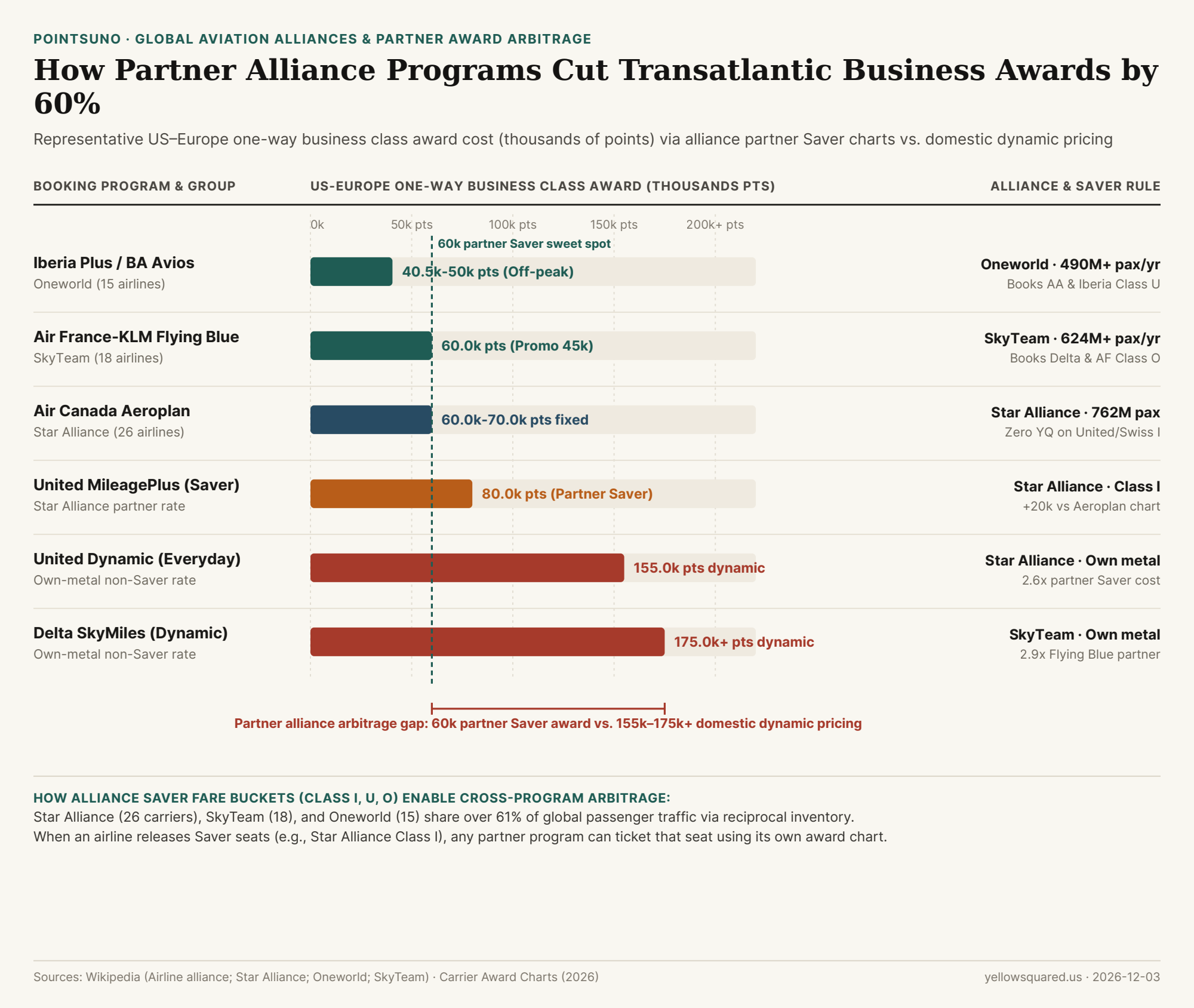
Horizontal bar chart comparing one-way US to Europe business class award costs in thousands of points across Oneworld, SkyTeam, and Star Alliance partner programs versus domestic dynamic pricing.
Figure 1: Representative US–Europe one-way business class award pricing (thousands of points) across alliance partner Saver programs vs. own-metal dynamic pricing, alongside global passenger scale. Source: Wikipedia (Airline alliance), Star Alliance, Oneworld, and SkyTeam.

The Big Three Alliances by the Numbers: Star Alliance vs. SkyTeam vs. Oneworld

To prevent cross-border antitrust conflicts while offering global connectivity, airlines formed three major multilateral networks between 1997 and 2000:

  • Star Alliance (Founded May 14, 1997): The oldest and largest alliance, comprising 26 member airlines operating over 5,000 aircraft to more than 1,300 airports across 195 countries (~762 million annual passengers, 23.0% global RPK share). Core members include United Airlines, Air Canada, Lufthansa, SWISS, ANA, Singapore Airlines, Turkish Airlines, and EVA Air.
  • SkyTeam (Founded June 22, 2000): The second-largest alliance by passenger volume (~624 to 667 million annual passengers, 20.4% global RPK share), uniting 18 active member airlines across 960+ destinations in 165+ countries. Core members include Delta Air Lines, Air France, KLM, Korean Air, Virgin Atlantic, and Aeromexico.
  • Oneworld (Founded February 1, 1999): Unites 15 member airlines operating roughly 3,300 aircraft across ~1,000 airports in 170 countries (~490 to 535 million annual passengers, 17.8% global RPK share). Core members include American Airlines, Alaska Airlines (with Hawaiian Airlines), British Airways, Cathay Pacific, Japan Airlines, Qatar Airways, Iberia, Finnair, and Qantas.

"You never have to book a United flight with United miles or an American flight with American miles: if Saver award inventory (Class I or Class U) is open, any partner program in the same alliance can ticket that exact seat at its own price."

How Saver Fare Buckets (Class I, U, O, X) Unlock Partner Arbitrage

Why does the same physical seat cost 60,000 points on one website and 155,000 points on another? Every airline divides its cabin into single-letter reservation booking designators (fare buckets). When an airline sells its own flights to its own loyalty members, it uses dynamic pricing (JN or Z buckets on United; Z or D on Delta) tied to the cash ticket price. However, alliance contracts require carriers to designate specific Saver award buckets that are shared across the entire alliance at fixed wholesale clearing rates:

  1. Star Alliance Standard Saver Buckets: Class X (Economy), Class I (Business), and Class O (First Class). When United or Lufthansa opens a Class I business seat across the Atlantic, United MileagePlus charges 80,000 miles (or 155,000+ miles dynamically when I is closed), whereas Air Canada Aeroplan prices that same Class I seat on its distance chart at 60,000 to 70,000 points with zero carrier fuel surcharges.
  2. Oneworld Standard Saver Buckets: Class X (Economy), Class U (Business), and Class Z (First Class). Because the Avios currency is freely convertible 1:1 between British Airways, Iberia, Qatar Airways, and Finnair, travelers can book off-peak Madrid flights on Iberia for 40,500 Avios in business class or domestic American Airlines flights without touching AAdvantage miles.
  3. SkyTeam Partner Pricing Floors: While Delta SkyMiles often prices transatlantic Delta One flights at 175,000 to 300,000+ miles, Air France–KLM Flying Blue prices business-class Saver seats (Class O) between North America and Europe at a standardized 60,000 miles (and 45,000 miles during monthly Promo Rewards).
Booking Loyalty Program Alliance & Member Count Shared Saver Bucket US–Europe 1-Way Business Key Transfer & Fee Advantage
Iberia Plus / BA Avios Oneworld (15 airlines) Class U (Biz) / X (Econ) 40,500 – 50,000 pts 1:1 transfers from Chase, Amex, Bilt, Capital One, Wells Fargo
Air France–KLM Flying Blue SkyTeam (18 airlines) Class O (Biz) / X (Econ) 60,000 pts (45k Promo) Transfers from all 5 major banks; free stopovers on awards
Air Canada Aeroplan Star Alliance (26 airlines) Class I (Biz) / X (Econ) 60,000 – 70,000 pts Zero fuel surcharges (YQ) on United, SWISS, Lufthansa, ANA
United MileagePlus (Saver) Star Alliance (26 airlines) Class I (Partner Saver) 80,000 – 88,000 pts No close-in fees and free online changes, but +20k higher chart
United MileagePlus (Dynamic) Star Alliance (Own metal) Class JN / Z (Non-Saver) 155,000+ pts Available on almost every flight, but 2.6x partner Saver rate
Delta SkyMiles (Dynamic) SkyTeam (Own metal) Class Z / D (Non-Saver) 175,000 – 295,000+ pts High dynamic floor; always check Flying Blue or Virgin Atlantic first

The Golden Rule Before You Transfer Credit Card Points

Credit card point transfers to airline loyalty programs are one-way and irreversible. Never transfer Chase Ultimate Rewards, Amex Membership Rewards, Capital One Miles, Bilt Points, or Wells Fargo Rewards into an airline account until you have verified on the booking partner's own website that the partner Saver bucket (Class I, U, or O) is live and bookable—because an airline's high-priced dynamic "Everyday" award seats (155k+) are invisible to alliance partners. To map out every bank-to-airline transfer path and compare cents-per-point redemption values offline, Compare airline transfer ratios and point valuations in Pointsuno.

005 / 47

What Is the Chase 5/24 Rule, and Which Credit Cards Count Toward Your 5-Card Limit?

If you collect transferable travel points, the single most important application constraint in the U.S. banking system is the Chase 5/24 rule: Chase's automated underwriting algorithm will automatically deny your application for virtually any Chase consumer or small-business credit card if your personal credit report shows 5 or more revolving credit card accounts opened across any issuing bank within the previous 24 months (Chase 5/24 Rule: What to Know - NerdWallet; Chase's 5/24 rule: Everything you need to know - The Points Guy).

Because the 5/24 counter is driven strictly by what appears on your personal credit bureau report (Experian, Equifax, and TransUnion) rather than an internal multi-bank database, understanding which accounts report to personal bureaus versus commercial bureaus lets you sequence applications without locking yourself out of Chase Ultimate Rewards—and maximize your portfolio when you Compare credit card point valuations and transfer partners in Pointsuno.

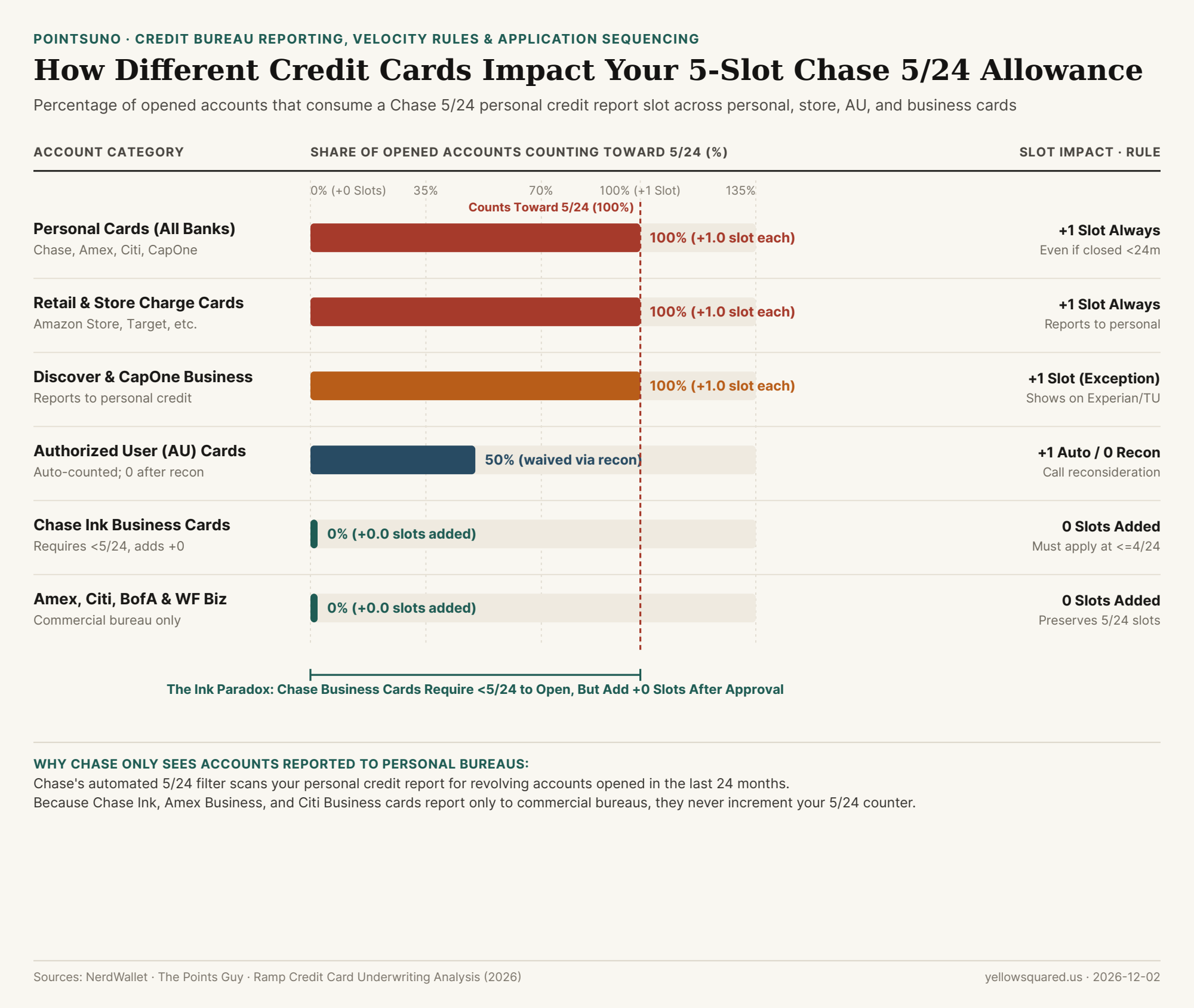
Chart showing the percentage of opened credit card accounts that count toward a borrower's Chase 5/24 limit across personal cards, retail store cards, Discover/Capital One business cards, Authorized User cards, and Chase Ink/Amex/Citi business cards
Figure 1: Share of opened accounts that increment your Chase 5/24 personal credit report counter across six credit card categories. Data: chase-5-24-rule-credit-card-account-types-and-personal-bureau-reporting.csv (NerdWallet; The Points Guy; Ramp).

How Chase's Automated 5/24 Algorithm Evaluates Your Credit Report

When you submit an application for a Chase Sapphire Preferred, Freedom Unlimited, World of Hyatt, or Ink Business card, Chase pulls your personal credit report and counts every revolving credit card tradeline with an Account Opened Date within the last 24 months (Chase 5/24 Rule Explained - Ramp):

  • Every Issuer Counts Toward the 5-Slot Cap: The limit is not 5 Chase cards in 24 months; opening 3 American Express personal cards and 2 Citi personal cards puts you at 5/24 and blocks new Chase approvals (Ramp).
  • Closing an Account Does Not Erase Its Slot: Because the filter checks the Date Opened field on your report, closing a card opened 10 months ago leaves it in your 5/24 count for the remaining 14 months (Ramp).
  • The 1st-of-the-25th-Month Aging Rule: Credit bureaus report account opening dates by month and year, so Chase's system resets a slot on the first day of the 25th calendar month after opening (for example, a card opened on November 18, 2024 ages off your 5/24 count on December 1, 2026) (The Points Guy).
  • Non-Revolving Loans Never Count: Mortgages, auto loans, student loans, and personal installment loans do not count toward 5/24.

"The Chase Ink paradox: you must be under 5/24 (at 4/24 or below) to be approved for a Chase Ink Business card, but once approved, that Ink card adds +0 to your 5/24 count."

Which Cards Count (+1 Slot) vs. Which Business Cards Add +0 Slots

The golden rule of 5/24 is simple: if a revolving card reports to your personal credit report, it adds +1 to your 5/24 count; if it reports only to commercial bureaus (Dun & Bradstreet, Experian Business, Equifax Business), it adds +0 (NerdWallet):

  1. Chase, Amex, Citi, BofA & Wells Fargo Business Cards (+0 Slots): Business cards issued by Chase (Ink Business Preferred, Ink Business Cash, Ink Business Unlimited), American Express (Business Platinum, Business Gold, Blue Business Plus), Citi (AAdvantage Business), Bank of America, and Wells Fargo do not appear on your personal credit report as long as the account remains in good standing. Thus, someone sitting at 4/24 can open a Chase Ink card and an Amex Business Gold card and remain at 4/24 (NerdWallet; The Points Guy).
  2. Discover & Select Capital One Business Cards (+1 Slot Exception): Unlike other issuers, Discover business cards and several Capital One small-business cards (Spark consumer-reporting tiers) report directly to personal credit bureaus and therefore consume a 5/24 slot (Ramp).
  3. Retail Store Charge Cards (+1 Slot): Store-only cards (such as Target or Amazon store cards) and deferred-interest financing lines opened as revolving credit accounts appear on personal credit reports and count as +1 slot.
  4. Authorized User (AU) Cards (+1 Automated, 0 After Reconsideration): If a spouse or parent adds you as an Authorized User on a card opened within the past 24 months, the tradeline appears on your personal report and triggers an automated 5/24 denial. However, you can call Chase's reconsideration line and ask the analyst to exclude the AU account because you are not financially responsible for the debt—or ask the primary cardholder to remove you and dispute the AU tradeline off your bureau report (Ramp).
Credit Card Category Personal Bureau Report? 5/24 Slot Impact Requires <5/24 to Open? Examples & Strategy Note
1. All Personal Credit Cards Yes (100%) +1.0 slot Yes (for Chase) Sapphire, Freedom, Amex Gold, Venture X
2. Retail Store Charge Cards Yes (100%) +1.0 slot No (non-Chase) Amazon Store Card, Target, department stores
3. Discover & CapOne Business Yes (Select tiers) +1.0 slot No (non-Chase) Exceptions that report to personal bureaus
4. Authorized User (AU) Cards Yes (Removable) +1 auto / 0 recon Waivable via phone Call Chase reconsideration to exclude AU
5. Chase Ink Business Cards No (Commercial only) 0.0 slots (+0) Yes (<=4/24 required) Ink Preferred, Ink Cash, Ink Unlimited
6. Amex, Citi, BofA & WF Biz No (Commercial only) 0.0 slots (+0) No (Exempt) Amex Biz Gold/Plat/BBP, Citi AAdvantage Biz

Optimal Application Sequencing Before and After Hitting 5/24

If you are currently below 5/24 (at 0/24 through 4/24), prioritize Chase Ink Business cards and core Chase personal cards (such as Sapphire Preferred/Reserve or co-branded Hyatt/United/Southwest cards) before filling your remaining personal slots with American Express, Citi, or Capital One personal cards (NerdWallet). To calculate exact cents-per-point transfer values and compare airline and hotel partners across Chase Ultimate Rewards, Amex Membership Rewards, Citi ThankYou, and Bilt, Compare credit card point valuations and transfer partners in Pointsuno.

006 / 47

How Does Hotel '5th Night Free' vs. '4th Night Free' Work on Points—And Which Programs Save You 20% to 25%?

Redeeming hotel points for a one- or two-night weekend stay gives you baseline cents-per-point (CPP) value, but crossing the 4-night or 5-night threshold at three of the four major hotel chains unlocks an automatic 16% to 25% bonus on your points. Both Hilton Honors and Marriott Bonvoy offer a 5th Night Free on standard-room point redemptions, while IHG One Rewards goes a step further by giving co-branded credit cardholders every 4th Night Free—cutting a 4-night stay's point cost by a full 25.0%. Yet subtle calculation differences between those three programs—and strict rules against mixing Free Night Certificates (FNCs) with points—routinely cost travelers tens of thousands of points at checkout.

Reader outcome: You will see the exact eligibility rules, math formulas, and repeat caps across IHG, Hilton, Marriott, and Hyatt, understand why Marriott deducts the lowest-priced night while IHG and Hilton deduct the chronological 4th or 5th night, and avoid the certificate-mixing trap.

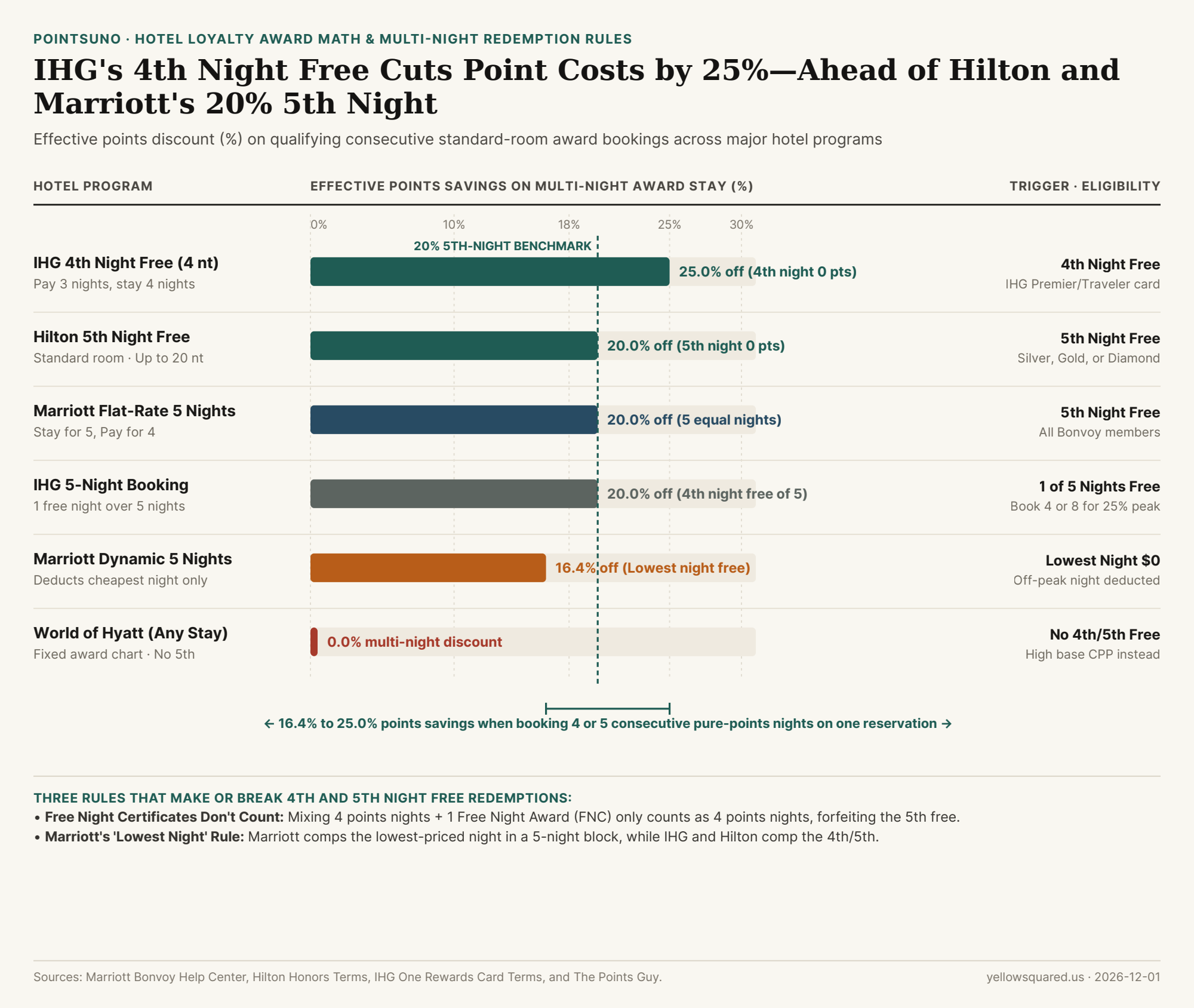
Chart comparing effective points discount percentages across IHG 4th Night Free (25%), Hilton 5th Night Free (20%), Marriott Stay for 5 Pay for 4 (16.4% to 20%), and World of Hyatt (0%)
On a 4-night award booking, IHG One Rewards cardholders save 25.0% via the 4th Night Free benefit. On a 5-night booking, Hilton Elite members save a flat 20.0%, while Marriott Bonvoy members save up to 20.0% (comping the lowest-rate night in the 5-night window). Data: Download CSV dataset.

Program-by-Program Rules: IHG (4th Night) vs. Hilton & Marriott (5th Night)

While travelers lump all multi-night hotel perks together, the underlying qualification and pricing formulas differ across every chain:

  • IHG One Rewards — Every 4th Night Free (25.0% Max Savings): Exclusive to holders of the IHG One Rewards Premier, Premier Business, or Traveler credit cards. When you book 4 or more consecutive reward nights at the same property on a single reservation, the chronological 4th night is billed at 0 points. Better still, the perk repeats uncapped on longer stays: book an 8-night pure-points stay, and both Night 4 and Night 8 cost 0 points (maintaining the full 25.0% discount).
  • Hilton Honors — Every 5th Night Free (20.0% Savings): Open to all members with Silver, Gold, or Diamond elite status (which comes automatically with every Hilton Honors credit card or via 10 nights / 4 stays). When you book 5 or more consecutive Standard Room Reward nights using 100% Hilton Honors points (up to 20 nights, yielding up to 4 free nights on one stay), Hilton calculates the average nightly point cost across the 5 nights and deducts 20% so the 5th night costs zero points (and zero resort fees on all award nights).
  • Marriott Bonvoy — "Stay for 5, Pay for 4" (~16% to 20% Savings): Open to all Marriott Bonvoy members regardless of status or credit card ownership. For every 5 consecutive standard-room nights redeemed with points on a single reservation, Marriott deducts the single lowest point-value night (and on a 10-night stay, deducts the two lowest point-value nights). If all 5 nights cost 50,000 points, you save 20.0% (50,000 / 250,000); if four peak nights cost 60,000 and one midweek night costs 47,000, Marriott comps the 47,000-point night (a 16.4% discount).
  • World of Hyatt — No 4th or 5th Night Free (0% Multi-Night Discount): Hyatt does not offer a 4th or 5th night free on points bookings, relying instead on its published off-peak/standard/peak award chart that delivers high baseline value (`1.8 to 2.2+ cents per point`) from Night 1.

On dynamically priced stays where one weekday night dips lower than the weekend, Hilton averages the 5 nights (always saving 20%), IHG comps the chronological 4th night, and Marriott comps the cheapest night.

Comparison Table: Eligibility, Calculation Method, and Certificate Rules

Before transferring flexible bank points (Chase Ultimate Rewards, Amex Membership Rewards, Bilt, Capital One, or Wells Fargo) or booking a 5-night resort stay, check these six structural parameters:

Hotel Loyalty Program Free Night Trigger Max Points Discount Eligibility Requirement How Free Night Is Calculated Repeat Cap & Certificate Mixing Rule
IHG One Rewards Every 4th Night 25.0% (4 or 8 nt) IHG Premier or Traveler Card Chronological 4th/8th night is 0 pts Uncapped repeats; Cash/FNC breaks 4-nt chain
Hilton Honors Every 5th Night 20.0% (5 to 20 nt) Silver, Gold, or Diamond Elite 20% average discount on Standard Room Max 4 free nights (20 nt); 100% points only
Marriott Bonvoy Every 5th Night Up to 20.0% All Bonvoy Members (Free) Lowest point-value night is 0 pts Repeats on 10+ nt; FNCs don't count toward 5
World of Hyatt None 0.0% N/A Each night priced by category chart High baseline CPP; Pay My Way mixes FNCs

Why Mixing a Free Night Certificate With 4 Points Nights Costs You the Free Night

The single most common mistake in hotel award booking happens when a traveler holds an annual credit card Free Night Certificate (FNC)—such as a Marriott 35k/50k/85k certificate, a Hilton Free Night Reward, or an IHG 40k certificate—and tries to combine 1 FNC + 4 Points Nights (or 1 FNC + 3 Points Nights at IHG) expecting the 5th (or 4th) night to be free. As Marriott, Hilton, and IHG rules explicitly state, Free Night Certificates and Cash + Points nights do not count toward the 4- or 5-consecutive-points-night counter. To trigger the free night AND use a certificate on the same trip, you must redeem points for a full 5 consecutive nights (or 4 at IHG) and attach the certificate as a 6th night (or 5th night at IHG). To calculate net cents-per-point redemptions across 4-night and 5-night stays before transferring points, Compare airline and hotel point valuations in Pointsuno.

007 / 47

What Is an Airline Stopover vs. a Layover—And How Do You Book a Free Multi-Day Stopover on an Award Ticket?

Search a flight from New York to Rome connecting through Paris, and arriving at Charles de Gaulle at 8:00 AM Monday with an onward flight at 7:30 AM Tuesday (23 hours and 30 minutes on the ground) usually prices as a single continuous through-fare—giving you a full afternoon, dinner, and hotel night in Paris for zero extra airfare or miles. Push that second flight to 9:00 AM Tuesday (25 hours on the ground), and most airline booking engines immediately split the itinerary into two separate tickets, often doubling the price. That cliff is hard-coded into global airline pricing engines by the Airline Tariff Publishing Company (ATPCO) Category 8 rules, which draw a strict mathematical boundary between a layover (connection/transfer) and a stopover.

Reader outcome: You will learn the exact 4-hour domestic and 24-hour international ATPCO cutoff rules, how to use the <24-hour international transfer window on any airline, and how to book true 14-day to 365-day stopovers for 0 to 5,000 points using Alaska Atmos Rewards, Air France–KLM Flying Blue, Singapore KrisFlyer, and Air Canada Aeroplan.

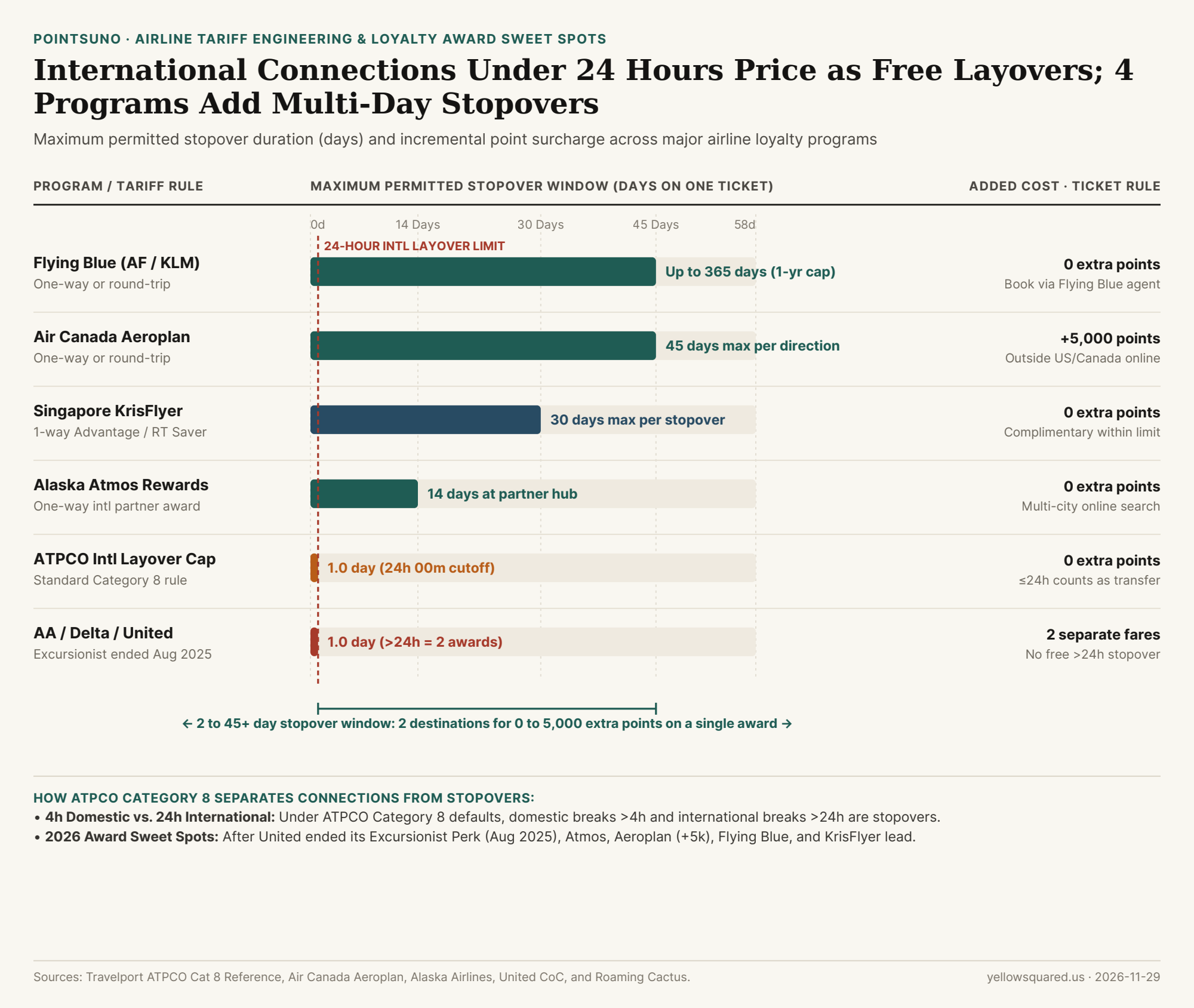
Chart comparing the 24-hour ATPCO international layover cutoff against multi-day award ticket stopover allowances across Flying Blue, Aeroplan, KrisFlyer, and Alaska Atmos
Under default ATPCO Category 8 rules, any international ground break over 24 hours becomes a stopover. After United retired its Excursionist Perk in August 2025, four major loyalty programs still unlock multi-day stopovers on single award tickets. Data: Download CSV dataset.

The 4-Hour Domestic vs. 24-Hour International Rule (ATPCO Category 8)

In everyday conversation, travelers use "layover" and "stopover" interchangeably, but inside global distribution systems (Amadeus, Sabre, and Travelport) and airline contracts of carriage (such as United Airlines' Contract of Carriage), the two words have opposite pricing rules:

  • Domestic North American Journeys (4-Hour Cutoff): On wholly domestic itineraries within the United States and Canada, an intermediate stop of 4 hours or less is classified as a connection (layover). An interruption of more than 4 hours (unless the passenger is taking the next available scheduled flight on that route) is classified as a stopover.
  • International Journeys (24-Hour Cutoff): Whenever an itinerary includes an international segment, ATPCO Category 8 sets the default threshold at 24 hours. Any transfer of 24 hours or less (for example, arriving at 10:15 AM and departing at 9:45 AM the next morning = 23 hours 30 minutes) is legally a connection, not a stopover—meaning even programs that ban stopovers (like American AAdvantage, Delta SkyMiles, and United MileagePlus) will price a 23-hour overnight visit on a single through-award when saver space exists on both segments.

On an international award ticket, a 23-hour, 50-minute break in a hub city is legally a connection—giving you a full day and night in a second city even on airlines that prohibit stopovers.

Which Airline Loyalty Programs Allow Free (or 5,000-Point) Multi-Day Stopovers?

What if you want to spend 4, 7, or 14 days in your intermediate city before continuing to your final destination? On August 21, 2025, United MileagePlus permanently retired its Excursionist Perk, joining American Airlines AAdvantage and Delta SkyMiles in pricing multi-day breaks as two separate one-way awards. However, four major transferable-points loyalty programs still allow true multi-day stopovers on a single ticket:

Rule or Loyalty Program Stopover Trigger Threshold One-Way Stopover Allowed Additional Points Cost Max Stopover Duration Geographic & Booking Rules
ATPCO Domestic Tariff (Cat 8) > 4 hours on domestic fare Fare-dependent Breaks through-fare if disallowed 4 hours max layover North America domestic default
ATPCO International Tariff (Cat 8) > 24 hours on intl fare Fare-dependent 23h 59m still prices as layover 24 hours max layover Global international default
Air France–KLM Flying Blue > 24 hours connection Yes (1 per one-way) 0 points (Complimentary) Up to 365 days Air France, KLM, and partner awards via phone
Air Canada Aeroplan > 24 hours connection Yes (1 per direction) +5,000 points per stopover Up to 45 days Outside US & Canada; online Multi-City tool
Singapore Airlines KrisFlyer > 24 hours connection Advantage 1-way / Saver RT 0 points (Complimentary) Up to 30 days 1 free on one-way Advantage or RT Saver
Alaska Airlines Atmos Rewards > 24 hours connection Yes (1 per one-way) 0 points (Complimentary) Up to 14 days International partner hubs on Multi-City search

How to Book a Stopover Without Breaking the Fare Calculation

Even when a loyalty program explicitly allows stopovers, standard round-trip or one-way search bars only display connections under 24 hours. To force the pricing engine to evaluate Category 8 stopover permissions, follow three rules:

  1. Search Segment-by-Segment for Saver Availability First: Before using a multi-city search or calling an agent, verify that partner "Saver" award space is available on Leg 1 (e.g., Seattle to Tokyo on Japan Airlines on Day 1) and Leg 2 (e.g., Tokyo to Bangkok on Japan Airlines on Day 8) individually.
  2. Use the Dedicated Stopover / Multi-City Booking Flow: On Air Canada Aeroplan, select the Multi-city / Stopover radio button on aircanada.com; as long as the stopover city is outside Canada and the United States, lasts 45 days or less, and does not backtrack or exceed twice the nonstop distance between origin and destination, the checkout screen automatically prices both flights as a single zone/distance award plus 5,000 points. On Alaska Atmos Rewards, use the Multi-City search tool to pair two segments on the same international partner (or combine with Alaska domestic positioning flights).
  3. Watch Departure Taxes at Stopover Airports: While a connection under 24 hours through London Heathrow (LHR) is exempt from the United Kingdom's steep Air Passenger Duty (APD), turning London into a >24-hour stopover triggers full UK long-haul departure taxes (`$115–$250+` in premium cabins). To compare transfer partners and cents-per-point redemptions across Aeroplan, Flying Blue, KrisFlyer, and Atmos Rewards, Compare airline and hotel point valuations in Pointsuno.

008 / 47

What Is the '24-Hour Flight Cancellation Rule' in the US—And When Can Airlines Legally Refuse a Refund?

Almost every frequent flyer knows that the United States has a federal "24-hour flight cancellation rule" allowing you to cancel even the most restrictive, non-refundable Basic Economy airline ticket within 24 hours of purchase for a 100% full refund. Yet every week, travelers book a last-minute flight four days before departure—or book through a third-party travel site, or tweak a flight time inside the first 24 hours before deciding to cancel—and are shocked when the airline refuses to refund their credit card and issues a restricted voucher instead. Why did the airline legally deny the refund? As codified by the U.S. Department of Transportation (DOT) in Guidance on the 24-Hour Reservation Requirement (14 CFR § 259.5(b)(4)) and analyzed across individual airline contracts of carriage by UponArriving, Air Travel Rights, and Travel Code, the federal regulation contains specific statutory boundaries—including the 7-day (168-hour) advance-purchase rule—that every cash and points traveler needs to know.

1. What Federal Law Actually Says: 14 CFR § 259.5(b)(4)

Enacted under the U.S. Department of Transportation's Enhancing Airline Passenger Protections consumer rule (76 Fed. Reg. 23110), 14 CFR § 259.5(b)(4) requires every U.S. air carrier and every foreign air carrier that markets and sells tickets directly to consumers for scheduled passenger flights to, from, or within the United States to do one of two things for reservations made at least seven days before the flight's scheduled departure time:

  • Option A — 24-Hour Penalty-Free Cancellation: Allow the consumer to cancel the reservation within 24 hours after the booking is made and receive a 100% full refund in the original form of payment without penalty (even on non-refundable promotional or Basic Economy fares).
  • Option B — 24-Hour Unpaid Fare Hold: Allow the consumer to hold the reservation at the quoted fare for 24 hours without payment. As DOT's Enforcement Office clarified, an airline only has to offer one of these two options—not both. (For several years, American Airlines offered a 24-hour unpaid hold instead of 24-hour paid cancellations, before switching to offering 24-hour refunds for tickets booked at least 2 days ahead).
  • Ban on Voucher Dark Patterns: Per DOT's Enforcement Notice, it is an unfair and deceptive practice under 14 CFR § 259.5(b)(4) for an airline to default to an expiring travel credit or hide the option to receive a full refund back to your original credit card, debit card, or cash payment method.

"In deciding whether to pursue enforcement action, the Enforcement Office considers it to be a violation of 14 CFR 259.5(b)(4) and an unfair and deceptive practice for a carrier not to offer consumers the option of receiving a full refund in the original form of payment before the cancellation request is submitted."

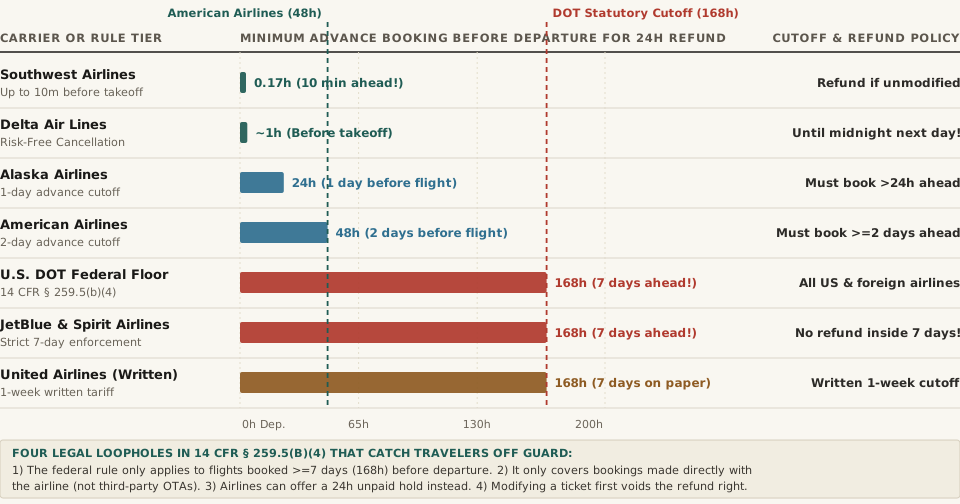
Chart comparing the minimum advance booking window before departure (in hours) required to qualify for a 24-hour full refund across Southwest (0.17h / 10 min), Delta (1h), Alaska Airlines (24h), American Airlines (48h), and the US DOT Federal Statutory Floor / JetBlue / Spirit / United (168h / 7 days)
Figure 1: Minimum advance purchase window (hours before scheduled departure) required to invoke the 24-hour full refund rule across federal DOT law and major U.S. airlines (U.S. DOT 14 CFR § 259.5; UponArriving).

2. How Major U.S. Airlines Differ on the 7-Day (168-Hour) Cutoff

While the federal regulation sets a floor at 7 days (168 hours) before departure, individual airlines are free to offer more generous terms in their published Contracts of Carriage. As documented in UponArriving's carrier-by-carrier audit, U.S. airlines split into two camps when you book a last-minute flight inside the 7-day window:

  1. Carriers More Generous Than the 7-Day DOT Floor:
    • Southwest Airlines (Up to 10 Minutes Before Departure): Allows a 24-hour method-of-payment refund on tickets booked up to 10 minutes prior to scheduled takeoff—provided you do not modify the reservation before canceling.
    • Delta Air Lines ("Risk-Free Cancellation" Through Midnight the Next Day): Delta often gives you more than 24 hours: tickets can typically be canceled for a full refund until 11:59 PM on the calendar day after purchase (or before departure for same-day flights).
    • Alaska Airlines (24 Hours / 1 Day Before Departure): Honors the 24-hour full refund policy on any ticket purchased more than 24 hours before scheduled departure (UponArriving).
    • American Airlines (48 Hours / 2 Days Before Departure): Honors the 24-hour full refund policy provided you purchase the ticket at least 2 days (48 hours) before departure.
  2. Carriers That Enforce the 7-Day (168-Hour) Cutoff:
    • JetBlue & Spirit Airlines: Strictly enforce the federal 7-day threshold. If you book a Spirit or JetBlue flight 5 days before departure and try to cancel 20 minutes later, you are not entitled to a 24-hour cash refund under either DOT rules or their contract of carriage (UponArriving).
    • United Airlines: States in its written policy that the 24-hour flexible booking rule applies to tickets purchased one week (7 days) or more before scheduled departure.

3. Four Hidden Traps That Void Your 24-Hour Refund Right

Even when you book more than 7 days in advance, four technical pitfalls can strip away your 14 CFR § 259.5 protection (U.S. DOT Guidance; Air Travel Rights; UponArriving):

  • Trap 1 — Modifying a Reservation Instead of Canceling It Outright: As both JetBlue and Southwest explicitly state in their terms, if you book a flight, make a flight-time or date change 3 hours later, and then try to cancel at hour 10 for a cash refund, modifying the PNR voids your 24-hour refund eligibility! Within the first 24 hours, never use the "Change Flight" button—always cancel the original reservation for a full refund and book a fresh ticket.
  • Trap 2 — Booking Through Online Travel Agencies (OTAs) or Vacation Bundles: The DOT's 14 CFR § 259.5 rule applies directly to air carriers, not to third-party ticket agents (OTAs), consolidators, or hotel+air vacation packages (such as JetBlue Vacations). While major portals like Expedia or Chase Travel voluntarily offer 24-hour cancellation on many flights, lesser-known OTAs frequently charge $50–$150 "agency processing fees" within 24 hours.
  • Trap 3 — Foreign Flights That Do Not Touch U.S. Soil: If you book a British Airways flight from London (LHR) to New York (JFK) directly on ba.com, British Airways must obey 14 CFR § 259.5 because the flight touches the United States. However, if you book an intra-European flight from London to Rome on ba.com or Ryanair, U.S. DOT jurisdiction does not apply.
  • Trap 4 — How Points & Miles Flyers Use the 24-Hour Window: On U.S. legacy carriers (American, Delta, United, Alaska, JetBlue, Southwest), canceling an award ticket within 24 hours (and in most cases anytime before departure on domestic/originating awards) returns 100% of your miles and taxes—and when a foreign program offers a 24-hour hold option, you can lock in rare saver Business Class space while waiting for a bank point transfer to clear.

4. Complete Data Table: U.S. DOT 14 CFR § 259.5 & Airline 24-Hour Policies

The reproducible table below—matching the companion CSV (us-dot-24-hour-flight-cancellation-rule-14-cfr-259-5-airline-advance-purchase-cutoffs.csv)—summarizes advance-purchase cutoffs and refund rules across federal law and major carriers:

Airline or Policy Tier Authority / Tariff Advance Cutoff (Hours) Advance Cutoff (Days) Award Ticket Coverage Critical Consumer Rule (U.S. DOT / UponArriving)
Southwest Airlines Carrier Policy 0.17 hr Up to 10 min before flight Yes (100% points + taxes) Never modify first—changing the PNR voids 24h cash refund
Delta Air Lines Risk-Free Cancellation ~1.0 hr Before takeoff (midnight next day) Yes (SkyMiles + taxes) Extends until 11:59 PM the day after booking
Alaska Airlines Contract of Carriage 24.0 hr At least 1 day ahead Yes (Miles + partner fees) Bookings inside 24h of takeoff follow standard fare rules
American Airlines Conditions of Carriage 48.0 hr At least 2 days ahead Yes (AAdvantage miles) Switched from 24h unpaid hold to 24h refund (≥2 days out)
U.S. DOT Statutory Floor 14 CFR § 259.5(b)(4) 168.0 hr At least 7 days ahead Permits carrier discretion Binds all US & foreign airlines on direct bookings to/from US
JetBlue & Spirit Airlines Strict DOT 7-Day Rule 168.0 hr At least 7 days ahead Yes on JetBlue Strictly enforces 7-day cutoff; JetBlue voids if modified first
United Airlines 24-Hour Flexible Policy 168.0 hr 1 week ahead (written) Yes (MileagePlus awards) Covers Basic Economy when booked directly on united.com

When you are comparing refundable vs. non-refundable cash fares against transferable credit card points within the 24-hour booking window, Compare award tax valuations on Pointsuno to see whether paying cash or redeeming miles delivers the higher return.