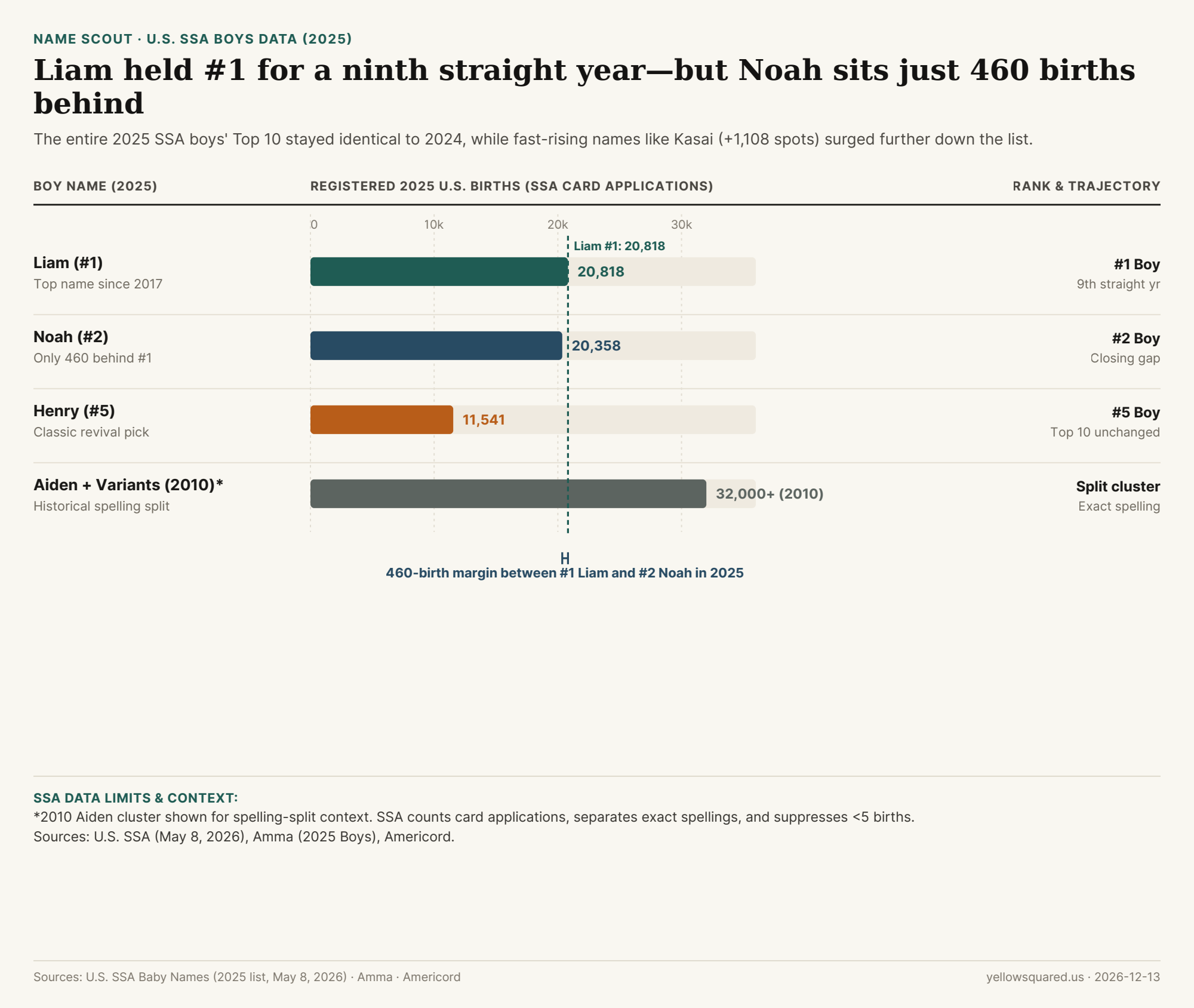
In its May 8, 2026 release of 2025 U.S. birth data, the Social Security Administration (SSA) confirmed that Liam—an Irish short form of William—has now held the #1 spot for American boys for nine consecutive years (since 2017). Even more striking, the entire boys' Top 10 remained identical to 2024: Liam, Noah, Oliver, Theodore, Henry, James, Elijah, Mateo, William, and Lucas.
Official 2025 U.S. SSA birth counts for #1 Liam, #2 Noah, and #5 Henry, alongside historical exact-spelling context. Data: Download CSV.
Why the Boys' Top 10 Barely Budged—While Lower Ranks Surged
According to 2025 SSA national tallies and Americord's 2026 trend breakdown, Liam received 20,818 births in 2025, with Noah (20,358) trailing by just 460 babies. Meanwhile, Theodore climbed from #23 in 2020 to #4, and Henry held #5 with 11,541 births. Further down the chart, Eithan jumped from #226 to #97, and Kasai (meaning "fire" in Japanese and Swahili) surged +1,108 spots to enter the Top 1,000 at #639.
"About 75% of boys got a name from the Top 1,000—compared with about 67% of girls, reflecting slightly broader spelling experimentation on the girls' list." — Americord 2026 Baby Name Analysis
SSA Data Limits to Keep in Mind
As with all SSA baby name tables, counts are drawn from Social Security card applications rather than raw state birth certificates, every exact spelling is ranked separately (so Eithan and Ethan do not combine), and any spelling with fewer than 5 annual births (<5) is suppressed for privacy. To see how your favorite boy names have climbed or split across spellings, track historical boy name rankings in Name Scout.
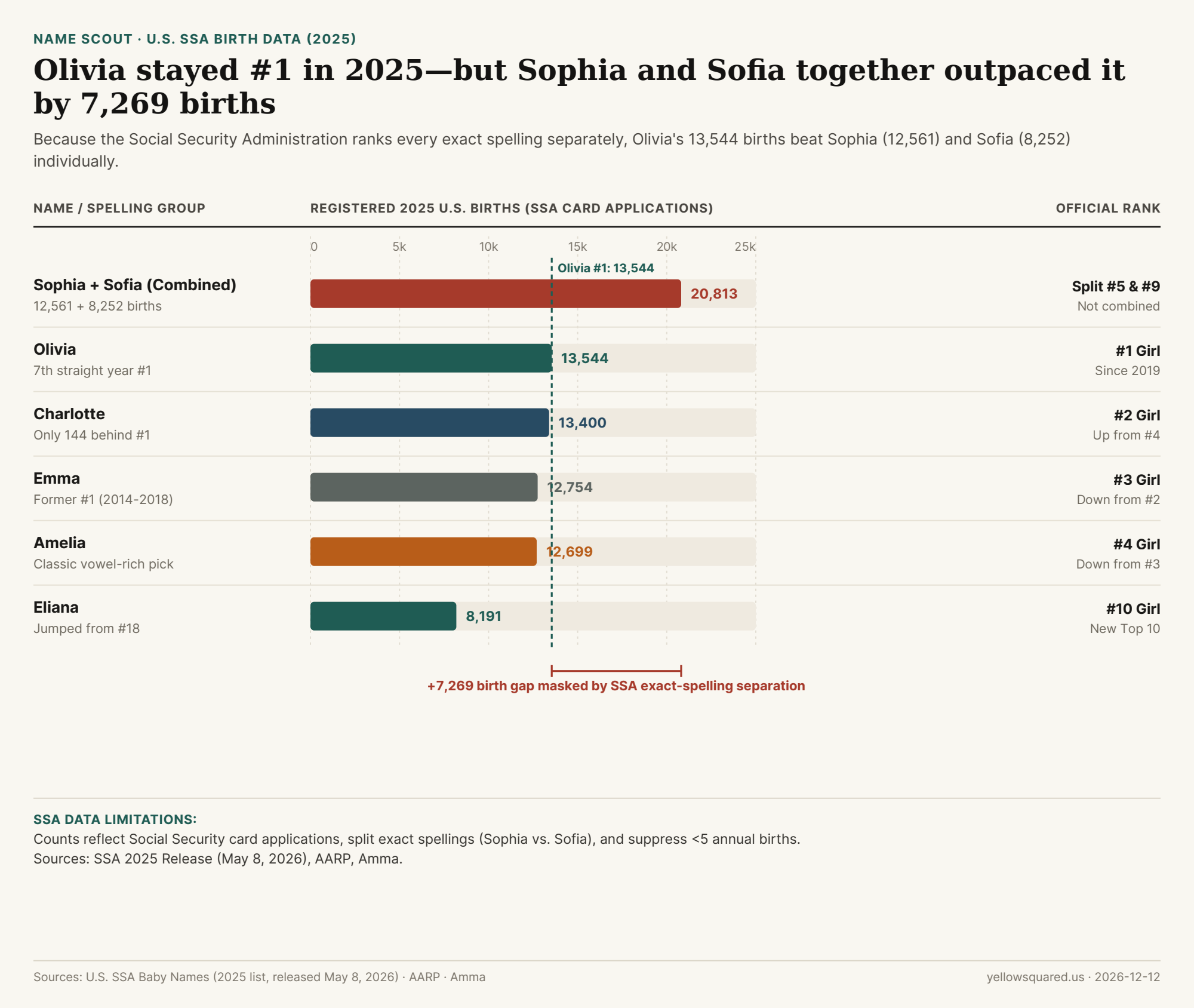
In May 2026, the Social Security Administration (SSA) announced that Olivia and Liam remained America's most popular baby names for the seventh consecutive year (and ninth straight year overall for Liam). Yet looking closely at the 2025 birth counts reveals a surprisingly tight race—and a major quirk in how official rankings work.
Official 2025 U.S. SSA birth counts for leading girls' names versus the combined total for Sophia and Sofia. Data: Download CSV.
Why Olivia Holds #1—and How Close Charlotte Came
According to the SSA Popular Baby Names database and 2025 national birth tallies, 13,544 baby girls were named Olivia in 2025. That was enough to hold #1, but Charlotte surged from #4 to #2 with 13,400 births—trailing Olivia by just 144 babies nationwide. Rounding out the top five were Emma (12,754), Amelia (12,699), and Sophia (12,561), while Eliana (8,191) jumped from #18 to #10 as the only new Top 10 entrant.
As AARP's analysis of the 2025 release notes, parents increasingly favor soft, vowel-rich names—and often tweak a single letter to make a classic feel distinct without confusing teachers taking attendance.
"When you combine exact spellings, Sophia (12,561) and Sofia (8,252) reached 20,813 newborns in 2025—more than 7,200 births ahead of #1 Olivia." — 2025 U.S. Social Security Administration Birth Tallies
Three SSA Data Limits to Keep in Mind
Card Applications, Not Raw Birth Certificates: SSA counts come from Social Security card applications filed for births in the 50 states and D.C., which covers nearly all newborns but excludes unregistered births.
Exact-Spelling Separation: Every spelling is ranked independently, so phonetic twins like Sophia (#5) and Sofia (#9), or Ailany (#14, 7,136 births) and Ailanny, never pool together in official ranks.
Small-Count Privacy Suppression: Any spelling with fewer than 5 annual births (<5) in a given year or state is omitted from public SSA files.
To check whether a favorite name's apparent rarity is real or simply split across alternate spellings, compare spelling variants in Name Scout before finalizing your shortlist.
003 / 59
Why Are Vintage Baby Names Like Theodore, Arthur, Evelyn, and Clara Coming Back?
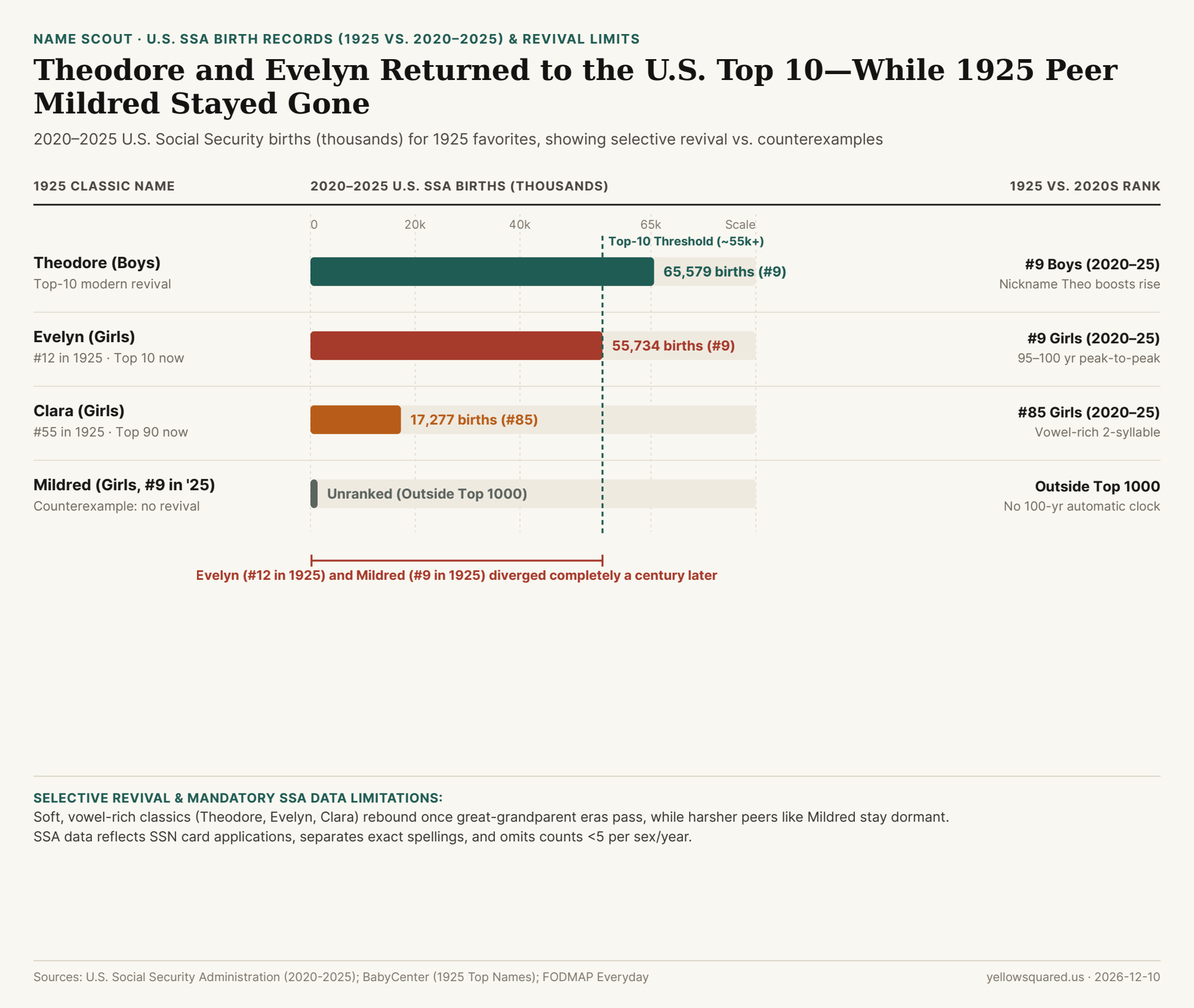
Walk onto any preschool playground today and you will hear names that sound straight out of a 1925 census roll: Theodore, Evelyn, Clara, and Arthur. According to the U.S. Social Security Administration (SSA) 2020–2025 decade table, Theodore ranks #9 for boys (65,579 births) and Evelyn ranks #9 for girls (55,734 births), alongside Clara at #85 (17,277 births).
Why Some 1925 Names Rebound—and Why the 100-Year Rule Fails
In 1925, Evelyn ranked #12 for girls and Mildred ranked #9. A century later, Evelyn is back at #9 while Mildred sits completely outside the Top 1000. Generational distance (names feel fresh once they belong to great-grandparents rather than parents) opens the door, but modern phonetic preferences decide which names walk through:
Soft Consonants & Vowel Flow:Theodore (Theo), Evelyn (Evie), and Clara share open vowels and liquid consonants (l, r, v) that match contemporary favorites like Liam, Olivia, and Eleanor.
Important SSA Data Limits: SSA records count Social Security card applications (not every birth), split exact spellings separately (such as Clara vs. Klara), and suppress any name with fewer than 5 births per sex/year for privacy.
"Generational distance makes 1920s names eligible for revival, but phonetic fit—not an automatic 100-year clock—separates Top-10 comebacks like Evelyn from dormant peers like Mildred."
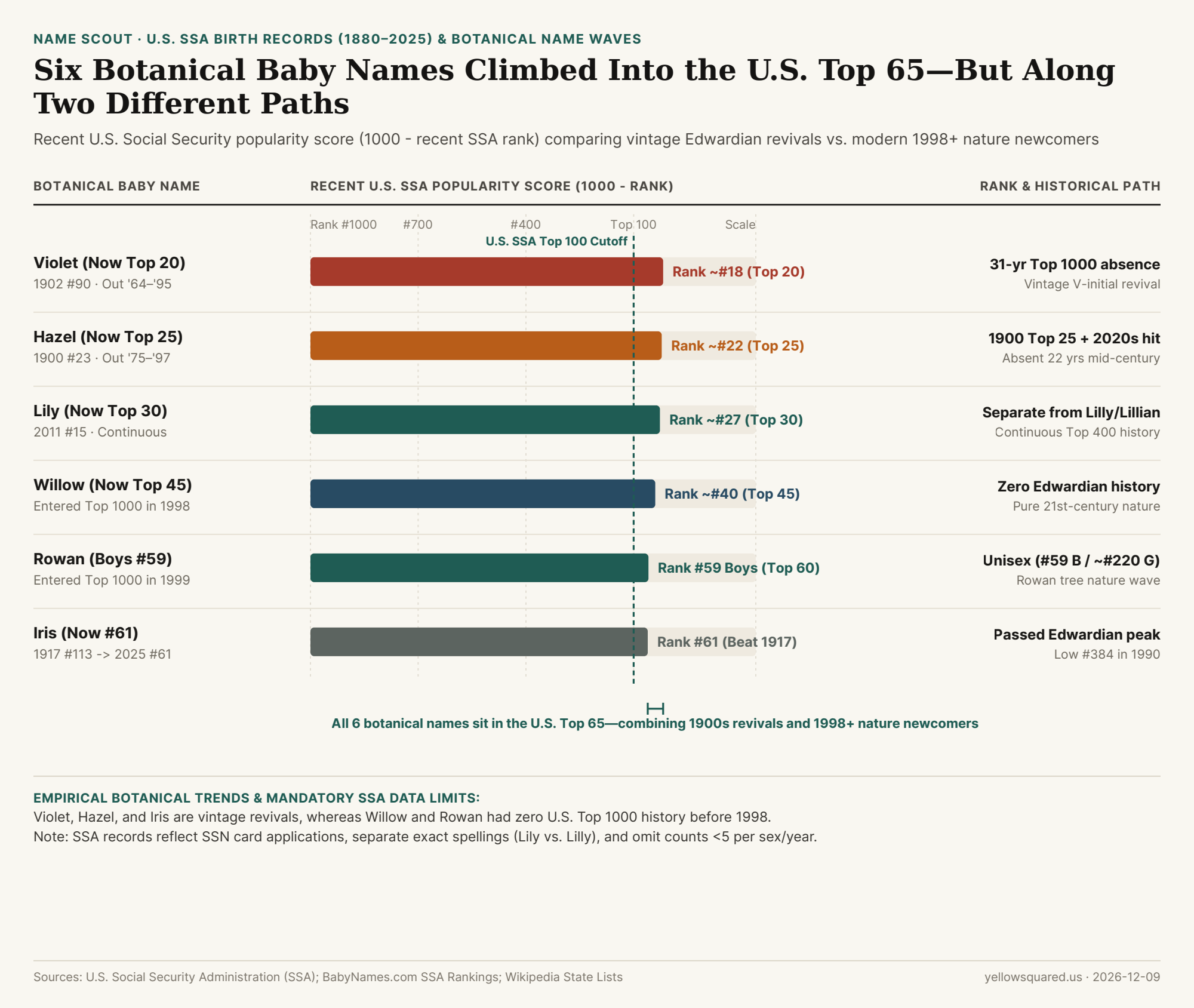
Scan recent U.S. Social Security Administration (SSA) birth rankings in Social Security Baby Name Rankings and U.S. state popularity tables and one naming family stands out: botanical flower and tree names. Six plant-inspired names—Violet, Hazel, Lily, Willow, Rowan, and Iris—now sit simultaneously inside the U.S. Top 65.
Yet grouping them together hides a striking split in American naming history. While Hazel (#23 in 1900), Violet (#90 in 1902), and Iris (#113 in 1917) are century-old Edwardian revivals returning from mid-century obscurity, Willow and Rowan had zero presence in the U.S. Top 1000 before 1998. Compare botanical and vintage baby name trajectories in Name Scout to inspect exact spelling counts and multi-decade curves.
Two Paths to the Top 65: Edwardian Revivals vs. Modern Nature Newcomers
Looking at 145 years of SSA records shows why botanical names cannot be explained by a single folk "100-year rule":
Path 1 — Vintage Edwardian Revivals (Violet, Hazel, Iris):Hazel peaked at #23 in 1900 before dropping completely out of the Top 1000 from 1975 to 1997; it has since climbed more than 700 spots back into the Top 25. Violet peaked at #90 in 1902, vanished from the Top 1000 for 31 years (1964–1995), and surged into the Top 20. Iris beat its 1917 high (#113) to reach Rank #61 in recent SSA rankings. Meanwhile, other 1900s floral contemporaries like Myrtle and Beulah never returned—showing that soft vowel-and-liquid phonetics (L, V, Z) drive which vintage botanicals revive.
Path 2 — Modern 1998+ Nature Newcomers (Willow, Rowan): Unlike Violet or Hazel, Willow never cracked the U.S. Top 1000 once between 1880 and 1997; it debuted in 1998 and climbed steadily into the Top 45. Similarly, Rowan (from the European mountain-ash tree) entered the U.S. boys' Top 1000 in 1999 and now ranks #59 for boys (and inside the Top 250 for girls).
Path 3 — Continuous Floral Staple (Lily):Lily never left the U.S. Top 400 in the 20th century, peaked at #15 in 2011, and remains a Top 30 fixture.
"These rankings describe historical SSA curves rather than a universal 100-year naming clock: while Violet, Hazel, and Iris rebounded from mid-century troughs, Edwardian floral peers like Myrtle stayed out of the Top 1000—and Willow and Rowan are purely 21st-century nature arrivals."
Botanical Name Trajectory Table & Mandatory SSA Data Limits
Before comparing counts in the table below (download the raw CSV dataset), note three structural limits of U.S. Social Security Administration baby name records:
SSN Card Applications vs. Birth Certificates: SSA counts reflect Social Security card applications rather than raw state birth certificates (undercounting early-1900s rural births before 1937 and universal 1987 hospital enumeration).
Exact-Spelling Separation: Every spelling is counted separately—so Lily (Top 30), Lilly, and Lillie appear as separate entries even though they sound identical.
Small-Count Suppression (<5): Names with fewer than 5 occurrences (<5) in a given sex and birth year are omitted for privacy.
Botanical Name
Primary Sex
Plant / Tree Origin
Historical Peak
Mid-Century Trough
Recent SSA Rank
Violet
Female
Viola flower
#90 (1902)
Out of Top 1000 (1964–1995)
#15–#20 (Top 20)
Hazel
Female
Corylus hazel tree
#23 (1900)
Out of Top 1000 (1975–1997)
#19–#25 (Top 25)
Lily
Female
Lilium flower
#15 (2011)
#387 (1979)
#24–#30 (Top 30)
Willow
Female
Salix willow tree
2022–2025
Unranked pre-1998
#35–#45 (Top 45)
Rowan
Unisex (B/G)
Sorbus rowan tree
2023–2025
Unranked pre-1999
#59 Boys / ~#220 Girls
Iris
Female
Iris flower
#113 (1917)
#384 (1990)
#61 (New all-time high)
How to Check Spelling Clusters & Unisex Balance
If you are considering Lily or Rowan, check both spelling clusters (Lily + Lilly) and combined boy-plus-girl totals so you know how often your child will actually hear their name in a classroom. Compare botanical and vintage baby name trajectories in Name Scout to explore year-by-year counts and regional trends side by side.
005 / 59
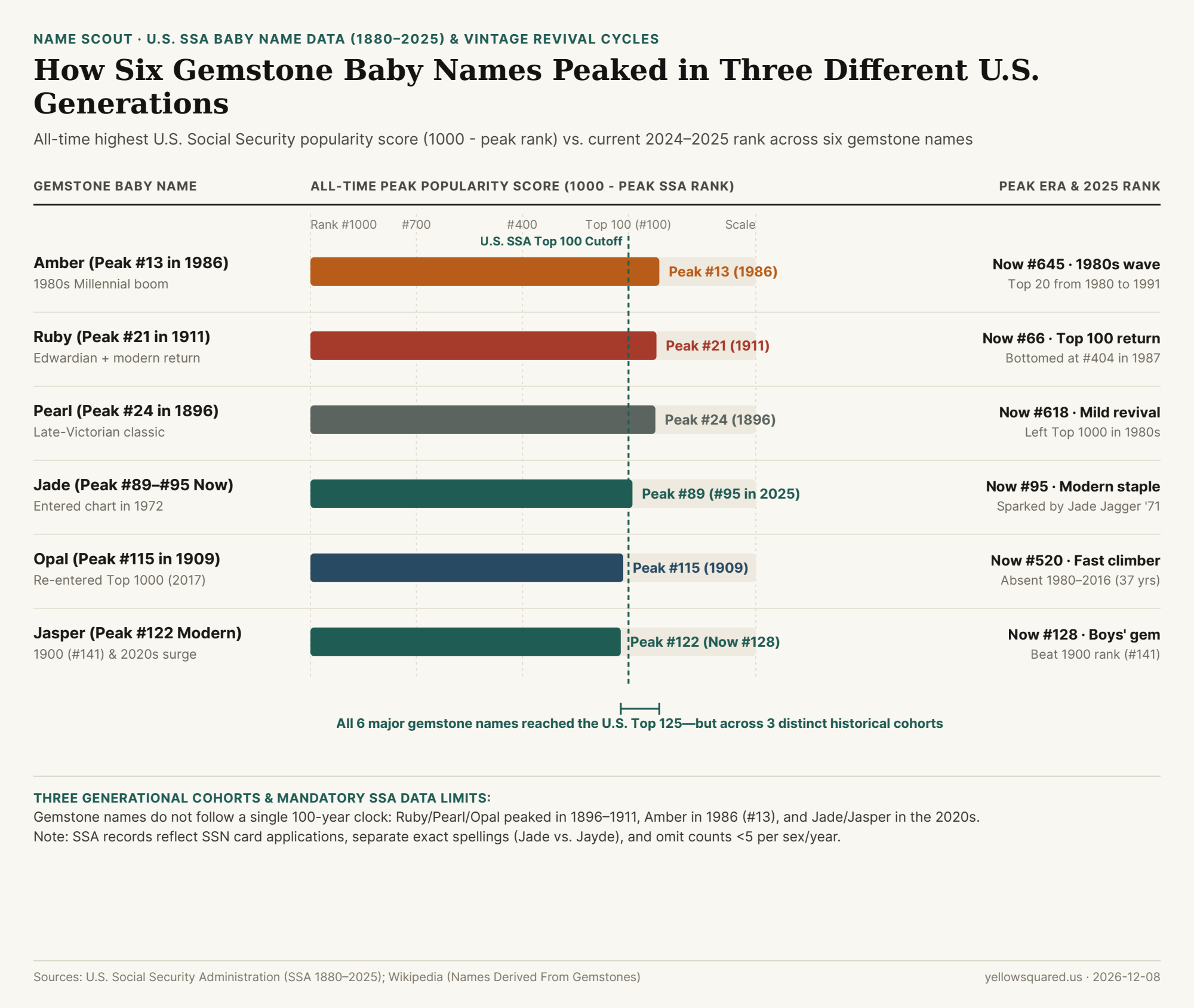
Why Have Gemstone Baby Names (Ruby, Jade, Pearl, Opal, Jasper, and Amber) Cycled Across U.S. Birth Records?
Parents searching for nature-inspired names frequently group gemstone and jewel baby names—such as Ruby, Pearl, Jade, Amber, Opal, Jasper, Gemma, and Esmeralda—into a single category. Yet a closer look at historical U.S. Social Security Administration (SSA) birth records alongside the etymological catalog in List of names derived from gemstones, Given names derived from gemstones, and U.S. Social Security Baby Name Rankings reveals that gemstone names have never moved together. Instead, they split into three distinct generational cohorts separated by up to a century.
Why did turn-of-the-century favorites like Ruby, Opal, and Jasper rebound in the 2020s while 1980s blockbuster Amber fell past Rank #600—and why has Jade held steady inside the U.S. Top 100? Explore historical gemstone and vintage name trajectories in Name Scout to compare year-by-year curves and spelling variants before choosing a name.
Three Distinct Waves—Not a Universal "100-Year Clock"
Popular naming blogs often claim that vintage names automatically return on a rigid "100-year rule." Empirical SSA data across gemstone names shows why that folk heuristic fails as a universal forecast tool—and why phonetics and pop-culture catalysts matter just as much as generational spacing:
Cohort 1: Late-Victorian & Edwardian Jewels (Ruby, Pearl, Opal, Beryl, Garnet): In the late 19th and early 20th centuries, ornamental jewel names were mainstream staples. Pearl peaked at Rank #24 in 1896, Ruby peaked at Rank #21 in 1911, and Opal peaked at Rank #115 in 1909. All three fell out of fashion between 1940 and 1985 (with Opal and Pearl dropping completely out of the U.S. Top 1000). Yet their modern rebounds diverged dramatically by syllable structure: two-syllable, vowel-ending Ruby roared back to Rank #66, and two-syllable Opal re-entered the Top 1000 in 2017 after a 37-year absence to reach #520, whereas one-syllable Pearl recovered much more modestly (#618) and Beryl has not returned to the Top 1000 at all.
Cohort 2: The 1980s Millennial Boom (Amber, Crystal): Virtually absent before World War II, Amber (fueled by Kathleen Winsor's 1944 novel and 1947 film Forever Amber) climbed through the 1960s and spent 12 consecutive years inside the U.S. Top 20 (1980–1991), peaking at Rank #13 in 1986 alongside Crystal (#9 in 1982). Because Amber is strongly tied to the millennial parent generation today, it currently sits in its post-boom cooldown phase around Rank #645.
Cohort 3: Modern Contemporary Staples (Jade, Jasper, Gemma): As noted in gemstone naming histories, Jade did not even appear in the U.S. Top 1000 until 1972—the year after Mick and Bianca Jagger named their daughter Jade Jagger (born October 1971). Rather than spiking and crashing like Amber, Jade climbed steadily for five decades to become a modern Top 100 fixture (Rank #95 in recent SSA rankings). Meanwhile, the Persian-derived boys' gemstone name Jasper ("bringer of treasure") surpassed its 1900 rank (#141) to reach #122–#128 in the 2020s.
"These figures describe historical trajectories in the chart, not a deterministic rule about what parents will choose next: while two-syllable Ruby (#21 in 1911 to #66 today) rebounded strongly, Victorian contemporary Beryl remained outside the Top 1000, and Jade (#95) only entered the U.S. chart in 1972."
Historical Peak vs. Modern Ranking Table (With Mandatory SSA Data Limits)
When interpreting the table below (download the raw CSV dataset), keep three structural limitations of U.S. Social Security Administration baby name data in mind:
SSN Card Applications vs. Birth Certificates: SSA counts come from Social Security number card applications (which strongly undercounted Southern, rural, and non-covered births prior to the 1937 establishment of Social Security and the 1987 "Enumeration at Birth" hospital program).
Exact-Spelling Separation: The SSA tabulates each exact spelling separately. For example, Jade (#95), Jayde, Jada, and Italian cognate Giada are counted on separate rows, as are Gemma and Jemma.
Small-Count Privacy Suppression (<5): To protect individual privacy, the public national SSA file omits any name-spelling/sex combination with fewer than 5 occurrences (<5) in a given birth year.
Gemstone Name
Primary Sex
Historical Peak Era
All-Time Peak Rank
Mid-Century / Trough
2024–2025 SSA Rank
Phonetic & Cultural Pattern
Amber
Female
1980–1991 Boom
#13 (1986)
Pre-1960 (> #900)
#645
Millennial generational peak; now in post-boom cooldown
Single-syllable Victorian classic; gentler modern return
Jade
Female
Modern (2021–2025)
#89 (2021)
Unranked pre-1972
#95 (Top 100)
Entered chart in 1972; steady 50-year climb to Top 100
Opal
Female
Edwardian (1909)
#115 (1909)
Out of Top 1000 (1980–2016)
#520
Re-entered Top 1000 in 2017 after a 37-year absence
Jasper
Male
Modern (2022–2025)
#122 (2022)
#828 (1983 trough)
#128
Surpassed its 1900 high (#141) in the 2020s
How to Compare Spelling Clusters Before You Decide
If you love the crisp sound of a gemstone name like Jade, Ruby, or Gemma, always check its phonetic spelling neighbors (such as Gemma vs. Jemma, or Jade vs. Giada) so you know the combined classroom frequency rather than just a single spelling's rank. Explore historical gemstone and vintage name trajectories in Name Scout to inspect exact SSA counts and multi-spelling totals from 1880 to the present.
006 / 59
Why Are Palindrome Baby Names (Hannah, Ava, Anna, Ada, and Otto) So Popular in U.S. Birth Records?
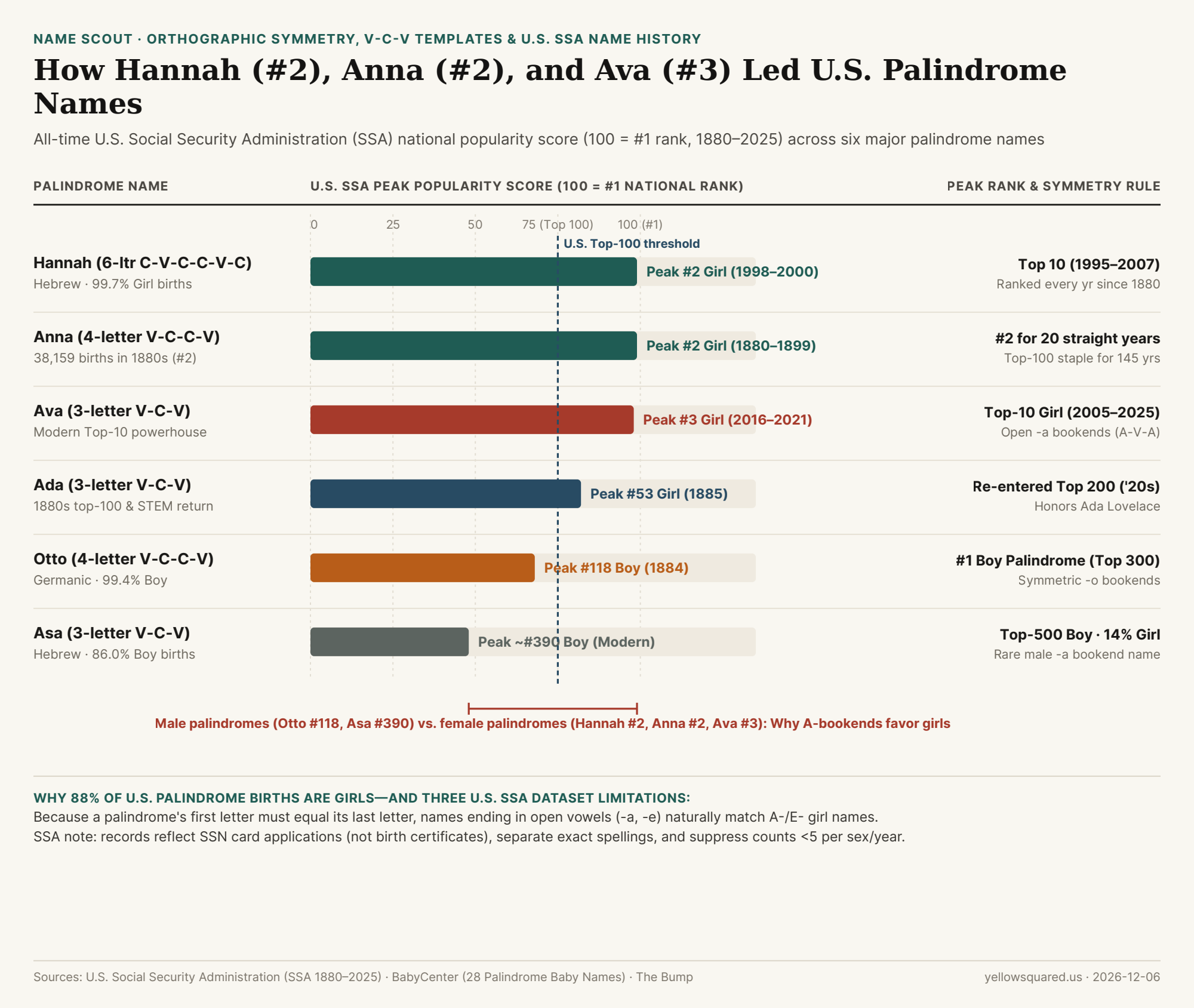
A palindrome name—from the Greek palindromos ("running back again")—reads the exact same letter-for-letter backward as it does forward: Hannah, Anna, Ava, Ada, Elle, Eve, Otto, and Asa. You might expect such a strict orthographic constraint to produce only rare, novelty monikers. Instead, across 145 years of U.S. Social Security Administration (SSA) birth records and historical rankings analyzed by BabyCenter's palindrome name study and The Bump's national SSA top-1,000 tracker, three palindrome names have climbed all the way into the top 3 most popular baby names in the United States—and nearly 88% of all babies given palindrome names in modern U.S. records are girls.
The "Bookend Constraint": Why Palindrome Names Skew 88% Female in English
Why are top-ranked palindrome names overwhelmingly female (Hannah, Anna, Ava, Ada, Elle, Eve, Emme, Viv), while only a handful of male palindromes (Otto, Asa, Bob, Reinier) ever crack the U.S. top 1,000? The answer lies in a structural linguistic bottleneck called the Bookend Constraint:
First Letter = Last Letter Symmetry: In any palindrome, the opening letter of the name must be identical to its final letter (or silent final letter, as in H-A-N-N-A-H).
English Vowel Endings Favor Girls' Names: In American English onomastics, over 38% of girls' names end in the open vowel -a (and another 18% end in silent -e). Because millions of traditional names also begin with A- or E-, three-letter V-C-V (A-C-A / E-C-E) and four-letter V-C-C-V (A-N-N-A / E-L-L-E) palindromes sound completely natural and melodic as girls' names.
Why Three Female Palindromes Reached the U.S. Top 3:
Anna (Peak #2 Girl for 20 Straight Years, 1880–1899): As BabyCenter's historical SSA review notes, Anna (the Greek and Latin form of Hebrew Channah, meaning "grace") held the #2 spot in America every single year from 1880 through 1899 (with 38,159 births in the 1880s alone) and has never fallen out of the U.S. top 100 in 145 years.
Hannah (Peak #2 Girl in 1998–2000): Protected by silent-h bookends surrounding the core A-N-N-A palindrome, Hannah stayed in the U.S. top 1,000 every year since 1880, surged into the top 10 from 1995 to 2007 (peaking at #2 for three consecutive years), and remains a top-50 mainstay.
Ava (Peak #3 Girl in 2016–2021): Driven by the 21st-century preference for compact three-letter V-C-V names with liquid/labiodental consonants, Ava vaulted into the U.S. top 10 in 2005 and has stayed near the very top for two decades, joined by vintage sibling Ada (which peaked at #53 in 1885, briefly exited the top 1,000 around 2000, and rebounded into the top 200 honoring computing pioneer Ada Lovelace).
"Because a palindrome's first letter must match its final letter, the romance-language -a ending that dominates American girls' names turns A-V-A, A-D-A, and A-N-N-A into effortless top-100 classics."
How Otto and Asa Anchor Boys' Palindrome Names
Because American boys' names overwhelmingly end in consonants (such as -n, -r, -s, -l, and -d), a male consonant-bookend palindrome requires starting and ending with the exact same stop or fricative (like Bob, Pip, or Dutch Reinier). As a result, the two most enduring male palindromes in U.S. SSA records rely on -o and -a vowel bookends:
Otto (99.4% Boy, Peak #118 in 1884 / Top-300 Revival): Derived from the Old High German stem aud- ("wealth, fortune"), Otto ranked in the U.S. top 150 throughout the 1880s and 1890s, faded mid-century, and has climbed steadily back into the U.S. top 300 alongside Leo, Theo, and Milo.
Asa (86.0% Boy / 14.0% Girl, Top-500 Boy): A three-letter Hebrew biblical palindrome meaning "healer" or "physician," Asa is one of the few A-_-A palindromes used primarily for boys, though its open vowel ending has recently lifted its female share to 14%.
Palindrome Name
Letter & Syllable Structure
Primary Gender Share
Historical SSA Peak
Current SSA Tier
Linguistic Origin & Symmetry Note
Hannah
6 letters (C-V-C-C-V-C)
99.7% Girl
#2 Girl (1998–2000)
Top-50 Mainstay
Hebrew ("grace"); top 10 from 1995 to 2007
Anna
4 letters (V-C-C-V)
99.6% Girl
#2 Girl (1880–1899)
Top-100 Classic
Held #2 nationwide for 20 straight years
Ava
3 letters (V-C-V)
99.8% Girl
#3 Girl (2016–2021)
Top-10 Powerhouse
3-letter open-vowel A-V-A triad
Ada
3 letters (V-C-V)
99.5% Girl
#53 Girl (1885)
Top-200 Revival
Germanic/Hebrew + Ada Lovelace tribute
Otto
4 letters (V-C-C-V)
99.4% Boy
#118 Boy (1884)
Top-300 Revival
Old High German ("wealth"); #1 boy palindrome
Asa
3 letters (V-C-V)
86.0% Boy / 14% Girl
~#390 Boy
Top-500 Boy
Hebrew ("healer"); rare male A-_-A pattern
Three U.S. SSA Dataset Limitations to Keep in Mind
When analyzing palindrome frequencies and historical return curves across U.S. Social Security Administration baby name files, remember three structural boundaries of the dataset:
SSN Card Applications vs. NCHS Birth Certificates: SSA figures count Social Security Number card applications (Form SS-5 and hospital Enumeration at Birth records) rather than raw birth certificates; cohorts prior to 1937 reflect adults who applied retroactively when Social Security launched.
Exact-Spelling Separation Breaks or Preserves Palindromes: The SSA ranks every exact spelling separately. For instance, Hannah (6 letters) and Anna (4 letters) are true palindromes, whereas their close spelling variant Hanna (5 letters) is tabulated on its own row and is not a palindrome because it drops the trailing -h!
Small-Count Privacy Suppression (<5 Rule): Names given to fewer than 5 babies (<5) of a given sex in a year or state are excluded from public SSA files to protect privacy, omitting ultra-rare palindromes like Ivi or Nen in smaller states.
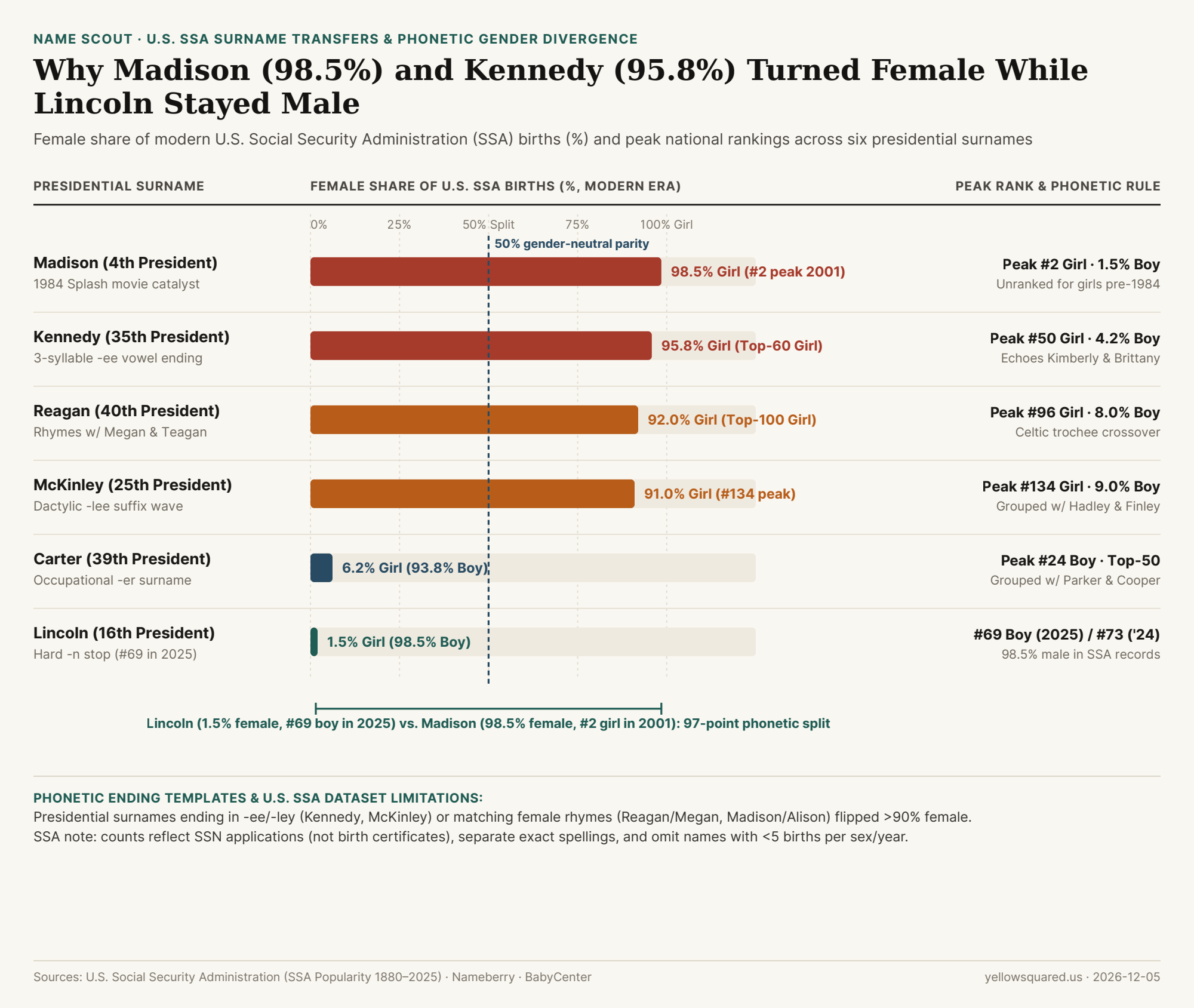
From the 1880s through the 1970s, giving a child a U.S. president's last name—Washington, Jefferson, Jackson, Lincoln, Grant, Harrison, or Carter—was an almost exclusively male tradition in American birth records. Yet over the past four decades, U.S. Social Security Administration (SSA) national baby name rankings and onomastic analyses from Nameberry's presidential girl-name history and BabyCenter's presidential naming study reveal a dramatic 97-percentage-point gender split: Madison (98.5% female), Kennedy (95.8% female), Reagan (92.0% female), and McKinley (91.0% female) crossed over to become overwhelmingly female first names, whereas Lincoln (98.5% male, ranked #69 for boys in 2025) and Carter (93.8% male) remained anchored on the boys' chart.
The March 1984 "Splash" Catalyst and the Phonetic Rules That Flipped Surnames Female
Why did four specific presidential surnames—honoring James Madison (4th President), John F. Kennedy (35th), Ronald Reagan (40th), and William McKinley (25th)—detach from male political commemoration and surge past 90% female share? As documented in Nameberry's analysis of presidential baby name trajectories, the crossover followed three distinct phonetic and pop-culture mechanisms:
The 1984 Splash Effect on Madison (98.5% Female, Peak #2 in 2001): Prior to 1984, Madison (an English matronymic meaning "son of Maud," popularized as a surname by Founding Father James Madison) did not even appear in the U.S. top 1,000 for girls, while ranking occasionally in the bottom half of the boys' top 1,000. In March 1984, Ron Howard's romantic comedy Splash featured Daryl Hannah as a mermaid who walks down Manhattan's Madison Avenue (named after James Madison), points to the street sign, and chooses "Madison" as her human name—prompting Tom Hanks's character to joke, "Madison's not a name!" Because Madison shared the three-syllable dactylic cadence of 1980s girl favorites Allison and Addison (and yielded the nickname Maddie), it debuted at #628 for girls in 1985, broke the top 30 by 1993, and peaked at #2 nationwide in 2001.
Three-Syllable -ee Endings in Kennedy (95.8% Female) and McKinley (91.0% Female): In the 1990s, parents moving on from 1980s three-syllable -ee staples (Kimberly, Brittany, Tiffany, Stephanie) gravitated toward Irish and Scottish surnames with the exact same rhythmic stress pattern (DA-da-dee). Boosted by MTV VJ Kennedy (Lisa Kennedy Montgomery, named after JFK) in 1992, Kennedy entered the girls' top 100 in 1999 and peaked at #50 nationally, while McKinley climbed to #134 for girls in 2015 alongside Finley and Hadley.
The Celtic Trochee Rhyme in Reagan (92.0% Female): Although Ronald Reagan left office in 1989, the surname Reagan (`RAY-gən`) rhymed directly with established female Celtic names Megan and Teagan, carrying it into the girls' top 100 (peaking at #96) with over 92% female usage.
"Parents didn't choose Kennedy, Reagan, or Madison as partisan ballots—they selected them because three-syllable dactyls ending in -ee and -son matched the dominant acoustic templates of American girls' names."
Why Lincoln (#69 in 2025), Jackson, and Carter Stayed Over 93% Male
By contrast, presidential surnames that lacked a female rhyme partner or carried hard velar/alveolar consonant stops remained overwhelmingly male:
Lincoln (98.5% Male, Ranked #69 in 2025 / #73 in 2024): Per the SSA 2024–2025 national popularity tables, Lincoln (16th President Abraham Lincoln) rose from outside the top 200 in 2008 to a peak of #38 in 2017 and currently holds #69 nationwide for boys in 2025 (climbing 4 spots from #73 in 2024), driven by the modern male two-syllable -n trend and the crisp nickname Link.
Carter (93.8% Male, Peak #24 Boy): Grouping phonetically with occupational -er boys' names like Parker, Cooper, and Hunter, Carter (39th President Jimmy Carter) has stayed nearly 94% male inside the U.S. top 50.
Presidential Surname
Presidential Origin
Modern Girl Share
Modern Boy Share
SSA Peak National Rank
Phonetic & Cultural Mechanism
Madison
James Madison (4th)
98.5%
1.5%
#2 Girl (2001)
1984 film Splash + matches Allison cadence & Maddie
Kennedy
John F. Kennedy (35th)
95.8%
4.2%
#50 Girl (2015–2021)
3-syllable -ee ending echoes Kimberly & Brittany
Reagan
Ronald Reagan (40th)
92.0%
8.0%
#96 Girl (2012–2016)
Two-syllable trochee rhymes with Megan & Teagan
McKinley
William McKinley (25th)
91.0%
9.0%
#134 Girl (2015)
Dactylic -lee suffix joins Hadley & Finley wave
Carter
Jimmy Carter (39th)
6.2%
93.8%
#24 Boy (2016–2019)
Occupational -er suffix groups with Parker & Cooper
Lincoln
Abraham Lincoln (16th)
1.5%
98.5%
#38 Boy (2017) · #69 (2025)
Velar stop + hard -n ending; #69 boy in 2025 SSA data
Three U.S. SSA Dataset Limitations Every Name Researcher Should Know
When comparing historical surname transfers across decades in U.S. Social Security Administration baby name files, keep three structural dataset constraints in mind:
SSN Card Applications vs. Birth Certificates: SSA totals count Social Security Number card applications (Form SS-5 and hospital Enumeration at Birth filings) rather than direct NCHS vital-statistics birth certificates; pre-1937 cohorts reflect retroactive adult registrations.
Exact-Spelling Separation: The SSA tabulates every spelling variant as an independent rank. Combining phonetic siblings—such as Madison, Madisyn, and Maddison, or Reagan and Raegan, or Jackson and Jaxon—makes the underlying phonetic wave substantially larger than any single ranked row.
Privacy Suppression Below 5 Births (<5 Rule): To protect individual privacy, the SSA omits any name given to fewer than 5 babies (<5) of the same sex in a given year (or state), slightly undercounting rare cross-gender usage in early decades.
In 1950, the ten most popular boys' names in the United States were James, Robert, John, Michael, David, William, Richard, Thomas, Charles, and Gary. Only one name in that entire top ten—John—ended in the letter N. Fast-forward to the early 2010s and read a preschool roster aloud: Aiden, Mason, Ethan, Jayden, Jackson, Logan, Benjamin, Owen, Ryan, Nathan, Dylan, Caleb, Landon, Gavin, Evan. Even as American parents abandoned the postwar habit of giving 30%+ of boys the same ten classic names, they unconsciously converged on a single terminal consonant sound.
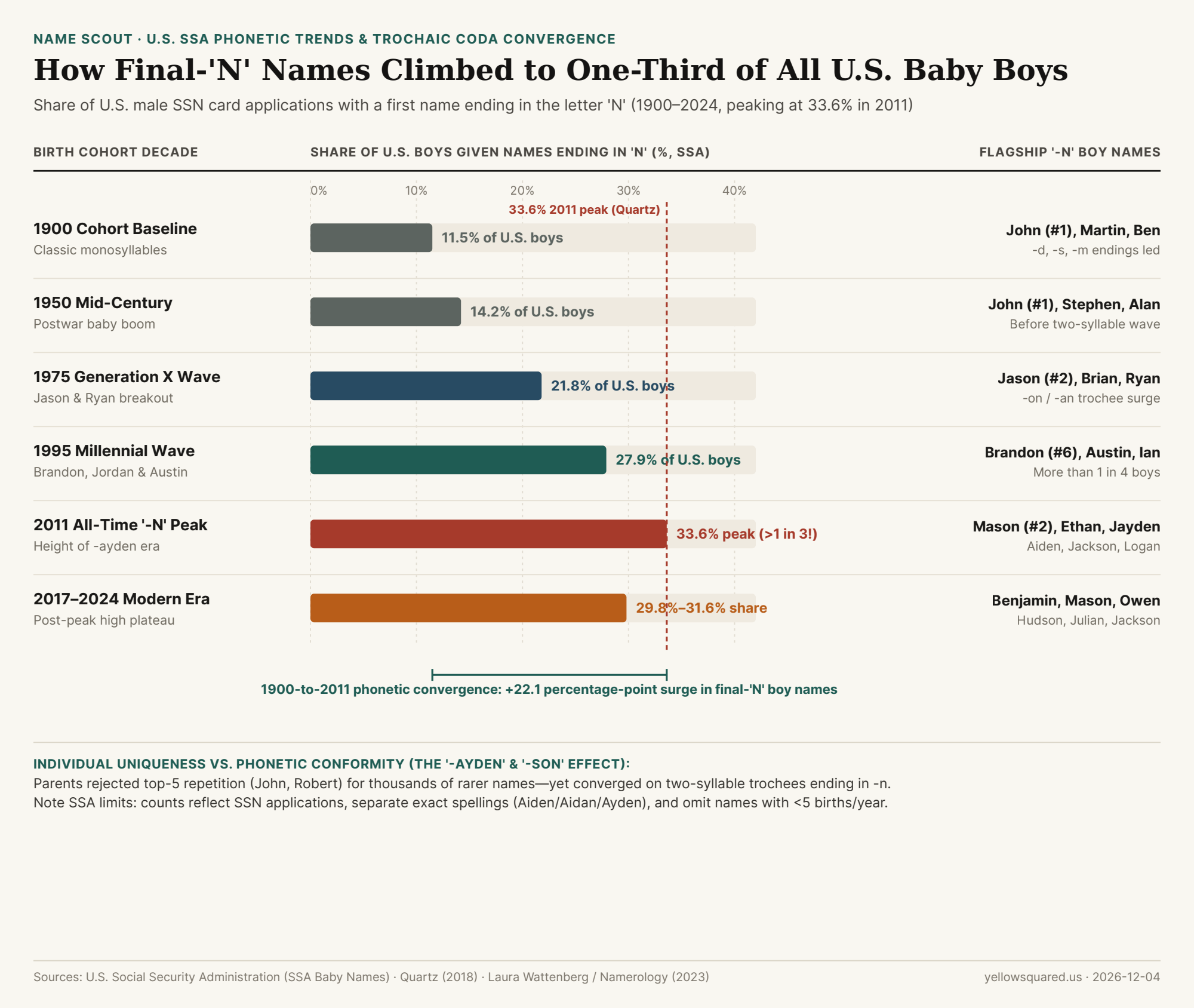
As analyzed by name researcher Laura Wattenberg and documented in Quartz's study of U.S. Social Security Administration (SSA) terminal-letter distributions, the share of American newborn boys given a name ending in the letter N climbed from 11.5% in 1900 and 14.2% in 1950 to an extraordinary all-time peak of 33.6% in 2011—meaning more than one out of every three baby boys born in the United States received an -n name. To inspect how terminal sounds, syllable counts, and state-by-state rankings have shifted across the last century, you can Explore historical U.S. baby name trends in Name Scout.
Why did a single consonant capture a third of all male births when there are 26 letters in the English alphabet? Phonetic historians point to a two-syllable trochaic template—a stressed first syllable followed by an unstressed nasal coda (DA-da-n, such as MA-son, E-than, LO-gan, AI-den)—that rolled across four successive generational waves:
The 1970s Jason / Brian / Ryan / Kevin Breakout (21.8% by 1975): Until the late 1960s, male names were dominated by hard plosive and sibilant endings (-d in David/Richard, -t in Robert, -s in James/Charles/Thomas). In 1972, Jason surged to #2 nationally (behind Michael), joined by Celtic imports Brian, Ryan, and Kevin. That quartet conditioned a generation of American ears to hear a two-syllable -on or -an cadence as the default sound of a modern boy's name.
The 1990s Surname & Geographic Wave (27.9% by 1995): When Generation X parents sought fresher alternatives to Jason and Brian, they kept the exact same two-syllable -n acoustic envelope and swapped in English surnames and place names: Brandon, Jordan, Austin, Dylan, Cameron, Christian, Evan, and Ian.
The 2000s–2011 -ayden & Occupational Peak (33.6% in 2011): In the 2000s, biblical revivals (Ethan, Nathan, Benjamin), occupational surnames (Mason, Jackson, Carson, Hudson), and the rhyming -ayden quartet (Aiden, Jayden, Brayden, Caden) converged simultaneously. By 2011, 6 of the Top 10 and 11 of the Top 20 U.S. boys' names ended in N.
The Double-'N' Spinoff & Post-2017 Cooling (~29.8%–31.6%): As noted in Quartz's phonetic breakdown and Laura Wattenberg's Namerology tracking, names ending in a double -nn (such as Finn, Quinn, Flynn, Brooklynn, and Adalynn) rose to roughly 2% of all U.S. births, while overall male -n share eased from 33.6% in 2011 to 31.6% in 2017 and roughly 29%–30% in the early 2020s as -r endings (Oliver, Asher, Carter, Colter) and -o endings (Mateo, Theo, Leo) gained ground.
"American parents rejected the conformity of naming every boy John or Robert, yet inadvertently recreated phonetic conformity: by carving out hundreds of spelling variations on the same two-syllable '-n' template (Aiden, Aidan, Ayden, Jaidyn), a record 33.6% of boys in 2011 shared the exact same final sound."
SSN Card Applications, Not Universal Birth Certificates: The public SSA baby-name file tabulates first names from Social Security Number (SSN) card applications rather than NCHS birth certificates directly (prior to the late-1980s Enumeration at Birth program, many applications occurred years after birth).
Exact-Spelling Separation: Every distinct orthographic string is ranked separately. During the peak -ayden wave, Aiden, Aidan, Ayden, Aidyn, and Aden—or Jackson, Jaxon, and Jaxson—were tabulated as separate entries; pooling phonetic equivalents pushes the true share of -n coda sounds even higher.
Small-Count Privacy Suppression (<5 Births): Any name given to fewer than 5 applicants of the same sex in a single birth year is omitted from the national SSA file to protect individual privacy.
Because terminal -n sounds are so deeply embedded in modern American naming tastes, parents frequently shortlist three or four favorites—say, Rowan, Julian, Owen, and Declan—without realizing that every single candidate shares the exact same unstressed nasal ending. Before locking in a first-and-middle-name combination or sibling pair, Explore historical U.S. baby name trends in Name Scout to compare ending sounds, decade curves, and regional state rankings side by side.