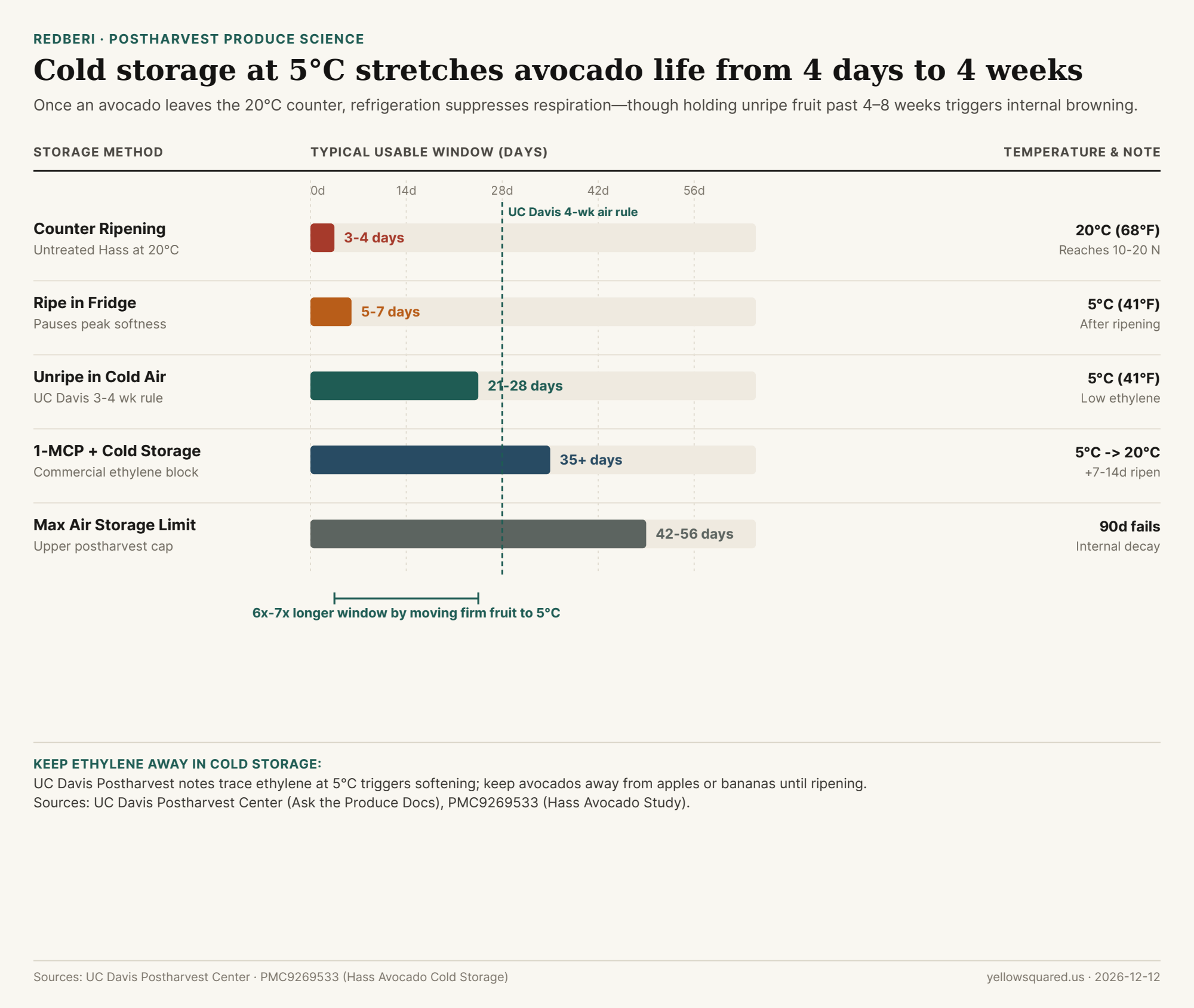
Avocados are climacteric fruit, meaning they do not ripen on the tree—they wait until harvest, then surge in respiration and ethylene gas production. At room temperature (20°C / 68°F), peer-reviewed Hass avocado trials show untreated fruit softens to the ready-to-eat stage (10–20 N firmness) in just 3 to 4 days. Moving them into the refrigerator changes that timeline dramatically.
Usable storage and ripening windows for Hass avocados across counter and 5°C cold-storage conditions. Data: Download CSV.
Why Timing the Fridge Matters
According to the UC Davis Postharvest Center, unripe avocados held in regular air at 5°C (41°F) typically keep for 3 to 4 weeks (21–28 days), with top-quality batches occasionally holding for 6 to 8 weeks before internal discoloration and decay set in (90 days is far beyond safe limits).
"It is a good rule of thumb to try to minimize any exposure to ethylene except when you want to ripen them. Low levels of ethylene during cold storage (5°C) can stimulate softening even in storage." — UC Davis Postharvest Center
In the same PMC9269533 study, researchers found that after 21 days at 5°C, avocados begin ramping up ethylene and respiration even while chilled—so fruit stored in your crisper for three weeks will soften faster once returned to the counter than freshly bought fruit.
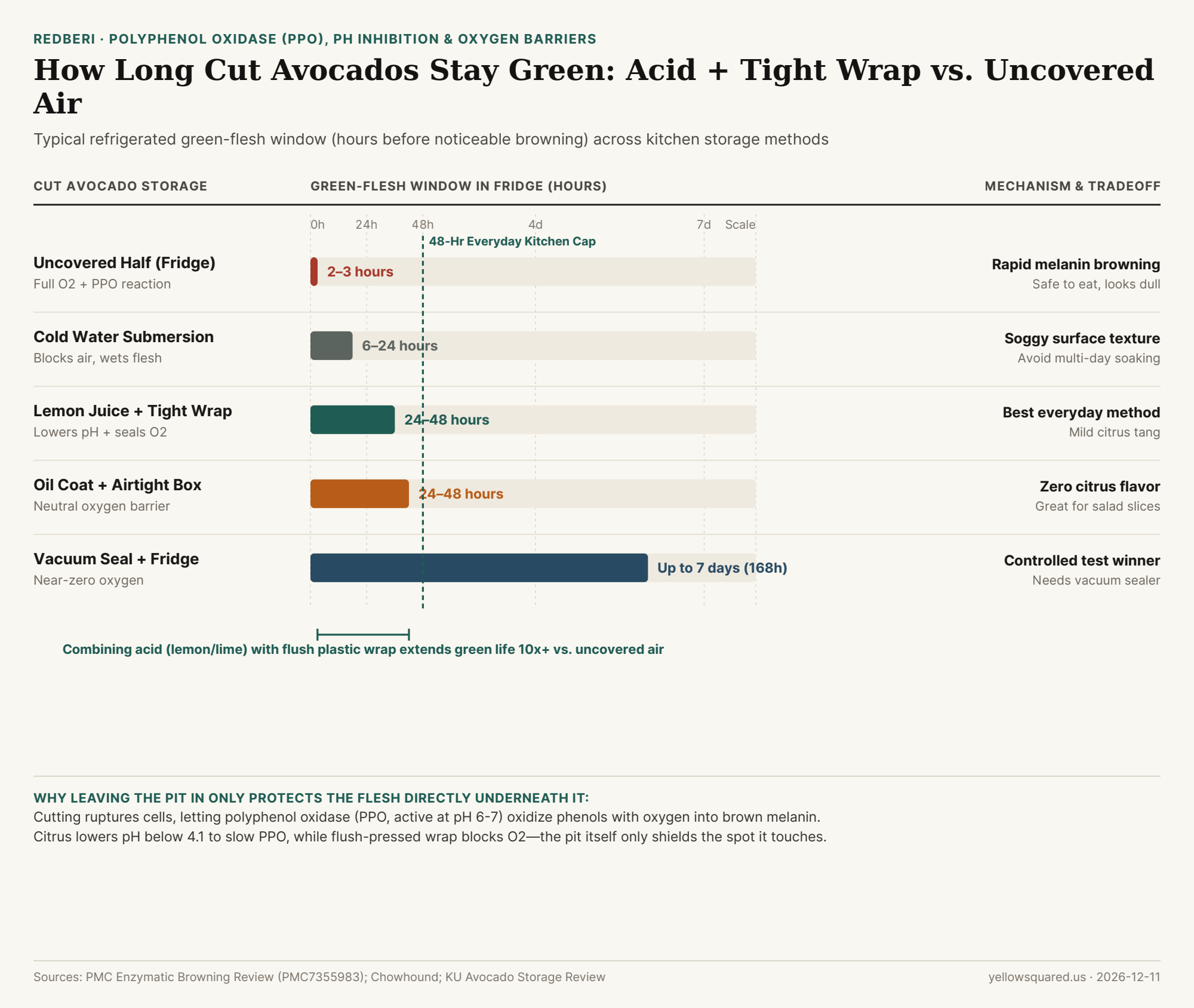
Slice open a ripe avocado and leave half on a plate in the fridge, and the bright green flesh starts turning dull brown within 2 to 3 hours. That color change is not rot—it is enzymatic browning, the exact same chemical reaction that turns cut apples and bananas brown.
When your knife slices through avocado cells, it exposes phenolic compounds and the enzyme polyphenol oxidase (PPO) to oxygen in the air. PPO converts those phenols into quinones, which polymerize into brown melanin pigments:
Lemon or Lime Juice (Lowers pH): PPO is most active at neutral pH 6–7 and slows sharply below pH 4.1 (becoming inactive below pH 3). Brushing fresh citrus juice—which contains both citric and ascorbic acid—slows the enzyme directly.
Flush Plastic Wrap or Oil Coat (Blocks Oxygen): Even with lemon juice, leaving an avocado uncovered lets oxygen reach the flesh. Pressing plastic wrap flush against the cut flesh (or brushing a thin layer of olive/avocado oil for neutral flavor) starves PPO of oxygen.
"Leaving the pit in a halved avocado has no chemical magic: it simply blocks air from touching the small circle of flesh directly beneath it while the surrounding ring still browns."
Nearly everyone has experienced the breakfast shock of taking a sip of fresh orange juice right after brushing their teeth: instead of tasting bright and sweet, the juice tastes intensely bitter, metallic, and astringent. While many people blame the menthol or peppermint oil in toothpaste, sensory psychophysics proves that mint flavoring is innocent. As explained by BBC Science Focus, Encyclopædia Britannica, and Colgate's oral biochemistry guide, the culprit is a single foaming detergent ingredient present at 1% to 2% concentration in most conventional toothpastes: Sodium Lauryl Sulfate (SLS, C₁₂H₂₅NaO₄S).
Why does a soap-like surfactant transform sweet citrus juice into liquid bitterness? Landmark psychophysical experiments by John A. DeSimone, Gerard L. Heck, and Linda M. Bartoshuk (1980) in Chemical Senses (reviewed in Tidalove's sensory chemistry analysis and Live Science) revealed that SLS executes a two-pronged biochemical attack on your tongue's taste buds that lasts for 15 to 30 minutes. Check citrus sweetness, acidity, and produce guides in Redberi to compare sugar-to-acid ratios across oranges, mandarins, and grapefruits.
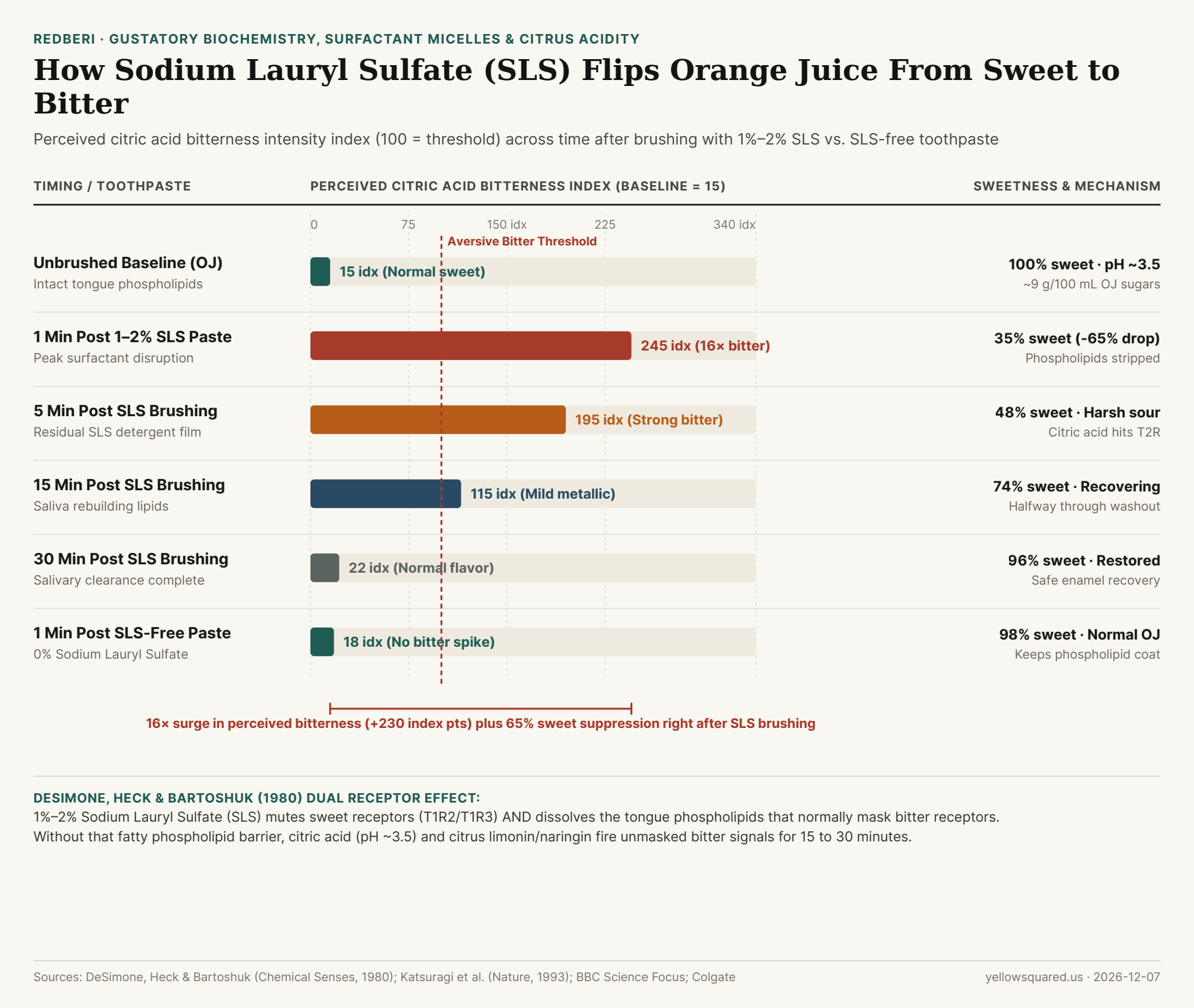
Figure 1: Perceived citric acid bitterness index (baseline = 15, aversive threshold = 100) and sweet receptor (T1R2/T1R3) sensitivity across time after brushing with 1%–2% Sodium Lauryl Sulfate (SLS) toothpaste vs. SLS-free toothpaste. Sources: BBC Science Focus, Colgate, and DeSimone, Heck & Bartoshuk (1980) · Download CSV dataset.
The Dual Mechanism: Muted Sweet Receptors + Stripped Phospholipids
A typical 240 mL glass of fresh orange juice is actually a high-acid beverage (pH ~3.5, containing roughly 0.8 to 1.2 g per 100 mL of citric acid plus trace bitter limonoids like limonin and flavonoids like naringin) whose sourness and bitterness are normally balanced by ~9 g per 100 mL of natural sugars (sucrose, fructose, and glucose) and by the natural lipid coating on your tongue. When you brush with an SLS toothpaste, two things happen simultaneously:
Sweet Receptor Suppression (~65% Drop in Perceived Sweetness): Your sweet taste receptors (the G-protein-coupled heterodimer T1R2/T1R3) are embedded in delicate cell-membrane lipid bilayers on your taste buds. As an amphiphilic anionic detergent, SLS temporarily disorders those membrane lipids, reducing sweet taste signaling by roughly 60% to 70%. Suddenly, the ~9 g/100 mL of sugar in orange juice barely registers on your tongue.
Destruction of Bitter-Masking Tongue Phospholipids: Your saliva and taste pore membranes are coated with fatty molecules called phospholipids, which naturally act as a molecular shield over your bitter taste receptors (T2Rs)—a mechanism confirmed in a landmark 1993 Nature study by Katsuragi et al. showing that phosphatidic acid and lipoproteins selectively suppress bitter taste without affecting other tastes. SLS breaks down and washes away those protective phospholipids, leaving your bitter receptors completely exposed. Even worse, DeSimone, Heck, and Bartoshuk (1980) demonstrated that after SLS exposure, citric acid itself directly stimulates bitter taste pathways alongside sourness!
"Orange juice doesn't change chemically in your mouth—your tongue changes. By muting sweet T1R2/T1R3 receptors by ~65% and stripping away bitter-masking phospholipids, Sodium Lauryl Sulfate turns a balanced sweet-tart fruit into pure unbuffered citric acid and limonin bitterness."
Time-Course of Taste Recovery & Enamel Safety Table
How long does it take for normal saliva flow to wash away SLS micelles and replenish your tongue's phospholipid barrier? The table below tracks sweet sensitivity, citric acid bitterness, and enamel safety across the 30-minute recovery window (download the raw CSV table):
Harsh sour-bitter taste persists even after water rinse
15 Min After SLS Brushing
Partial salivary lipid recovery
74% (Recovering)
115 (Mild metallic)
Salivary mucins and phospholipids halfway restored
30 Min After SLS Brushing
Surfactant cleared by saliva
96% (Near-normal)
22 (Normal tartness)
Sweet-to-acid balance restored; safe to drink citrus
1 Min After SLS-Free Toothpaste
0% SLS (Mild non-ionic/betaine)
98% (Unchanged)
18 (Zero bitter spike)
Preserves tongue phospholipids; orange juice tastes normal
Why You Shouldn't Brush Immediately After Drinking Orange Juice Either
Tempted to solve the problem by drinking your orange juice first and brushing your teeth 30 seconds later? Dental researchers summarized by Colgate and Live Science warn against brushing immediately after acidic drinks: because orange juice has a pH of ~3.5 (well below the pH 5.5 critical demineralization threshold of hydroxyapatite tooth enamel), acid temporarily softens the microscopic surface layer of your enamel. Scrubbing softened enamel right away accelerates abrasive wear. Instead, follow one of two dentist-approved routines: switch to an SLS-free fluoride toothpaste so you can brush before breakfast with zero bitter taste distortion, or—if you drink orange juice first—rinse with plain water and wait 30 to 60 minutes for saliva calcium and phosphate ions to remineralize your enamel before brushing. Check citrus sweetness, acidity, and produce guides in Redberi to pick sweeter, lower-acid oranges for your morning table.
004 / 60
Why Do Chili Peppers Burn Your Mouth, Why Does Water Make It Worse, and Why Does Milk Stop the Burn?
Bite into a fresh habanero or serrano pepper and your brain immediately registers an unmistakable emergency: your tongue feels as though it has been doused in boiling water, your face flushes, and sweat beads on your forehead. Yet if you place a thermometer on your tongue, the tissue temperature has not risen a single degree, and zero chemical blistering is taking place. In 1997, University of California, San Francisco physiologist David Julius solved this century-old sensory puzzle—work that earned him the 2021 Nobel Prize in Physiology or Medicine. As detailed in the Nobel Committee's scientific background on TRPV1 and the British Pharmacological Society's receptor review, chili peppers hijack a specific thermal ion channel on your pain nerves—and the molecular shape of capsaicin explains why gulping ice water backfires while dairy milk extinguishes the fire.
How Capsaicin Hijacks Your 43°C (109.4°F) Heat-Pain Ion Channel (TRPV1)
By screening millions of DNA fragments expressed in sensory pain neurons (nociceptive C-fibers and Aδ-fibers of the trigeminal and dorsal root ganglia), David Julius and his colleagues identified the exact protein receptor that binds capsaicin (8-methyl-N-vanillyl-6-nonenamide, C18H27NO3): a transmembrane ion channel named TRPV1 (Transient Receptor Potential Vanilloid 1). When Julius tested what TRPV1 does in the absence of chili peppers, he made a breakthrough discovery (Lindau Nobel Laureate review):
The Normal 42°C–43°C (109.4°F) Thermal Gate: In everyday life, TRPV1 is your body's physical scalding-heat alarm. Below 42°C, the channel stays closed; the instant a sip of hot coffee or a stove burner heats tissue above 42°C to 43°C (107.6°F–109.4°F)—the exact threshold where heat begins denaturing human proteins—TRPV1 pops open, flooding the nerve cell with positively charged calcium (Ca²⁺) and sodium (Na⁺) ions and firing a "burning pain" signal to the brain.
How Capsaicin Lowers the Thermostat Below Body Temperature: When capsaicin slips through the cell membrane and locks into the vanilloid binding pocket of TRPV1, it allosterically lowers the channel's thermal activation threshold from 43°C down below 30°C (86°F). Suddenly, the normal warmth of your own mouth (37.0°C / 98.6°F) is more than hot enough to hold TRPV1 wide open—causing your trigeminal nerve to scream "boiling heat!" at normal body temperature.
Why Sour Acids Can Make Spicy Food Feel Even Hotter: As documented in pharmacological studies of TRPV1, the channel is also gated by high proton concentrations (acidity at pH 5.5 and below), which potentiates capsaicin's opening of the pore.
"Capsaicin does not burn your mouth; it lowers the activation threshold of your TRPV1 heat-pain channels from 43°C down below 30°C, so your own 37°C body warmth triggers the brain's scalding-water alarm."
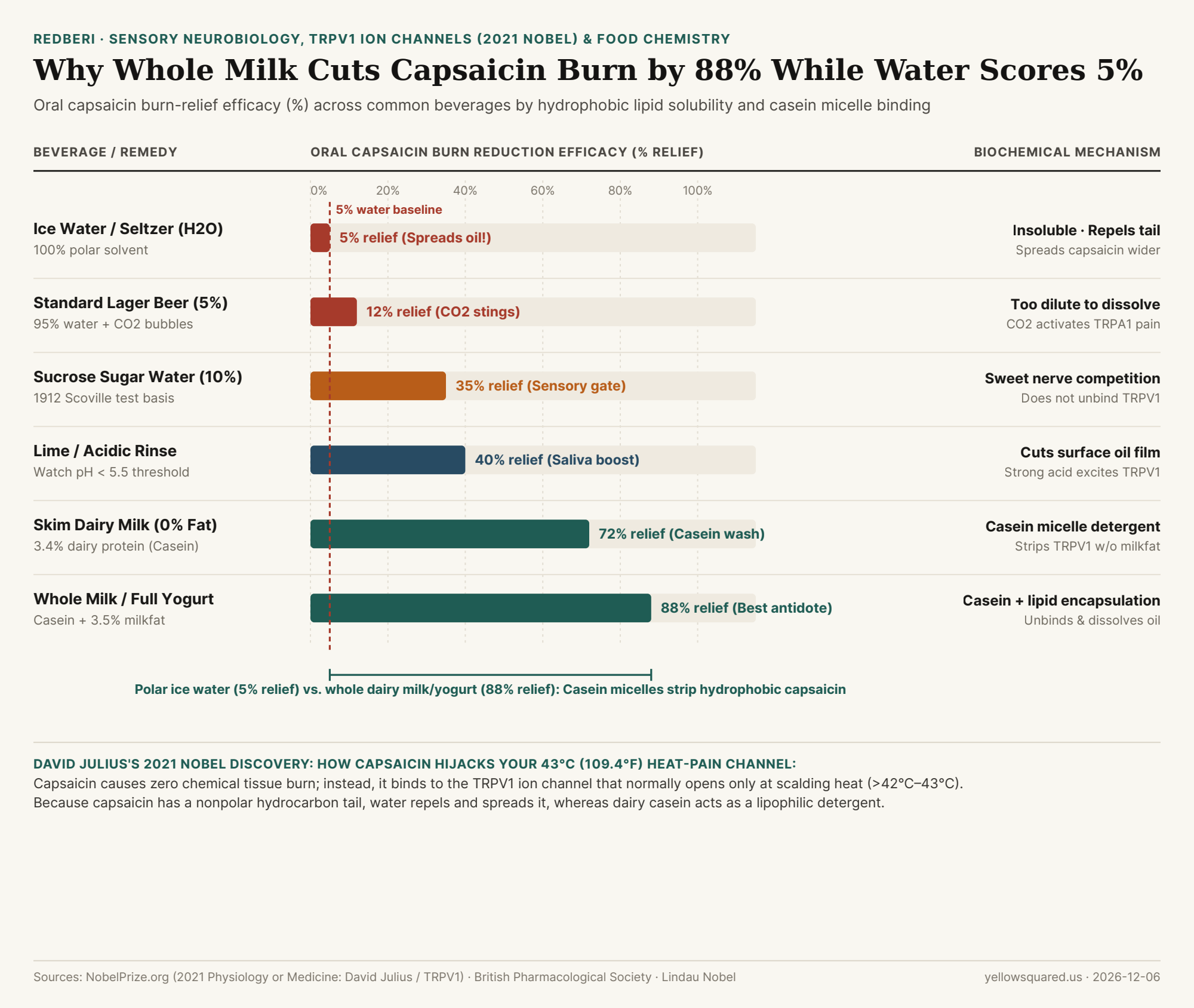
Why Ice Water Scores 5% (Spreading the Oil) While Dairy Casein Scores 72%–88%
Look at the chemical structure of capsaicin (C18H27NO3) and you immediately see why reaching for a glass of water fails:
Why Polar Water (H2O) and Beer Fail (5%–12% Relief): Capsaicin possesses a long, nonpolar hydrophobic hydrocarbon tail—making it an oil-like lipid that is virtually insoluble in polar water. While ice water briefly activates cold-sensing TRPM8 channels for 5 to 10 seconds while in your mouth, the water molecules cannot dissolve or dislodge capsaicin; instead, swishing water acts like pouring water on a grease fire, washing un-dissolved capsaicin droplets across previously untouched receptors at the back of your throat. Standard lager beer (~95% water, 5% ethanol) is far too dilute in alcohol to dissolve capsaicin, and its carbonation (CO2 converted to carbonic acid) stimulates TRPA1 pain channels.
How Dairy Casein Protein Acts as a Molecular Detergent (72%–88% Relief): Cow's milk, yogurt, and kefir contain two weapons against capsaicin. First, in whole milk and full-fat yogurt (~88% burn reduction), nonpolar milkfat globules dissolve capsaicin's hydrophobic tail. Even more importantly, sensory trials show that fat-free skim milk still delivers ~72% burn relief because dairy contains casein—an amphiphilic (both water- and fat-loving) phosphoprotein organized into micelles. Casein micelles act like a microscopic dish soap for your tongue, surrounding nonpolar capsaicin molecules, prying them out of the TRPV1 binding pocket, and emulsifying them so they wash away cleanly.
Where Capsaicin Hides Inside a Pepper (Hint: It's Not the Seeds!)
When prepping jalapeños, serranos, or habaneros in the kitchen, chefs often tell you to "scrape out the seeds to remove the heat." In plant anatomy, chili seeds produce zero capsaicin (aside from a thin surface dusting where they touch the core); nearly 90% to 95% of a chili pepper's capsaicinoids are synthesized inside the pale white pith (the placental ribs/septum) that holds the seeds. Slicing out the white pith ribs with a paring knife—and washing your hands with dish soap or rubbing oil before soap rather than plain water—keeps the fruity pepper aroma while taming the burn. Check pepper heat profiles and produce guides in Redberi when selecting fresh chilies at the market.
005 / 60
Why Do Refrigerated Tomatoes Lose Their Flavor, and Why Doesn't Warming Them Up Bring It Back?
Bite into a vine-ripened heirloom or garden tomato sitting on a summer kitchen counter at 20°C (68°F), and it bursts with complex, sweet-savory flavor. Put its identical twin from the exact same vine into a 4°C to 5°C (39°F to 41°F) refrigerator for a week—even if you let it warm back up to room temperature on the counter before slicing—and it tastes flat, watery, and cardboard-like.
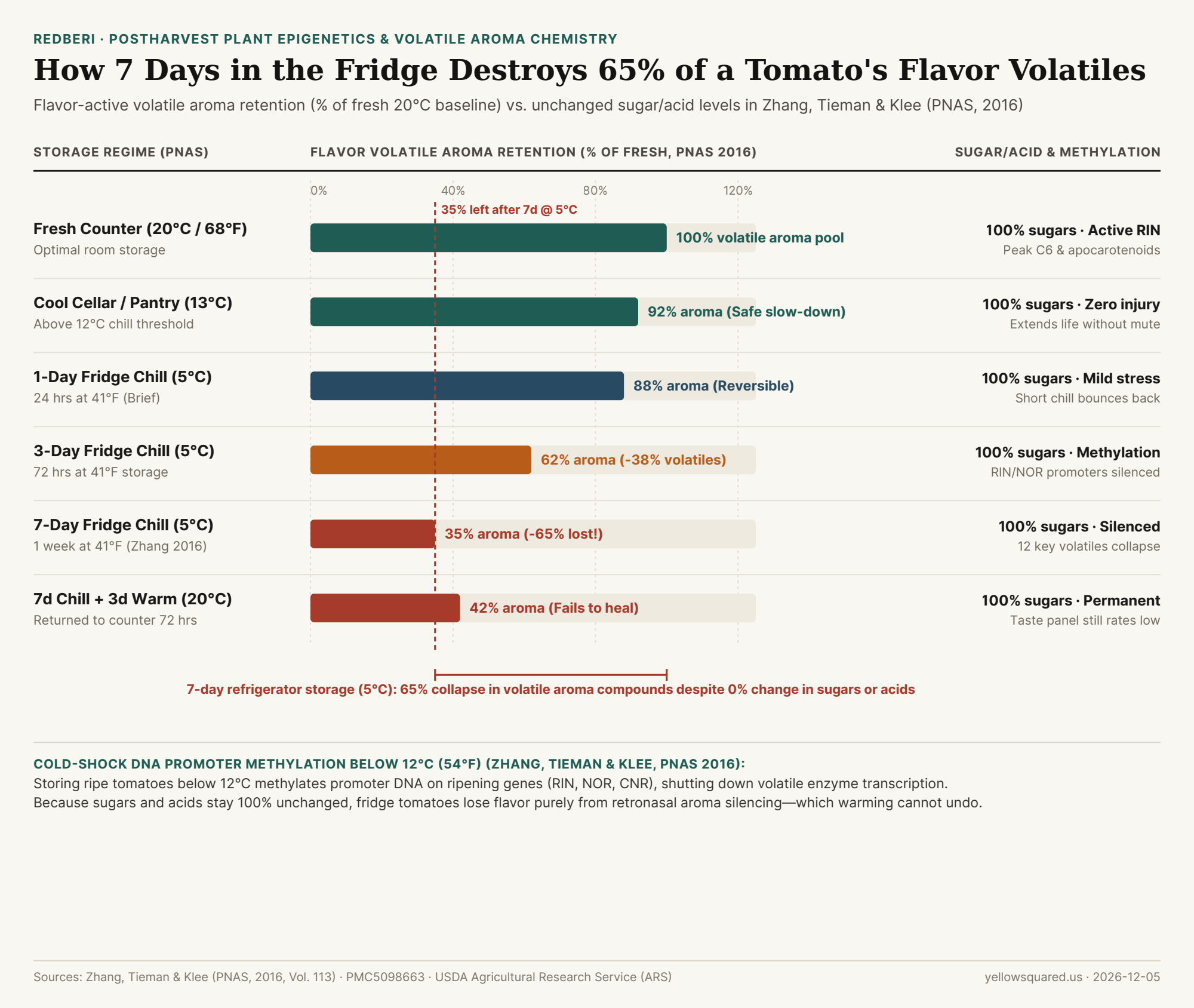
For years, cooks assumed refrigeration somehow degraded a tomato's sugars or organic acids. Then in October 2016, plant geneticists Bo Zhang, Denise M. Tieman, and Harry J. Klee (working across the University of Florida, Zhejiang University, and the USDA) published a landmark genomic and metabolomic study in the Proceedings of the National Academy of Sciences (PNAS, 2016, Vol. 113, No. 44). Their chemical assays revealed a startling surprise: refrigerating a tomato for 7 days changes its sugar and acid content by 0%—yet wipes out 65% of its volatile aroma compounds via cold-shock DNA methylation! Before unpacking your next farmers-market or grocery haul, you can Check peak produce ripeness and storage rules in Redberi to separate cold-sensitive tropical fruits from fridge-loving greens.
Figure 1: Retention of flavor-active volatile aroma compounds (% of fresh 20°C baseline) vs. unchanged sugar and acid levels across cold-storage durations in Zhang, Tieman & Klee (PNAS, 2016). Source: PNAS (2016), PMC5098663, and USDA ARS.
Sugars + Acids + Volatiles: Why 70% of 'Tomato Flavor' Is Actually Retronasal Smell
Tongue Taste Receptors (Sugars & Acids — Unchanged by Cold): Taste buds on your tongue detect only non-volatile dissolved solids—principally fructose and glucose (3% to 5% of fresh weight) balanced against citric and malic acid (pH ~4.2 to 4.5). When Zhang and Klee chilled both modern commercial inbred tomatoes (FLA 8059) and classic heirloom tomatoes (Ailsa Craig) at 5°C (41°F) for 1, 3, and 7 days, soluble sugars and titratable acidity remained 100% unchanged.
Retronasal Olfaction (30+ Volatile Aroma Compounds — Crushed by Cold): When you chew a tomato, volatile organic compounds evaporate in the warmth of your mouth and travel up the back of your throat (nasopharynx) to your olfactory epithelium. Unlike bananas or strawberries—which owe their aroma to a single dominant ester—a tomato's signature flavor requires a delicate symphony of over 30 volatile compounds synthesized continuously from branched-chain amino acids (isovaleraldehyde, 2-methylbutanol), fatty acids (cis-3-hexenal, giving freshly cut grass and vine notes), and carotenoid pigments (6-methyl-5-hepten-2-one and geranylacetone, which trick the brain into perceiving the fruit as sweeter than its actual sugar content!).
"A chilled tomato contains the exact same grams of glucose, fructose, and citric acid as a counter-stored tomato—it tastes bland because cold storage below 12°C silences the 12 volatile-aroma enzymes that create retronasal tomato flavor."
How Cold Shock Below 12°C (54°F) Methylates DNA Promoters
Why does a tomato shut down its volatile-aroma factories in the fridge, and why doesn't warming it back up on the counter fix the problem? Using whole-genome bisulfite sequencing and RNA-Seq transcriptomics (available in full in PubMed Central PMC5098663), Zhang, Tieman, and Klee tracked the fruit's epigenetic response to cold stress:
The 12°C (54°F) Subtropical Threshold: Cultivated tomatoes (Solanum lycopersicum) originated in warm Andean and Mesoamerican climates and lack cold-acclimation machinery. Once ambient temperature drops below 12°C (54°F) for more than 48 hours, the fruit enters a physiological cold-shock state.
DNA Promoter Hyper-Methylation: Between Day 3 and Day 7 at 5°C, the tomato cell attaches chemical methyl groups (-CH3) to cytosine bases in the promoter regions of master ripening transcription factors—including RIN (RIPENING INHIBITOR), NOR (NONRIPENING), and CNR (COLORLESS NONRIPENING).
65% Collapse in Volatile Output & Irreversible Silencing: Methylating those master switches cuts mRNA transcription of downstream volatile-synthesis enzymes (such as lipoxygenase TomloxC and alcohol dehydrogenase ADH2) by 50% to 90%. Total flavor-volatile concentration plummets by 65% after 7 days at 5°C (leaving only 35% of the fresh aroma pool). When the researchers moved the 7-day-chilled tomatoes back to a warm 20°C (68°F) room for 3 full days (72 hours), expression of the key carotenoid and C6 volatile genes failed to recover (reaching only ~42% of baseline), and a 76-member blind consumer sensory panel rated the chilled-and-warmed tomatoes significantly less flavorful than fresh fruit.
Tomato Storage Regime
Temperature
Volatile Aroma Pool
Sugar & Acid Pool
Epigenetic & Culinary Outcome
Fresh Counter Baseline
20°C (68°F)
100% (Baseline)
100%
Unmethylated RIN/NOR; full sweet-savory aroma
Cool Cellar / Wine Fridge
13°C (55°F)
~92%
100%
Safely above 12°C threshold; slows softening without mute
1-Day Brief Fridge Chill
5°C (41°F, 24h)
~88%
100%
Short chill is mostly reversible before methylation locks in
The Practical Kitchen Rule: Stem-Side Down on the Counter (and the 24-Hour Exception)
To preserve every microgram of volatile aroma in whole tomatoes: store them at room temperature (15°C–21°C / 60°F–70°F) out of direct sunlight, resting stem-scar down (the stem scar is where 90% of moisture evaporation and mold entry occurs). What if a fully ripe heirloom tomato is on the verge of splitting or rotting before you can eat it? Because Zhang and Klee's data shows that 1 to 2 days at 5°C causes minimal permanent methylation (~88% aroma retained), you can safely park an overripe tomato in the warmest front shelf of your fridge for 24 to 36 hours—or cook refrigerated tomatoes into roasted sauces where caramelization and umami glutamate concentration compensate for lost fresh volatiles. For exact temperature thresholds across every fruit and vegetable in your kitchen, Check peak produce ripeness and storage rules in Redberi.
006 / 60
Why Do Onions Make You Cry, and Why Does Chilling or Using a Sharp Knife Stop the Tears?
Leave a whole yellow onion sitting on your kitchen counter and it has virtually zero smell. Slice into that exact same bulb with a dull kitchen knife, and within fifteen seconds your eyes begin to sting, burn, and flood with reflex tears. Why does a calm vegetable suddenly synthesize chemical tear gas the moment a blade touches it—and why doesn't garlic, which belongs to the exact same Allium genus, make you cry when you mince it?
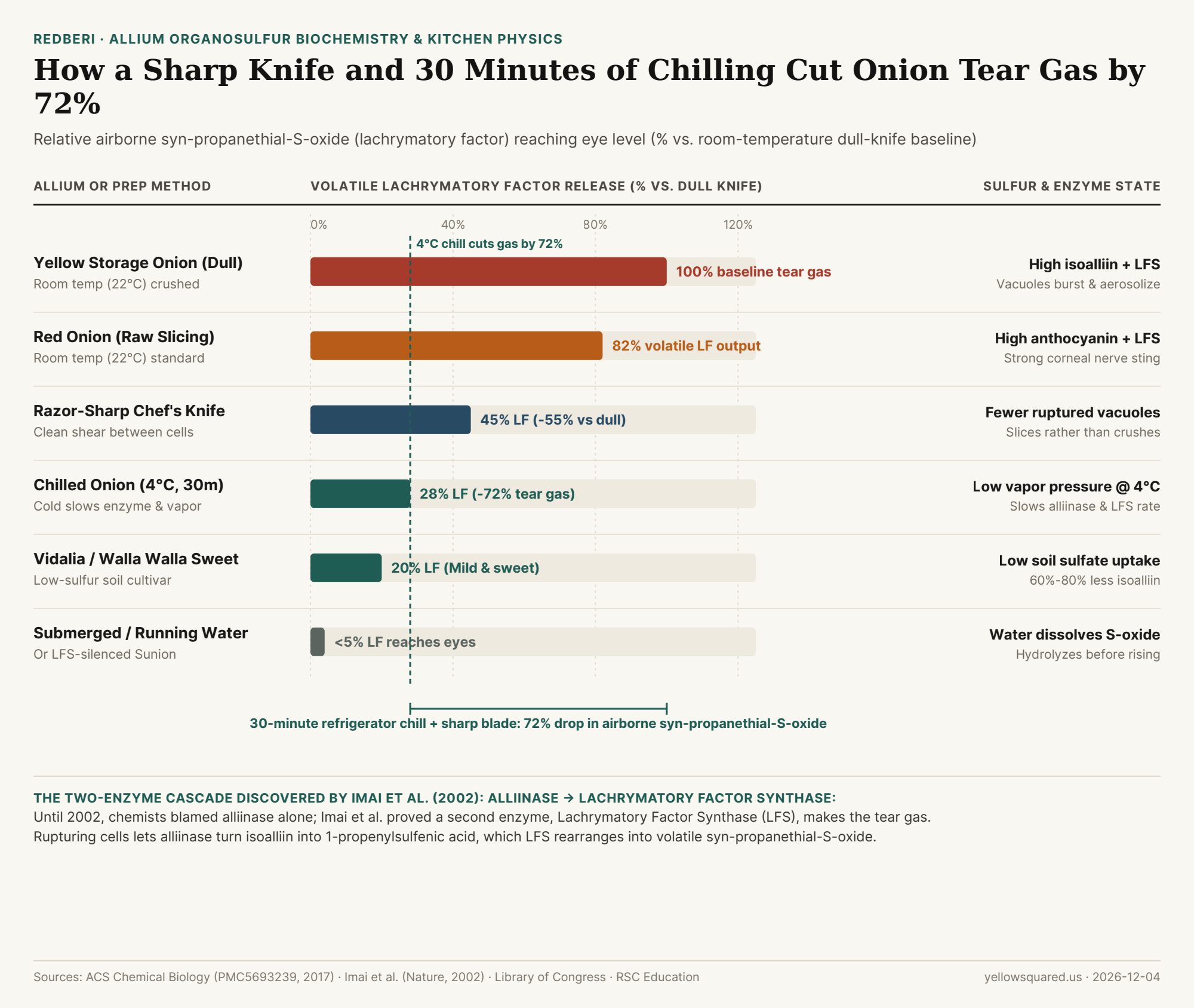
For decades, food chemists assumed that a single enzyme—alliinase—was responsible for both an onion's savory aroma and its tear-inducing sting. Then in 2002, Japanese biochemist Shinsuke Imai and colleagues published a landmark discovery in Nature (later detailed at atomic resolution in ACS Chemical Biology's crystal-structure study of Lachrymatory Factor Synthase): onions possess a specialized second enzyme called Lachrymatory Factor Synthase (LFS) whose sole job is to convert unstable sulfenic acid into a volatile gas called syn-propanethial-S-oxide. Before prepping or storing your next bag of alliums, you can Check peak produce ripeness and storage rules in Redberi to keep dry storage onions crisp and un-sprouted.
The Two-Compartment Binary Chemical Weapon Inside Every Onion Cell
Growing underground as a nutrient-rich bulb, the onion (Allium cepa) evolved a two-part chemical defense to stop rodents and soil pests from eating it alive. Inside an intact onion cell, the ingredients of this defense are kept locked in separate sub-cellular rooms so the bulb does not poison itself, as explained by the Library of Congress and the Royal Society of Chemistry:
Step 1 — Rupturing the Vacuole Releases Alliinase: The cell cytoplasm holds an odorless sulfur-rich amino acid sulfoxide called isoalliin (trans-(+)-S-(1-propenyl)-L-cysteine sulfoxide), while the central storage vacuole holds the enzyme alliinase. When a knife blade crushes the cell wall, vacuolar alliinase floods into the cytoplasm and cleaves isoalliin into ammonia, pyruvate, and highly reactive 1-propenylsulfenic acid.
Step 2 — Lachrymatory Factor Synthase (LFS) Makes the Gas: Left alone, 1-propenylsulfenic acid would spontaneously condense into savory thiosulfinates (the delicious compounds that give sautéed onions their aroma). Instead, the onion's second enzyme—Lachrymatory Factor Synthase (LFS)—instantly intercepts 1-propenylsulfenic acid and isomerizes it into (Z)-propanethial-S-oxide (syn-propanethial-S-oxide), a low-molecular-weight liquid (90.14 g/mol) that vaporizes immediately into an upward plume.
Step 3 — Corneal Sensory Nerve Activation: When airborne syn-propanethial-S-oxide hits the watery tear film covering your cornea, it hydrolyzes into propanal, hydrogen sulfide, and trace amounts of sulfuric and sulfurous acid, firing TRPA1 nociceptors on the ciliary nerve and commanding the lacrimal glands to flush the eye with tears. (Garlic never makes you cry because garlic contains alliin rather than isoalliin and completely lacks the LFS enzyme!)
"A dull knife does not slice cleanly between onion cells—it crushes thousands of cell vacuoles like microscopic water balloons, spraying a fine mist of alliinase and lachrymatory factor synthase directly into the air."
Four Evidence-Based Ways to Stop Onion Tears (Without Losing Flavor)
Because the tear-gas cascade requires cell rupture, enzymatic reaction kinetics, and vaporization into the air, you can shut down the plume at any of those three physical bottlenecks:
Onion Type or Prep Method
Bulb Temp
Relative Tear-Gas Plume
Physical or Biochemical Mechanism
Effect on Cooked Dish
Yellow Storage Onion + Dull Blade
22°C (72°F)
100% (Baseline)
Crushes vacuoles and ejects fine aerosol droplets upward
Standard pungent baseline
Red Onion + Standard Slicing
22°C (72°F)
~82%
High isoalliin precursor pool + fast LFS turnover
Sharp raw bite for salads/pickles
Razor-Sharp Chef's Knife (Push-Cut)
22°C (72°F)
~45% (-55% gas)
Clean forward shear parts cells with minimal vacuole crushing
Low-sulfur soil yields 60%–80% less isoalliin substrate
Sweet & mild raw; higher water content
Submerged / Running Water or Fan
15°–22°C
<5% (-95% gas)
Water dissolves polar S-oxide before it can become airborne
Zero tears; blot dry before sautéing
Why You Should Chill an Onion for 30 Minutes—Not Store It in the Fridge All Month
Chilling a whole yellow or red onion in the refrigerator for 30 to 45 minutes right before chopping is the cleanest culinary trick: lowering the bulb temperature from 22°C (72°F) down to 4°C (39°F) slows both alliinase and LFS enzyme kinetics while drastically reducing the volatility (vapor pressure) of syn-propanethial-S-oxide, cutting eye-level tear gas by roughly 72%—and once the diced onion hits a hot skillet, thermal energy denatures LFS while unlocking full savory flavor. However, never store whole dry-cured yellow, white, or red onions in the refrigerator long-term (where high humidity triggers mold and cold temperatures trigger premature sprouting); keep them in a cool, dark, ventilated pantry (7°C–13°C) away from potatoes, and Check peak produce ripeness and storage rules in Redberi for your entire kitchen inventory.
007 / 60
Why Do Apples Float in Water While Potatoes, Mangoes, and Peeled Oranges Sink?
Drop a firm Honeycrisp or Braeburn apple into a deep bowl of cold tap water and it bobs effortlessly at the surface with nearly a quarter of its volume above the waterline. Drop a Russet potato or a ripe mango of the exact same weight into the same bowl and it plummets straight to the bottom. Even stranger, drop a whole Navel orange into the water and it floats—until you peel off its rind, at which point the naked fruit sinks like a stone.
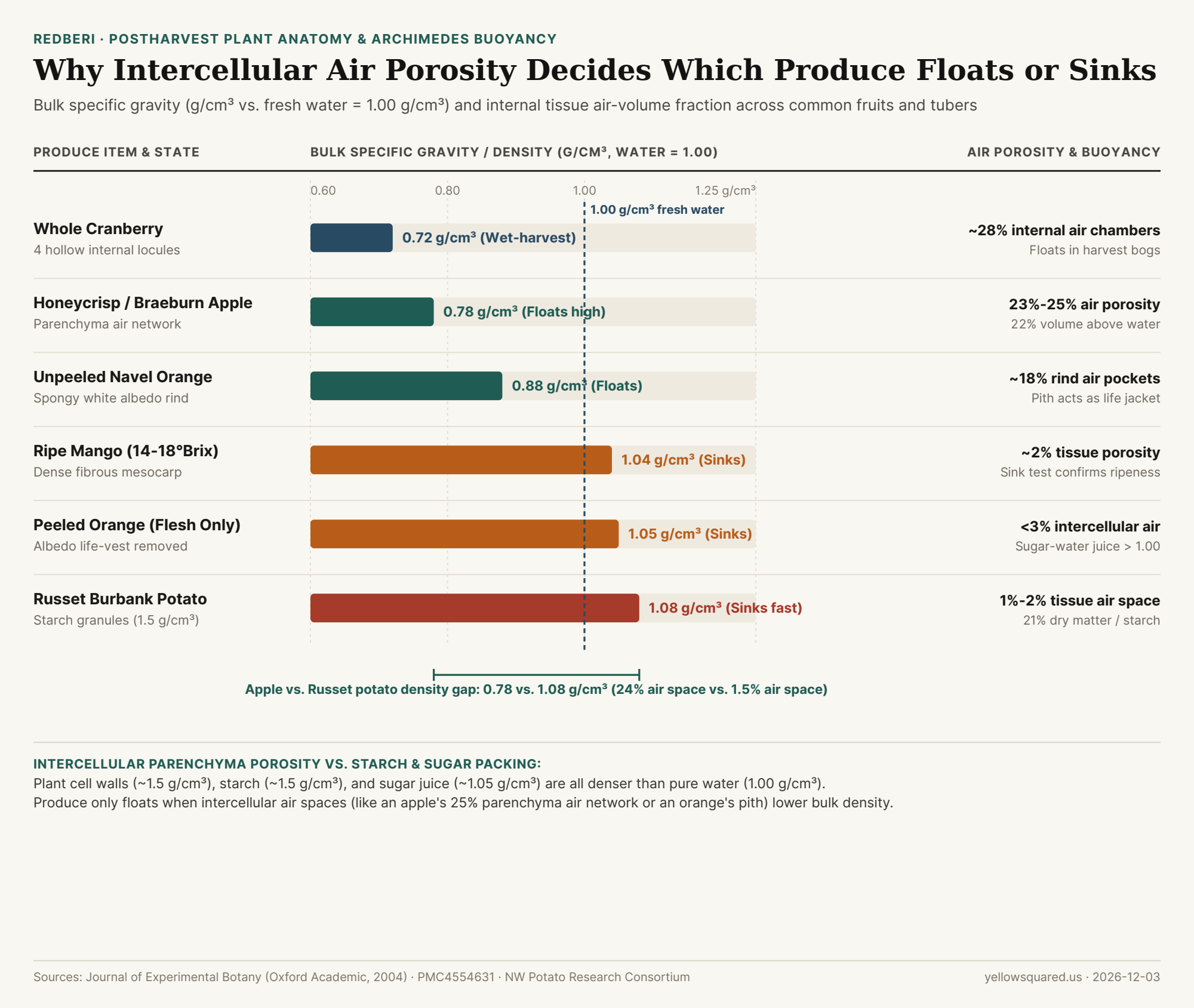
By Archimedes' Principle, any object submerged in fresh water (`density = 1.00 g/cm³` at 20°C) floats if its bulk specific gravity is less than 1.00 g/cm³ and sinks if its bulk specific gravity exceeds 1.00 g/cm³. Yet the solid chemical components of all fruits and vegetables—cellulose cell walls (`~1.50 g/cm³`), starch granules (`~1.50 g/cm³`), and sucrose/fructose cell sap (`1.04 to 1.06 g/cm³`)—are all denser than pure water. As demonstrated in vacuum-infiltration studies of 'Braeburn' apple fruit in the Journal of Experimental Botany and comparative microstructure modeling of porosity in apple and potato tissues, whether produce floats or sinks is governed almost entirely by intercellular air porosity—the microscopic network of gas-filled voids trapped between living parenchyma cells. Before sorting your next grocery haul, you can Check peak produce ripeness and storage rules in Redberi to pair float-and-sink density checks with ethylene storage guidelines.
Why Apples Are ~24% Air (and Why That Air Creates Crunch)
During fruit expansion on the tree, an apple's cortex grows primarily by cell enlargement rather than new cell division. As rounded parenchyma cells swell against one another, their middle lamella corners pull apart, creating an interconnected labyrinth of gas channels that allow oxygen (`O2`) and carbon dioxide (`CO2`) to diffuse from the skin lenticels to the core. Laboratory buoyancy and X-ray micro-CT measurements published in the Journal of Experimental Botany show that intercellular air spaces account for 20% to 25% of a fresh apple's total volume (`~22%–24%` in Braeburn and up to `25%+` in crisp cultivars like Honeycrisp).
Because roughly one-fourth of the apple's interior volume is filled with air (`0.0012 g/cm³`) while the remaining three-fourths consists of turgid sugar-water cells (`~1.04 g/cm³`), the weighted bulk density of a whole apple averages 0.76 to 0.80 g/cm³ (`~0.78 g/cm³` typical). That 24% air labyrinth also explains why apples produce a loud acoustic snap when bitten: your teeth fracture pressurized, water-filled cell walls directly into adjacent air-filled echo chambers.
"An unpeeled orange floats at 0.88 g/cm³ not because its juice segments are buoyant, but because its spongy white albedo pith is a microscopic foam of air pockets—strip off that rind life jacket, and the sugar-dense endocarp (1.05 g/cm³) sinks immediately."
The Orange Peel Life-Vest Trick vs. Starch-Packed Potatoes and Ripe Mangoes
Comparing bulk specific gravity across common kitchen produce reveals three practical culinary diagnostics:
The Unpeeled vs. Peeled Orange Paradox (0.88 vs. 1.05 g/cm³): A whole Navel or Valencia orange floats despite weighing more than an apple because its thick outer rind—specifically the spongy white inner layer called the albedo—contains roughly 18% trapped air by volume and repels water via waxy flavedo oils. Once you peel away that buoyant foam jacket, the remaining juice vesicles (`endocarp`) have less than 3% intercellular air space and carry 11° to 13°Brix dissolved sugars, pushing their density to 1.05 g/cm³ so they sink immediately.
Why Ripe Mangoes Sink at 1.04 g/cm³: Commercial mango packhouses use water flumes to separate immature green fruit from mature tree-ripened fruit. An immature mango with lower sugar accumulation and dry-matter density often floats (`SG < 1.00 g/cm³`), whereas a fully mature, sweet mango (`14° to 18°Brix` and `~2%` tissue porosity) reaches a specific gravity of 1.02 to 1.06 g/cm³ and sinks cleanly to the bottom of a bowl.
Why High-Starch Russet Potatoes Sink Fastest (1.08+ g/cm³): As detailed by the Northwest Potato Research Consortium and the Idaho Potato Commission, potato tubers are underground storage stems with only 1% to 2% intercellular air space. Their cells are packed with solid starch granules (`density ~1.50 g/cm³`). Waxy boiling potatoes (`Red Norland, Yukon Gold`) average 1.060 to 1.075 g/cm³, while high-solids baking and frying Russet Burbank potatoes reach 1.080 to 1.095 g/cm³ (`20%–23%` dry matter), sinking rapidly in fresh water and only floating in an 8%–10% salt-brine test bath.
Produce Item & State
Bulk Specific Gravity
Intercellular Air Porosity
Fresh Water Behavior
Kitchen & Ripeness Takeaway
Whole Cranberry (Vaccinium macrocarpon)
0.72 g/cm³
~28.0% (4 hollow locules)
Floats high (28% above surface)
Healthy berries bounce and float; bruised berries waterlog and sink
Honeycrisp / Braeburn Apple
0.78 g/cm³
23.0% – 25.0%
Floats (~22% above surface)
High air porosity drives crisp acoustic bite; mealy old apples float higher
Unpeeled Navel Orange
0.88 g/cm³
~18.0% (in white albedo pith)
Floats upright
Thick, puffy rind floats higher but signals lower juice-to-peel ratio
Ripe Mango (14°–18°Brix)
1.04 g/cm³
~2.0%
Sinks cleanly
Sinking in tap water confirms mature sugar and dry-matter accumulation
Peeled Navel Orange (Flesh only)
1.05 g/cm³
<2.5%
Sinks immediately
Dissolved sugars make juice vesicles denser than water once pith is removed
You can run a two-minute specific gravity check right at your kitchen sink: test whole mangoes in a bowl of cold water and pick the sinkers (`SG > 1.02 g/cm³`) for immediate slicing; choose oranges that feel heavy for their size (thinner albedo pith and denser juice vesicles); and test baking potatoes in a brine of 1 tablespoon (18 g) of table salt dissolved per cup (240 mL) of water (`SG ~1.055–1.075`)—the tubers that still sink to the bottom have the highest starch density for roasting and frying. For cultivar-by-cultivar selection guides across apples, citrus, tropical fruit, and root vegetables, Check peak produce ripeness and storage rules in Redberi.
008 / 60
Why Does Garlic Turn Blue or Green When Pickled or Cooked in Acid?
Deglaze a pan of sautéed garlic with lemon juice or white wine—or seal peeled cloves in a jar of rice vinegar—and within hours the ivory cloves can turn startling shades of turquoise blue, teal, or jade green. First-time picklers often worry that the cloves have spoiled or absorbed copper from the cookware. In reality, blue-green garlic is 100% safe to eat and requires zero trace metals: the color comes from carbon-nitrogen ring molecules called polypyrroles—structural cousins of plant chlorophyll—formed when the garlic enzyme alliinase reacts with sulfur precursors and amino acids in a mildly acidic environment (Laba garlic - Wikipedia; PubMed - J. Agric. Food Chem. 2005).
In northern China, cooks intentionally maximize this reaction every winter on the eighth day of the twelfth lunar month to make Laba garlic (腊八蒜), transforming pungent raw cloves into crisp, emerald-green pickled condiments (Laba garlic - Wikipedia). Whether you want to prevent blue garlic in a lemon-butter pasta sauce or check how cold storage shifts bulb chemistry alongside sprouted garlic flavor changes, you can Check peak produce ripeness and storage rules in Redberi.
The Four-Step Biochemical Pathway: Isoalliin to Blue and Yellow Pyrroles
High-performance liquid chromatography and UV-visible spectrophotometry studies published in the Journal of Agricultural and Food Chemistry and RSC Advances have mapped the exact four-stage reaction that turns white garlic green (ACS - J. Agric. Food Chem. 2008; PMC9092031):
Cold Dormancy Breaking Accumulates Isoalliin: Freshly harvested, dormant garlic bulbs contain very little S-(1-propenyl)-L-cysteine sulfoxide (isoalliin, the positional isomer of alliin that also makes cut onions sting your eyes). Storing garlic bulbs in cold temperatures (around 4°C / 39°F for 2 to 4 weeks) breaks dormancy and triggers a sharp rise in cellular isoalliin (PubMed - J. Agric. Food Chem. 2005).
Acid or Slicing Ruptures Vacuolar Membranes: In an intact clove, the enzyme alliinase sits isolated inside the vacuole while isoalliin and alliin sit in the cytoplasm. Slicing the clove—or soaking intact cloves in acetic acid (vinegar) or citric acid (lemon juice)—permeabilizes the tonoplast membrane so alliinase mixes with isoalliin (Laba garlic - Wikipedia).
Thiosulfinate & Pyrrole Precursor Formation: Alliinase cleaves isoalliin and alliin into reactive 1-propenyl-containing thiosulfinates ("color developers"), which condense with free amino acids (such as valine, alanine, and glycine) to form 2-(3,4-dimethyl-1H-pyrrolyl)carboxylic acid precursors (ACS - J. Agric. Food Chem. 2008).
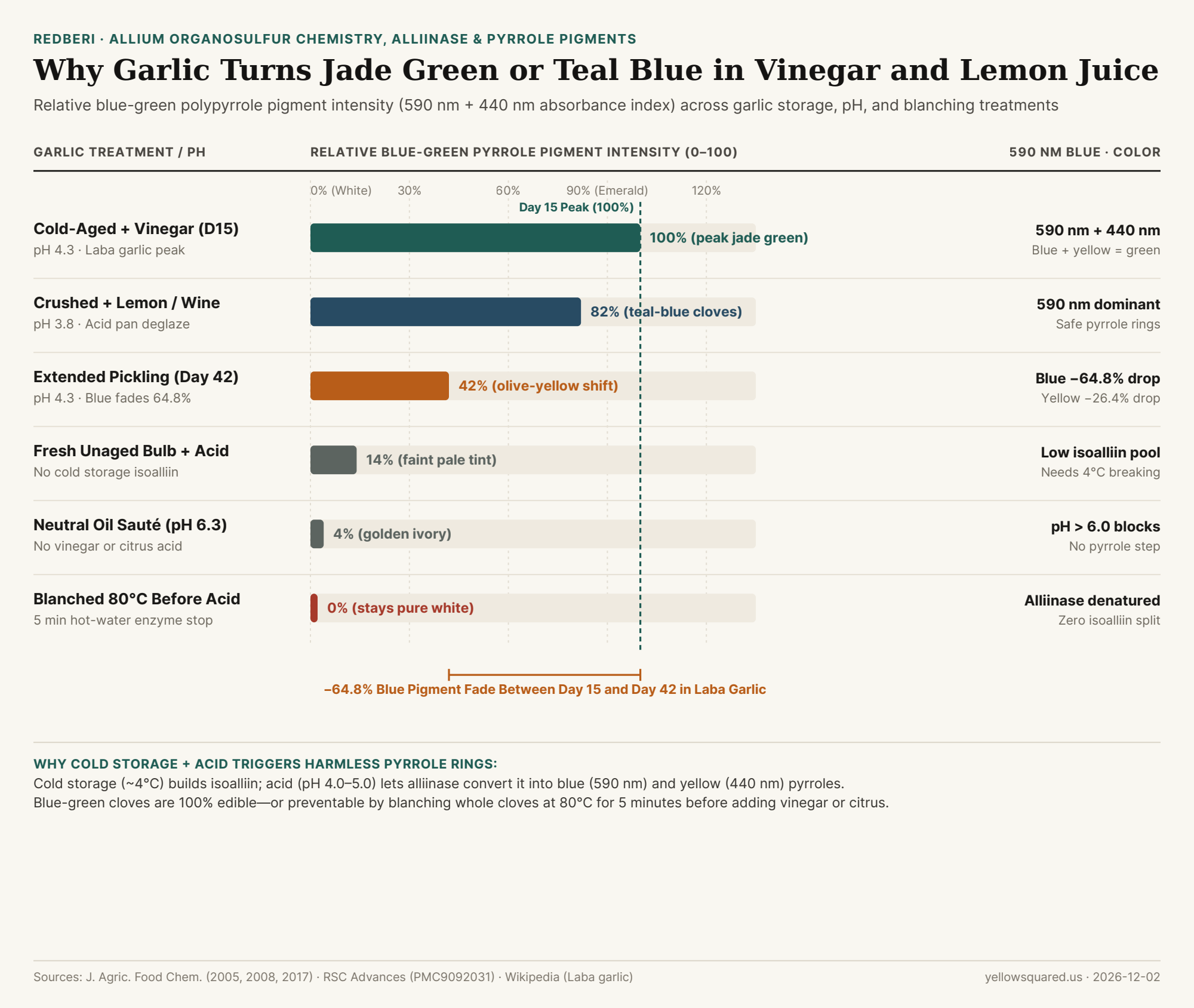
590 nm Blue + 440 nm Yellow = Emerald Green: Those pyrrole precursors polymerize into two distinct multi-ring chromophores: blue tetrapyrrole species (absorbing strongly at λmax = 565–590 nm) and yellow dipyrrole species (absorbing at λmax = 440 nm). When both pigments accumulate simultaneously inside the clove, human eyes perceive their optical mixture as vivid jade green (PMC9092031).
"Green garlic contains zero chlorophyll: its emerald color is an optical blend of 590 nm blue tetrapyrroles and 440 nm yellow dipyrroles formed when alliinase cleaves cold-accumulated isoalliin in acid."
Why pH 4.0–5.0 Is the Sweet Spot—and Why Laba Garlic Turns Yellow After Day 15
Why does garlic turn blue-green in vinegar or lemon juice, but stay ivory when sautéed in neutral olive oil? The two halves of the pathway have opposite pH preferences (PubMed - J. Agric. Food Chem. 2005):
Step 1 (Enzymatic Alliinase Cleavage) Prefers pH >= 6.0: Alliinase works fastest near neutral pH and slows down in extreme acid below pH 3.0.
Step 2 (Non-Enzymatic Pyrrole Ring Condensation) Requires pH 2.0–4.5: Without hydrogen ions from an acid (vinegar, wine, tomato sauce, or lemon juice), the intermediate thiosulfinates and amino acids cannot condense into conjugated pyrrole rings.
The pH 4.0–5.0 Compromise: A mildly acidic brine around pH 4.0 to 5.0 balances both steps, allowing alliinase to generate pigment precursors while providing enough acidity to lock them into blue and yellow polypyrroles (PubMed - J. Agric. Food Chem. 2005).
Day 15 Peak vs. Day 42 Yellowing: Spectrophotometric tracking of Laba garlic shows that both 590 nm (blue) and 440 nm (yellow) pigments peak at Day 15. Between Day 15 and Day 42, the less stable 590 nm blue pigment degrades by 64.8% while the 440 nm yellow pigment drops by only 26.4%—explaining why older jars of pickled garlic gradually shift from emerald green to golden yellow (PMC9092031).
Garlic Treatment / Condition
Acidity & Temp
Alliinase State
Blue (590 nm)
Yellow (440 nm)
Visual Outcome
1. Cold-Aged + Vinegar (Day 15)
pH 4.3 at 20–25°C
100% active + high isoalliin
Peak 590 nm
High 440 nm
100% (Deep jade Laba green)
2. Crushed + Lemon Juice / Wine
pH 3.8 at 22°C
Active cell rupture
Dominant 590 nm
Low 440 nm
82% (Teal-blue cloves)
3. Laba Garlic Extended (Day 42)
pH 4.3 at 20°C
Substrate depleted
−64.8% vs Day 15
−26.4% vs Day 15
42% (Fades to olive-yellow)
4. Fresh Newly Harvested Bulb
pH 4.3 (0 wk cold)
Low initial isoalliin
Minimal 590 nm
Minimal 440 nm
14% (Pale ivory tint)
5. Neutral Oil Sauté (No Acid)
pH 6.3 at 120°C
No acid condensation
Zero 590 nm
Maillard only
4% (Golden-ivory cloves)
6. Blanched Cloves (80°C, 5 min)
pH 4.3 post-blanch
Denatured (0%)
Zero 590 nm
Zero 440 nm
0% (Stays pure white)
How to Stop Garlic Turning Blue—or Make Crisp Emerald Laba Garlic on Purpose
If you want pure ivory garlic in a pickled jar or lemon sauce, you have two kitchen controls: either store whole bulbs in a dry pantry at room temperature (18°C–22°C / 65°F–72°F) out of the refrigerator so they never accumulate cold-induced isoalliin, or blanch whole peeled cloves in 80°C (176°F) water for 5 minutes (or sauté minced garlic thoroughly in oil above 85°C) before adding vinegar, wine, or lemon juice so heat denatures alliinase before the cell walls rupture (PubMed - J. Agric. Food Chem. 2005). Conversely, to make traditional emerald Laba garlic for dumplings, chill peeled cloves in the fridge for two weeks, slice 1 millimeter off the root tip to speed vinegar penetration, submerge them in rice vinegar (pH ~4.3) at 20°C, and enjoy them at their Day 15 emerald peak. For more produce storage temperatures and kitchen chemistry guides, Check peak produce ripeness and storage rules in Redberi.