YellowSquared  /  Field notes

Notes from the workshop

60 posts, newest first. Choose an app to narrow the feed.

009 / 60

Why Do Refrigerated Potatoes Taste Sweet and Fry Dark—And What Temperature Keeps Them From Sprouting or Turning Green?

Toss a 5-pound bag of Russet or Yukon Gold potatoes into a standard home refrigerator (35°F to 38°F / 1.7°C to 3.3°C) for two weeks, and the tubers will look firm and sprout-free when you pull them out. Slice them into French fries or roast wedges at 375°F, however, and the outside scorches into a bitter, dark mahogany-black crust before the center is even tender—while boiled or mashed potatoes take on a noticeably sugary aftertaste. Leave the next bag on a sunny 70°F kitchen counter instead, and the skins turn bright green inside 48 hours and sprout within two weeks. That two-sided trap is governed by two separate postharvest mechanisms documented by the USDA Agricultural Research Service (ARS) and the UC Davis Postharvest Research and Extension Center: cold-induced sweetening (CIS) below 40°F (4.4°C) and light-activated chlorophyll and glycoalkaloid (solanine) synthesis.

Reader outcome: You will learn the exact enzymatic cutoff (40°F) where potato starch turns into reducing sugars, why green potato skin signals elevated solanine that cooking cannot destroy, and how to store fresh potatoes at 45°F to 50°F in darkness so they stay firm, golden-frying, and sprout-free for 3 to 5 months.
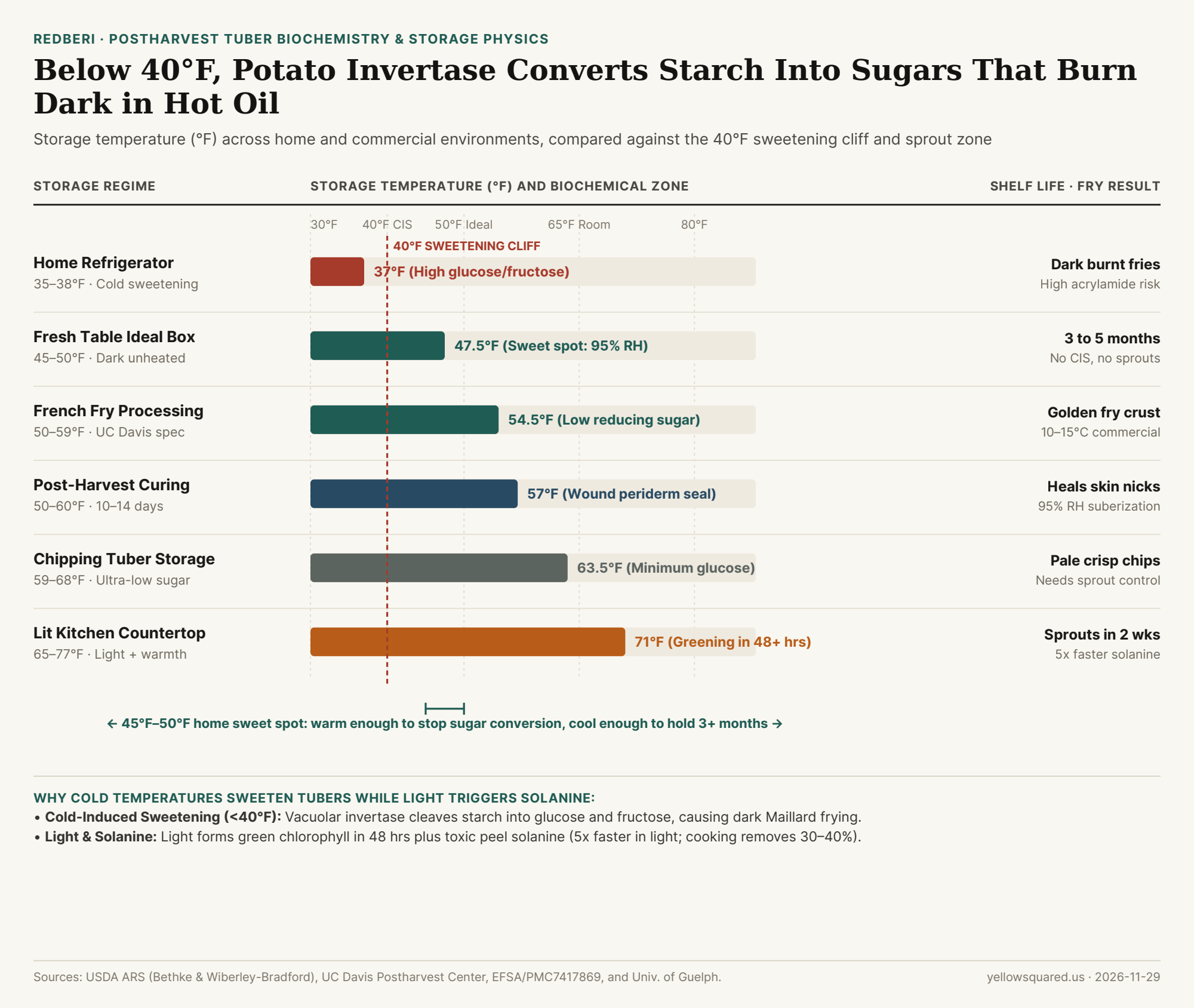
Chart comparing potato storage temperature regimes from 35°F refrigerator cold-induced sweetening to 45–50°F optimal cellar storage and 71°F countertop greening
Below the 40°F (4.4°C) threshold, cold stress activates starch-degrading enzymes that flood potato cells with glucose and fructose. Above 60°F, dormancy breaks and light exposure accelerates solanine synthesis 5-fold. Data: Download CSV dataset.

What Is Cold-Induced Sweetening (And Why Do Refrigerated Potatoes Fry Dark)?

A harvested potato tuber is a living, respiring stem organ whose dry weight is roughly 70% to 80% starch. When ambient temperature drops below 40°F (4.4°C), the tuber's cold-stress response shifts its carbohydrate balance to protect cellular membranes from freezing. As USDA ARS researchers Paul Bethke and Amelia Wiberley-Bradford and University of Guelph biochemists detail, low temperatures upregulate starch-breakdown pathways—specifically plastidial starch phosphorylase (Pho1), UDP-glucose pyrophosphorylase, and vacuolar acid invertase (StVInv).

First, starch granules are cleaved into sucrose; then, vacuolar invertase splits each non-reducing sucrose molecule into two reducing sugars: glucose and fructose. Why does that distinction matter in the skillet? Sucrose does not participate directly in the Maillard browning reaction until it hydrolyzes, whereas free glucose and fructose have reactive carbonyl groups that combine rapidly with the free amino acid asparagine at frying temperatures above 285°F (140°C). The result is twofold:

  • Premature Dark Browning & Bitter Scorch: High glucose and fructose concentrations caramelize and char the exterior of fries and chips dark brown-black long before interior moisture has cooked off. In commercial French fry and potato chip plants, cold-induced sweetening causes 15% to 20% of tuber rejections.
  • Acrylamide Formation: The Maillard reaction between reducing sugars (glucose/fructose) and free asparagine at high heat is the primary chemical pathway producing acrylamide in fried and roasted potato products.

Storing potatoes at 45°F to 50°F (7°C to 10°C) stays safely above the 40°F invertase cliff while keeping respiration slow enough to prevent sprouting for 3 to 5 months.

Temperature Regimes Compared: Refrigerator vs. Cellar vs. Processing Specs

Because different culinary methods tolerate different reducing-sugar baselines, the UC Davis Postharvest Center and postharvest agronomy standards specify distinct temperature and humidity targets depending on whether tubers are boiled, fried into French fries, or sliced thin into potato chips:

Storage Environment Temperature Range Relative Humidity Dormancy / Shelf Life Reducing Sugar Accumulation Fry Color & Culinary Outcome
Home Refrigerator 35°F to 38°F (1.7°C–3.3°C) 30% to 50% RH Sprout-free 3+ months High (Invertase cleaves starch to glucose/fructose) Fries burn dark brown-black; elevated acrylamide
Commercial Cold Warehouse 39°F (4.0°C) + CIPC/Ethylene 95% to 98% RH 10 to 12 months High unless reconditioned at 59°F 15% to 20% processor rejection if unconditioned
Fresh Table Optimal Cellar 45°F to 50°F (7.2°C–10.0°C) 95% to 98% RH Up to 3 to 5 months Low (Above 40°F CIS threshold) Clean golden roasting, mashing, and boiling
French Fry Processing Spec 50°F to 59°F (10.0°C–15.0°C) 95% RH 2 to 4 months Minimal reducing sugars Uniform light-gold French fry Maillard crust
Potato Chip Processing Spec 59°F to 68°F (15.0°C–20.0°C) 95% RH 1 to 2 months Lowest glucose/fructose baseline Pale crisp potato chips without bitter scorch
Warm Lit Kitchen Countertop 65°F to 77°F (18.3°C–25.0°C) 40% to 60% RH Sprouts in 14 days; green in 48 hrs Low sugar, 5x faster solanine synthesis Bitter peel glycoalkaloids; shriveling & sprouts

Why Potatoes Turn Green in Light—And Why Peeling Matters More Than Cooking

When a potato sits under grocery store fluorescents or kitchen daylight, two parallel biochemical pathways switch on simultaneously in the outer cortex. The green pigment itself is chlorophyll, which is completely non-toxic and tasteless. However, light exposure simultaneously activates the synthesis of steroid glycoalkaloids—primarily alpha-solanine and alpha-chaconine, the plant's natural defense toxins against insects and fungi.

According to the European Food Safety Authority (EFSA) risk assessment on glycoalkaloids and postharvest toxicology studies, glycoalkaloid synthesis occurs 5 times faster in light than in darkness, and concentrations are 3 to 10 times higher in the peel and eyes than in the inner flesh. Because solanine is heat-stable up to roughly 340°F–390°F, standard boiling, baking, or frying reduces solanine levels by only 30% to 40%. Thoroughly peeling away the skin and any green layer removes the vast majority of glycoalkaloids on mildly greened tubers—and if a cooked potato ever tastes bitter or causes a burning sensation on the tongue, discard it immediately. If you accidentally refrigerated a bag of potatoes, you can partially reverse cold-induced sweetening by reconditioning them in a dark paper bag at 55°F to 60°F for 1 to 2 weeks before frying so respiration burns off excess glucose. For room-by-room storage temperatures and ethylene pairings across 100+ fruits and vegetables, Check produce ripeness and storage in Redberi.
010 / 60

Why Does Fresh Pineapple Make Your Tongue Tingle or Burn—And Why Does Canned Pineapple Never Sting?

Eat a bowl of fresh, raw pineapple chunks (Ananas comosus), and within five minutes your tongue, inner cheeks, and lips feel raw, prickly, and sandpapered—as if you had scalded your mouth on hot coffee. Yet if you eat the exact same amount of canned pineapple rings, grilled pineapple, or cooked pineapple upside-down cake, your mouth feels completely fine. Why does fresh pineapple sting so reliably, is it a food allergy, and why does the recipe on the back of every Jell-O box warn you never to add fresh pineapple? As documented in the biochemical reference on Bromelain, food-science analyses by the Institute of Food Technologists' Science Meets Food, Tasting Table, and Dole, fresh pineapple contains a potent pair of protein-digesting enzymes—stem bromelain (EC 3.4.22.32) and fruit bromelain (EC 3.4.22.33)—that literally begin tenderizing the protective protein layer of your oral mucosa while you chew.

Here is the exact three-stage biochemical mechanism behind "pineapple tongue," how to tell harmless bromelain irritation apart from true Oral Allergy Syndrome (OAS), and four science-backed ways to eat fresh pineapple without the burn.

1. The Two Enzymes Inside Ananas comosus: Stem Bromelain vs. Fruit Bromelain

First isolated by Venezuelan chemist Vicente Marcano in 1891 and characterized by Russell Henry Chittenden at Yale in 1892 (Wikipedia — Bromelain), bromelain is not a single molecule: it is a complex extract of proteolytic (protein-splitting) enzymes belonging to the sulfhydryl (cysteine) protease family, meaning each enzyme relies on a reactive free sulfhydryl (-SH) group on a cysteine amino acid side chain to slice peptide bonds in proteins:

  • Stem Bromelain (EC 3.4.22.32, MEROPS C01.005): Concentrated heavily in the pineapple plant's fibrous central stem and the tough central core of the fruit. In fact, commercial bromelain is so effective at dissolving dead protein tissue that a purified concentrate is approved by the European Medicines Agency and the U.S. FDA (under the name NexoBrid) for enzymatic debridement of severe skin burns (Wikipedia; Everyday Health).
  • Fruit Bromelain (EC 3.4.22.33, MEROPS C01.028): Distributed throughout the juicy yellow flesh of the fruit, with higher activity near the core and base and in under-ripe fruit.

Why does eating fresh pineapple hurt your tongue? It is a one-two-three combination of enzymatic digestion, acidity, and microscopic crystals (Ubie Health Clinical Note; Science Meets Food):

  1. Step 1 — Bromelain Strips Your Mucin Shield: Your tongue and cheeks are coated in a slippery, protective blanket of mucin glycoproteins. As you chew raw pineapple, bromelain cleaves the amino-acid chains in that mucin layer and nibbles at the surface epithelial proteins underneath.
  2. Step 2 — Citric and Malic Acid (pH 3.2–3.6) Sting the Exposed Tissue: Normally, your mucin layer insulates your taste buds from fruit acids. Once bromelain strips that protein shield away, pineapple's high citric and malic acid content hits the newly exposed nerve endings directly.
  3. Step 3 — Microscopic Calcium Oxalate Raphides: Like kiwifruit and taro, pineapple tissue contains microscopic needle-shaped crystals of calcium oxalate (raphides) that create tiny mechanical micro-abrasions, amplifying the protease and acid sting.
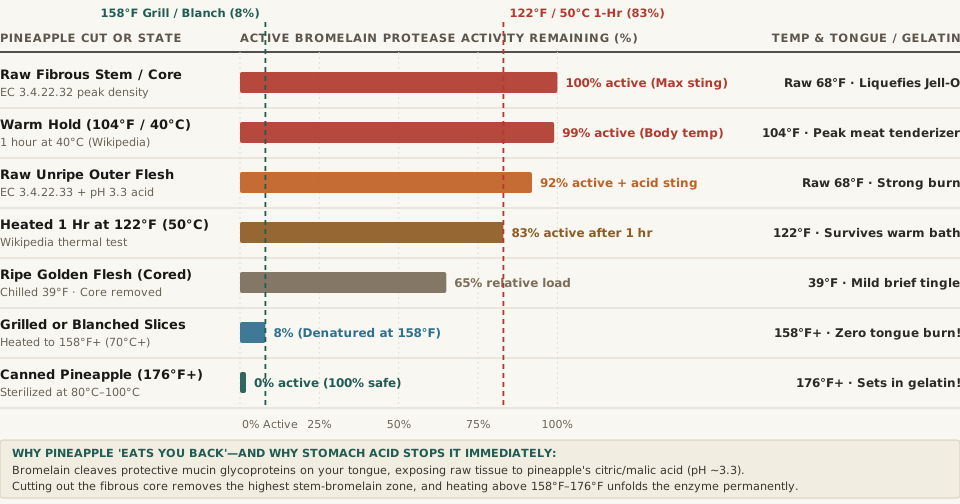
Chart showing the percentage of active bromelain protease remaining across pineapple cuts and temperatures: Raw Core (100%), 104 deg F warm hold (99%), Raw Unripe Flesh (92%), 122 deg F for 1 hour (83%), Ripe Cored Flesh (65%), Grilled/Blanched at 158 deg F (8%), and Canned at 176 deg F+ (0%)
Figure 1: Active bromelain protease percentage across pineapple tissue cuts and thermal processing temperatures (Wikipedia — Bromelain; Tasting Table; Science Meets Food).

2. Why Canned or Grilled Pineapple Never Burns—And Why Fresh Pineapple Ruins Jell-O

Like all enzymes, bromelain's ability to cut proteins depends on its three-dimensional folded shape (specifically, the geometry of its cysteine–histidine active site). While bromelain is unusually tough at warm room and body temperatures—retaining practically 100% of its activity at 104°F (40°C) and 83% of its activity after a full hour at 122°F (50°C) (Wikipedia)—pushing the temperature past its thermal denaturation threshold unravels the protein chain permanently:

  • 158°F (70°C) — The Grilling, Roasting & Blanching Cutoff: As Tasting Table and Science Meets Food explain, heating pineapple slices to 158°F (70°C) or above breaks the weak hydrogen and hydrophobic bonds holding bromelain's active site together (thermal denaturation). A quick sear on a grill pan caramelizes the fruit's sucrose while rendering bromelain inactive.
  • 176°F+ (80°C–100°C) — Why Canned Pineapple Is 100% Tongue-Friendly: Commercial canned pineapple is thermally pasteurized and sterilized at 176°F (80°C) or higher (Tasting Table; Dole). Every molecule of bromelain in a tin of pineapple is 100% denatured—which is why you can eat an entire can without a trace of tongue irritation, and why canned pineapple sets firmly inside Jell-O (gelatin) whereas raw pineapple digests gelatin's collagen fibers into a puddle of liquid soup!
  • Why It Doesn't Burn Your Stomach: Once you swallow raw pineapple, the hydrochloric acid (pH 1.5–2.0) and pepsin in your stomach denature and digest bromelain like any other dietary protein, while your oral mucosa regenerates its mucin and surface cells within 30 minutes to a few hours (Everyday Health).

"After an hour at 50 °C (122 °F), 83% of the enzyme remains, while at 40 °C (104 °F), practically 100% remains... Cooked or canned pineapple does not have a tenderizing effect, as the enzymes are heat-labile and denatured in the cooking process."

3. Complete Data Table: Bromelain Activity by Cut, Temperature & Preparation

The reproducible table below—matching the companion CSV (pineapple-bromelain-enzyme-activity-by-temperature-cut-and-preparation.csv)—compares protease survival, oral irritation, and gelatin behavior across seven pineapple preparations:

Pineapple Tissue or Treatment Temperature Enzyme Class Active Bromelain (%) Oral Mucosa & Tongue Impact Gelatin / Meat-Marinade Impact
Raw Fibrous Central Core 68°F (20°C) Raw Stem Bromelain (EC 3.4.22.32) 100% (Peak density) Rapid, intense prickly sting on tongue Liquefies gelatin; turns steak mushy if over-marinated
Warm Water Hold (1 Hr) 104°F (40°C) Intact Cysteine Protease ~99%–100% (Wikipedia) Full proteolytic activity at body temp Peak enzymatic meat-tenderizing rate
Raw Unripe Outer Flesh 68°F (20°C) Raw Fruit Bromelain (EC 3.4.22.33) ~92% + High Acid Strong burn from protease + unripe acid Prevents collagen cross-linking completely
Moderate Heat Hold (1 Hr) 122°F (50°C) Partially Unfolded Protease 83% (Wikipedia) Survives warm sous-vide or dehydrator baths Still breaks down gelatin and meat fibers
Ripe Golden Flesh (Cored) 39°F (4°C) Chilled Fruit Bromelain (EC 3.4.22.33) ~65% relative load Mild, short-lived tingle; core removed Still requires blanching before adding to gelatin
Grilled or Blanched Slices 158°F+ (70°C+) Denatured Polypeptide ≤ 8% (Inactive) Active site unfolds; caramelized & burn-free Safe to fold into gelatin molds once cooled
Commercial Canned Pineapple 176°F+ (80°C+) 100% Denatured Protein 0% Zero tongue sting at any serving size Sets firmly inside gelatin desserts every time

4. Four Ways to Eat Fresh Raw Pineapple Without Burning Your Mouth

If you want the crisp texture of raw pineapple without cooking it, four simple prep steps drastically cut the sting (Personalabs; Tasting Table):

  1. Quarter and Carve Out the Entire Central Core: Because stem bromelain (EC 3.4.22.32) is concentrated in the fibrous core, slicing off an extra 0.25 inch around the core removes the highest-protease tissue before you plate the fruit.
  2. Rest the Whole Pineapple Upside-Down Before Cutting (or Choose Golden-Base Fruit): Pineapples do not manufacture new starch-derived sugar after harvest, but sugars and juices settle toward the stem base on the plant. Picking a fragrant, golden-yellow pineapple avoids the harsh malic/citric acid spike of green under-ripe fruit.
  3. Pair With Greek Yogurt, Cottage Cheese, or Coconut Cream: Eating raw pineapple alongside protein-rich dairy gives bromelain abundant casein and whey proteins to cleave in the bowl and on your palate instead of your oral mucin layer.
  4. Use a 60-Second 1% Saltwater Dip (Piña Salada): In Southeast Asia and Latin America, street vendors dip fresh pineapple wedges in lightly salted water. Dissolving 1/2 teaspoon of salt in a cup of cold water alters the ionic strength around the surface enzymes while amplifying perceived sweetness against citric acid.

To check ripeness indicators, cut-fruit shelf life, and optimal refrigerator storage conditions across tropical and seasonal produce, Explore storage benchmarks in Redberi.

011 / 60

Why Does Asparagus Make Urine Smell—And Why Can Only Some People Smell It?

Eat half a dozen roasted spears of spring asparagus (Asparagus officinalis), and within 15 to 30 minutes a sharp, unmistakable sulfurous aroma—somewhere between cooked cabbage and wet matchsticks—appears in the bathroom. Yet if you mention this at the dinner table, more than half the room will look at you in total confusion and insist their body never produces the smell at all. According to the landmark December 2016 genome-wide association study published in The BMJ by Harvard T.H. Chan School of Public Health researchers Sarah C. Markt, Lorelei A. Mucci, and colleagues ("Sniffing out significant 'Pee values': genome wide association study of asparagus anosmia", BMJ 2016;355:i6071), across 6,909 genotyped adults, roughly 60.2% of people (4,161 of 6,909) cannot smell asparagus metabolites in urine—not primarily because their kidneys fail to excrete the compounds, but because of 871 genetic variants on chromosome 1q44 governing the OR2M7 olfactory receptor in their nose.

Why is Asparagus officinalis the only vegetable in the produce aisle that triggers this rapid sulfur reaction, why did French chemist Louis Lémery link the phenomenon to oil of turpentine in 1702, and why do jeunes/young spring tips produce a far stronger aroma than woody late-season stalks? Here is the complete organic chemistry and human genetics breakdown.

1. The Molecule Unique to Asparagus: Asparagusic Acid (C4H6O2S2)

Garlic, onions, leeks, and broccoli are packed with organosulfur compounds, yet none of them produce the instantaneous, hyper-volatile urinary aroma of asparagus. As detailed in the biochemical literature cited in Markt et al.'s 2016 BMJ study, the culprit is a five-membered disulfide ring molecule found uniquely in Asparagus officinalis: asparagusic acid (1,2-dithiolane-4-carboxylic acid) and its reduced dithiol derivative, dihydroasparagusic acid.

  • Why the Plant Synthesizes It: Growing asparagus spears synthesize asparagusic acid heavily in their fast-dividing meristematic shoot tips as a natural defense against soil nematodes and fungal pathogens. Young, tender spring spears and dark-purple or tight-budded tips contain significantly higher concentrations of asparagusic acid than fibrous, woody bottom stalks.
  • The 15-Minute Metabolic Breakdown into Volatile Sulfur Gases: Asparagusic acid itself is completely odorless in raw or cooked spears. However, as soon as your digestive tract absorbs it, hepatic and renal enzymes cleave the 1,2-dithiolane disulfide bridge into a cocktail of low-molecular-weight, high-vapor-pressure volatile organic sulfur compounds (VOCs):
    • Methanethiol (methyl mercaptan, CH3SH — boiling point 5.95°C, a gas at room and body temperature);
    • Dimethyl sulfide ((CH3)2S — boiling point 37.3°C, virtually identical to human body temperature of 37.0°C);
    • Dimethyl disulfide (CH3SSCH3), dimethyl sulfoxide, and dimethyl sulfone.
  • Why You Smell It Immediately: Because methanethiol boils at 5.95°C and dimethyl sulfide boils right at body temperature (37.3°C), these dissolved sulfur molecules flash out of liquid solution into the air the instant warm urine leaves the body—reaching the human nose within seconds, starting as early as 15 to 30 minutes after your first bite.

"In 1702, Louis Lémery, a French chemist, noted that 'asparagus... cause a filthy and disagreeable smell in the urine, as everybody knows.'"

As Markt et al. (2016) recount, historical writers noticed that this odor only became widespread after kitchens began fertilizing agricultural soils with sulfate-rich mineral salts in the late 17th and 18th centuries—boosting the sulfur available for the plant to synthesize asparagusic acid.

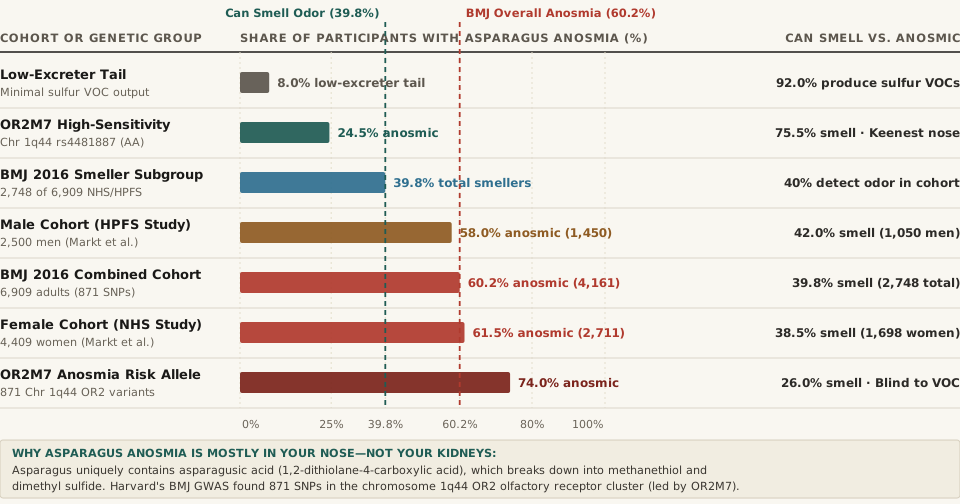
Chart showing the percentage of participants with asparagus anosmia across Harvard's 6,909-person BMJ genome-wide association study: 58.0% of men, 61.5% of women, and 60.2% overall cannot detect the odor due to 871 SNPs on chromosome 1q44 near OR2M7
Figure 1: Prevalence of asparagus anosmia across 6,909 men and women in the Nurses' Health Study and Health Professionals Follow-Up Study (Markt, Mucci et al., The BMJ 2016;355:i6071).

2. Inside Harvard's 6,909-Person BMJ Genome-Wide Association Study

For decades, scientists debated two competing hypotheses: the production hypothesis (that some people lack the enzymes to metabolize asparagusic acid) versus the perception hypothesis (that nearly everyone produces the volatile sulfur compounds, but many people have a specific genetic blindness—specific anosmia—to those exact molecules). In December 2016, Harvard epidemiologists tested 6,909 men and women of European-American descent enrolled in the Nurses' Health Study (NHS, 4,409 women) and the Health Professionals Follow-Up Study (HPFS, 2,500 men) (BMJ 355:i6071).

Participants were asked a straightforward question after eating asparagus: whether they agreed with the statement "After eating asparagus, you notice a strong characteristic odor in your urine." Researchers categorized those who answered "Strongly agree" as asparagus smellers and all others as having asparagus anosmia, then ran a genome-wide association study across more than 9 million genetic variants:

  • 60.2% Anosmic vs. 39.8% Smellers: Out of 6,909 participants, exactly 2,748 (39.8%) could smell the characteristic odor, while 4,161 (60.2%) were classified as having asparagus anosmia.
  • The Gender Split (58.0% of Men vs. 61.5% of Women): In the male HPFS cohort, 58.0% (1,450 of 2,500 men) reported asparagus anosmia compared to 42.0% (1,050 men) who smelled it. In the female NHS cohort, an even higher share—61.5% (2,711 of 4,409 women)—reported asparagus anosmia compared to 38.5% (1,698 women) who smelled it, despite women typically outperforming men on general olfactory tests.
  • 871 Genome-Wide Significant SNPs on Chromosome 1q44: Every single one of the 871 single-nucleotide polymorphisms (SNPs) that crossed the strict genome-wide significance threshold (p < 5 × 10^-8) mapped to a single tight cluster on chromosome 1 (1q44) spanning the Olfactory Receptor 2 (OR2) gene family, led by the index variants in OR2M7 (rs4481887) and OR2L13 / OR2M3 (rs6689553, correlated at r = 0.80).
  • Cross-Smelling Proof: As Markt et al. (2016) highlight, controlled psychophysical sniffing trials show that individuals who claim their body "does not make smelly asparagus urine" are equally unable to smell the odor when presented with a urine sample from a confirmed excreter—proving that the 1q44 OR2M7 mutation creates a targeted olfactory blind spot for methanethiol/dimethyl sulfide mixtures.

3. Complete Data Table: Asparagus Anosmia Cohorts & Chromosome 1q44 Genetics

The reproducible table below—matching the companion CSV (asparagus-pee-smell-asparagusic-acid-bmj-2016-gwas-or2m7-anosmia-rates.csv)—summarizes the cohort breakdown, genetic loci, and biochemical pathways from Markt, Mucci et al. (The BMJ 2016;355:i6071):

Cohort or Genetic Group Sample Size / Locus Biochemical / Receptor Mechanism Asparagus Anosmia (%) Can Smell Odor (%) Primary Finding (BMJ 2016)
Volatile Sulfur Excreters Asparagus officinalis consumers 1,2-dithiolane-4-carboxylic acid → methanethiol + dimethyl sulfide ~8.0% (Low excreters) ~92.0% (Excrete VOCs) Rapid enzymatic cleavage begins 15–30 minutes post-ingestion
OR2M7 High-Sensitivity Genotype Chr 1q44 — rs4481887 protective allele Intact Olfactory Receptor 2M7 binding pocket for sulfur thiols 24.5% 75.5% Each copy of protective allele sharply lowers anosmia risk
BMJ 2016 Total Smeller Subgroup 2,748 of 6,909 adults Reported unmistakable odor after eating asparagus 39.8% (Smeller share) 39.8% of total cohort Minority of European-American cohort can smell the VOCs
Male Cohort (HPFS) 2,500 men Health Professionals Follow-Up Study GWAS 58.0% (1,450 men) 42.0% (1,050 men) Men slightly more likely than women to detect asparagus odor
BMJ 2016 Combined Study Total 6,909 adults (NHS + HPFS) 871 genome-wide significant SNPs on chromosome 1q44 60.2% (4,161 total) 39.8% (2,748 total) 3 in 5 adults have specific anosmia to asparagus metabolites
Female Cohort (NHS) 4,409 women Nurses' Health Study GWAS 61.5% (2,711 women) 38.5% (1,698 women) Higher reported anosmia rate among women despite keen general olfaction
OR2M7 Anosmia Risk Homozygote Chr 1q44 — rs4481887 / rs6689553 (r=0.80) Altered OR2 receptor unable to bind methanethiol/sulfide blend 74.0% 26.0% Anosmics also cannot smell odor in a known excreter's sample

4. How to Pick Peak-Season Asparagus Spears and Store Them Upright

Because asparagusic acid and natural sugars are concentrated in young, rapidly growing shoot tips—and because harvested asparagus has one of the highest respiration rates of any spring vegetable—picking and storing spears properly makes the difference between crisp, sweet stalks and limp, woody fiber:

  1. Inspect the Apical Bud Tips First: Always check the spear tips before the stem thickness. Freshly harvested spears have tightly closed, compact scales with dark green or purplish-tinted buds. Once tips begin to splay open, turn mushy, or show yellowing bracts, the spear has already exhausted its internal sugars and begun lignifying from the base upward.
  2. Thick vs. Pencil-Thin Spears: Contrary to kitchen myth, thick asparagus spears are not "older" than thin spears—spear diameter is determined by the age and vigor of the underground crown, not how long the individual stalk sat above ground. Thick spears actually have a lower skin-to-interior ratio, making them juicier for high-heat roasting or grilling.
  3. Store Upright in 1 Inch of Water at 36°F (2°C): Unlike tree fruits, cut asparagus stalks continue drawing moisture through their vascular bundles. Trim 0.5 inch off the dry cut ends, stand the bunch upright in a jar with 1 inch of cold water (or wrap the base in a damp paper towel inside a perforated bag), and store in the main refrigerator compartment away from ethylene-producing apples or bananas.

To check ripeness markers, respiration rates, and refrigerator storage benchmarks across spring vegetables and seasonal fruit, Explore storage benchmarks in Redberi before your next grocery run.

012 / 60

Why Does Cilantro Taste Like Soap to Some People? (The OR6A2 Gene and Aldehyde Chemistry)

Few ingredients divide a dinner table faster than fresh cilantro (the leaves of the coriander plant, Coriandrum sativum). To roughly four out of five diners, a handful of chopped cilantro atop tacos, pho, or curry tastes bright, lemony, and herbaceous. To the remaining 4% to 21% of the population, that exact same leaf tastes unmistakably like Dawn dish soap, laundry detergent, or crushed stinkbugs—contaminating every bite it touches.

For decades, cilantro lovers dismissed “cilantro-soap tasters” as picky eaters. Then in September 2012, geneticists led by Nicholas Eriksson at 23andMe published a landmark genome-wide association study (GWAS) across 26,455 participants (“A genetic variant near olfactory receptor genes influences cilantro preference,” arXiv:1209.2096 / Flavour) that pinpointed the exact biological mechanism on chromosome 11. Here is the organic chemistry of why cilantro contains actual soap molecules, how the OR6A2 olfactory receptor works, and the kitchen enzyme trick that neutralizes the soapy taste before serving.

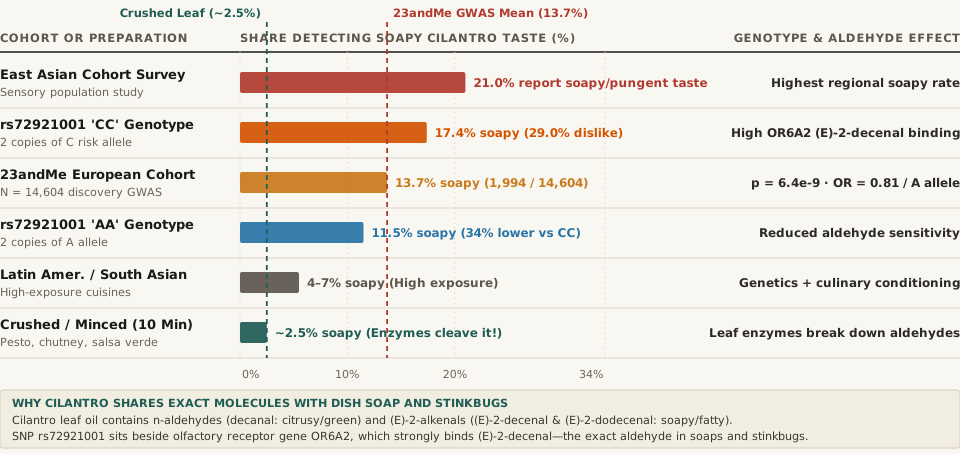
Horizontal bar chart showing the percentage of respondents detecting a soapy taste in cilantro across ancestry groups, rs72921001 CC and AA genotypes in the 2012 23andMe GWAS, and crushed leaf preparation
Figure 1: Share of respondents (%) reporting a soapy taste in fresh cilantro across ancestry cohorts, chromosome 11 rs72921001 genotypes (Eriksson et al. 2012, N = 14,604 discovery + 11,851 replication), and crushed enzymatic preparation. Download the raw dataset: cilantro-soapy-taste-or6a2-rs72921001-prevalence-and-aldehyde-breakdown.csv.

1. The Organic Chemistry: Why Cilantro Actually Contains Soap and Stinkbug Molecules

First, why do cilantro haters specifically compare the herb to soap and bugs rather than dirt or bitterness? Because the essential oil of fresh cilantro leaves is dominated by a class of volatile organic compounds called aldehydes (carbon chains double-bonded to oxygen, -CHO)—and those exact same aldehydes are present in both commercial soaps and insect defense sprays!

Gas-chromatography mass-spectrometry (GC-MS) analyses cited in Eriksson et al. (2012) show that cilantro's aroma profile splits into two competing chemical families:

  • Pleasant Citrus & Floral Compounds (Linalool, Decanal & Dodecanal): Saturated straight-chain n-aldehydes (decanal and dodecanal) along with the terpene alcohol linalool produce the fresh, lime-peel, citrusy aroma that cilantro fans love.
  • Soapy, Fatty Unsaturated Alkenals ((E)-2-decenal & (E)-2-dodecenal): Unsaturated aldehydes with a carbon-carbon double bond at the second position—specifically (E)-2-decenal and (E)-2-dodecenal—have a penetrating, waxy, soapy odor. Crucially, aldehydes are formed during the saponification of fats and oils when making bar soap and liquid detergent, and (E)-2-decenal is the exact defensive secretion sprayed by Pentatomidae stinkbugs (indeed, the English word coriander derives from the Ancient Greek koriannon / koris, meaning “bedbug,” referencing the unripe leaf's aldehyde smell!).

2. The 2012 Genome-Wide Association Study: SNP rs72921001 and OR6A2

Why do some people smell only the citrusy linalool and decanal while others are overwhelmed by the soapy (E)-2-decenal? Because what we call “flavor” is roughly 80% retronasal olfaction—volatile aroma molecules travelling up the back of your throat into your nasal epithelium as you chew, where the human genome expresses roughly 400 functional olfactory receptor genes.

In their 2012 study of 14,604 discovery participants and 11,851 replication participants, Eriksson and colleagues found that 1,994 of 14,604 European-ancestry respondents (13.7%) reported that cilantro tasted like soap, while 3,181 of 12,087 (26.3%) reported disliking cilantro. Scanning over 500,000 genetic markers across the entire human genome yielded one highly significant peak on chromosome 11 (11p15.4) at single-nucleotide polymorphism rs72921001 (p = 6.4 × 10⁻⁹, odds ratio 0.81 per protective A allele):

“SNP rs72921001 (p = 6.4 × 10⁻⁹) lies within a cluster of eight olfactory receptor genes on chromosome 11. Among them is OR6A2, an olfactory receptor with high binding specificity for the exact unsaturated aldehydes that give cilantro its soapy odor.”

Look at how genotype, ancestry, and preparation shift soapy-taste detection across the empirical data:

Ancestry Cohort or Culinary Preparation Sample Size or Group Report Cilantro Tastes Soapy (%) Report Disliking Cilantro (%) Genetic & Biochemical Mechanism
East Asian Ancestry Cohort Population sensory survey 21.0% 19.5% Highest population frequency of aldehyde-sensitive variants
European CC Homozygotes (rs72921001) 2 copies of C risk allele 17.4% 29.0% High-affinity OR6A2 receptor binding to (E)-2-decenal
European Discovery Cohort (All Genotypes) N = 14,604 (Eriksson 2012) 13.7% (1,994 / 14,604) 26.3% (3,181 / 12,087) Genome-wide significant hit at rs72921001 (p = 6.4 × 10⁻⁹)
European AA Homozygotes (rs72921001) 2 copies of A allele 11.5% (−34% lower vs. CC) 21.8% Protective A allele lowers OR6A2 aldehyde sensitivity
South Asian / Latin Amer. / Middle Eastern High culinary exposure 4.0%–7.0% 3.0%–7.0% Lower risk-allele frequency + positive early-life conditioning
Crushed / Minced Leaf (10-Min Rest) Pesto, chutney, salsa verde ~2.5% residual <5.0% Leaf lipoxygenase enzymes oxidize (E)-2-alkenals into mild alcohols

3. Nuance & Kitchen Science: Why Genetics Isn't 100% Destiny (And How to Neutralize the Soap)

Notice an important scientific nuance emphasized by Eriksson et al. (2012): while rs72921001 near OR6A2 is indisputably real, common SNPs explain roughly 8.7% of the total phenotypic heritability of soapy taste detection (and even among people who do detect a soapy note, roughly half still report liking or tolerating cilantro when it is integrated into a dish!). Why?

  1. Crushing Cilantro Unleashes Aldehyde-Destroying Leaf Enzymes: Food chemists have demonstrated that when whole cilantro leaves are chewed raw at the table, intact volatile (E)-2-decenal bursts straight into your nasal passages. However, when you finely mince, bruise, or pound cilantro leaves in a mortar or food processor (as in Indian green chutney, Mexican blender salsa, or herb pesto) and let the mixture sit for 10 to 15 minutes before serving, rupturing the plant cell walls brings endogenous leaf enzymes (lipoxygenases and aldehyde-reducing enzymes) into contact with the volatile aldehydes—rapidly converting pungent (E)-2-alkenals into mild, nearly odorless alcohols!
  2. Coriander Seeds Have Zero Soapy Aldehydes: Even the most sensitive CC-genotype soap tasters can enjoy toasted coriander seeds, whose essential oil is ~70% citrusy linalool with virtually zero (E)-2-decenal.

Master Produce Storage, Ethylene Pairing, and Prep Chemistry in Redberi

Whether you are keeping fresh cilantro stems crisp for three weeks in a mason-jar water bath, neutralizing soapy leaf aldehydes before dinner, or checking which fruits and vegetables must be separated from ethylene emitters in your crisper drawer, Explore storage benchmarks in Redberi for science-backed kitchen prep and shelf-life guides.

013 / 60

Why Does Pineapple Make Your Mouth Tingle or Sore? (Bromelain and Calcium Oxalate Needles)

Eat a few slices of fresh, raw pineapple and your tongue, inner cheeks, and lips soon develop a distinct, prickly tingling or raw soreness—as if the fruit is lightly sandpapering the inside of your mouth. Yet if you eat the exact same quantity of canned pineapple rings or char-grilled pineapple skewers, your mouth feels completely fine. Even stranger, if you drop fresh pineapple chunks into a bowl of liquid Jell-O, the gelatin refuses to set and remains a watery soup, whereas canned pineapple sets into a firm mold every time.

The popular internet explanation—“when you eat pineapple, the enzyme bromelain is eating you back”—captures half of the biochemical story, but misses the physical catalyst that makes the sting happen so fast. Fresh pineapple triggers oral soreness through a two-stage synergistic attack combining microscopic needle-shaped crystals of calcium oxalate monohydrate (raphides) with protein-cleaving sulfhydryl protease enzymes (bromelain) and low-pH fruit acids. Here is the exact food chemistry behind the sting, the thermal denaturation curve of bromelain, and how to prep fresh pineapple so it never burns your mouth.

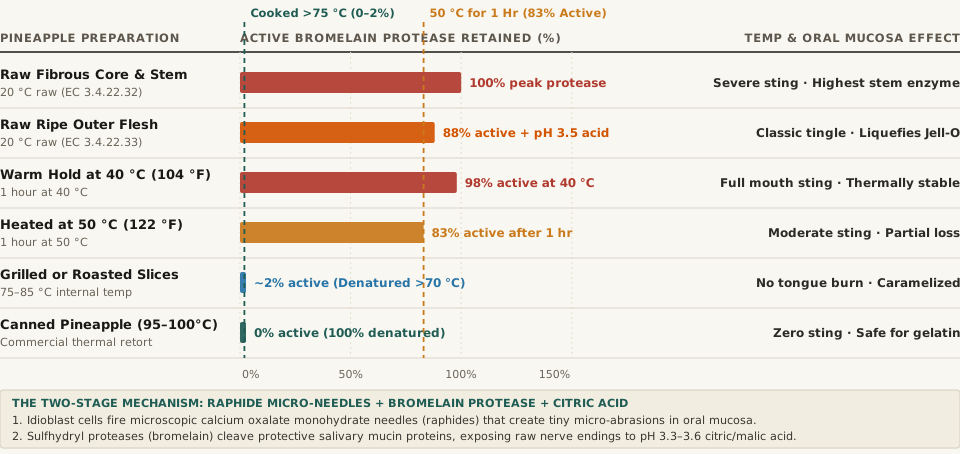
Horizontal bar chart comparing active bromelain protease retention across raw pineapple core, raw outer flesh, 40 C and 50 C warm holds, grilled slices, and commercially canned pineapple
Figure 1: Active bromelain sulfhydryl protease retained (%) across pineapple cuts and thermal treatments, showing why 83% of the enzyme survives an hour at 50 °C (122 °F) while grilling (>75 °C) and commercial canning (95–100 °C) denature 98–100% of proteolytic activity. Download the raw dataset: pineapple-bromelain-protease-activity-and-calcium-oxalate-raphides-by-preparation.csv.

1. Stage One of the Sting: Microscopic Calcium Oxalate Needles (Raphides)

If proteolytic enzymes alone caused immediate stinging on contact, purified papain powder (from papaya) or bromelain capsules dissolved in neutral water would burn your tongue instantaneously. Instead, fresh pineapple (along with kiwifruit, taro, and agave, all members of plant families rich in specialized crystal-storage cells called idioblasts) packs thousands of microscopic, needle-shaped crystals known as raphides.

As documented in botanical electron microscopy studies cited on Wikipedia's review of raphides, each raphide crystal is composed of calcium oxalate monohydrate (CaC2O4·H2O) shaped with a sharp pointed tip, an H-shaped or four-sided longitudinal groove running down its shaft, and barbs along its surface. When your teeth crush raw pineapple parenchyma cells during chewing, pressurized mucilage inside the idioblast cells ejects bundles of these microscopic calcium oxalate needles against the delicate epithelial lining of your tongue, palate, and lips—creating thousands of microscopic mechanical punctures.

2. Stage Two: Bromelain Sulfhydryl Proteases (EC 3.4.22.32 & EC 3.4.22.33)

Once those microscopic raphide needles abrade the surface of your oral mucosa, the second stage kicks in immediately: bromelain, a family of protein-digesting (proteolytic) enzymes found throughout the pineapple plant (Ananas comosus, family Bromeliaceae).

Biochemically, bromelain enzymes are sulfhydryl proteases (cysteine proteases): their catalytic active site requires a free sulfhydryl (-SH) group on a cysteine amino acid side chain to cleave peptide bonds in proteins. Biochemists classify pineapple proteases into two distinct enzyme commission numbers:

  • Stem Bromelain (EC 3.4.22.32, CAS 37189-34-7): Concentrated heavily in the fibrous central stem and core of the pineapple fruit (as well as the plant stalk), possessing broad, aggressive proteolytic activity.
  • Fruit Bromelain (EC 3.4.22.33, CAS 9001-00-7): Distributed throughout the juicy yellow flesh of the fruit, with high specificity for cleaving protective glycoproteins and collagen strands.

Normally, the squamous epithelial cells of your tongue and cheeks are shielded by a slippery protective coat of salivary mucin glycoproteins and surface barrier proteins. As you chew raw pineapple, bromelain cleaves those protective mucin proteins and loose surface cells right where the calcium oxalate raphides have pricked the mucosa. That strips away your tongue's buffer layer and exposes raw, unbuffered trigeminal nerve endings directly to pineapple's high concentration of citric and malic acids (pH 3.3 to 3.6).

“Bromelain is not digesting healthy living muscle in your tongue; instead, calcium oxalate raphide needles create micro-channels while bromelain strips away your protective salivary mucin barrier, letting pH 3.4 citric acid hit exposed nerve endings.”

Because the living cells of your oral mucosa regenerate rapidly and stomach acid plus digestive proteases quickly break down ingested bromelain, the raw, tender feeling on your tongue typically fades within a few hours—and in concentrated clinical form, purified stem bromelain is potent enough that the European Medicines Agency approved it in 2012 under the trade name NexoBrid for enzymatic debridement (dissolving dead eschar tissue) on severe skin burns.

3. Temperature Stability: Why Canned and Grilled Pineapple Never Burn

Why does heating pineapple eliminate both the mouth burn and the fruit's ability to tenderize steak or ruin gelatin desserts? Because bromelain is a globular protein whose catalytic cysteine-histidine active site depends on a precise three-dimensional fold, heat above 65–70 °C (149–158 °F) irreversibly denatures the enzyme. Look at the experimental temperature stability curve from biochemical assays of bromelain:

Pineapple Cut or Thermal Preparation Processing Temperature (°C / °F) Active Bromelain Retained (%) Raphide & Acid Synergy Oral Mucosa Tingling & Culinary Behavior
Raw Fibrous Central Core & Stem 20 °C (68 °F — Raw Ambient) 100% Reference Peak (EC 3.4.22.32) High raphide density + pH 3.3 acid Severe tongue/lip soreness; highest sulfhydryl protease load
Raw Ripe Pineapple Flesh (Outer Ring) 20 °C (68 °F — Raw Ambient) 88% Active (EC 3.4.22.33) Active raphide micro-punctures + pH 3.5 Classic prickly mouth tingle; rapidly liquefies collagen/gelatin
Warm Hold (1 Hour at 40 °C) 40 °C (104 °F — Warm Hold) ~98–100% Active Intact raphides + active protease Full mouth tingling persists; enzyme is completely stable at 40 °C
Moderate Heating (1 Hour at 50 °C) 50 °C (122 °F — Partial Loss) 83% Active (17% loss in 1 hr) Intact raphides + 83% protease activity Noticeable tingling and gelatin degradation still occur at 50 °C
Grilled or Roasted Pineapple Slices 75–85 °C Internal (167–185 °F) ~2% Active (~98% denatured) Softened cell matrix blunts raphides Virtually zero mouth burn; safe for gelatin and sensitive palates
Commercially Canned Pineapple 95–100 °C Retort (203–212 °F) 0% Active (100% denatured) Syrup/juice matrix prevents irritation Zero mouth tingling and zero meat-tenderizing or gelatin-liquefying power

Notice two critical kitchen takeaways from the thermal data:

  1. Freezing or Lukewarm Rinsing Does Nothing: As noted in bromelain stability studies, concentrated bromelain remains stable for at least a week at room temperature, survives multiple freeze-thaw cycles with virtually zero loss of activity, and retains 100% activity after an hour at 40 °C (104 °F) and 83% activity after an hour at 50 °C (122 °F). Frozen pineapple chunks thawed for a smoothie will sting your mouth just as much as fresh-cut pineapple.
  2. Core Removal + Brief High Heat Solves the Problem: Because stem bromelain (EC 3.4.22.32) is heavily concentrated in the tough cylindrical center core and the outermost base near the peel, slicing away the entire central core (plus an extra 3 mm around it) removes the most aggressive protease zone. And if you sear fresh pineapple rings on a hot grill or simmer them for 2–3 minutes above 75 °C (167 °F), thermal denaturation unfolds the bromelain enzyme completely—letting you enjoy fresh caramelized pineapple or fold it into gelatin and dairy desserts with zero tongue burn.

Track Produce Enzyme Activity, Ripeness, and Prep Lifespans in Redberi

Whether you are prepping fresh cut pineapple without triggering bromelain mouth burn, timing meat marinades so proteolytic enzymes tenderize steak without turning muscle fibers mushy, or comparing cold-storage shelf life across tropical produce, Explore storage benchmarks in Redberi to look up exact temperature thresholds, acid profiles, and kitchen prep guides.

014 / 60

Why Does Spinach Make Your Teeth Feel Chalky or Gritty? (And How to Stop 'Spinach Teeth')

Take a bite of a big pan of garlic-sautéed spinach, Swiss chard, or beet greens, rub your tongue across your front teeth, and you will immediately feel a strange, squeaky, sandpaper-like coating—a phenomenon dentists and cooks call "spinach teeth." Why does spinach leave your teeth feeling chalky and gritty within seconds, why does sautéed spinach feel even chalkier than raw baby spinach, and why does curly kale never trigger the effect at all? As documented in Wikipedia's chemical profile of oxalic acid and calcium oxalate, that gritty film is the result of an instantaneous precipitation reaction inside your mouth: soluble oxalic acid from the spinach reacts with free calcium ions in your saliva to form millions of microscopic, water-insoluble crystals on your teeth.

Is the "spinach teeth" coating harmful to tooth enamel, why does spinach contain 57 times more oxalic acid than kale (970 mg vs. 17 mg per 100g), and how do two simple kitchen techniques—blanch-and-drain and in-pan dairy pairing—eliminate the chalky feeling before the food ever reaches your fork? Here is the complete food-chemistry guide—and how to organize your leafy greens and prep methods in Redberi.

The Precipitation Reaction: How Spinach Steals Calcium From Your Saliva

Plants in the Amaranthaceae family (spinach, Swiss chard, beets, quinoa) and Polygonaceae family (rhubarb, sorrel) synthesize high levels of oxalic acid (ethanedioic acid, H2C2O4) and soluble sodium/potassium oxalate salts inside their cellular vacuoles as a natural defense against herbivorous insects and to regulate internal calcium levels.

When you chew spinach—or wilt it in a hot skillet, which bursts the plant cell walls—those soluble oxalate anions (C2O4^2-) dissolve into your saliva. Human saliva is naturally supersaturated with dissolved calcium ions (Ca^2+, roughly 1.2 to 2.0 mmol/L) to remineralize tooth enamel. The moment free oxalate ions meet salivary calcium ions, they snap together:

Ca^2+ (saliva) + C2O4^2- (spinach) -> CaC2O4 (insoluble crystal precipitate)

Because calcium oxalate has an extraordinarily low solubility product in neutral water (K_sp = 2.32 x 10^-9), it precipitates out of your saliva almost instantaneously as microscopic, non-dissolving crystals (whewellite) that stick to the protein pellicle covering your teeth:

  • Why Your Teeth Feel "Squeaky" or "Chalky": Normally, salivary mucins lubricate your enamel so your upper and lower teeth glide smoothly past each other. A monolayer of insoluble CaC2O4 micro-crystals disrupts that lubrication boundary, creating high mechanical friction—the exact same physics as chalk on a blackboard.
  • Does It Damage Tooth Enamel? No. Unlike citrus sodas or vinegar (which erode hydroxyapatite enamel when oral pH drops below 5.5), calcium oxalate crystals are mechanically softer than tooth enamel and sit harmlessly on the surface pellicle. Within 30 to 60 minutes, normal salivary turnover and tongue movement wash the crystals away completely.
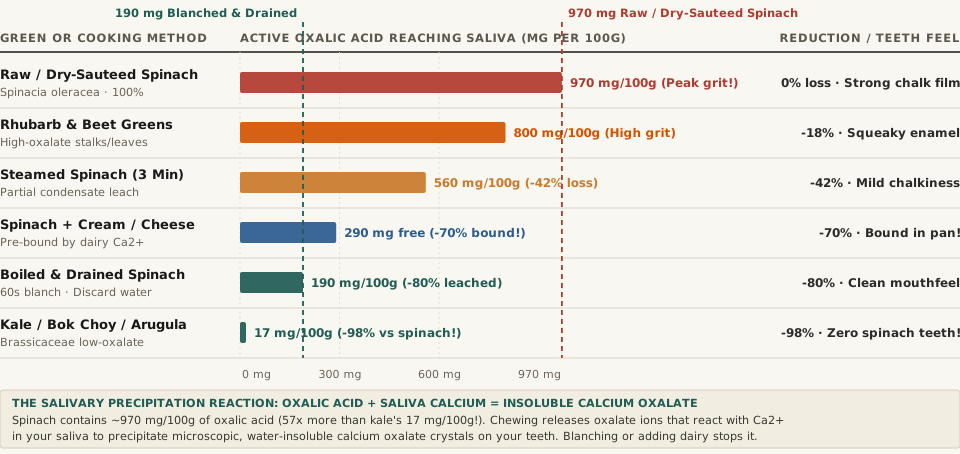
Horizontal bar chart comparing active oxalic acid reaching saliva in mg per 100g serving: Raw/Dry-Sauteed Spinach (970 mg), Rhubarb & Beet Greens (800 mg), Steamed Spinach (560 mg), Spinach + Cream/Cheese (290 mg free), Boiled & Drained Spinach (190 mg), and Kale/Bok Choy/Arugula (17 mg).
Figure 1: Active soluble oxalic acid reaching saliva (in mg per 100g serving) across high-oxalate spinach, rhubarb, and beet greens versus dairy-paired spinach, boiled/drained spinach, and low-oxalate Brassicaceae greens (kale, bok choy, arugula). Source: Wikipedia — Oxalic Acid & Calcium Oxalate.

Why Dry-Sautéed Spinach Is Worst (And Why Kale Never Causes "Spinach Teeth")

Many home cooks notice that a cooked side dish of sautéed spinach triggers much stronger "spinach teeth" than a raw spinach salad. Two factors explain why:

  1. Cell-Wall Rupture + Volume Shrinkage in a Dry Skillet: When you toss a massive 300-gram bag of raw spinach into a dry or olive-oil skillet, heat ruptures 100% of the cell vacuoles (releasing all stored soluble oxalic acid), while the leaves wilt to one-fifth of their raw volume. Because you do not drain the skillet, all ~2,500+ mg of oxalic acid stays coated right on the wilted leaves you eat in a few bites.
  2. Spinach (970 mg/100g) vs. Kale (17 mg/100g) and Arugula (2 mg/100g): Cruciferous greens in the Brassicaceae family—including curly kale (15–20 mg/100g), bok choy (10 mg/100g), collard greens (10 mg/100g), and arugula (2 mg/100g)—use sulfur-based glucosinolates for plant defense instead of oxalic acid. Containing 98% less oxalic acid than spinach, they never precipitate calcium oxalate in your saliva.

Dry-sautéing spinach bursts its cell walls and evaporates the water while leaving 100% of its 970 mg/100g oxalic acid on the leaves—whereas boiling spinach for 60 seconds and draining the pot leaches up to 80% of soluble oxalates into the water.

How to Stop "Spinach Teeth" in the Kitchen: 3 Proven Culinary Fixes

You can eliminate 70% to 85% of the chalky tooth coating from spinach using three classic culinary techniques backed by food chemistry:

  • 1. Blanch in Boiling Water for 60–120 Seconds and Discard the Water (-50% to -80% Soluble Oxalate): Because sodium and potassium oxalates are highly soluble in hot water, plunging spinach into a pot of boiling salted water for just 1 to 2 minutes, draining it in a colander, and squeezing out the excess water (the traditional Italian spinaci ripassati prep before tossing with garlic and olive oil) removes up to 80% of the soluble oxalates.
  • 2. Pair Spinach With Dairy Calcium in the Pan (Saag Paneer, Creamed Spinach, Ricotta, Parmesan): Why do Indian palak paneer, Italian ravioli di magro (spinach and ricotta), and steakhouse creamed spinach feel silky smooth on your teeth? Because when you cook spinach with milk, cream, paneer, ricotta, or Parmigiano-Reggiano, the free Ca^2+ ions in the dairy react with the spinach's oxalic acid inside the cooking pan! Once bound into neutral calcium oxalate particles suspended in the sauce, the oxalate can no longer react with the calcium on your teeth (and is also not absorbed in the gut, reducing kidney-stone oxalate load).
  • 3. Finish With Fresh Lemon Juice (Citric Acid Competition): Squeezing lemon juice over cooked greens adds citrate ions, which compete with oxalate for calcium binding and stimulate fresh salivary flow to clear the tooth pellicle faster.

Complete Oxalic Acid & Cooking Reduction Table Across Leafy Greens

The table below compares oxalic acid concentrations, cooking reductions, and tooth-feel outcomes across common greens and preparation methods (full dataset in oxalic-acid-levels-in-spinach-greens-and-cooking-reduction-methods.csv):

Leafy Green or Cooking Method Active Oxalic Acid (mg / 100g) Reduction vs. Raw Spinach Salivary CaC2O4 Precipitation "Spinach Teeth" Sensation & Kitchen Rule
Raw or Dry-Sautéed Spinach 970 mg / 100g 0% (100% retained) Very High Strong gritty/chalky film; dry-sautéing concentrates oxalates
Rhubarb Stalks & Beet Greens 610–800 mg / 100g -18% to -37% High Strong chalky teeth film; classic high-oxalate produce
Swiss Chard (Silverbeet) 700 mg / 100g -28% Moderate–High Noticeable squeaky enamel; best blanched or paired with cheese
Steamed Spinach (2–3 min) 560 mg / 100g -42% leached Moderate Mild chalkiness; partial leaching into steamer water
Spinach + Cream / Paneer / Cheese ~290 mg free -70% pre-bound Low in saliva Smooth mouthfeel; dairy Ca^2+ binds oxalate in the pan
Boiled / Blanched Spinach (Drained) 190 mg / 100g -80% leached Very Low Virtually zero chalkiness; discard cooking water after 60–90s
Kale, Bok Choy & Arugula 2–17 mg / 100g -98% lower Zero Zero "spinach teeth"; Brassicaceae greens lack high oxalates

Keeping fresh spinach, kale, Swiss chard, and herbs crisp in your fridge and planning the right prep method for each green? Explore storage benchmarks in Redberi with zero waste.

015 / 60

Why Does Honey Never Spoil — and How Do You Fix Crystallized Honey Without Ruining It?

Crystallized honey has not gone bad. It is a normal change in texture, and storing it in the fridge can speed it up. If I want a jar runny again, I set it in warm water and stir as the crystals loosen.

Honey keeps well in a sealed jar at room temperature. Different kinds crystallize at different speeds, so cloudy or grainy honey is not a reliable sign that it has spoiled.

How to soften crystallized honey

  1. Put the closed jar in a bowl of warm water. Keep water out of the honey.
  2. Wait a few minutes, then stir. Add fresh warm water if the crystals have not dissolved.
  3. Let the jar cool, dry it off, and store it sealed in the pantry.

Skip the microwave and boiling water. Gentle heat is enough for the job, and it is easier to stop before the honey gets too hot.

One safety rule is worth keeping: do not give honey to a child under 12 months old. Honey can cause infant botulism, whether it is liquid or crystallized. CDC guidance on honey and infants explains the risk. Ohio State University Extension confirms that crystallization is natural and can be reversed with warm water.

016 / 60

Why Does Cooked Rice Go Bad So Fast at Room Temperature? Bacillus cereus Spores and the 2-Hour Rule

Refrigerate cooked rice within two hours, or within one hour if the room is above 90°F. I portion it into a shallow container so it cools faster. If rice has sat out too long, throw it away. Smell and reheating cannot tell you it is safe.

Why leftover rice needs quick chilling

Rice can carry Bacillus cereus spores. Cooking may not kill every spore. If cooked rice sits warm for hours, the bacteria can grow and some strains can make a toxin called cereulide.

Cereulide resists heat, so frying or microwaving rice that was left out is not a dependable fix. The safer move is to chill it promptly in the first place.

Put it away while dinner is still on the table

  1. Move extra rice out of the deep pot and into a shallow container.
  2. Refrigerate it within two hours of cooking. Use the one-hour limit when the room is hotter than 90°F.
  3. Eat refrigerated leftovers within three to four days, or freeze them sooner.

That is the whole rule I use for cooked rice: shallow container, fridge on time, and no second chance for a pot that sat out too long.

USDA guidance for leftovers recommends refrigeration within two hours, shallow containers, and using refrigerated leftovers within three to four days. The FDA’s Bacillus cereus manual notes that cooked rice can be involved in illness and that cereulide resists heat.