The oil on top is normal. Stir it back in, then store the jar upright. You can turn an unopened jar over for a while to help move the oil through the spread.
Natural peanut butter separates because it has no stabilizer to keep the oil mixed in. The oil is still part of the peanut butter, not a sign that it has gone bad.
My simple rule is to stir it well when I open the jar, then keep it upright. If the oil is stubborn, you can turn the sealed jar upside down and let it sit until the oil shifts toward the lid. Turn it right-side up before opening.
Refrigeration is optional unless the label says otherwise. It makes the spread firmer and may slow separation, but it can also make it harder to stir or spread. Use the storage directions on your jar.
The Canadian Food Inspection Agency says oil separation is natural, and recommends stirring or briefly storing the jar upside down before returning it upright.
018 / 60
Should You Store Coffee Beans in the Fridge or Freezer?
Keep the coffee you're using in a sealed bag or container in a cool, dark cupboard. The fridge is a poor spot for a bag you open every day.
For extra beans you won't use soon, divide them into airtight portions and freeze them. Keep each portion sealed while it thaws, then use it without moving it back and forth between the counter and freezer.
Quick storage rules
Daily coffee: Keep it sealed, dry, and away from light, heat, and strong food smells.
Longer storage: Freeze only well-sealed portions you won't need right away.
Skip the daily fridge trip: Repeated opening brings warm, damp air to cold beans, and coffee can pick up nearby odors.
My rule is simple: cupboard for the open bag, freezer for extra beans sealed in portions. I don't use the freezer for coffee I reach for every morning.
In the US, keep supermarket eggs in the fridge. In much of Europe, eggs are sold unwashed at room temperature. The difference comes from how they are handled before they reach the store.
US commercial eggs are washed, which removes dirt and can damage the shell’s natural outer coating. They are then kept refrigerated through sale. European marketing rules generally preserve the cuticle on Class A eggs, so shops do not handle them the same way. The cuticle helps protect the shell, but it is not a reason to change how you store eggs at home.
Cold eggs can sweat when left in a warm room. USDA advises keeping eggs refrigerated and not leaving them out for more than two hours. I put mine back in the fridge after cooking and leave them in the carton on a shelf.
If you buy eggs outside the US, follow the package and local food-safety advice. Once eggs have been chilled, keep them cold. USDA egg storage guidance explains the cold-chain advice, and the EU egg marketing standards describe handling rules for Class A eggs.
020 / 60
Why Does Chocolate Turn White in the Pantry? Fat Bloom vs. Sugar Bloom and Cocoa Butter Crystal Temperatures Explained
Unwrap a bar of dark or milk chocolate that has been sitting in a warm cupboard since summer—or a box of truffles stored in the refrigerator—and you will often find the glossy mahogany surface covered in pale, chalky white streaks or a dusty gray film. Millions of home cooks throw those bars away assuming the chocolate has grown mold. In reality, because solid chocolate has an extremely low water activity (aw ≈ 0.30–0.40, far below the aw ≥ 0.61 minimum required for any mold or bacterium to grow), that white coating is almost never microbial spoilage: it is a purely physical phase separation known as chocolate bloom.
When you organize pantry and confectionery staples in Redberi, distinguishing between the two types of chocolate bloom—fat bloom and sugar bloom—tells you what went wrong in storage and how to restore a mirror-gloss finish in minutes.
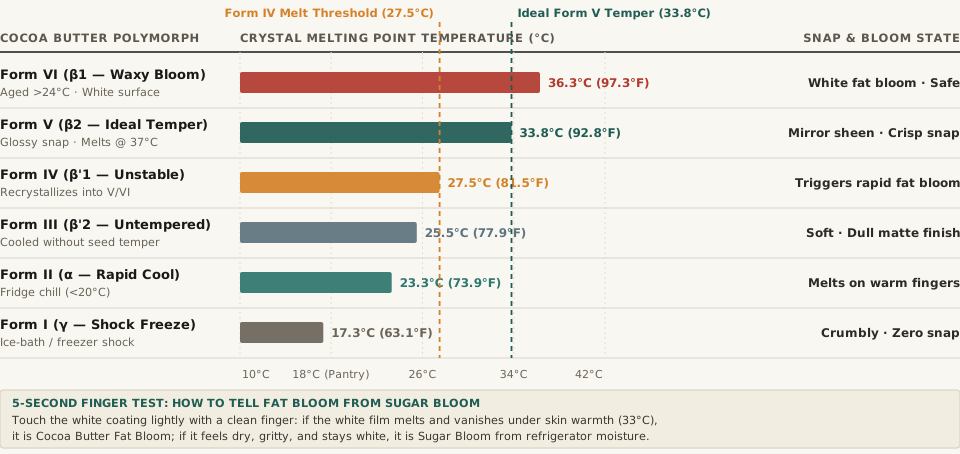
The 6 Crystal Polymorphs of Cocoa Butter (Why Only Form V Snaps at 33.8°C)
To understand why chocolate turns white when it gets warm, you have to look at the crystallography of cocoa butter. Unlike simple fats, cocoa butter is composed primarily of three symmetrical triglycerides (POP, POS, and SOS, made of palmitic, oleic, and stearic fatty acids) that can pack together into six different crystalline shapes (polymorphs), labeled Forms I through VI (or γ, α, β'2, β'1, β2, β1 in Wille and Lutton’s classic 1966 nomenclature):
Forms I, II, and III (17.3°C–25.5°C / 63°F–78°F): Unstable, loosely packed crystals formed when melted chocolate is cooled too quickly without agitation. They look matte, feel soft, and melt immediately on your fingers.
Form IV (27.5°C / 81.5°F — The Bloom Trigger): Formed when melted chocolate solidifies on a kitchen counter without proper tempering. Because Form IV is thermodynamically unstable at room temperature, it spontaneously rearranges into denser Form V and Form VI crystals over a few days—squeezing liquid cocoa butter out to the surface where it solidifies into white blotches.
Form V (33.8°C / 92.8°F — The Chocolatier’s Target Temper): A dense, interlocking β2 crystal lattice created during professional tempering. Because 33.8°C sits well above room temperature (20°C) yet just below human mouth temperature (37.0°C / 98.6°F), Form V chocolate has a mirror-like sheen, breaks with a sharp acoustic snap, and melts silkily on the tongue.
Form VI (36.3°C / 97.3°F — Aged Fat Bloom): The most thermodynamically stable crystal state of all, formed only by slow solid-state transition from Form V over months of storage (or rapid transition during heat spikes between 24°C and 30°C). Form VI crystals protrude from the surface as microscopic white needles that scatter light—creating visible fat bloom and a slightly waxy mouthfeel because 36.3°C barely melts in the mouth.
Comparing the six crystal polymorphs shows why chocolate is uniquely sensitive to temperature swings between 24°C and 32°C:
Polymorph Form
Crystal Notation
Melting Point (°C)
Melting Point (°F)
Surface Sheen & Snap
Confectionery & Storage Behavior
Form I
γ (Sub-α)
17.3°C
63.1°F
Crumbly, zero snap, dull
Forms during rapid freezer shock-chilling
Form II
α (Alpha)
23.3°C
73.9°F
Soft, smears on touch
Forms when chilled below 20°C; rapidly converts
Form III
β′2 (Mixed)
25.5°C
77.9°F
Firm but matte, no snap
Untempered melted chocolate cooled at room temp
Form IV
β′1 (Dense)
27.5°C
81.5°F
Smooth at first; blooms fast
Contracts into Form V, pushing fat to surface
Form V (Ideal)
β2 (Tempered)
33.8°C
92.8°F
Mirror gloss + crisp snap
Target temper (solid in hand, melts at 37°C mouth)
Form VI (Bloom)
β1 (Aged)
36.3°C
97.3°F
Chalky white fat streaks
Forms from Form V after heat spikes (>24°C) or age
“To tell fat bloom from sugar bloom in five seconds, touch the white patch with a clean, warm fingertip: if the white coating melts and disappears under your skin’s 33°C warmth, it is cocoa butter fat bloom; if it stays dry, rough, and gritty, it is sugar bloom.”
Three Rules for Preventing and Fixing Chocolate Bloom at Home
Fat Bloom vs. Sugar Bloom (Heat Swings vs. Fridge Condensation): While fat bloom is caused by warm storage (>24°C / 75°F) or poor tempering, sugar bloom is caused by moisture (RH > 65% or refrigerator condensation). When you pull an unwrapped bar out of a cold 4°C refrigerator into warm kitchen air, microscopic water droplets condense on the bar, dissolving surface sugar (sucrose). When the moisture evaporates, the sugar recrystallizes on the exterior as a rough, dusty white crust.
How to Store Chocolate in Summer (15°C–18°C, Sealed Dual-Wrap): The ideal storage window for solid chocolate is 15°C to 18°C (59°F to 65°F) in a dark pantry at <55% relative humidity. If your kitchen exceeds 25°C (77°F) in summer and you must use a wine cooler or refrigerator, seal the chocolate bar tightly inside a zip-top freezer bag with the air pressed out, and let the sealed bag warm to room temperature for 60 minutes on the counter before opening so condensation forms on the outside of the plastic bag rather than on the chocolate.
How to Rescue Bloomed Chocolate: Fat-bloomed chocolate is 100% safe and delicious to use in brownies, ganache, hot cocoa, or cookies (where the cocoa butter melts completely). To restore a solid bar, melt it gently to 45°C (113°F) to erase all Form VI crystal memory, cool to 27°C (80.6°F) while stirring in 15%–20% finely chopped tempered “seed” chocolate (rich in Form V crystals), and warm briefly to 31.5°C–32.0°C (89°F–90°F) before molding.
Managing pantry temperatures and shelf-life windows for couverture chocolate, nuts, spices, and baking staples? Open Redberi to track storage conditions across your kitchen, or explore our food chemistry and storage guides.
Keep whole lemons and limes dry in a bag in the fridge. They stay juicy longer there than in an open fruit bowl.
Wash citrus when you're ready to use it. If the fruit is already wet, dry it before putting it away. A sealed bag in the crisper slows moisture loss; check the fruit now and then and remove any that starts to spoil.
Don't store citrus submerged in a jar of water. It takes up space and makes the peel wet. A bag is easier.
How I store whole and cut citrus
Whole fruit: Keep it dry in a bag in the crisper. Lemons and limes can keep for a few weeks, depending on how fresh they were when you bought them.
Cut fruit: Cover the cut side or place the piece in a sealed container in the fridge. Use it soon.
My rule is simple: leave a few out if I'll use them soon, and bag the rest for the fridge. I keep Redberi's storage notes this practical too: look up produce storage in Redberi.
Take the leafy tops off, then store carrots in the fridge in a bag with a dry paper towel. The tops keep drawing moisture from the roots, and an open bunch dries out faster.
Whole carrots
Remove the tops, wipe off moisture, and put the carrots in a loose bag with a paper towel. Keep the bag in the crisper and replace the towel if it gets damp. I use this method for a whole bunch because it takes almost no prep.
Cut carrots
For peeled sticks, use a container of cold water and keep it covered in the fridge. Change the water every few days. Dry the carrots before serving.
Keep whole bell peppers dry in the fridge. For cut peppers, remove the seeds and white ribs, dry the pieces, and refrigerate them in a covered container.
Peppers are often sold green or after they have turned red, yellow, or orange. Color alone won't tell you which one will last longer at home, so use the softer peppers first.
Store whole peppers
Keep whole peppers unwashed in the refrigerator's produce drawer or in a loose produce bag. Wash them just before cutting. Check the peppers every few days and use any that are starting to wrinkle or soften.
Store cut peppers
Remove the stem, seeds, and white ribs.
Pat the pieces dry and place them in a covered container.
Add a dry paper towel if the pieces are damp. Replace it if it gets wet.
The white ribs aren't a guaranteed cause of sliminess, but removing them makes the pepper easier to prep and helps keep loose moisture away from the cut pieces. Use cut peppers within a few days, and discard them if they become slimy or develop mold.
My rule is to cut only what I need for the next meal. Redberi has the same kind of plain storage notes for other produce: see the Redberi guide.
Keep ginger unpeeled and dry. I wrap it in a paper towel, tuck it into a bag, and put it in the fridge. If I will not use it soon, I freeze it whole and grate it straight from frozen.
For the fridge
Leave the skin on and brush off any dirt. Let a freshly snapped or cut end dry before packing it.
Wrap the ginger in a dry paper towel, then place it in a bag in the crisper.
Check the towel now and then. Replace it if it gets damp, and use the ginger while it is still firm.
Ginger keeps for different lengths of time depending on how fresh it was, how it was cut, and how cold your fridge runs. I do not count on an exact number of weeks.
For longer storage
Freeze whole, unpeeled ginger in a sealed freezer bag. When a recipe needs some, grate it while it is still frozen. The fibers stay firm enough to grate, and there is no need to thaw the whole piece first.
If ginger turns soft, slimy, or moldy, toss it. A little wrinkling means it has dried out, but the texture may already be too tough for fresh slicing.