If cucumbers go slimy in your fridge, the cold back wall may be part of the problem. They prefer 50°F to 55°F, warmer than most refrigerators. Keep them dry in a loose bag near the front, and use them soon.
Store whole cucumbers away from the cold vent
Cucumbers can develop pits, water-soaked patches, and faster decay when they spend too long below 50°F. A normal fridge is usually colder than they like, so I do not promise a two-week fridge life.
Leave cucumbers unwashed until you are ready to eat them. Wipe off any moisture before storage.
Wrap them in a dry paper towel and place them in a loose or partly open bag.
Put the bag near the front of a shelf or crisper, away from the cold back wall. Check the towel and replace it if it gets damp.
Keep cucumbers away from apples, bananas, and tomatoes. Those fruits release ethylene, which can make cucumbers yellow faster.
After you cut one
Cover the cut cucumber and refrigerate it. A dry paper towel in the container can catch moisture. I try to use cut cucumber within a few days, while it is still crisp.
Exposed avocado flesh browns within 4 hours as polyphenol oxidase reacts with atmospheric oxygen; acidic lemon juice and airtight surface wraps delay discoloration by lowering enzymatic pH below 4.0.
Slice a ripe Hass avocado in half for lunch, set the second half in the refrigerator, and by dinner time the vibrant pale-green flesh has degraded into a muddy, dull brown skin. Few kitchen frustrations occur as rapidly or predictably as avocado discoloration. Supermarket lore abounds with home remedies—leaving the seed in the bowl, submerging slices in water, or storing onions nearby—yet avocados frequently brown regardless.
The speed at which avocados discolor is not a sign of bacterial spoilage or rotting; it is a high-speed enzymatic defense mechanism. Understanding the biochemistry of polyphenol oxidase (PPO) explains why traditional kitchen folklore fails and reveals the exact acid-and-barrier routine that keeps cut avocados bright green for up to 72 hours.
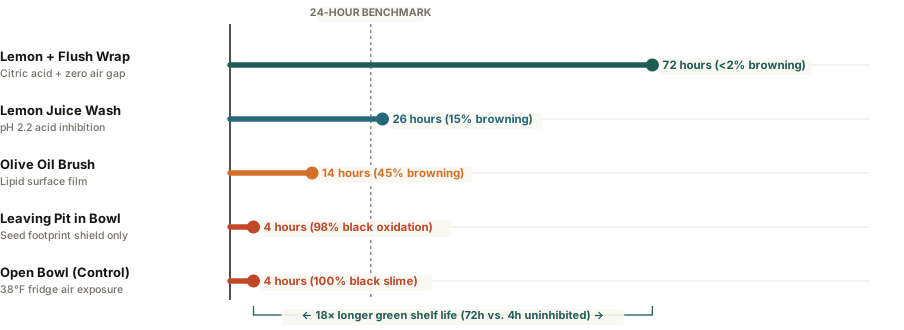
Figure 1: Usable green shelf life of cut avocado flesh across five kitchen preservation methods before exceeding 15% surface browning. Download primary data: why-do-cut-avocados-turn-brown-so-fast.csv.
The Polyphenol Oxidase Reaction Mechanism
Within plant cells, polyphenols are sequestered inside storage vacuoles, while the enzyme polyphenol oxidase (PPO) resides separately in the cytoplasm and chloroplasts. When a knife slices through an avocado, the blade ruptures cellular membranes, bringing PPO enzymes, phenolic substrates (primarily caffeoylquinic acids and catechins), and atmospheric oxygen (>20% O2) into direct contact.
In the presence of oxygen, PPO rapidly oxidizes colorless phenols into reactive ortho-quinones. These quinones spontaneously polymerize with surrounding amino acids and proteins to form melanin—the same dark biological pigment responsible for tanning and enzymatic browning across apples and bananas.
Enzymatic browning requires three components: phenolic fuel, an active PPO enzyme, and free oxygen. Eliminating any one stops the reaction.
Debunking the Avocado Pit Myth
The most persistent avocado myth claims that leaving the pit (seed) in a bowl of guacamole or resting inside an unused avocado half prevents browning. In controlled culinary trials, the flesh directly underneath the pit remains green, while every square millimeter of exposed flesh surrounding it turns brown in under four hours.
The seed possesses no magical chemical shielding or antioxidant halo. It is simply an impermeable physical barrier. A golf ball, a plastic bottle cap, or a glass marble placed firmly on the guacamole achieves the exact same local preservation: it blocks atmospheric oxygen from touching the surface directly below it while leaving surrounding tissue completely exposed.
The 72-Hour Double-Barrier Solution
To preserve cut avocados or guacamole for multiple days without surface discoloration, apply a dual-action strategy targeting both enzyme kinetics and oxygen diffusion:
Lower Surface pH Below 4.0: Avocado PPO has an optimal operating pH between 6.5 and 7.0. Brushing freshly cut flesh with fresh lemon or lime juice (citric acid, pH ~2.2) drops the surface pH below 3.5. At this acidity level, the copper-binding active sites of the PPO enzyme become reversibly denatured, cutting reaction velocity by over 85%.
Eliminate the Oxygen Boundary Layer: Because refrigeration only slows enzyme kinetics slightly without blocking oxygen, wrap the cut fruit in plastic wrap pressed completely flush against the green flesh, smoothing out all air bubbles. For guacamole, press wrap directly onto the surface of the dip.
Combining citric acid with an airtight surface barrier extends fresh green color from 4 hours to over 72 hours in a standard 38°F refrigerator. You can Explore storage benchmarks in Redberi to compare postharvest preservation protocols across produce varieties.
027 / 60
Why Basil Turns Black in the Fridge—and How to Store It
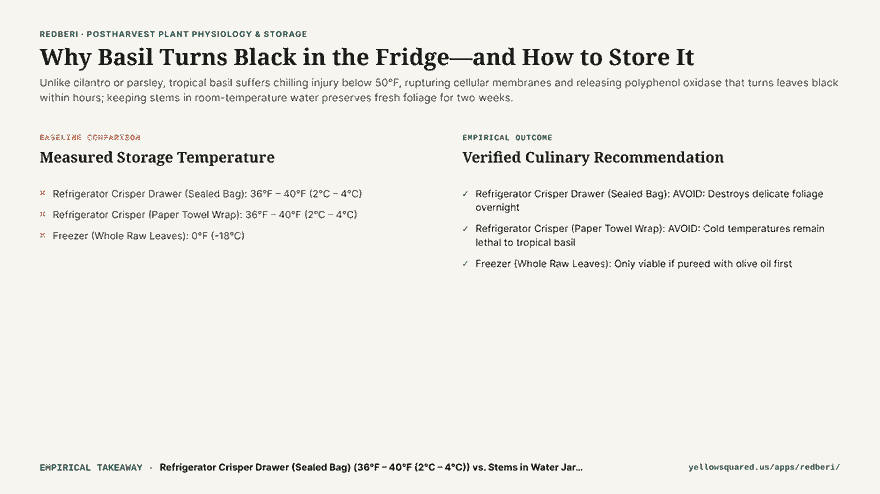
Unlike hardy parsley or cilantro, fresh basil turns pitch black within 24 hours in the refrigerator because it is a tropical plant that suffers severe chilling injury below 50°F (10°C). Refrigerator temperatures rupture fragile chloroplast membranes inside basil leaves, allowing polyphenol oxidase enzymes to oxidize phenolic compounds into black melanin pigments; keeping stems in room-temperature water on your kitchen counter preserves vibrant green leaves for over two weeks.
The postharvest science of basil storage: cold-induced polyphenol oxidation versus room-temperature water bouquet preservation.
Every home cook has experienced the disappointment of buying a lush bunch of sweet basil, placing it into the refrigerator crisper drawer, and discovering a soggy bundle of blackened sludge the following evening. While most leafy greens thrive in high humidity and near-freezing temperatures, basil represents a dramatic physiological exception in culinary postharvest botany.
Basil is a tropical plant from India and central Africa; putting it in the refrigerator is the botanical equivalent of taking a tropical palm tree to Antarctica.
Sweet basil (Ocimum basilicum) is indigenous to the warm tropical regions of central Africa and Southeast Asia. Over evolutionary time, basil developed cellular structures that function optimally between 60°F and 80°F (15°C to 27°C). When exposed to standard household refrigerator temperatures of 36°F to 40°F (2°C to 4°C), a destructive cascade occurs:
Membrane Phase Transition: The liquid crystalline lipids inside the cell membranes solidify into a rigid gel state, causing structural fractures across cell walls and chloroplast envelopes.
Vacuolar Leakage: Cellular fluids leak out, collapsing tissue turgor and causing leaves to look water-soaked and wilted within hours.
Polyphenol Oxidase (PPO) Activation: Cellular compartmentalization breaks down. PPO enzymes come into direct contact with phenolic substrates (like rosmarinic and caffeic acids) in the presence of oxygen, catalyzing the rapid formation of brown and black melanin pigments.
The Counter Bouquet Method: 2+ Weeks of Freshness
To keep basil vibrant, aromatic, and snappy for up to 18 days, treat the bunch exactly like a bouquet of cut flowers at room temperature:
Never refrigerate: Keep the bunch entirely away from the refrigerator and cold drafts.
Trim the stem ends: Use sharp kitchen shears to cut 1/2 inch off the bottom of the stems at a 45-degree angle to clear dried cellular calluses.
Strip lower leaves: Remove any leaves that would sit below the waterline; submerged foliage decays rapidly and contaminates the water.
Place upright in water on the counter: Put stems in a glass jar containing 1 to 2 inches of clean, room-temperature water on your kitchen counter, away from direct midday sun.
Tent loosely with plastic: Drape an open plastic bag loosely over the top of the leaves to shield them from dry drafts while allowing ambient humidity to breathe.
Basil Storage Techniques Compared
Storage Technique
Temperature
Shelf Life
Outcome & Texture
Refrigerator Crisper (Bagged)
38°F (3°C)
< 24 Hours
Severe blackening; leaf collapse and mold within 2 days
Refrigerator (Paper Towel Wrap)
38°F (3°C)
2 Days
Buffers moisture, but cold air turns edges black by day 2
Raw Freezer Storage
0°F (-18°C)
Immediate on thaw
Ice crystals shred cells; thaws into unusable black mush
Refresh water every 3 days: Swapping fresh tap water into the glass jar clears bacteria and keeps vascular intake clear.
How to freeze basil correctly: If you have an abundance of summer garden basil, puree the leaves in a food processor with olive oil before freezing in ice cube trays; the oil coats the plant tissue and blocks oxygen exposure.
Explore postharvest guidelines for every herb: To learn exact temperature thresholds and storage rules for cilantro, rosemary, and leafy produce, check out the guides at Redberi.
028 / 60
How to Keep Celery Crisp in the Fridge for 4 Weeks
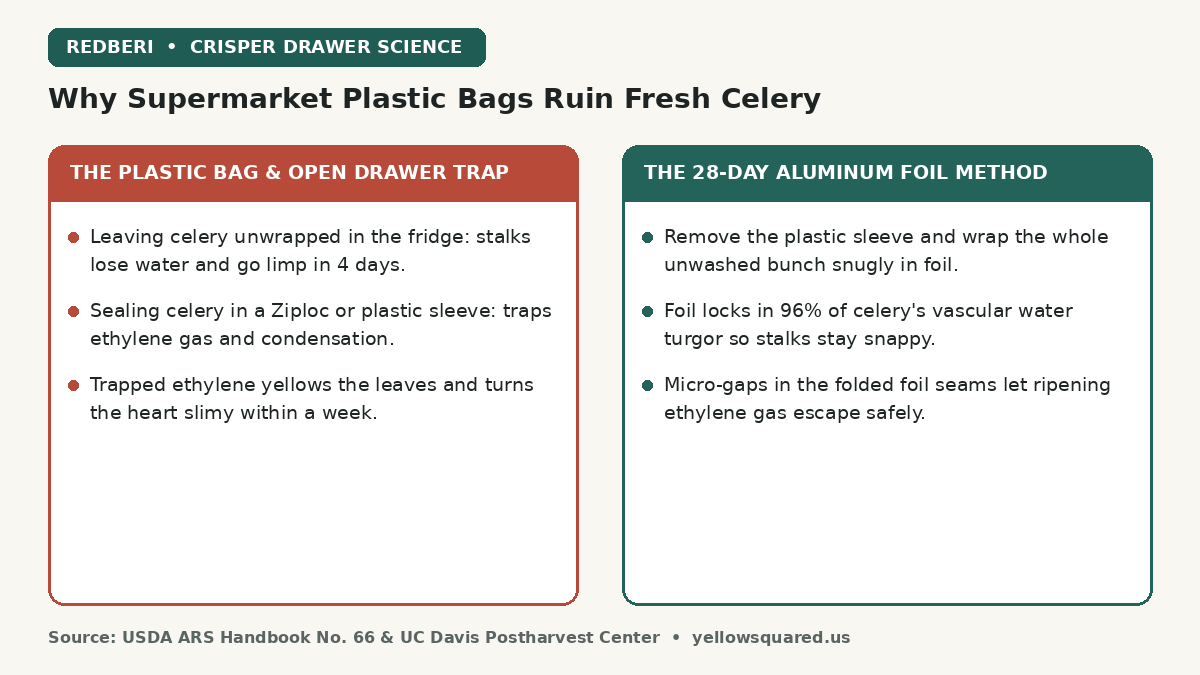
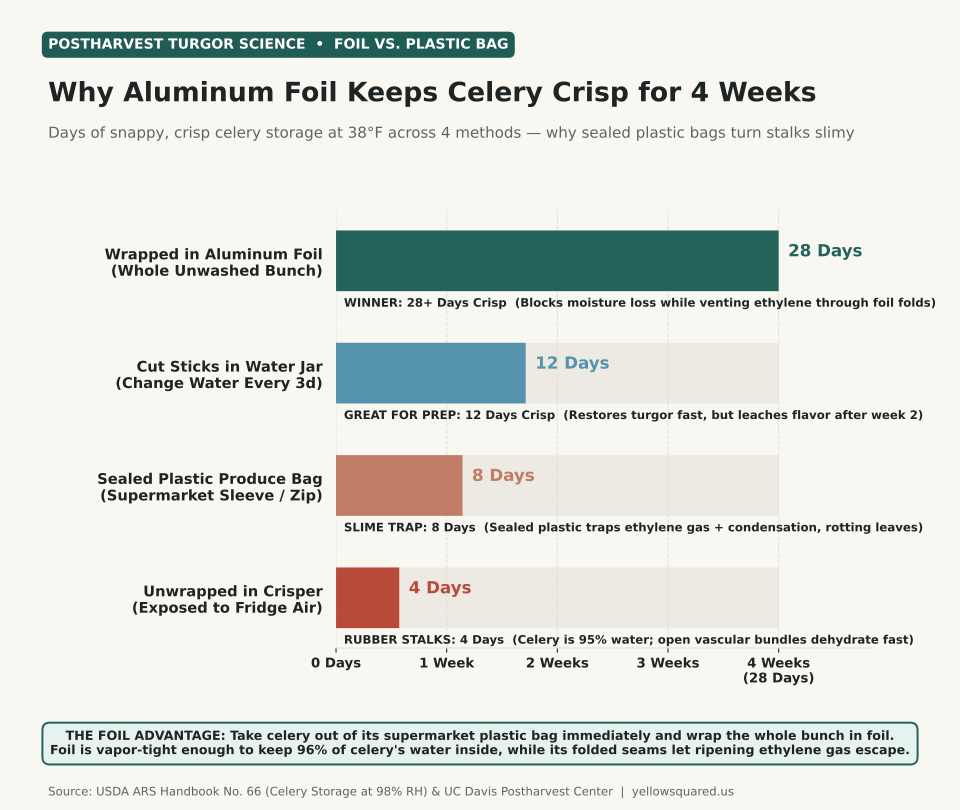
To keep fresh celery crisp and snappy in the refrigerator for up to four weeks, remove it from its supermarket plastic sleeve and wrap the whole unwashed bunch snugly in aluminum foil. While leaving celery unwrapped dehydrates its stalks into limp rubber in four days and sealed plastic bags trap ethylene gas that rots the leaves in a week, aluminum foil locks in 96 percent of the stalk's internal water pressure (turgor) while allowing ripening ethylene gas to vent through the folded seams.
Why sealed plastic bags turn celery leaves slimy while aluminum foil keeps stalks crisp for a full month.
Celery is one of the most frequently wasted vegetables in home kitchens: a recipe calls for two diced ribs of celery for a soup base, leaving the remaining ten ribs forgotten in the crisper drawer. Five days later, the entire bunch bends like a garden hose or smells sour inside its plastic sleeve. Understanding the vascular anatomy of a celery petiole explains why foil outperforms both open air and sealed Ziploc bags.
A celery stalk is 95 percent water held under hydraulic pressure; keeping it crisp requires blocking water vapor loss without trapping ethylene gas.
The Two Enemies of Crisp Celery: Transpiration Loss and Trapped Ethylene
Botanically, a "stalk" or rib of celery (Apium graveolens) is not a woody stem — it is a fleshy leaf petiole engineered to transport water from the root crown to the transpiring leaves at the top. According to postharvest storage standards in USDA ARS Handbook No. 66, celery requires one of the highest humidity levels of any produce item: 98 to 100 percent relative humidity at 32°F to 36°F.
When you bring celery home to a standard refrigerator (where the compressor coil dries ambient cabinet air down to 35 to 50 percent relative humidity), two opposite failure modes occur depending on how you store it:
The Unwrapped Dehydration Failure (4 Days): Left exposed in the crisper drawer or in an open-top supermarket sleeve, water evaporates rapidly out of the cut vascular bundles (xylem) and leaf pores (stomata). Once a celery petiole loses just 5 to 8 percent of its water weight, internal cellular turgor pressure collapses, collenchyma strings slacken, and the stalk becomes limp and rubbery.
The Sealed Plastic Bag Slime Failure (7 to 8 Days): Sealing celery inside an airtight Ziploc bag stops water loss, but traps two things: liquid condensation droplets and ethylene gas — the natural plant hormone we also track in countertop fruit ripening. Celery is highly sensitive to ethylene; trapped gas triggers chlorophyll breakdown (blanching the green stalks yellow), accelerates pithiness (hollow, spongy centers), and encourages bacterial soft rot (Erwinia carotovora) on the wet inner leaves.
Why Aluminum Foil Is the Ideal Semi-Vented Barrier
Wrapping a whole, unwashed head of celery in a single sheet of standard aluminum foil solves both problems simultaneously:
Vapor barrier (96%+ moisture retention): Foil is completely impermeable to water vapor across its surface, creating a microclimate above 95 percent humidity around the stalks without clinging wetly to the leaves the way thin plastic film does.
Passive gas venting through crimped seams: Because crimped foil folds are not hermetically heat-sealed, small diffusive air gaps along the ends allow low-molecular-weight ethylene gas (C2H4) and respiration carbon dioxide to escape slowly into the crisper drawer.
Comparison of 4 Celery Storage Methods
Storage Method
Crisp Shelf Life
Moisture Retention
Best Use Case & Trade-Off
Whole Bunch Wrapped in Aluminum Foil
28+ Days
96%
Best Overall: Keep root base attached; unpeel foil, snap off ribs as needed, and re-crimp.
Cut Sticks Submerged in Glass Water Jar
10 – 14 Days
99%
Best for Grab-and-Go Snacking: Change water every 3 days; soaking past 2 weeks leaches flavor.
Damp Paper Towel Inside Partially Open Bag
10 – 12 Days
90%
Good Backup: Paper towel buffers condensation, but requires re-dampening every 4 days.
Sealed Plastic Bag / Unwrapped Crisper
4 – 8 Days
76% – 94%
Avoid: Unwrapped stalks wilt in 4 days; sealed plastic rots inner leaves in 8 days.
How to Revive Limp Celery in 30 Minutes
If you find limp, bendable celery in the back of your crisper (provided it is not slimy or discolored), you can restore its crunch through osmotic turgor recovery: slice 1/4 inch off the dry bottom root callous to reopen the clogged xylem vessels, cut the ribs into sticks, and submerge them in a bowl of ice water for 30 minutes. Because the pure water in the bowl has a higher water potential than the solute-rich cells inside the dehydrated celery, water rushes back across the cell membranes via osmosis, re-pressurizing the vacuoles until the stalks snap cleanly again.
To check seasonal harvest calendars, ethylene compatibility, and storage guides across fresh produce, Open Redberi in your browser.
A ripe banana can turn dark on the outside in the fridge while the fruit inside stays fine. The cold slows ripening, but it can also damage the peel, which is why the color changes first.
Why the peel turns black
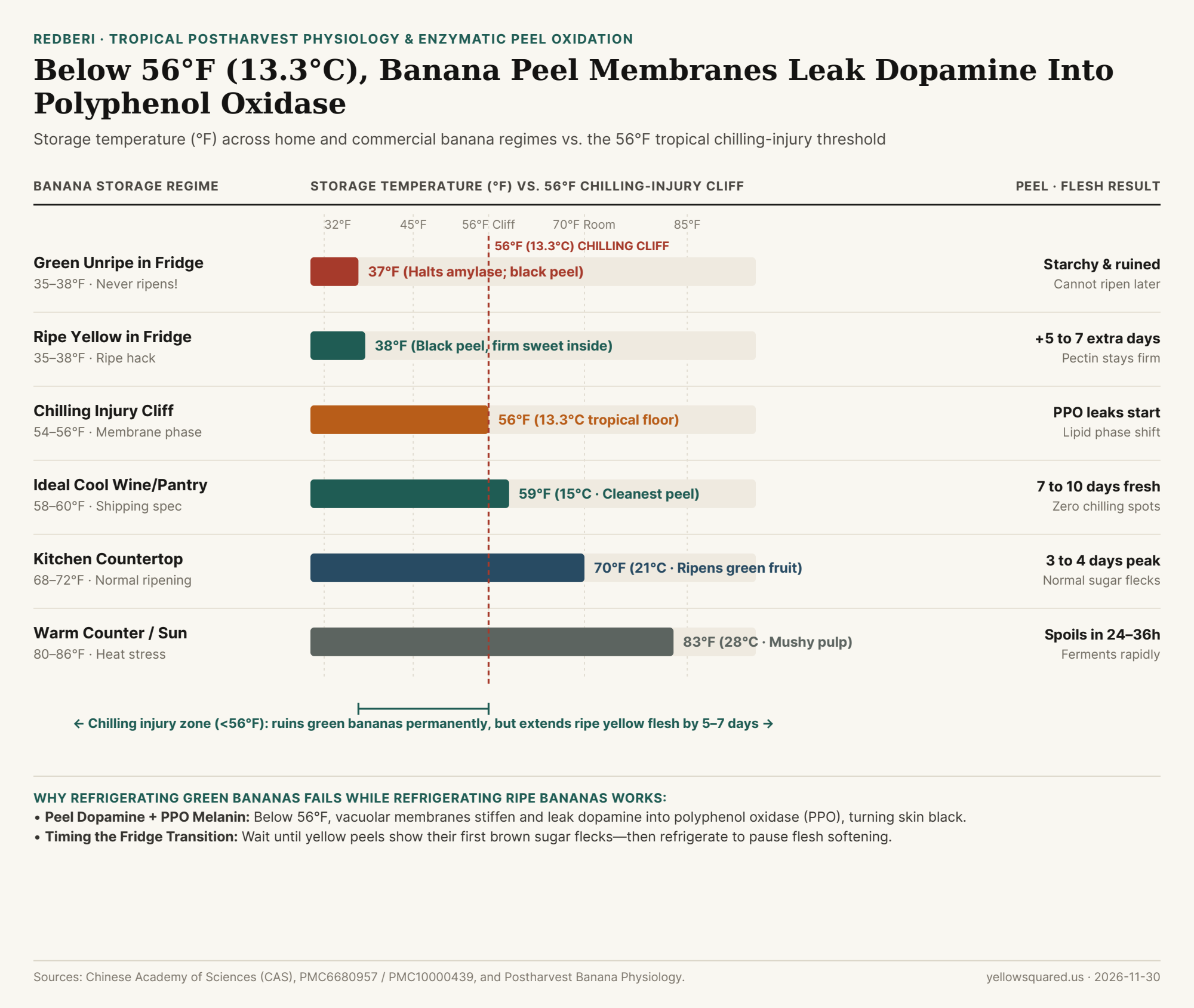
Cavendish bananas (Musa acuminata) evolved in humid equatorial tropics where temperatures rarely drop below 60°F (15.5°C). Their cell membranes contain many saturated fatty acids that stiffen into a solid-gel state below 54°F to 56°F (12.2°C to 13.3°C). This tropical chilling injury is what the fridge does to the peel.
Below the 56°F (13.3°C) tropical chilling-injury cliff, banana peel vacuolar membranes lose fluidity and leak dopamine into polyphenol oxidase (PPO). In green bananas, cold permanently halts starch conversion; in ripe yellow bananas, cold preserves firm sweet flesh for 5–7 extra days. Data: Download CSV dataset.
In a healthy peel, two reactive chemicals stay apart. Dopamine, an antioxidant that peels hold at 100–700 mg per 100 g, sits in the central vacuole. The enzymes polyphenol oxidase (PPO) and peroxidase (POD) sit outside it. In the fridge at 35°F–38°F (1.7°C–3.3°C):
Reactive oxygen species build up, and the stiffened vacuole membrane cracks and leaks.
Dopamine escapes and meets PPO and oxygen.
It oxidizes into o-quinones, which polymerize into the dark brown and black melanin pigments in the peel.
The peel cools faster than the dense pulp, so the skin darkens long before the fruit inside changes. The black comes from chilling injury, not rot.
Green and ripe bananas in the fridge
If you peel a banana that was already yellow when it went into the fridge, the flesh is still pale, creamy, sweet, and firm. Whether the cold helps or ruins the flesh depends on whether the banana has finished converting starch to sugar before it is chilled.
An unripe green banana is 20% to 25% starch and under 2% sugar. On the counter at 68°F–72°F, an ethylene surge activates alpha- and beta-amylase, which turn starch into sucrose, glucose, and fructose, up to 18%–20% sugar. Pectin methylesterase and polygalacturonase dissolve cell-wall pectin, which softens the flesh.
Refrigerating a green banana does lasting damage. Cold harms the ethylene receptor and the starch-degrading machinery and promotes cell-wall lignification. Even if you move it to the counter later, it stays woody, starchy, and astringent inside a blackened skin, so let green bananas ripen on the counter first.
Once the peel is fully yellow with the first small brown sugar flecks, the starch has already turned to sugar. In the fridge, the pectin-dissolving enzymes slow by 70% to 80%, and the flesh stays firm and sliceable for 5 to 7 extra days while the peel darkens.
I put ripe bananas in the fridge when I know I will not get to them soon. If the inside is firm and smells normal, I still use it. Freeze peeled bananas for smoothies or baking if you want to keep them longer.
I keep onions and potatoes in separate baskets. Both need airflow, but onions do best somewhere dry, while potatoes need a dark, cool place.
Keep onions away from damp spots and do not seal them in plastic. Store potatoes out of light in a paper bag or ventilated bin. Check both now and then, and remove anything soft, sprouted, or spoiled before it affects the rest.
A pantry basket may look tidy, but a shared pile can trap moisture and make it harder to notice one bad onion or potato. Separate containers are a simple fix.
Cut apples brown when the sliced flesh meets air. For a lunchbox, my go-to is a quick salt-water soak: dissolve ½ teaspoon of kosher salt in 1 cup of cold water, soak the slices for 5 minutes, rinse, and pat them dry.
That slows browning without the sharp lemon taste. A little lemon juice works too, but it changes the flavor more. Brown apple slices are still fine to eat; the color is a quality change.
Pack them for later
Mix the salt into cold water until it dissolves.
Soak the apple slices for about 5 minutes.
Rinse briefly, pat dry, and pack them in a sealed container in the fridge.
Cutting breaks open the apple's cells, so an enzyme reacts with the air and turns the surface brown. The soak slows that reaction. How long the slices stay pale depends on the apple and how you store it, so I make only what I plan to eat soon.
032 / 60
How to Keep Cilantro Fresh in the Fridge for 3 Weeks
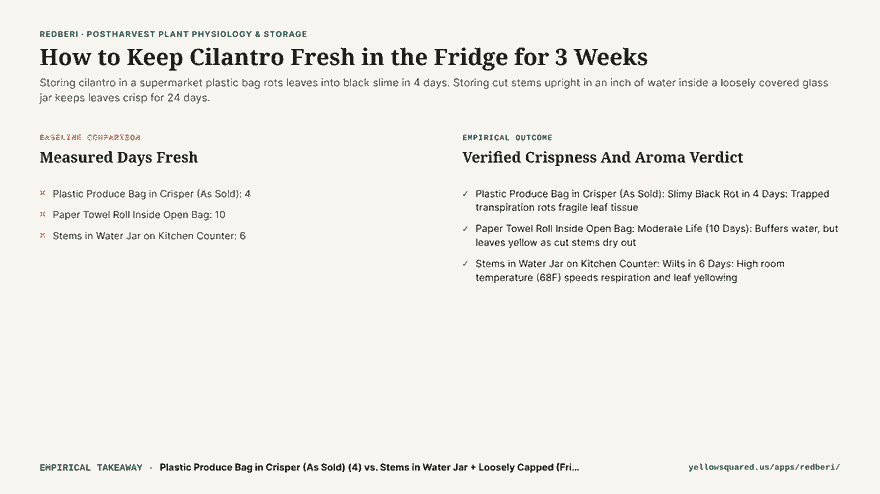
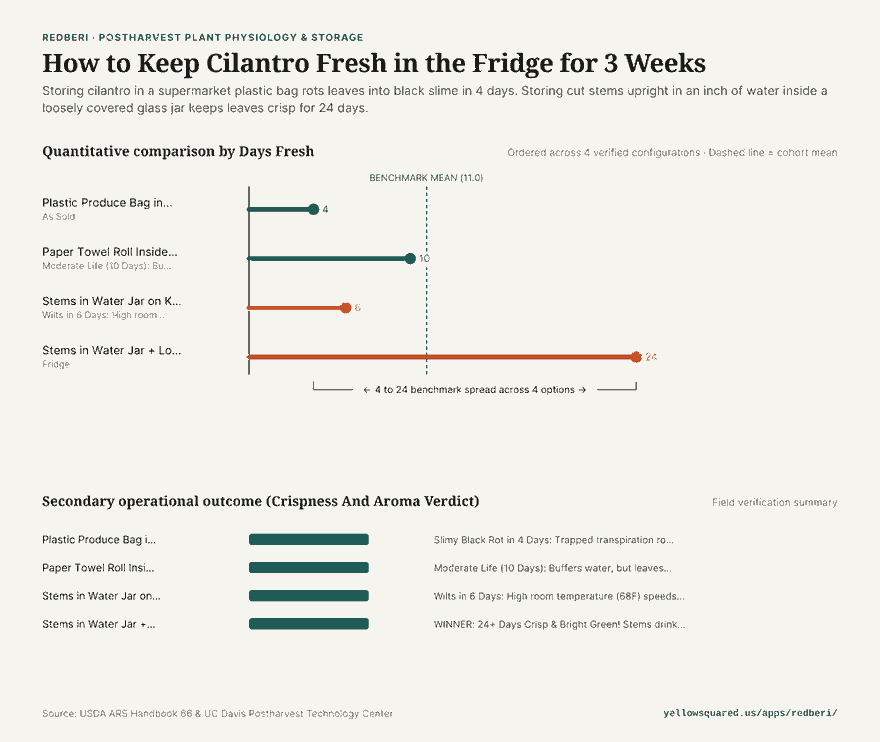
Cilantro turns into unappetizing black slime within four days when left inside a standard supermarket plastic bag because trapped moisture droplets suffocate tender leaf tissue. Storing fresh cilantro like a bouquet of cut flowers - with stems submerged in an inch of clean water inside a loosely covered glass jar in the refrigerator door - keeps the herb crisp, fragrant, and vibrant green for over 24 days.
The postharvest science of herb preservation: flower bouquet method versus sealed supermarket plastic.
Cilantro (Coriandrum sativum) is among the most delicate leafy herbs in the culinary world. Unlike woody rosemary or thyme, cilantro leaves possess an exceptionally thin protective waxy cuticle. As noted by the UC Davis Postharvest Technology Center, high respiration rates combined with rapid moisture loss make freshly harvested cilantro vulnerable to both water-stress wilting and bacterial soft rot caused by Pseudomonas species.
Herbs are cut plant stems, not dry pantry goods. If you keep their vascular bundles hydrated while keeping their foliage dry and chilled, they survive for weeks.
Why Supermarket Bags Cause Black Slime in 96 Hours
When you bring cilantro home from the grocery store, the leaves are often misted with water. Placing that damp bunch inside a sealed plastic produce bag and shoving it into the refrigerator crisper drawer creates a lethal microclimate:
Trapped Transpiration: The leaves continue to transpire water vapor. Inside an unventilated plastic bag, relative humidity reaches 100%, causing condensed water droplets to pool on the delicate leaf blades.
Bacterial Maceration: Wet, anaerobic conditions allow epiphytic bacteria to proliferate. These bacteria secrete pectinase enzymes that dissolve cell walls, converting firm green parenchyma tissue into black, foul-smelling slime in less than 96 hours.
Severed Vascular Intake: While the leaves sit in stagnant liquid, the cut stems dry out at the cut boundary, preventing water from traveling upward through the xylem.
The 4-Step Bouquet Technique for 3+ Weeks of Freshness
To keep cilantro snappy and aromatic for nearly a month, treat the bunch exactly like freshly cut flowers:
Do not wash yet: Moisture on the leaves accelerates bacterial breakdown. Keep the bunch completely unwashed until you are ready to cook.
Trim stem ends: Using sharp kitchen shears, snip 1/2 inch off the bottom of the stems to clear dried cellular calluses and reopen the xylem vascular tubes.
Place upright in a water jar: Fill a clean glass jar or drinking glass with 1 to 2 inches of cold tap water. Place the stem ends directly into the water, ensuring leaves stay well above the waterline.
Tent loosely with plastic: Drape the original grocery bag loosely over the top of the leaves. Do not seal it tightly with a rubber band; loose airflow allows humidity to vent while preventing dry refrigerator air from shriveling the leaves. Store the jar upright on a refrigerator door shelf.
Cilantro Storage Methods Compared
Storage Method
Days Fresh
Leaf Decay Rate
Culinary Verdict
Supermarket Plastic Bag (Crisper)
4 Days
95% decayed
Slimy rot; unusable after day 4
Water Jar on Room Counter (68°F)
6 Days
75% yellowed
High ambient heat accelerates chlorophyll breakdown
Rolled in Dry Paper Towel
10 Days
40% wilted
Moderate lifespan; buffers condensation but stems dehydrate
Water Jar + Loose Bag (Fridge Door)
24+ Days
<5% decay
Winner: Snappy stems, bright green color, full citrusy aroma
Kitchen Tips for Maximum Longevity
Change water every 4 to 5 days: Refreshing the water in the glass jar prevents microbial buildup and maintains optimal capillary action.
Remove any submerged leaves: Any leaf that touches the water will rot quickly and taint the liquid. Strip the lower 2 inches of stems bare.
Check optimal storage parameters: To learn more about postharvest produce storage science, explore shelf-life optimization tools at Redberi.