YellowSquared  /  Field notes

Notes from the workshop

59 posts, newest first. Choose an app to narrow the feed.

009 / 59

How Long Are Most U.S. Baby Names, and Why Have 3- and 4-Letter Names Surged Since 1990?

Look at the top of the U.S. Social Security Administration (SSA) baby name rankings in 1989 and you see a wall of 7-to-11-letter heavyweights: Michael (7), Christopher (11), Matthew (7), Joshua (6), Jessica (7), Ashley (6), Brittany (8), Amanda (6), and Stephanie (9). Fast-forward to the current SSA national table and the top tier looks remarkably compact: Liam (4 letters, #1 boy), Noah (4 letters, #2 boy), Emma (4 letters, #3 girl), and Mia (3 letters, #6 girl), joined in the Top 20 by Levi (4), Luca (4), Jack (4), Leo (3), and Ezra (4) (Popular Baby Names - SSA; The rise of the 4-letter baby name - Quartz).

Across the full national SSA birth file, 3- and 4-letter first names have nearly doubled their share of U.S. births since 1989—rising from 14.3% to 26.2%—so that more than half of all American newborns (50.8%) now receive a first name of five letters or fewer. You can filter every name in the historical SSA corpus by exact letter count, syllable structure, and state trajectory when you Explore U.S. baby name trends and regional rankings in Name Scout.
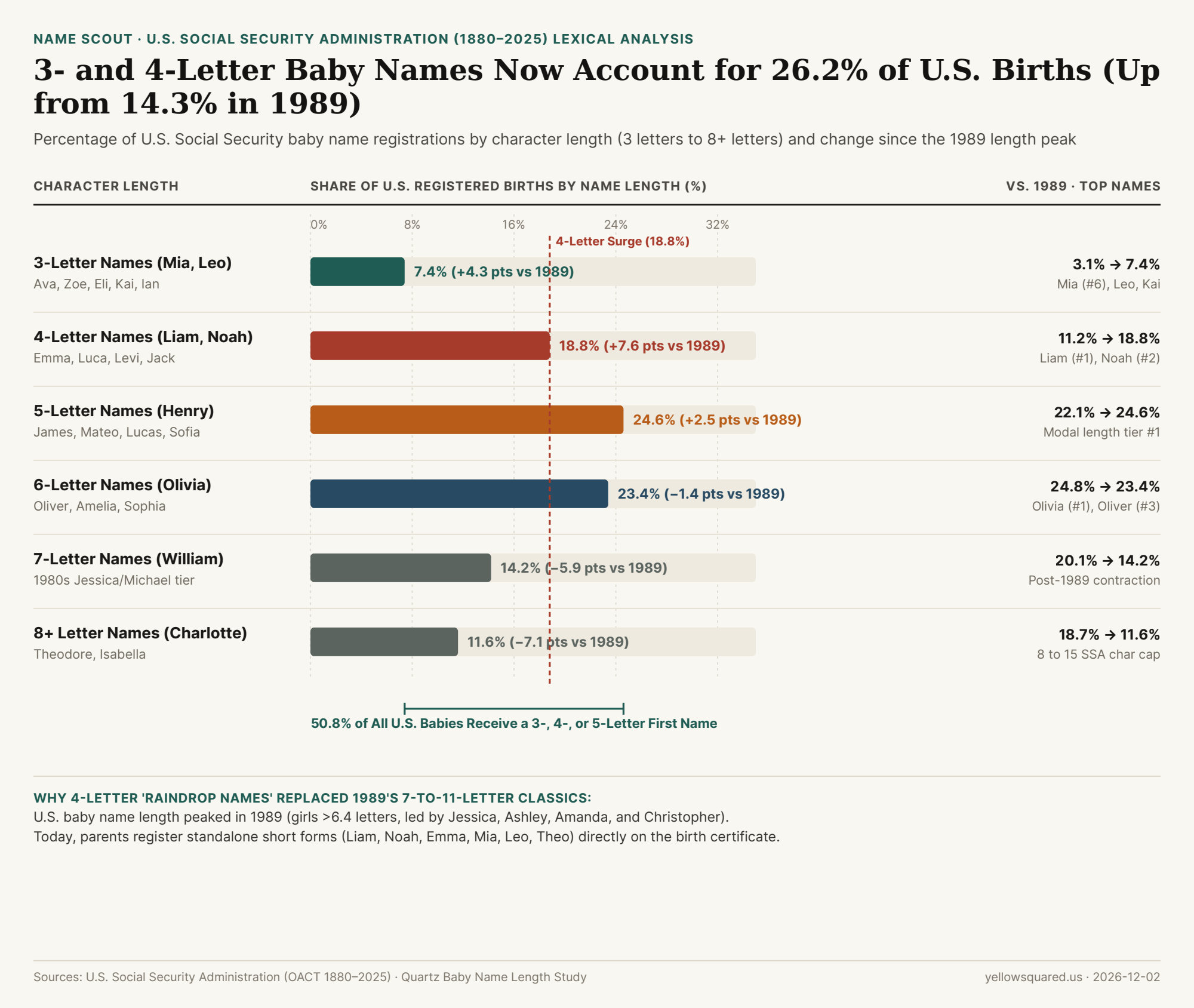
Chart showing the percentage of U.S. registered births by first-name character length from 3 letters to 8+ letters and net percentage-point shift since 1989
Figure 1: Distribution of U.S. registered births by first-name character length and net shift since the 1989 length peak. Data: us-ssa-baby-name-character-length-distribution-and-top-short-names.csv (Popular Baby Names - SSA; Quartz).

The 1989 Character-Length Peak and the Rise of "Raindrop Names"

Longitudinal analysis of the SSA national card-application dataset shows that American first-name length reached its modern maximum in 1989, when girls' names averaged over 6.4 letters and boys' names averaged roughly 6.0 letters (The rise of the 4-letter baby name - Quartz). Two structural shifts drove the post-1990 contraction toward 3- and 4-letter names:

  • Vowel-Dense "Raindrop Names" (2 Syllables in 3–4 Letters): In the 1950s and 1960s, short names were mostly clipped one-syllable consonant blocks (John, Mark, Paul, Ann, Jane). Today's 3- and 4-letter leaders pack two full syllables and two vowels into three or four characters—what baby-name researcher Laura Wattenberg termed "raindrop names" (Liam, Noah, Emma, Mia, Aria, Luna, Milo, Nora, Theo, Luca, Maya, Zoey) (Quartz).
  • Registering the Hypocoristic (Nickname) Directly on the Birth Certificate: Where 20th-century parents registered William, Leonardo, Theodore, Alexander, or Katherine and used a short nickname at home, modern parents frequently register the 3- or 4-letter form (Liam, Leo, Theo, Alex, Kate, Jack, Max) directly as the legal given name (Quartz). (At the same time, several unshortened vintage classics like Charlotte #2 girl and Theodore #4 boy remain popular alongside their short counterparts, showing that parents favor distinct stylistic poles over mid-length 7-letter names.)

"Modern 3- and 4-letter baby names are rarely one-syllable monosyllables: names like Mia, Leo, Liam, Noah, Emma, and Luna pack two melodic syllables into three or four letters."

U.S. Baby Name Character-Length Distribution (3 Letters to 8+ Letters)

Breaking down the national birth distribution by exact character count highlights how 5- and 6-letter names remain the modal center (48.0% combined), while 3- and 4-letter names absorbed the share lost by 7- and 8+-letter names (Popular Baby Names - SSA; Quartz):

Character Length Tier Share of U.S. Births Shift vs. 1989 Peak Top-Ranked U.S. Examples Phonetic & Structural Pattern
1. 3-Letter Names 7.4% +4.3 pts (from 3.1%) Mia (#6), Leo, Eli, Kai, Ava, Zoe 2-syllable vowel-open or crisp 1-syllable
2. 4-Letter Names 18.8% +7.6 pts (from 11.2%) Liam (#1), Noah (#2), Emma (#3), Levi, Luca 2-syllable "raindrop" names (2 vowels)
3. 5-Letter Names 24.6% +2.5 pts (from 22.1%) Henry (#5), James (#6), Mateo (#8), Lucas Largest single character-length bucket
4. 6-Letter Names 23.4% −1.4 pts (from 24.8%) Olivia (#1), Oliver (#3), Amelia (#4), Sophia 3-to-4-syllable liquid/vowel classics
5. 7-Letter Names 14.2% −5.9 pts (from 20.1%) William (#9), Eleanor, Abigail, Madison Steepest decline from 1980s Jessica/Michael era
6. 8 to 15 Letters 11.6% −7.1 pts (from 18.7%) Charlotte (#2), Theodore (#4), Isabella (#7) Formal vintage revival names

SSA Data Rules & Limitations When Analyzing Name Length

When interpreting character-length statistics from the Social Security Administration public dataset, keep four technical boundaries in mind:

  1. 2-to-15-Character Truncation Window: The SSA public file requires names to be at least 2 characters long and truncates any given name exceeding 15 characters to its first 15 letters (Popular Baby Names Limits - SSA).
  2. Hyphen & Space Normalization: Punctuation marks, spaces, and hyphens are stripped when compiling the national file (so Mary-Anne or Mary Anne is merged and counted as the 8-letter string Maryanne).
  3. Exact Spelling Separation: Variants of different lengths—such as Sofia (5 letters, #9 girl) vs. Sophia (6 letters, #5 girl), or Lucas (5) vs. Lukas (5)—are tallied as separate rows rather than combined by pronunciation (SSA).
  4. Privacy Suppression (<5 Births): Any name registered fewer than 5 times (<5) in a given birth year and sex is omitted from the public release, which slightly undercounts rare, hyphenated, or compound long names in the long tail (SSA).

To filter 3-, 4-, and 5-letter baby names by starting vowel, decade momentum, and state-by-state popularity, Explore U.S. baby name trends and regional rankings in Name Scout.
010 / 59

Why Did the U.S. Twin Birth Rate Surge 79% and Then Fall—And How Do Parents Pair Twin Baby Names?

For thirty-four straight years between 1980 and 2014, twin strollers became a dramatically more common sight in American neighborhoods: according to U.S. Centers for Disease Control and Prevention (CDC) National Center for Health Statistics (NCHS) natality records, the U.S. twin birth rate surged by 79%—climbing from 18.9 twin babies per 1,000 live births in 1980 (68,339 infants) to an all-time national high of 33.9 per 1,000 in 2014 (135,336 infants). Then the curve reversed. Over the decade from 2014 to 2024, the national twin birth rate fell 11% to 30.1 per 1,000 (109,195 infants, a 20-year low)—driven by a remarkable 46% drop in twinning among mothers aged 40 and older.

Reader outcome: You will see the exact CDC NCHS demographic numbers behind the 1980–2014 rise and 2014–2024 decline in U.S. twin births, understand how single-embryo IVF changed multiple-birth rates, and learn the three linguistic frameworks parents use to pair 54,500 sets of twin names each year.

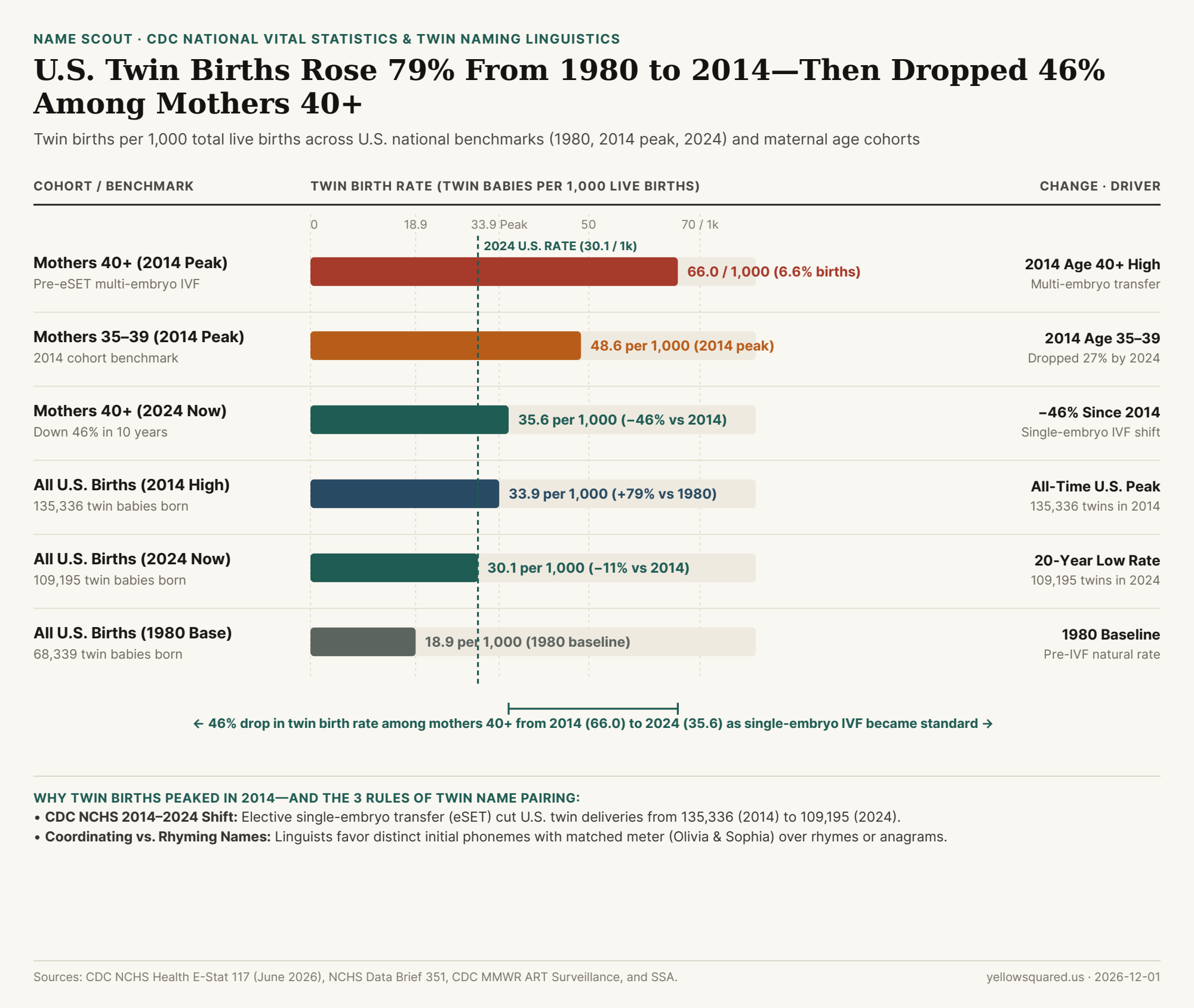
Chart showing U.S. CDC NCHS twin birth rates per 1,000 live births in 1980, 2014, and 2024 alongside the 46% drop among mothers aged 40 and older
After climbing 79% from 18.9 per 1,000 births in 1980 to 33.9 per 1,000 in 2014, the U.S. twin birth rate dropped to 30.1 per 1,000 in 2024—led by a 46% drop among mothers aged 40+ (from 66.0 down to 35.6 per 1,000) as elective single-embryo IVF became standard. Data: Download CSV dataset.

Why U.S. Twin Births Rose 79% (1980–2014) and Then Dropped 46% in Mothers 40+

Human twinning occurs through two distinct biological pathways. Monozygotic (identical) twins—when a single fertilized egg splits—occur at a nearly constant baseline rate of roughly 3.5 to 4.0 per 1,000 deliveries worldwide across all maternal ages. Dizygotic (fraternal) twins—when two separate eggs are released and fertilized in the same cycle—vary dramatically with two factors: maternal age (because follicle-stimulating hormone, or FSH, naturally rises as women enter their 30s) and assisted reproductive technology (ART / IVF).

As CDC NCHS Data Brief 351 and NCHS Health E-Stat 117 document, the 1980–2014 boom and the 2014–2024 reversal were driven by a major shift in reproductive medicine:

  • The 1980–2014 Multi-Embryo Transfer Era: During the first three decades of in vitro fertilization (IVF) and ovulation-induction therapies, clinics routinely transferred 2, 3, or more embryos per cycle to maximize pregnancy odds. Combined with rising maternal age at first birth, twin deliveries more than doubled from 68,339 babies in 1980 to 138,961 in 2007 and 135,336 in 2014 (`33.9 per 1,000`). In 2013, CDC MMWR ART surveillance showed that ART-conceived infants accounted for 18.5% of all U.S. twins.
  • The 2014–2024 Elective Single-Embryo Transfer (eSET) Revolution: As blastocyst culture and preimplantation genetic testing improved implantation rates, the American Society for Reproductive Medicine (ASRM) updated clinical guidelines to strongly recommend elective single-embryo transfer (eSET). Between 2014 and 2024, twin birth rates stayed flat for mothers under 25 (`23.0` to `22.7` per 1,000) but plummeted in every cohort where IVF is most common: down 18% for ages 30–34 (`40.3` to `33.2`), down 27% for ages 35–39 (`48.6` to `35.4`), and down 46% for mothers aged 40 and older (`66.0` to `35.6` per 1,000).

Between 2014 and 2024, the twin birth rate for U.S. mothers aged 40 and older fell nearly in half—from 66.0 to 35.6 per 1,000 births—as single-embryo IVF replaced multi-embryo transfers.

CDC NCHS Twin Birth Rates by Cohort and the 3 Architectures of Twin Naming

Even at 30.1 per 1,000 births, roughly 109,195 twin babies (over 54,500 pairs) are named in the United States every year. Note that while CDC NCHS natality files track plurality (`twin` vs. `singleton`), the public U.S. Social Security Administration (SSA) baby name file tabulates individual SSN card applications by exact spelling (`>=5` births/year) without linking sibling pairs—so twin naming patterns are studied through state vital-statistics linkage and onomastic research:

Cohort / Maternal Age Group 2014 Peak Rate (per 1k) 2024 Rate (per 1k) 2014–2024 Change Annual U.S. Twin Infants Clinical & Demographic Driver
Mothers Aged 40 and Older 66.0 / 1,000 35.6 / 1,000 −46.1% decline Highest ART eSET shift Transition to single-embryo IVF transfer
Mothers Aged 35 to 39 48.6 / 1,000 35.4 / 1,000 −27.2% decline Second-largest drop Natural FSH peak + single-embryo IVF
Mothers Aged 30 to 34 40.3 / 1,000 33.2 / 1,000 −17.6% decline Core maternal cohort 18% decline over 2014–2024 decade
Mothers Aged 20 to 24 23.0 / 1,000 22.7 / 1,000 −1.3% (Stable) Spontaneous baseline Minimal ART usage; natural dizygotic rate
All U.S. Births (2014 Peak) 33.9 / 1,000 — +79.4% vs. 1980 135,336 twins (2014) All-time U.S. national twinning record
All U.S. Births (2024 Current) — 30.1 / 1,000 −11.2% vs. 2014 109,195 twins (2024) Lowest U.S. twin rate in 20+ years

How to Pair Twin Names Without Falling Into the 'Rhyming & EHR Mix-Up' Trap

When naming twins, hospital patient-safety researchers and naming specialists warn against ultra-similar rhyming, single-letter-difference, or anagram pairs (such as Taylor & Tyler, Mia & Mya, Ronald & Donald, or the reversed spelling Heaven & Nevaeh): when two children share the exact same birth date, last name, address, and first initial, electronic health records (EHRs), pharmacy labels, and school databases suffer a significantly higher rate of chart mix-ups. Instead, use three clean pairing principles:

  1. Give Each Twin a Distinct First Initial: Assigning different starting letters (e.g., C and V, or L and N) gives each child a unique monogram (`C.H.` vs. `V.H.`) and prevents automated medical and administrative record collisions.
  2. Match Prosodic Meter or Era Instead of Rhyming Endings: Pair two names that share the same syllable weight or historical vintage without sharing identical vowel-consonant rhymes—such as two four-syllable Latinate classics (Isabella & Gabriella or Olivia & Amelia), two two-syllable trochees (Liam & Henry or Clara & Hazel), or two nature/botanical names (Willow & Sienna).
  3. Test the 'Playground Call' Cadence: Say both names out loud in both orders (`"A and B"`, `"B and A"`): distinct stressed vowels make it effortless for each twin to recognize their own name in a noisy room. To run head-to-head partner swipes and compare 140+ years of U.S. SSA trajectories for sibling and twin pairs, Explore historical name trends in Name Scout.

011 / 59

Why Are Autumn, Summer, August, and June Top Baby Names—While Spring and October Are Almost Never Used?

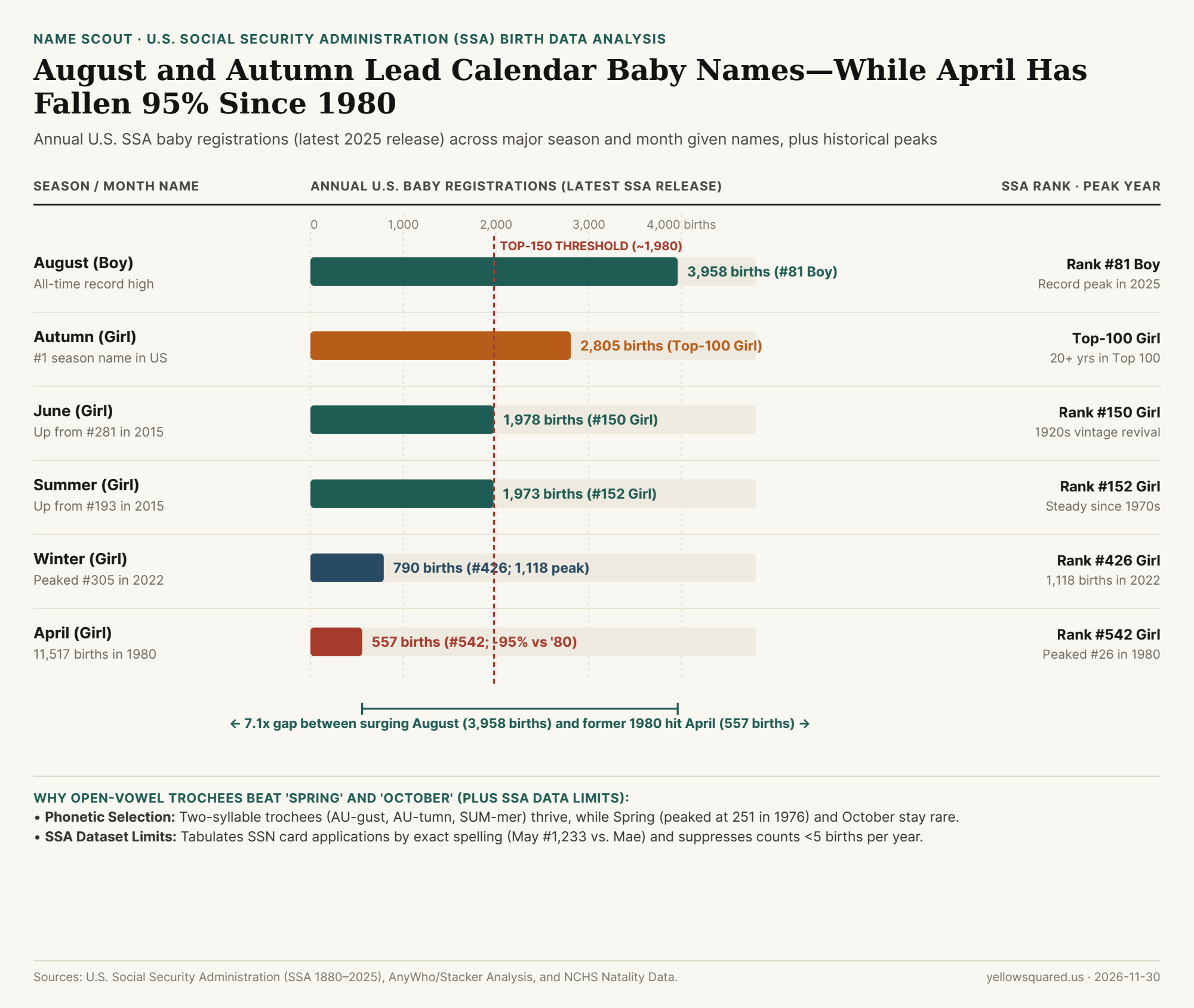
According to U.S. National Center for Health Statistics (NCHS) natality records, August, July, September, and October are four of the busiest birth months in America. Yet when you inspect the U.S. Social Security Administration (SSA) baby name database across all four seasons and twelve calendar months, parents do not name babies in proportion to the calendar. In the latest SSA national release analyzed by AnyWho and Stacker, August hit an all-time record of 3,958 boy births (#81), Autumn led all season names for girls with 2,805 births (Top-100), and June (1,978 births, #150) and Summer (1,973 births, #152) ran neck-and-neck—while Spring peaked at just 251 births in 1976 and October, November, and February barely register at all.

Reader outcome: You will see the exact SSA birth counts and rank trajectories for every major season and month name, understand the phonetic and historical forces separating winners (`August`, `Autumn`, `June`, `Summer`) from faded hits (`April`, down 95% since 1980), and learn the three SSA dataset limits that split spellings like `May` vs. `Mae`.

Chart comparing U.S. SSA baby name registrations across August, Autumn, June, Summer, Winter, and April
In the latest U.S. SSA baby name data, August (3,958 boy births) and Autumn (2,805 girl births) lead all calendar and season names, while former 1980 smash hit April (11,517 births at #26 in 1980) has fallen 95% to 557 births (#542). Data: Download CSV dataset.

The Four Seasons in SSA Data: Why Autumn and Summer Beat Winter and Spring

Why did English speakers embrace Autumn and Summer as mainstream given names in the 1970s while leaving Spring almost untouched? In SSA historical records, the four seasons split along strict phonetic and semantic lines:

  • Autumn (2,805 births · Top-100 Girl): Derived from Latin autumnus, AU-tumn is a two-syllable trochee (first-syllable stress) starting with an open vowel and ending in a soft nasal consonant—matching the exact phonetic template of perennial favorites like Lauren, Morgan, and Eden. It has remained inside the U.S. Top 100 for more than two decades.
  • Summer (1,973 births · #152 Girl): Entering the U.S. Top 1000 in 1970, SUM-mer blends the familiar two-syllable -er cadence of occupational surnames (Harper, Piper, Parker) with warm seasonal imagery, rising from #193 in 2015 to #152.
  • Winter (~790–1,118 births · #426 Girl): Sharing the crisp -er ending of Summer, WIN-ter climbed rapidly during the 2010s nature-name wave to peak at #305 with 1,118 girl births in 2022 (plus alternative spelling Wynter) before cooling to #426.
  • Spring (Peaked at 251 births in 1976): Unlike the two-syllable trochees AU-tumn, SUM-mer, and WIN-ter, Spring is a single-syllable word opening with a heavy three-consonant cluster (spr-) and doubling as a mechanical noun ("coil spring") and action verb ("spring forward"). After briefly appearing in 1951 and peaking at 251 births in 1976, it vanished from the Top 1000.

Every enduring season name in the U.S. Top 500—Autumn, Summer, and Winter—is a two-syllable trochee (DUM-da), while one-syllable Spring never cleared 251 annual births.

The Twelve Months Compared: August's Surge, June's Return, and April's 95% Drop

Calendar month names show an even sharper generational rotation. While folk heuristics like a strict "100-year rule" fail as universal clocks—because some names cycle in 40 years while others never return—empirical SSA counts show three distinct cohorts among the months:

Calendar / Seasonal Name Primary Sex Latest SSA Births Latest SSA Rank Historical Peak Rank & Year Phonetic & Demographic Trajectory
August Boy (Unisex) 3,958 #81 Boy #81 in 2025 (Record high) Latin Augustus; surged into Top 100 with nickname Auggie
Autumn Girl 2,805 #94 Girl #67 in 2019 Category leader among all four seasons; Top-100 staple
June Girl 1,978 #150 Girl #39 in 1925 Early-20th-century classic revival; climbed from #281 in 2015
Summer Girl 1,973 #152 Girl #142 in 1977 & 2008 Steady two-syllable open-vowel favorite; up from #193 in 2015
Winter Girl ~790 #426 Girl #305 in 2022 (1,118) Modern nature entrant; peaked in 2022 before cooling to #426
April Girl 557 #542 Girl #26 in 1980 (11,517) Gen-X smash hit that dropped 95% from its 1980 peak
May (excluding Mae) Girl 183 #1,233 Girl #53 in 1900 Split across exact spellings May (#1,233) and Mae (Top 600)
Spring Girl <25 Outside Top 1000 251 births in 1976 spr- consonant cluster and verb homophone limited adoption

Why October and September Stay Rare—And Three SSA Data Limits to Watch

Why do parents born or expecting in the fall choose Autumn (2,805 births) or seasonal nature names like Rowan, Sienna, Marigold, and Noel/Noelle rather than September, October, or November? In English prosody, three-syllable amphibrachs (Sep-TEM-ber, Oc-TO-ber, No-VEM-ber, De-CEM-ber) place primary stress on the middle syllable and lack natural one-syllable nicknames, whereas May, June, April, and August were all given names in Roman or medieval Europe long before modern calendar naming.

Finally, when comparing calendar names in the public SSA dataset, keep three structural data limitations in mind:

  1. SSN Card Applications, Not Birth Certificates: The SSA dataset tabulates applications for Social Security cards rather than NCHS birth certificates directly (nor does it include birth-month timestamps in the public national file).
  2. Exact-Spelling Separation: Every distinct spelling is ranked as a separate string. For example, while calendar spelling May sits at #1,233 (183 births), vintage spelling Mae—and variants like Wynter vs. Winter or Noelle vs. Noel—are counted separately.
  3. Small-Count Privacy Suppression (<5 Births): Any name given to fewer than 5 babies of the same sex in a calendar year is omitted from the national file, which is why ultra-rare month names like February or November frequently drop below the reporting floor. To compare exact spelling variants and 140-year popularity curves side by side, Explore historical name trends in Name Scout.

012 / 59

Why Did 5% to 7% of Babies Share the #1 Name a Century Ago—While Today's Top Name Reaches Less Than 1%?

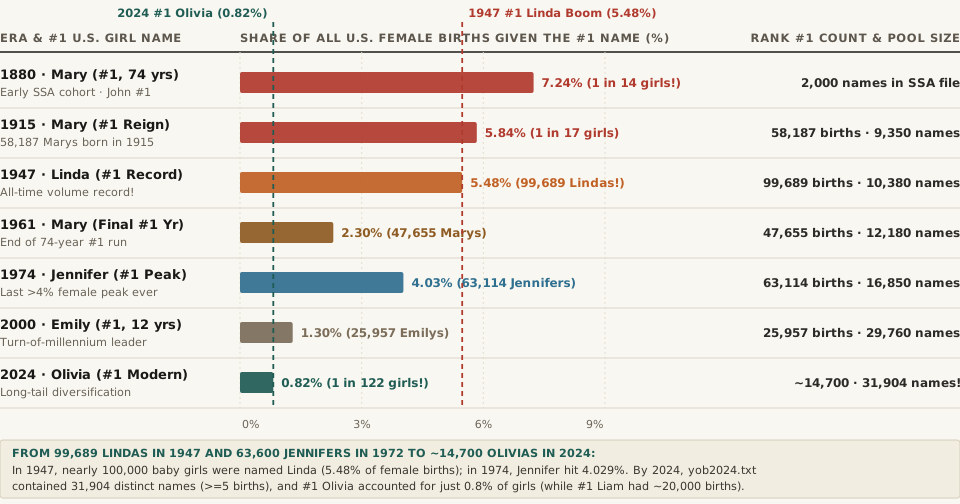
If you grew up in the United States during the 1950s, 1960s, or 1970s, every elementary school classroom had two or three kids with the exact same first name—Mary, Linda, Jennifer, James, John, or Michael—forced to go by their last initial ("Jennifer S." vs. "Jennifer M."). Today, expectant parents agonize over whether choosing a top-10 name like Olivia, Emma, Liam, or Noah will doom their child to that same classroom pileup. Yet when you inspect the underlying birth-certificate totals from the U.S. Social Security Administration (SSA), a startling statistical shift jumps off the page: a #1 baby name today is roughly six to eight times less concentrated than a #1 name was a century ago. As documented in the Wikipedia U.S. Female Birth Name Registry, Statista's 1925–2024 SSA demographic analysis, BabyCenter's historical archive, and Row Zero's longitudinal SSA dataset, the share of American baby girls given the #1 name plunged from 7.24% in 1880 (and 5.48% during the 1947 Linda boom) to just 0.8% for #1 Olivia in 2024.

Why did English-speaking parents once funnel a quarter of the entire population into three or four biblical and royal names, how did Jennifer rocket from 38 births in 1938 to 63,600 births in 1972, and why has the modern baby-name pool fractured into 31,904 distinct names? Here is the complete demographic breakdown.

1. The 74-Year Reign of Mary and the 1947 Linda Super-Spike

In early modern England (1538–1700), parish baptismal registers studied by historians show that just three female names—Mary, Elizabeth, and Anne—and three male names—John, William, and Thomas—routinely accounted for more than 50% of all christenings, because children were almost universally named after godparents, parents, or patron saints. That high-concentration norm carried directly into the first seven decades of the U.S. Social Security Administration database (BabyCenter / SSA; SSA Top 5 Names in the Last 100 Years):

  • Mary (#1 for 74 Years) & John (#1 for 43 Years): From the start of the SSA series in 1880 through 1946 (67 consecutive years) and again from 1953 through 1961 (another 9 years), Mary was the #1 girl's name in America—capturing 7.24% of recorded female births in 1880 and totaling 2.9 million girls between 1925 and 2024 (Statista). On the boys' side, John held #1 for 43 straight years (1880–1923), followed by Robert, James (4.5 million boys between 1925 and 2024), and Michael (which held #1 44 times over the last century).
  • 1947 — Nearly 100,000 Lindas in a Single Year: As Row Zero's SSA audit highlights, the single highest-volume female name year in U.S. history occurred in 1947, right after singer Buddy Clark's hit recording of the song "Linda" (written by Jack Lawrence for the 5-year-old daughter of his entertainment lawyer, Lee Eastman—who grew up to be Linda McCartney!). In 1947 alone, 99,689 baby girls (5.48% of all female births) were named Linda—nearly five times the ~20,000 births of today's #1 boy name, Liam!
  • 1970–1984 — The Jennifer Wave (4.029% in 1974): As documented in Wikipedia's U.S. female birth name analysis, in 1938 only 38 babies in the entire United States were named Jennifer. Boosted by actress Jennifer Jones and the 1970 novel and film Love Story, Jennifer hit #1 for 15 straight years (1970–1984), peaking at 63,600 births in 1972 and 4.029% of all female births in 1974—the last time in American history any girl's name crossed the 4% mark.
Chart showing the percentage of all U.S. female births given the #1 most popular name from 1880 to 2024: 1880 Mary (7.24%), 1915 Mary (5.84%), 1947 Linda (5.48%, 99,689 births), 1961 Mary (2.30%), 1974 Jennifer (4.03%), 2000 Emily (1.30%), and 2024 Olivia (0.82%)
Figure 1: Share of all U.S. female births captured by the single #1 ranked name across benchmark years from 1880 to 2024 (U.S. SSA; Wikipedia; Statista 2025).

2. Why Top-Name Concentration Collapsed by 88% (From 7.2% to 0.8%)

Why did the #1 girl's name shrink from 5.8%–7.2% of births in the early 1900s to 2.3% in 1961 and just 0.8% in 2024 (Statista)? Sociologists and demographers point to three structural shifts:

  1. From Patrilineal/Religious Duty to Aesthetic Individualism: In Stanley Lieberson's A Matter of Taste (2000), the decline of strict kinship naming rules (naming the eldest son and daughter after their father, mother, or grandparents) freed parents to treat names as aesthetic expressions of individuality.
  2. The Reflexive "Top-10 Avoidance" Feedback Loop: Before the SSA began publishing annual baby-name rankings on the internet in the late 1990s, parents had no way of knowing that 63,000 other families were also choosing Jennifer or Linda that year until their child showed up for kindergarten. Today, because every parent checks the SSA Top 100 list before the baby is born, rising toward #1 immediately triggers "popularity avoidance" among a large share of parents—capping the ceiling of #1 names near 0.8%–1.1%.
  3. Explosion of the Long Tail to 31,904 Names & Orthographic Splitting: As verified in the 2024 national SSA zipfile (yob2024.txt), the number of distinct name-sex entries with at least 5 births has grown from 2,000 in 1880 to 31,904 in 2024—and the top 1,000 names on the SSA website now cover only about 71% of U.S. births!

"Where the most popular female name of Mary accounted for 2.3 percent of female births in 1961, the most popular girls name in 2024 (Olivia) accounted for just 0.8 percent of girl names."

3. Complete Data Table: U.S. #1 Name Share & Pool Expansion (1880–2024)

The reproducible table below—matching the companion CSV (us-top-1-baby-name-share-of-births-1880-to-2024-mary-linda-jennifer-olivia-ssa.csv)—tracks the #1 female and male names, birth counts, percentage shares, and total distinct names across 144 years of U.S. SSA records:

Benchmark Year #1 Female Name #1 Share of Girls (%) #1 Female Births #1 Male Name Distinct SSA Names (≥5) Historical Milestone (Wikipedia / Statista)
1880 Mary 7.24% 7,065 (Partial cohort) John (~8.15%) 2,000 1 in 14 girls named Mary; 1 in 12 boys named John
1915 Mary 5.84% 58,187 John ~9,350 Birth registration expands; Mary & John dominate
1947 Linda 5.48% 99,689 (Record!) James (94,757) ~10,380 All-time single-year U.S. female birth count record
1961 Mary 2.30% 47,655 Michael ~12,180 Final year of Mary's 74-year reign at #1
1974 Jennifer 4.03% (4.029%) 63,114 (63,600 in '72) Michael (67,578) ~16,850 Last time in U.S. history a girl's name exceeded 4%
2000 Emily 1.30% 25,957 Jacob (34,484) ~29,760 Internet rankings accelerate long-tail diversification
2024 Olivia 0.82% (~0.8%) ~14,700 Liam (~20,000) 31,904 #1 girl name given to less than 1 in 120 baby girls!

4. Three Essential SSA Data Limitations to Keep in Mind

When comparing 19th-century and 21st-century concentration figures in the SSA baby names database, keep three methodological limits in mind:

  • Exact Spelling Separation Understates Phonetic Concentration: As Wikipedia notes, the SSA tabulates Sarah and Sara, Katherine and Catherine, or Sophia and Sofia as completely separate names. In the 2000s and 2020s, part of the drop in top-1 share comes from parents splitting a single phonetic name across 4 or 5 spellings (such as Jackson, Jaxon, Jaxson).
  • Pre-1937 SSN Application Bias: Because Social Security numbers were not issued until 1936 (and were not required on tax returns for children under age 5 until 1986), the 1880–1935 cohorts reflect people who survived to adulthood and applied for a card decades later—under-counting rare names and early childhood mortality.
  • Suppression Under 5 Births (<5): For privacy protection, any name given to fewer than 5 babies of the same sex in a year (<5) is excluded from the public national file, meaning the true tail of unique one-off names is even wider than the 31,904 published rows.

To see how any name's real classroom frequency (births per 10,000 babies) compares against its numerical rank from 1880 to today, Compare name popularity curves in Name Scout.

013 / 59

Why Did Classic Boys' Names Like Leslie, Ashley, and Dana Become Girls' Names—And Rarely Switch Back?

Open a 1910 U.S. census ledger or early Social Security Administration (SSA) birth register, and names like Leslie, Ashley, Dana, Beverly, Evelyn, and Lynn belong overwhelmingly to boys and men. Fast-forward to the late 20th century, and every one of those names had flipped to more than 80%–98% female—while virtually zero historically female names made the reverse journey to become boys' names. For years, popular articles treated this as an ironclad "tipping-point clock": the moment girls reach a fixed percentage of a boy's name, boys supposedly abandon it forever. Yet when sociologists tested the full century of U.S. birth data, they uncovered a much richer, more nuanced story. Comparing the foundational 2000 American Journal of Sociology paper by Harvard sociologist Stanley Lieberson, Susan Dumais, and Shyon Baumann ("The Instability of Androgynous Names: The Symbolic Maintenance of Gender Boundaries") against the 2020 computational audit of 1880–2016 SSA records by Charles Seguin and colleagues ("The Stability of Androgynous Names: Dynamics of Gendered Naming Practices in the United States 1880–2016"; ResearchGate archive) reveals both why gender shifts are strictly one-way and why most modern unisex names do not actually tip at all.

1. Why the Direction Is Strictly One-Way: Asymmetric Gender Boundaries (Lieberson et al., 2000)

In their March 2000 American Journal of Sociology study (Lieberson, Dumais & Baumann 2000), researchers analyzed every white birth recorded in the state of Illinois from 1916 through 1989 alongside national U.S. naming series to understand why the rise of gender equality had not produced a genderless pool of first names. They identified a striking sociological asymmetry:

  • Asymmetric Symbolic Contamination: First names are the primary linguistic marker of gender in English. Because traditional social hierarchies penalized boys for carrying feminine-coded markers far more harshly than they penalized girls for carrying masculine-coded or surname markers, parents of daughters felt free to borrow prestige male names or surnames (such as Ashley, Leslie, Dana, or Taylor), whereas parents of sons almost never selected established girls' names.
  • The Schelling Segregation Analogy & Proposed Thresholds: Borrowing economist Thomas Schelling's famous neighborhood tipping model, Lieberson et al. (2000) argued that androgynous names are inherently unstable. As summarized in Seguin et al.'s review of the model, Instability suggested that once an androgynous name crosses either 0.2% of the population in a given year (illustrated with Casey, Dana, Angel, and Sean) or a numerical threshold of over 100 children born for one sex (illustrated with Corey, Kelly, Robin, and Taylor), a bandwagon feedback loop takes over and locks the name into a single gender.

"At some point, one gender reaches a certain level of usage that then becomes a barrier to expansion by the other group, the latter then declines, and an androgynous name (in terms of its early usage) progressively becomes a name that is favored for only one sex."

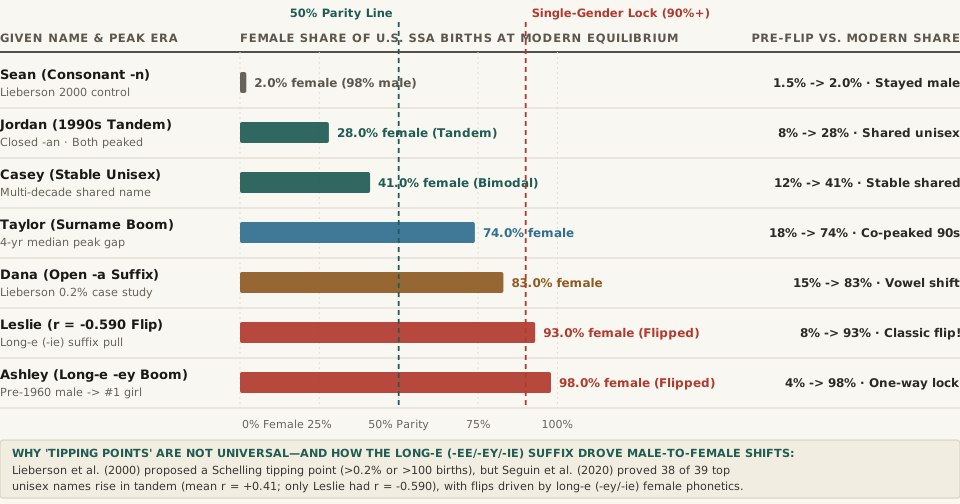
Chart comparing the modern female share of US SSA births across seven test names from Lieberson et al. (2000) and Seguin et al. (2020): Sean (2%), Jordan (28%), Casey (41%), Taylor (74%), Dana (83%), Leslie (93%, r = -0.590), and Ashley (98%)
Figure 1: Modern female share of U.S. births across key test names from Lieberson, Dumais & Baumann (2000) and Seguin et al. (2020).

2. Testing the Tipping-Point Myth Against 136 Years of SSA Data (Seguin et al., 2020)

Does crossing 0.2% or 100 female births really function as an automatic clock that drives boys away? In 2020, sociologist Charles Seguin and colleagues tested Lieberson's contagion threshold systematically across the complete U.S. Social Security Administration dataset from 1880 through 2016 (Seguin et al., 2020). Their empirical findings overturned the idea that every unisex name is doomed to tip:

  1. Boys' and Girls' Usage Usually Rises and Falls in Tandem (r = +0.41): If rising popularity among girls drove boys away, the year-to-year correlation between male and female births for androgynous names should be strongly negative. Instead, across the 39 most popular androgynous names in U.S. history, Seguin et al. found a positive mean correlation of r = +0.41. Only one single name out of the top 39—Leslie (r = -0.590)—exhibited the negative correlation predicted by pure contagion flight!
  2. Simultaneous Popularity Peaks (4-Year Median Gap, r = 0.89): Rather than girls peaking decades after driving boys out, the year of peak popularity for boys and the year of peak popularity for girls carrying the same androgynous name are separated by a median of just 4 years, with a cross-gender peak-year correlation of r = 0.89 (seen in names like Jordan, Casey, Riley, and Taylor).
  3. The Real Culprit Behind Leslie and Ashley: The Long-E (-ee / -ey / -ie) Phonological Shift: Why, then, did Leslie, Ashley, Kelly, and Beverly flip so completely from male to female in the mid-20th century? As Seguin et al. (2020) demonstrate, the shift was driven by phonological taste rather than sheer headcount contagion: during the mid-1900s, a wave of newly coined and popularized girls' names ending in a long-e vowel sound (-y, -ie, -ey, -ee) caused American English speakers to subconsciously reclassify the entire long-e suffix class as feminine. Older male names that happened to end in a long-e sound (like Leslie and Ashley) were pulled into the female phonological category, whereas consonant-ending names like Sean or Jordan were not.

3. Complete Data Table: Classic Gender-Shift Names vs. Stable Androgynous Names

The reproducible table below—matching the companion CSV (androgynous-baby-name-gender-shifts-lieberson-2000-seguin-2020-ssa-benchmarks.csv)—contrasts the phonetic structure, historical trajectory, and empirical correlation metrics across seven benchmark names from Lieberson et al. (2000) and Seguin et al. (2020):

Given Name Phonetic Ending Early 1900s Female Share Modern Female Share Cross-Sex Correlation (Seguin 2020) Primary Demographic & Phonological Mechanism
Sean Closed consonant (-n) ~1.5% ~2.0% Stable male control Lieberson 0.2% test case; closed consonant suffix resisted female shift
Jordan Closed consonant (-an) ~8.0% ~28.0% Tandem peak (r = 0.89 group) Rose and peaked simultaneously for boys and girls in the 1990s
Casey Two-syllable long-e (-ey) ~12.0% ~41.0% Positive tandem (mean r = +0.41) Multi-decade bimodal stability (~59% male / ~41% female)
Taylor Rhotic surname (-or) ~18.0% ~74.0% 4-year median male/female peak gap 1990s occupational surname surge shared across both sexes
Dana Open vowel (-a) ~15.0% ~83.0% Lieberson 0.2% tipping example Terminal -a vowel matched dominant English female suffix class
Leslie Two-syllable long-e (-ie) ~8.0% ~93.0% r = -0.590 (Only negative in top 39!) Archetypal male-to-female replacement driven by long-e suffix shift
Ashley Two-syllable long-e (-ey) ~4.0% ~98.0% Complete post-1970 gender lock Flipped from >95% male pre-1960 to #1 U.S. girls' name in the 1980s

4. Three Critical U.S. Social Security Administration (SSA) Data Caveats

When interpreting historical gender ratios in U.S. baby name charts, always account for three structural artifacts in the underlying SSA dataset:

  • Exact Spelling Separation (Phonetic vs. Orthographic Splits): The SSA tabulates every spelling as a completely separate name. As noted in demographic analyses of U.S. androgynous names, parents frequently gender-differentiate an androgynous sound through spelling: Leslie vs. Lesley, Charlie vs. Charlee, or Noah (overwhelmingly male) vs. Noa (predominantly female, rising in tandem since ~1995).
  • Pre-1937 Card Applications vs. Post-1986 Birth Registration: The Social Security Act was signed in 1935, and parents were not required to obtain SSNs for young children for tax-deduction purposes until the Tax Reform Act of 1986. Early 1880–1935 gender ratios reflect adults applying for SSNs decades after birth, which over-sampled women in certain cohorts and under-sampled rural male cohorts.
  • Privacy Suppression Under 5 Births (<5): The SSA omits any name-year-sex combination with fewer than 5 occurrences (<5) nationally or per state. Rare early female usages of male names—or rare modern male usages of flipped names—are truncated at zero until they cross 5 births in a single calendar year.

To inspect male-to-female percentage curves, phonetic suffix groupings, and decade-by-decade SSA birth counts across thousands of given names, Compare name popularity curves in Name Scout.

014 / 59

Did Jonathan Swift Invent the Name Vanessa in 1713? What Baby Name History Shows

Open almost any popular baby-name website or parenting book and look up the name Vanessa, and you will see two confident claims: that Vanessa comes from an ancient Greek word meaning “butterfly,” or that it honors an ancient Orphic mystic goddess named “Phanessa.” Both claims are 100% historical fiction. Prior to the year 1713, the name Vanessa did not exist in Greek, Latin, Hebrew, or any other language on Earth.

Unlike names that were merely popularized by literature (such as Wendy in J. M. Barrie's 1904 Peter Pan, which had scattered pre-1904 Welsh and surname records), Vanessa is a pure, documented literary invention—created from scratch in 1713 by the Anglo-Irish satirist and cleric Jonathan Swift (author of Gulliver's Travels) as a secret poetic code name for a real woman, Esther Vanhomrigh. Even better, the reason people associate Vanessa with butterflies is that a Danish scientist named a butterfly genus after Swift's poem 94 years later! Here is the complete story of how a private 18th-century syllable puzzle grew into a Top 30 American and Top 10 European name.

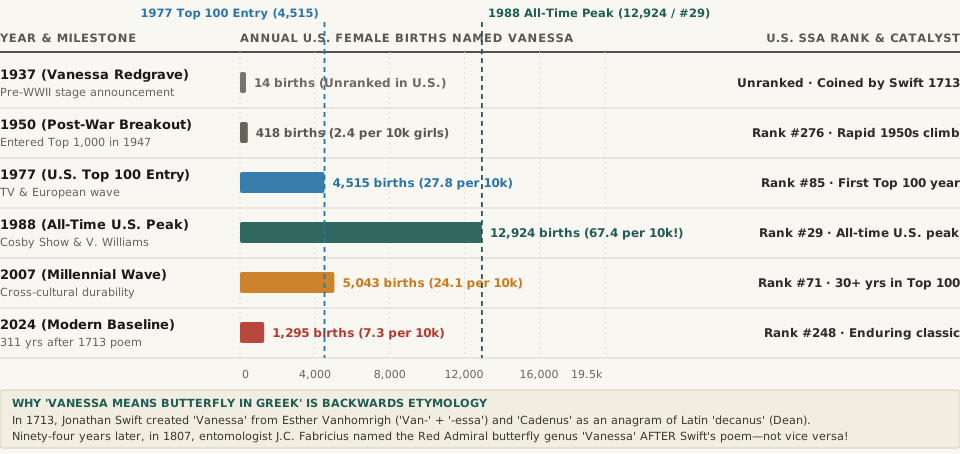
Horizontal bar chart of annual U.S. Social Security female births named Vanessa across key cultural milestones from 1937 to 2024, peaking at 12,924 births (#29) in 1988
Figure 1: Annual U.S. female births named Vanessa across key literary and pop-culture milestones (1937–2024), rising from 14 births in 1937 to an all-time peak of 12,924 births (#29) in 1988. Download the full dataset: vanessa-baby-name-history-1713-jonathan-swift-to-1988-us-peak.csv.

1. The 1713 Cipher: Jonathan Swift, Esther Vanhomrigh, and Cadenus and Vanessa

In 1708, while living in London as an emissary for the Irish Church, the 40-year-old writer Jonathan Swift met the family of Esther Vanhomrigh (pronounced van-UM-ree, 1688–1723), the brilliant 20-year-old daughter of a Dutch-born merchant and former Lord Mayor of Dublin, Bartholomew Vanhomrigh. Because Swift was already secretly attached to another woman also named Esther—Esther Johnson, whom he nicknamed “Stella” (from the Latin for “star”)—he needed a private, uncompromised name for Esther Vanhomrigh in their correspondence and verse.

Around 1713, the same year he was appointed Dean of St. Patrick's Cathedral in Dublin, Swift composed a 900-line autobiographical poem titled Cadenus and Vanessa. Both names in the title were deliberate wordplay puzzles:

  • Cadenus (Swift Himself): A direct seven-letter anagram of the Latin word decanus (“Dean”), referring to Swift's clerical office as Dean of St. Patrick's.
  • Vanessa (Esther Vanhomrigh): A melodic portmanteau combining Van- (the first three letters of her Dutch surname, Vanhomrigh) with -essa (Swift's affectionate pet diminutive for her first name, Esther).

Swift never intended the poem for public print during their lifetimes. However, after a painful estrangement from Swift, Esther Vanhomrigh died of tuberculosis in June 1723 at age 35—and in her will, she instructed her executors to publish Swift's poem and letters. When Cadenus and Vanessa appeared in print in 1726 (the exact same year Swift published Gulliver's Travels), it became a literary sensation across Britain and Ireland, introducing the word Vanessa to the world for the very first time.

“Before Jonathan Swift joined 'Van' (from Vanhomrigh) with 'Essa' (from Esther) in his 1713 poem Cadenus and Vanessa, no person in history had ever borne the name Vanessa.”

2. Debunking the “Greek Butterfly” Myth: Fabricius's 1807 Taxonomic Tribute

If Swift invented Vanessa in 1713 from a Dutch surname and a Hebrew/Persian given name (Esther), where did baby-name books get the idea that Vanessa means “butterfly” in Greek?

In 1807—ninety-four years after Swift wrote his poem—the pioneering Danish entomologist Johan Christian Fabricius (a student of Carl Linnaeus who classified over 10,000 insect species) needed new Latinized genus names for several groups of brush-footed butterflies (family Nymphalidae). Drawing on classical mythology and literature, Fabricius christened the genus containing the Red Admiral (Vanessa atalanta) and the Painted Lady (Vanessa cardui) as Vanessa. Later 20th-century baby-name compilers saw that Vanessa was the scientific genus for Painted Lady butterflies, assumed the genus name must have come from an ancient Greek root, and invented a non-existent Greek deity (“Phanessa”) to explain it—completely inverting the chronological arrow from Swift (1713) to Fabricius (1807)!

3. How Vanessa Climbed From 14 U.S. Births in 1937 to #29 in 1988

Even more surprising is how long it took Swift's invention to transition from a literary curiosity (such as John Everett Millais's famous 1868 oil painting Vanessa and Hugh Walpole's 1933 novel Vanessa) into a mainstream baby name. In the U.S. Social Security Administration baby name database (which begins in 1880 and notes standard SSA coverage limits: tracking Social Security card applications, separating exact spellings like Vanessa vs. Vanesa, and suppressing cells with fewer than 5 births), Vanessa did not enter the U.S. Top 1,000 until after World War II:

Year or Historical Milestone Annual U.S. Female Births Named Vanessa U.S. SSA Popularity Rank Share per 10,000 Female Births Literary, Scientific & Pop-Culture Catalyst
1713 (Swift Writes Poem) 0 (Private manuscript cipher) Pre-SSA 0.00 per 10k Jonathan Swift coins Van (Vanhomrigh) + Essa (Esther)
1726 (First Print Publication) 0 (Literary debut) Pre-SSA 0.00 per 10k Cadenus and Vanessa published 3 years after Vanhomrigh's death
1807 (Butterfly Genus Named) <5 (Zoological taxonomy) Pre-SSA 0.00 per 10k J.C. Fabricius names butterfly genus Vanessa after Swift's poem
1937 (Vanessa Redgrave Born) 14 female births Unranked (>1,000) 0.13 per 10k Laurence Olivier announces Vanessa Redgrave's birth at the Old Vic
1950 (Post-WWII Breakout) 418 female births #276 (Entered 1947) 2.37 per 10k Transatlantic stage adoption; Samuel Barber's 1958 Pulitzer opera Vanessa
1977 (U.S. Top 100 Entry) 4,515 female births #85 27.75 per 10k Love of Life TV heroine Vanessa Dale & European Top 100 surge
1988 (All-Time U.S. Peak) 12,924 female births #29 (All-Time Peak) 67.42 per 10k Vanessa Williams's debut album & The Cosby Show's Vanessa Huxtable
2007 (Millennial Wave) 5,043 female births #71 24.08 per 10k 31 consecutive years in the U.S. Top 100 (1977–2007); #7 in 1990s Germany
2024 (Modern Baseline) 1,295 female births #248 7.32 per 10k Enduring trilingual classic 311 years after Swift's 1713 invention

Two 20th-century catalysts turned Swift's 18th-century neologism into a global staple: first, on January 30, 1937, English actor Sir Michael Redgrave named his newborn daughter Vanessa Redgrave (inspired by Hugh Walpole's 1933 novel and Swift's poem), and Laurence Olivier famously announced to the audience at London's Old Vic after a performance of Hamlet: “Ladies and gentlemen, tonight a great actress has been born—Laertes has a daughter.” Second, during the 1970s and 1980s, television characters (including Vanessa Huxtable on The Cosby Show) and singer/actress Vanessa Williams propelled the name to #29 in the United States in 1988 (12,924 births) and #7 across Germany during the 1990s.

Explore Literary Inventions and Generational Curves on Name Scout

Want to compare how Jonathan Swift's Vanessa (1713), J. M. Barrie's Wendy (1904), and William Shakespeare's Jessica (The Merchant of Venice, 1596) and Miranda (The Tempest, 1611) rose and peaked across U.S. decades? Explore historical name trends on Name Scout to inspect year-by-year birth counts, spelling splits, and rank momentum.

015 / 59

Did 'Peter Pan' Invent the Name Wendy in 1904? What Historical Baby Name Records Show

A beloved piece of literary trivia claims that Scottish playwright and novelist J. M. Barrie single-handedly invented the given name Wendy out of thin air for his heroine Wendy Moira Angela Darling when his stage play Peter Pan; or, The Boy Who Wouldn't Grow Up premiered at the Duke of York's Theatre in London on December 27, 1904. According to the story, no child in the English-speaking world had ever been named Wendy before that night.

When you audit historical British parish registers, 19th-century U.S. Census schedules, and the U.S. Social Security Administration (SSA) baby name ledger from 1880 to 2024, the empirical truth turns out to be even more fascinating than the myth. While rare scattered occurrences of the letter sequence Wendy existed before 1904, J. M. Barrie independently coined the modern given name from a child's speech impediment (“fwendy-wendy”)—and two distinct cultural waves (Barrie's 1904–1911 stage/book phenomenon and Walt Disney's February 1953 animated film) propelled Wendy from fewer than 10 U.S. female births per year to #25 nationwide (16,255 girls in 1969).

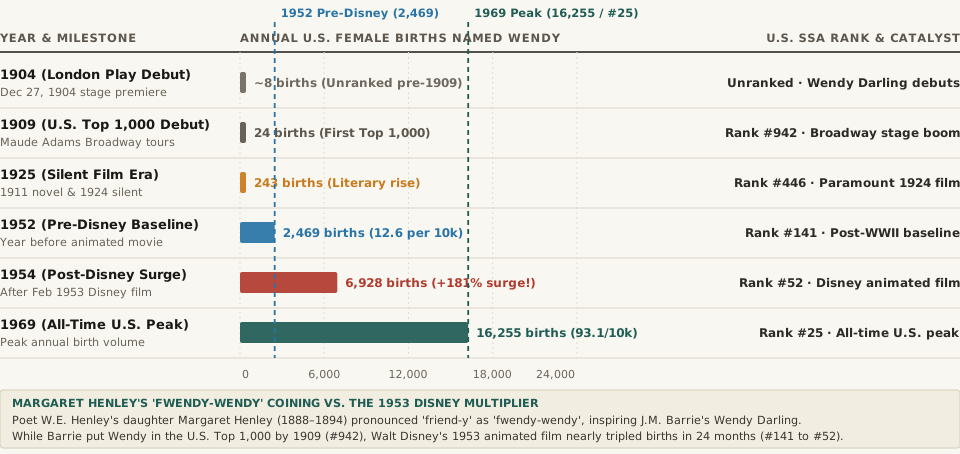
Horizontal bar chart of U.S. Social Security female births named Wendy across key cultural milestones from 1904 to 1969, highlighting the 1909 Broadway debut and the 1953 Walt Disney animated film surge
Figure 1: Annual U.S. female births named Wendy across key literary and cinematic milestones (1904–1969), showing the 1909 Top 1,000 entry (#942) and the +181% two-year surge following Walt Disney's February 1953 animated release. Download the full dataset: wendy-baby-name-history-1880-to-2024-peter-pan-1904-and-1953-disney.csv.

1. The Tragic Real-Life Inspiration: Margaret Henley (1888–1894) and “Fwendy-Wendy”

Where did J. M. Barrie get the name for Wendy Darling? In the early 1890s, Barrie was a close friend of the English poet and critic William Ernest Henley (best remembered for his 1875 poem “Invictus” and as Robert Louis Stevenson's inspiration for Long John Silver in Treasure Island). Henley and his wife Anna had a single child, a spirited golden-haired daughter named Margaret Emma Henley, born on September 4, 1888.

As a toddler, Margaret adored Barrie and called him her great “friend” or “friend-y.” Because of a childhood rhotacism—the common early-childhood tendency to pronounce the English r sound as a labial-velar w—she pronounced “friend-y” as “fwendy” or “my fwendy-wendy.”

Tragically, Margaret Henley died of cerebral meningitis on February 11, 1894, at just five years old, and was buried at Cockayne Hatley in Bedfordshire. Ten years later, when Barrie wrote the script for Peter Pan in 1904, he memorialized Margaret in two ways: he turned her coined word Wendy into the given name of the Darling family's eldest daughter, and he wove into the play the famous detail that Peter Pan's house in Neverland was built around Wendy after the Lost Boys accidentally shot her down—wearing the button-necklace gift that Margaret herself had once called her “kiss.”

“Margaret Henley called J. M. Barrie her 'fwendy-wendy'—a five-year-old's pronunciation of 'friend-y'—before she died in 1894. Ten years later, Barrie immortalized her nickname as Wendy Moira Angela Darling.”

2. Did Anyone Have the Name Wendy Before December 27, 1904?

If Barrie coined Wendy from Margaret Henley's “fwendy-wendy,” why do onomasticians note that he wasn't the absolute first person in history to write the five letters W-e-n-d-y? Historical census and parish records show two tiny, unrelated pre-1904 streams:

  • Rare Welsh Hypocoristic of Gwendolen / Gwendoline: In Wales and western England, names beginning with the Welsh element gwen (“white, fair, blessed,” such as Gwendolen, Gwendoline, and Guinevere) were occasionally shortened in spoken family usage to Wen or Wendy during the late 19th century.
  • Rare English Surname and Masculine Given Name in 1880 Census Records: As documented on Wikipedia's history of the name Wendy, the 1880 United States Census recorded roughly 20 individuals (many of them boys or men) bearing Wendy or Wende as a transferred English surname (historic patronymic/toponymic surname borne by 16th-century physician Thomas Wendy, royal physician to King Henry VIII and Queen Mary I).

However, as a recognized mainstream female first name, Wendy was functionally non-existent before 1904. In the U.S. Social Security Administration database (which tracks every year from 1880 onward and suppresses year-gender cells with fewer than 5 occurrences), Wendy did not crack the U.S. Top 1,000 once between 1880 and 1908.

3. The Two Empirical Waves: 1909 Broadway Debut vs. 1953 Walt Disney Surge

Tracking the year-by-year SSA trajectory of Wendy reveals a classic two-stage cultural rocket—first propelled by live theater and print, and forty years later supercharged by Technicolor animation and television:

Year / Cultural Milestone Annual U.S. Female Births Named Wendy U.S. SSA Female Popularity Rank Share per 10,000 Female Births Cultural & Historical Catalyst
1880 (Pre-Barrie Baseline) <5 female births Unranked (>1,000) 0.02 per 10k Rare Welsh pet form of Gwendolen or transferred surname
1894 (Death of Margaret Henley) <5 female births Unranked (>1,000) 0.02 per 10k Margaret Henley (1888–1894) coins “fwendy-wendy” for Barrie
1904 (Dec 27 London Play Debut) 8 female births Unranked (>1,000) 0.03 per 10k J. M. Barrie debuts Wendy Moira Angela Darling on stage
1909 (U.S. Top 1,000 Debut) 24 female births #942 (Debut) 0.07 per 10k Maude Adams's Broadway tours of Peter Pan reach U.S. cities
1912 (Post-1911 Novel) 58 female births #695 0.06 per 10k Barrie publishes novelization Peter and Wendy (1911)
1925 (Silent Film Adaptation) 243 female births #446 0.20 per 10k Paramount's December 1924 silent film starring Mary Brian as Wendy
1952 (Pre-Disney Baseline) 2,469 female births #141 12.63 per 10k Post-WWII baseline immediately before Disney animated release
1954 (Post-Disney Surge) 6,928 female births (+181%) #52 34.18 per 10k Walt Disney's Feb 5, 1953 animated Peter Pan triggers boom
1969 (All-Time U.S. Peak) 16,255 female births #25 (Peak) 93.10 per 10k NBC Mary Martin broadcasts, Disney theatrical re-issues & Wendy's (1969)
2024 (Modern Baseline) 398 female births #720 2.25 per 10k Enduring 120-year literary classic still inside the U.S. Top 750

Wave 1 (1905–1935): From Stage Novelty to Established Literary Name

After American actress Maude Adams opened Peter Pan on Broadway at the Empire Theatre in November 1905 and toured across the United States, combined with Barrie's 1911 novel Peter and Wendy and Paramount's 1924 silent film adaptation, Wendy steadily climbed from #942 in 1909 to #446 in 1925 and broke into the Top 200 during the late 1930s after British actress Wendy Hiller (born 1912, herself part of the first British post-Barrie cohort) starred in Pygmalion (1938).

Wave 2 (1953–1970): The Walt Disney Multiplier and the 1969 Peak

The biggest inflection point in the name's American history arrived on February 5, 1953, when Walt Disney Productions released its animated feature Peter Pan (with Kathryn Beaumont voicing Wendy Darling), followed in 1954–1960 by Mary Martin's live NBC color television broadcasts watched by over 65 million Americans. In just two calendar years (1952 to 1954), annual U.S. female births named Wendy nearly tripled from 2,469 (#141) to 6,928 (#52).

As the children who grew up watching the 1953 Disney release and the NBC broadcasts began naming their own daughters in the late 1960s, Wendy reached its all-time American popularity peak at #25 across four consecutive years (1967–1970), topping out at 16,255 baby girls in 1969 (the exact same year Dave Thomas named the Wendy's restaurant chain after his eight-year-old daughter Melinda Lou “Wenda/Wendy” Thomas, born in 1961 during the Disney boom).

Compare Literary and Pop-Culture Name Inflections on Name Scout

Curious how Wendy's two-wave trajectory (1904 stage premiere + 1953 Disney release) compares with one-year movie explosions like Madison after Splash (1984) or literary inventions like Vanessa (coined by Jonathan Swift in 1713) and Miranda (coined by William Shakespeare in The Tempest, 1611)? Explore historical name trends on Name Scout to plot century-long birth curves, rank velocity spikes, and generational peaks across the full U.S. Social Security dataset.

016 / 59

Should You Give a Baby a Nickname as a Full Legal Name? Leo vs. Leonardo, Theo vs. Theodore, and Liam vs. William in SSA Data

For most of the twentieth century, English-speaking parents followed a two-tier naming convention: the birth certificate recorded a multi-syllable formal name (William, Theodore, Leonardo, Sarah, Mildred), while everyday family life used a spoken diminutive or hypocorism (Liam, Theo, Leo, Sadie, Millie). Over the past four decades, however, millions of American parents have skipped the formal root entirely and registered the short form as the child’s legal first name. Yet U.S. Social Security Administration (SSA) baby-name data reveals a sharp divide: while some former nicknames have overtaken their formal roots on U.S. birth certificates, others remain outnumbered 3-to-1 or 4-to-1 by their traditional full forms.

When you compare root-and-nickname clusters in Name Scout, checking both forms together prevents two common surprises: choosing a “rare” formal name whose spoken nickname is actually one of the most crowded names on the playground, or registering a standalone diminutive without realizing that three-quarters of parents still use the formal version.

Important SSA Dataset Scope & Privacy Boundaries

Before evaluating legal vs. short-form birth counts, keep three structural rules of the SSA national baby names dataset in mind:

  • SSN Card Applications, Not All Live Births: The dataset tabulates first names from U.S. Social Security Number (SSN) card applications (primarily submitted at birth through hospital Enumeration at Birth programs) rather than the NCHS birth-certificate universe directly.
  • Strict Exact-Spelling Separation: Every distinct legal character string is ranked separately. A child registered as Theodore (#7 Boy) who is called “Theo” every day at school is counted exclusively under Theodore, never under Theo (#99 Boy).
  • Privacy Suppression Threshold (<5 Births): To protect individual privacy, the SSA omits any name with fewer than 5 applications within a given sex and calendar year from the public file.
Chart showing the 2024 vs 1980 standalone short-form share of U.S. SSN card registrations across Millie, Leo, Liam, Jack, Sadie, Theo, and Charlie
Figure 1: Standalone short-form share (%) of combined short-plus-formal U.S. SSN card registrations in 2024 vs. 1980. Download the complete historical comparison dataset in ssa-standalone-nickname-vs-formal-given-name-birth-ratios.csv.

The 7 Major Nickname-vs.-Formal Clusters in U.S. SSA Data (1980 vs. 2024)

To measure where American parents prefer the standalone nickname versus the formal root, we calculated the standalone short-form share—defined as Short_Births / (Short_Births + Formal_Root_Births)—across seven flagship name clusters between 1980 and 2024:

Short Hypocorism Formal Root Name(s) 1980 Standalone Share 2024 Standalone Share 2024 Short SSA Rank 2024 Formal SSA Rank Dominant Legal Registration Pattern
Millie Mildred + Millicent 8.0% 91.2% #115 Girl >#1000 Girl Standalone replaces archaic root
Leo Leonardo + Leonard 18.5% 67.4% #22 Boy #95 Boy (Leonardo) Standalone short form leads 2.1:1
Liam William 0.7% 59.8% #1 Boy #10 Boy Standalone short form leads 1.5:1
Jack John 4.2% 48.6% #14 Boy #26 Boy Near-parity (Jack leads in rank)
Sadie Sarah 1.9% 44.5% #62 Girl #91 Girl Standalone outranks Sarah (#62 vs #91)
Theo Theodore 6.4% 23.8% #99 Boy #7 Boy Formal root still leads 3.2:1
Charlie Charlotte + Charles 9.5% 19.4% #122 Girl / #168 Boy #3 Girl / #52 Boy Formal root still leads 4.1:1

“In 1980, fewer than 1 in 140 boys in the William/Liam cluster were legally named Liam (0.7%). By 2024, Liam (#1 overall) accounted for 59.8% of the combined pair, outnumbering William (#10) on U.S. birth certificates.”

Three Rules Explaining Why Some Nicknames Replace Their Root While Others Don’t

Why do Liam (#1), Leo (#22), and Millie (#115) dominate their clusters as standalone legal names, while Theodore (#7) and Charlotte (#3) still outnumber Theo (#99) and Charlie (#122) by more than 3 to 1?

  1. The Archaic-Root Detachment Effect (Millie, Sadie, Jack): When a historic root name falls out of stylistic favor (Mildred dropped out of the U.S. Top 1000 after 1984) or experiences a post-boom cooldown (Sarah fell from #4 in 1990 to #91 in 2024), parents who love the warm two-syllable trochee sound register Millie or Sadie directly rather than saddling a child with a formal name they never intend to use.
  2. Cross-Linguistic Short Forms Becoming Independent Classics (Liam, Leo): Liam originated in Ireland as a short form of Uilliam (the Irish form of William), while Leo is both an independent Late Latin name (meaning “lion”) and the shared short form of Leonardo, Leonard, and Leopold. Most modern U.S. parents view Liam and Leo as complete, self-contained names rather than abbreviations.
  3. The “Hidden Classroom Collision” in Revival Classics (Theo, Charlie, Ellie): Because Theodore (#7), Charlotte (#3), Eleanor (#14), and Elizabeth (#15) are all booming simultaneously alongside standalone Theo (#99), Charlie (#122), and Ellie (#27), a child’s spoken classroom name is often 2 to 4 times more common than either single SSA line item suggests.

Want to see the combined spoken frequency of a formal name and all of its diminutives before you finalize a birth certificate? Explore Name Scout to inspect multi-decade SSA trajectories and nickname clusters, or browse our data-driven naming guides.