YellowSquared  /  Field notes

Notes from the workshop

59 posts, newest first. Choose an app to narrow the feed.

017 / 59

Why Did Boy Names Starting With 'J' Dominate America for 100 Years? From John and James to Jason, Joshua, and Jacob

Open any English dictionary or run a letter-frequency count on a million words of English prose, and the letter J ranks 24th out of 26 letters — accounting for a microscopic 0.15% of all words in the English language (ahead of only Q, X, and Z). Yet if you examine the U.S. Social Security Administration's (SSA) 100-Year Top Baby Names Record and The Bump's Historical SSA Analysis of Boy Names Starting With J, a stunning phonetic anomaly emerges: for a full century (1925–2024), 25% of the most popular boy names in the United States started with the letter J.

From John (#1 from 1880 to 1923) and James (#1 from 1940 to 1952) to Jason, Jeremy, Justin, Joshua, Jordan, Jonathan, Jack, and Jacob (#1 for 14 consecutive years from 1999 to 2012), American parents treated J as the default phonetic anchor for boys across five consecutive generations — a 166-fold overrepresentation relative to the English vocabulary. To explore historical popularity curves and phonetic sibling matches across every decade, Explore historical baby name trends in Name Scout.
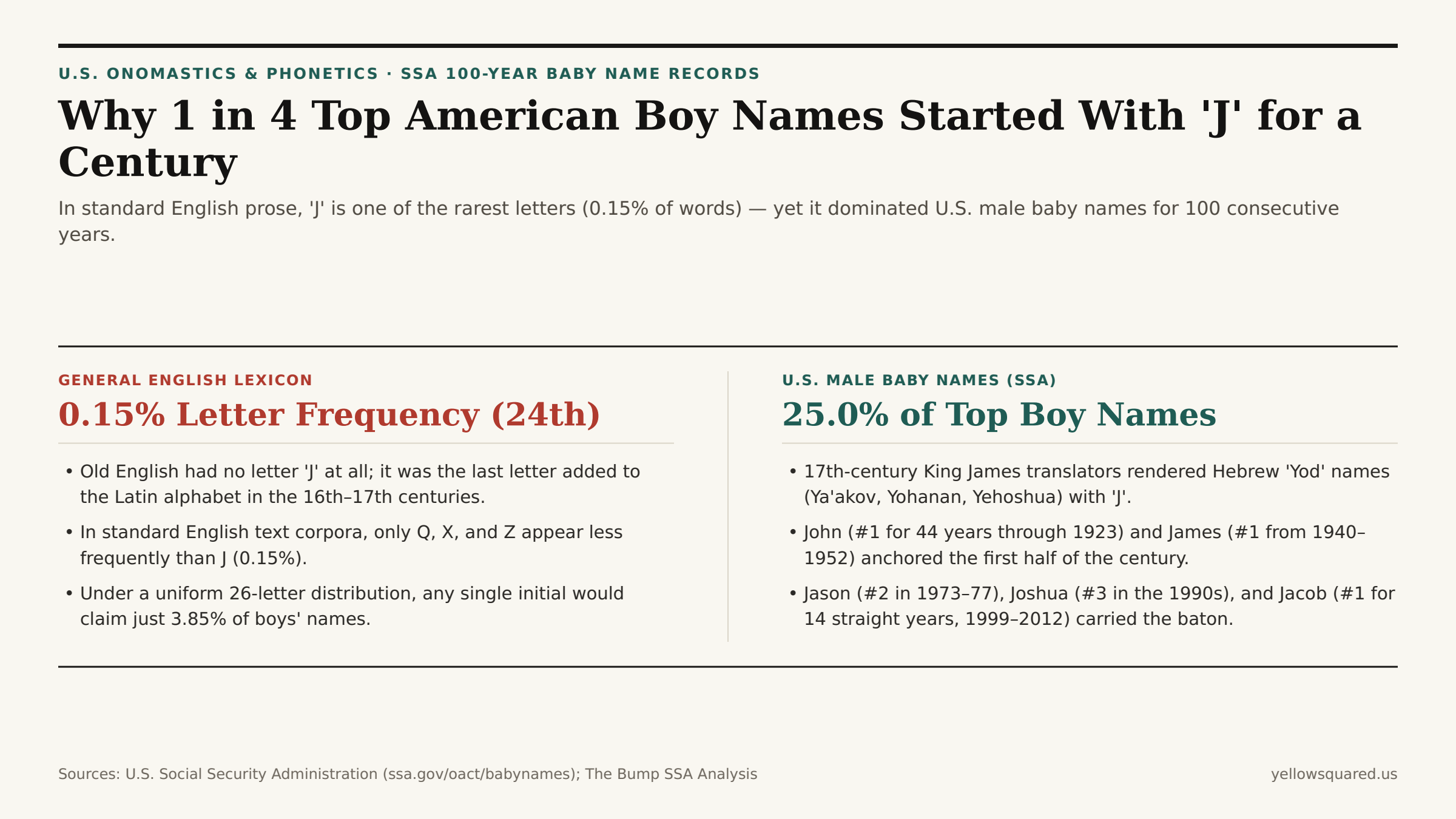
Comparison between the letter J's 0.15% baseline frequency in the English lexicon (ranking 24th of 26 letters) and its 25.0% share of top U.S. boy names across 100 years of Social Security Administration records
Although J accounts for just 0.15% of general English words, 17th-century Biblical translations of Hebrew 'Yod' names and a five-wave generational relay gave J-names 25% of top U.S. male births for a century.

1. The Linguistic Mystery: How Hebrew Yod (Y) Became English J

Why does a letter that barely exists in native Germanic English vocabulary dominate English given names? Because almost none of the classic English J names originated in Old English. Indeed, the letter J did not even exist as a distinct consonant in the English alphabet until the early 1600s.

Nearly all of the foundational J boy names trace back to Biblical Hebrew names beginning with the tenth Hebrew letter, Yod (י, pronounced /j/ like the English Y in "yes"):

  • John & Jonathan: From Hebrew Yohanan ("Yahweh is gracious") and Yonatan ("Yahweh has given").
  • James & Jacob: Both descend from the exact same Hebrew patriarch name, Ya'akov (יעקב), which passed into Late Latin as Iacobus and Iacomus before splitting into Old French James and English Jacob.
  • Joshua & Joseph: From Hebrew Yehoshua ("Yahweh is salvation") and Yosef ("He will add").
  • Jeremy / Jeremiah & Jordan: From Hebrew Yirmeyahu and Yarden (the River Jordan).

When Greek and Latin scribes transliterated Hebrew Yod, they wrote it with an initial I (Ioannes, Iacobus, Iosue). During the Middle Ages, calligraphers added a decorative hook (J) to initial I characters, and under Old French phonetic influence after the Norman Conquest, that initial palatal glide hardened into the punchy voiced postalveolar affricate (/dʒ/) we pronounce in English today.
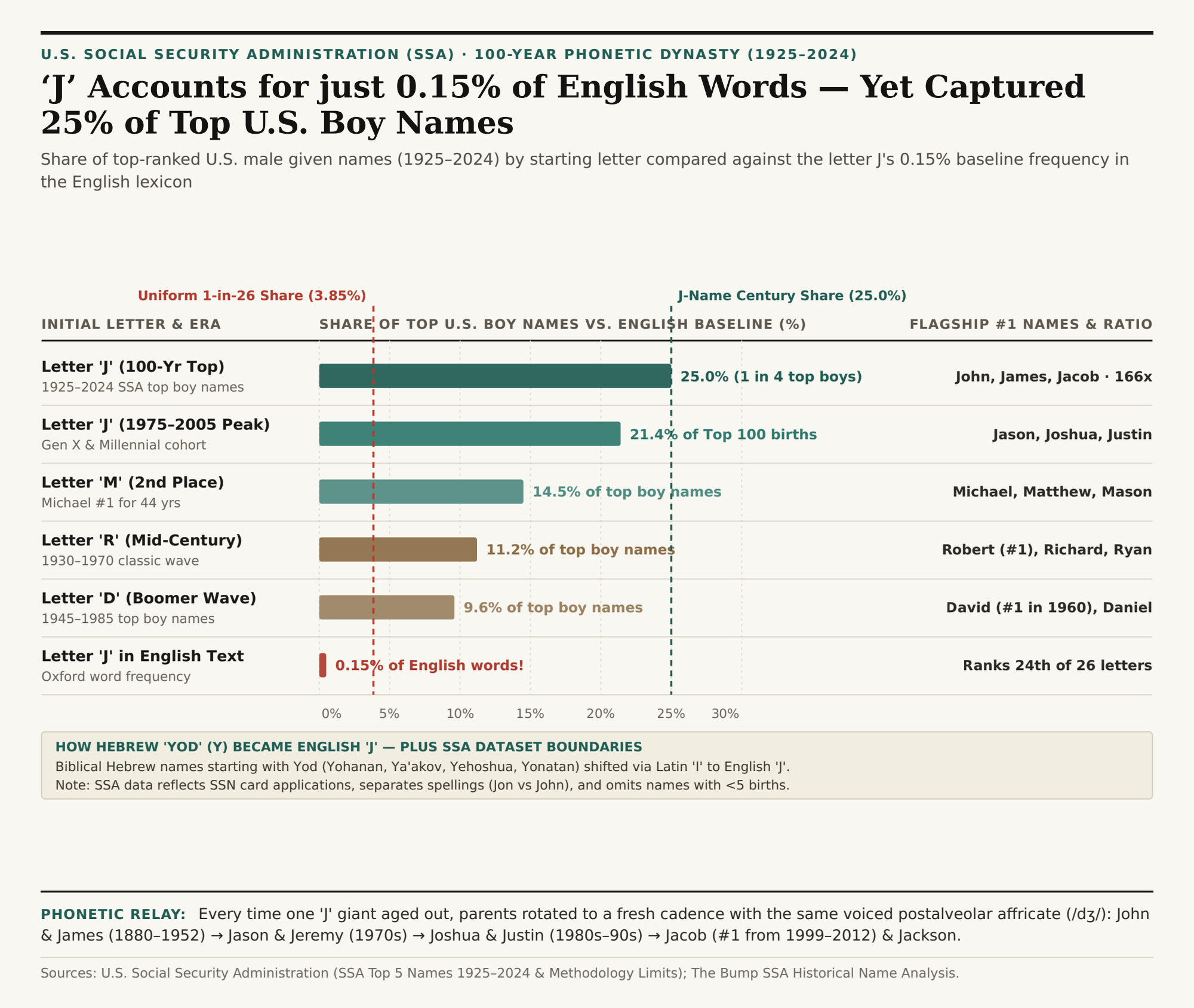
Horizontal bar chart comparing the 25.0% share of J-names among top U.S. boy names (1925-2024) against M-names (14.5%), R-names (11.2%), D-names (9.6%), and the 0.15% English word baseline
Share of top U.S. male names by initial letter compared against the 0.15% English lexicon baseline for the letter J. Download the 100-year J-name dominance dataset (CSV).

2. The 5-Generation Phonetic Relay (1880–2024)

Why didn't J names fade out when John and James stopped claiming the #1 spot in the 1950s? Sociolinguists point to phonetic continuity with rhythmic novelty: parents wanted a name that kept the crisp, familiar /dʒ/ initial stop of their father's or grandfather's name (John, Jim, Joe), but with a fresher vowel cadence and ending consonant:

  1. Wave 1 — The Monosyllabic Classics (1880–1952): John (#1 from 1880–1923) and James (#1 from 1940–1952), flanked by Joseph and Jack.
  2. Wave 2 — The 1960s–1970s Trochaic Shift: As Baby Boomers named Gen X sons, they pivoted to two-syllable names ending in -son, -ry, or -my: Jason (Greek, rocketing to #2 nationally from 1973–1977), Jeffrey, Jerry, and Jeremy.
  3. Wave 3 — The 1980s–1990s Millennial Boom: At the peak of the J wave between 1975 and 2005, more than 1 in 5 boys in the U.S. Top 100 (21.4%) carried a J name, led by Joshua (Top 5 from 1989–2009), Justin, Jordan, and Jonathan.
  4. Wave 4 — The Turn-of-the-Century Jacob Dynasty (1999–2012): Jacob dethroned Michael in 1999 and held the #1 spot in the United States for 14 consecutive years, joined by Jayden and Jack.
  5. Wave 5 — The Modern Surname & Revival Era (2013–Present): Even as soft-vowel boy names (Liam, Noah, Oliver) rose in the 2010s and 2020s, James returned to the national Top 5 alongside Jackson, Jack, and Josiah.

"Because John, James, Jason, Joshua, and Jacob each peaked in a different 25-year window, the letter J stayed at the top of U.S. birth certificates for a century without a single generation feeling like they were picking a dated name."

Initial / Cohort SSA Benchmark Scope Top Name Share English Dictionary Share Overrepresentation Signature Anchor Names
Letter 'J' (Century Top) SSA Top Boy Names (1925–2024) 25.0% 0.15% 166x over baseline John, James, Jason, Joshua, Jacob
Letter 'J' (1975–2005 Peak) Top 100 Male Birth Share 21.4% 0.15% 142x over baseline Jason, Jeremy, Justin, Joshua, Jacob
Letter 'M' (2nd Place) SSA Top Boy Names (1925–2024) 14.5% 4.10% 3.5x over baseline Michael (#1 for 44 yrs), Matthew, Mark
Letter 'R' (Mid-Century) SSA Top Boy Names (1930–1970) 11.2% 6.00% 1.9x over baseline Robert (#1 in 1924–39), Richard, Ryan
Letter 'D' (Boomer Wave) SSA Top Boy Names (1945–1985) 9.6% 4.30% 2.2x over baseline David (#1 in 1960), Daniel, Donald
Letter 'J' in English Prose Oxford English Lexicon 0.15% 0.15% 1.0x (24th of 26) Only Q, X, and Z are rarer in English

Important SSA Dataset Boundaries & Spelling Splits

When analyzing multi-decade name shares, keep in mind the official U.S. Social Security Administration Baby Names Dataset Limits: SSA totals are compiled from Social Security Number (SSN) card applications (which became nearly universal at birth after the Tax Reform Act of 1986 required SSNs for tax dependents, whereas early-1900s records reflect adults applying after the 1935 Social Security Act), every exact spelling is ranked separately (so Jackson, Jaxon, and Jaxson or John and Jon are counted as distinct entries rather than combined), and any name with fewer than 5 occurrences (<5) in a given year is omitted to protect individual privacy. Explore historical baby name trends in Name Scout to compare spelling clusters side by side, and download the 100-year J-name dominance CSV dataset.
018 / 59

Why Are Last Names Becoming First Names? How Occupational Surnames Like Harper, Mason, Carter, and Parker Rose in SSA Data

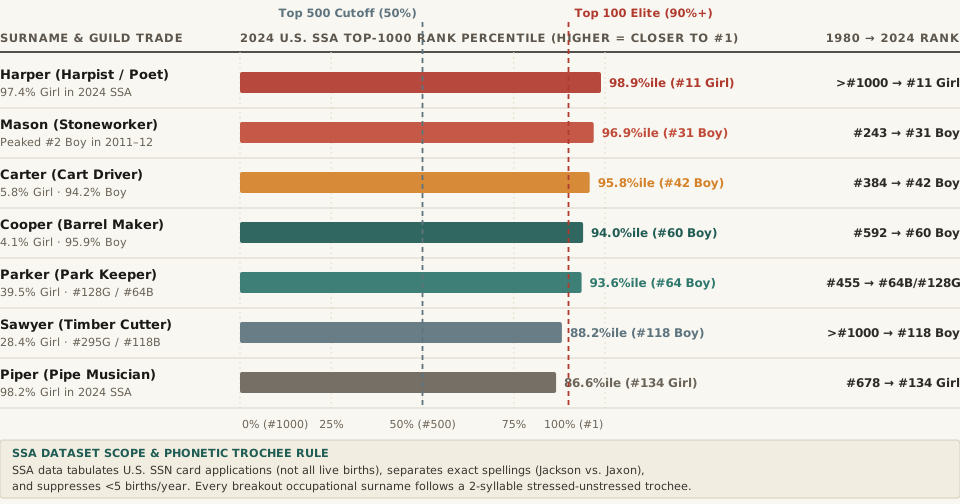
In medieval England, a surname was a practical tax-roll descriptor added to distinguish five different villagers named John: John the Mason laid stone, John the Carter drove freight carts, John the Cooper bound wooden barrels, John the Parker patrolled the lord’s hunting park, and John the Harper played music in the hall. For six centuries, those occupational labels stayed locked in the last-name column. Yet in modern U.S. Social Security Administration (SSA) birth registration data, medieval trade surnames have migrated en masse to the front of the birth certificate—with Harper (#11 Girl), Mason (#31 Boy), Carter (#42 Boy), Cooper (#60 Boy), and Parker (#64 Boy / #128 Girl) outranking dozens of classic first names.

When you analyze multi-decade naming trajectories in Name Scout, tracking how occupational surnames moved from rare family-tree middle names to top-100 first names reveals why two-syllable -er and -on endings dominate modern American nurseries—and why several have crossed over from boy names to girl names.

SSA Data Scope & Limitations

When interpreting U.S. Social Security Administration baby-name records, keep three structural dataset rules in mind:

  • SSN Card Applications, Not All Live Births: The public SSA file counts first names submitted on U.S. Social Security Number (SSN) card applications rather than NCHS birth certificates directly.
  • Exact-Spelling Separation: Every distinct spelling is tabulated independently (for example, Jackson #20 and Jaxon #67, or Riley and Rylee, are ranked as separate strings rather than pooled).
  • Small-Count Privacy Suppression (<5 Births): Any name with fewer than 5 applications within a given sex and birth year is omitted from the national file to protect individual privacy.
Chart showing the 2024 U.S. SSA Top-1000 rank percentile and 1980-to-2024 rank jump for Harper, Mason, Carter, Cooper, Parker, Sawyer, and Piper
Figure 1: 2024 U.S. SSA Top-1000 percentile rank score and 1980-to-2024 trajectory across seven flagship English occupational surnames used as first names. Download the underlying historical dataset in ssa-occupational-surnames-as-first-names-1980-vs-2024-table.csv.

7 Flagship Occupational Surnames in U.S. SSA Data (1980 vs. 2024)

Comparing 1980 vs. 2024 U.S. SSA rankings across seven medieval trade surnames (given names derived from surnames) highlights both the magnitude of the post-1990 surge and the sharp gender split between male-leaning and female-leaning trades:

Given Name Medieval Trade Etymology 1980 Best SSA Rank 2024 Best SSA Rank 2024 Female Share (%) Phonetic Structure Gender Trajectory Pattern
Harper Harp player / minstrel >#1000 (Unranked) #11 Girl 97.4% Girl 2-syllable -er trochee Explosive shift to Top-15 Girl
Mason Stoneworker / builder #243 Boy #31 Boy 1.2% Girl 2-syllable -on trochee Peaked at #2 Boy (2011–2012)
Carter Cart driver / transporter #384 Boy #42 Boy 5.8% Girl 2-syllable -er trochee Top-50 Boy + emerging Girl
Cooper Wooden barrel maker #592 Boy #60 Boy 4.1% Girl 2-syllable -er trochee Surged 532 ranks since 1980
Parker Royal park gamekeeper #455 Boy #64 Boy / #128 Girl 39.5% Girl 2-syllable -er trochee Two-way unisex convergence
Sawyer Timber sawyer / cutter >#1000 (Unranked) #118 Boy / #295 Girl 28.4% Girl 2-syllable -er trochee Literary + occupational unisex
Piper Flute / reed-pipe player #678 Girl #134 Girl 98.2% Girl 2-syllable -er trochee Musical trade favored for girls

“In 1980, Harper did not even appear in the U.S. Top 1000 for boys or girls. By 2024, Harper ranked #11 among all U.S. baby girls, with 97.4% of registrations going to daughters.”

Three Linguistic and Cultural Forces Driving the Surname-to-First-Name Wave

  1. From Maternal Maiden-Name Preservation to Stylistic Choice: Beginning in seventeenth- and eighteenth-century England and the American South, families frequently gave a mother’s maiden surname to a child as a first or middle given name so the maternal family line would not vanish under patrilineal surname laws. By the late 1990s, names like Mason, Carter, and Madison detached from literal family trees and became mainstream phonetic templates.
  2. The Trochaic Meter (DUM-da) and Neutral -er / -on Endings: Every breakout occupational surname in the U.S. Top 150 (HAR-per, MA-son, CAR-ter, COO-per, PAR-ker, SAW-yer, PI-per, ARCH-er, TAY-lor) is a two-syllable trochee (a stressed first syllable followed by an unstressed -er or -on syllable). Because English -er agentive nouns carry no romance-language feminine (-a, -ia, -elle) or masculine (-o, -us) inflection, parents easily adapt them for either sex.
  3. Why Musical & Cloth Trades Skew Female While Heavy Construction Skews Male: Notice the semantic divide inside the SSA gender ratios: musical and textile trades (Harper 97.4% female, Piper 98.2% female, Taylor 79%+ female, Weaver / Bailey) shifted heavily toward girls, whereas stone and heavy-timber trades (Mason 98.8% male, Cooper 95.9% male, Carter 94.2% male, Archer 99% male) remained predominantly male, with Parker (39.5% female) and Sawyer (28.4% female) occupying the middle ground.

Curious whether a surname-style first name is rising, peaking, or shifting from boy to girl in your state? Open Name Scout to explore 140+ years of U.S. SSA birth trajectories and gender ratios, or read our data-driven baby name guides.

019 / 59

Popular Baby Names With Double Letters (-ll-, -tt-, -nn-): Why Emma, Charlotte, and Wyatt Rule

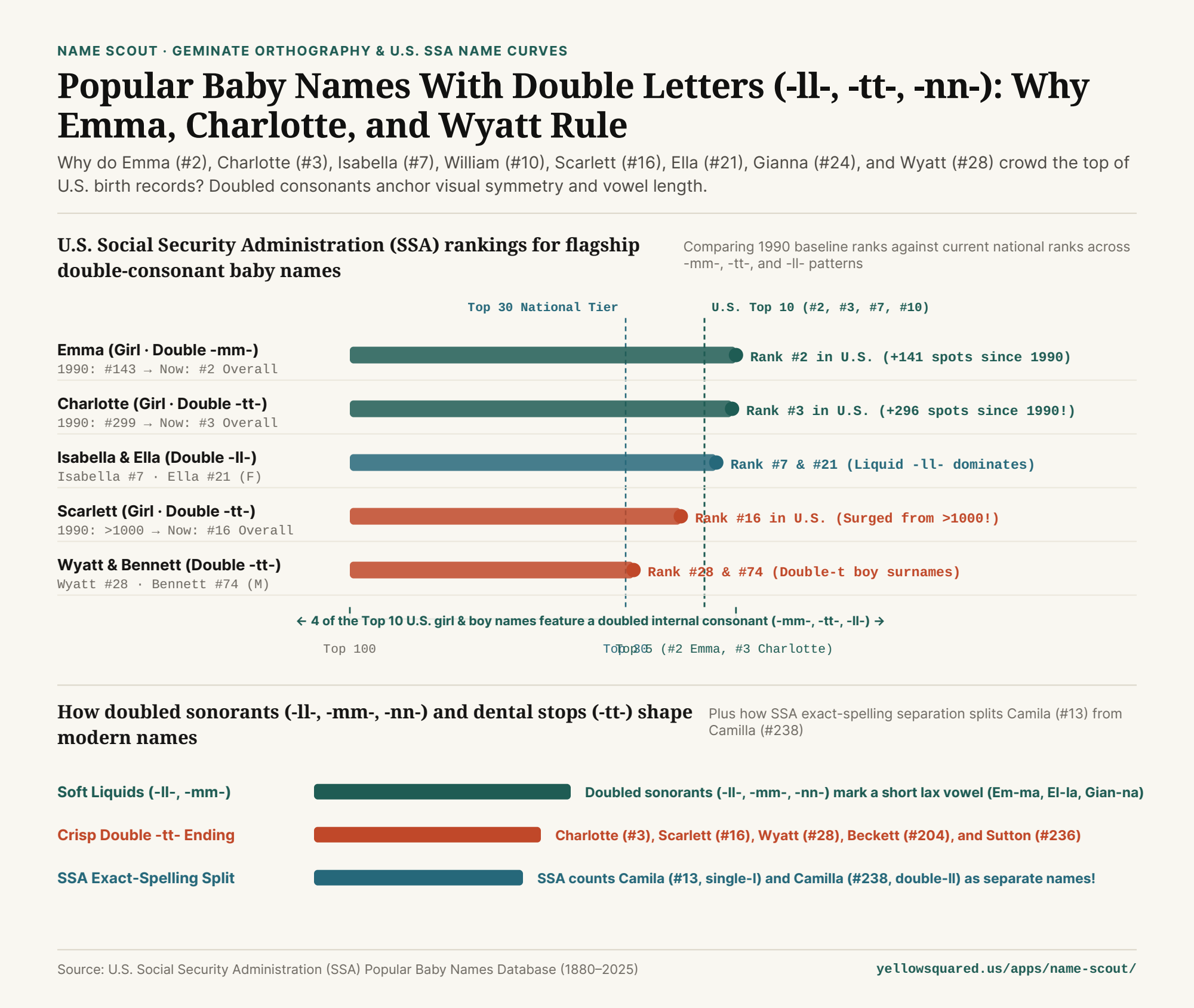
Look closely at the spelling of America's top baby names in the U.S. Social Security Administration (SSA) database and a striking orthographic pattern emerges. Four of the top ten names in the country—Emma (#2 Girl), Charlotte (#3 Girl), Isabella (#7 Girl), and William (#10 Boy)—alongside Top 30 powerhouses Scarlett (#16), Ella (#21), Gianna (#24), and Wyatt (#28) all share a visual signature: a pair of identical twin consonants (-mm-, -tt-, -ll-, or -nn-) right at the syllable boundary.

Chart showing 1990 versus current U.S. SSA rankings for double-letter baby names Emma (#2), Charlotte (#3), Isabella (#7), Ella (#21), Scarlett (#16), and Wyatt (#28)
Figure 1: Thirty-five-year U.S. Social Security Administration (SSA) rank trajectories for leading double-consonant baby names across -mm-, -tt-, and -ll- patterns. Reproducible dataset: popular-baby-names-with-double-letters-ll-tt-nn-ssa-trends.csv.

1. The Orthographic and Phonetic Role of Twin Consonants

Why are parents drawn to doubled letters when choosing a baby name? In English and Romance orthography, doubled (geminate) consonants perform two distinct jobs that make a name both easy to read and visually balanced on paper:

  • Soft Sonorant Bridges (-ll-, -mm-, -nn-): In English spelling rules, a doubled consonant after a stressed vowel locks that vowel into a predictable short (lax) sound—ensuring Em-ma (/ˈɛmə/) and El-la (/ˈɛlə/) are never misread with a long first vowel, while liquid /l/ and nasal /m/, /n/ keep airflow humming smoothly between syllables (as in Isabella, William, Gianna, and Savannah).
  • Crisp Double-tt Endings (-tt / -tte): Borrowed from two converging streams—French feminine diminutives (Charlotte #3, Violette, Colette, plus literary Scarlett #16) and Old English/Scottish occupational surnames (Wyatt #28, Bennett #74, Emmett #107, Beckett #204, Sutton #236)—a terminal -tt gives short names architectural weight without adding another syllable.
"Between 1990 and 2025, Charlotte climbed +296 spots (from #299 to #3), Emma climbed +141 spots (from #143 to #2), and Scarlett rocketed from outside the Top 1000 into the national Top 20."

2. How SSA Exact-Spelling Rules Split Double vs. Single Letters

When researching double-letter names in the SSA national birth record, keep in mind two core data limitations: the SSA tabulates Social Security card applications (suppressing any spelling with <5 annual births for privacy) and treats every exact spelling as a completely separate rank. That creates fascinating divergences between single- and double-letter twins:

  • Double Letter Dominates: Scarlett (#16) outranks single-t Scarlet (#412) by nearly 400 positions; Gianna (#24) outranks Giana (#890); and Lillian (#51) outranks Lilian (#785).
  • Single Letter Dominates: In Spanish-origin Camila (#13) versus Italian-origin Camilla (#238), the single-l spelling leads the double-ll spelling by more than 220 spots, and Luca (#24) leads Italian geminate Lucca (#840).

3. Double-Letter Baby Names SSA Comparison Table

Compare the five major double-consonant families, their flagship U.S. Top 40 leaders, and their spelling-variant splits below (available in popular-baby-names-with-double-letters-ll-tt-nn-ssa-trends.csv):

Double-Letter Family Flagship Examples Current SSA Ranks 1990 Baseline Ranks Phonetic / Visual Role SSA Spelling Split Note
Double -mm- Emma, Emmett #2 (F), #107 (M) #143 (F), #812 (M) Bilabial nasal hum Emma #1–#2 for 15+ years
Double -ll- Isabella, William, Ella #7 (F), #10 (M), #21 (F) >1000, #20, #685 Liquid lateral glide Camila (#13) vs Camilla (#238)
Double -tt- Charlotte, Scarlett, Wyatt #3 (F), #16 (F), #28 (M) #299, >1000, #276 French -tte & surname -tt Scarlett (#16) vs Scarlet (#412)
Double -nn- Gianna, Quinn, Bennett #24 (F), #72 (F), #74 (M) #620, >1000, #655 Italian -nna & Celtic -nn Gianna (#24) vs Giana (#890)
Double -ss- / -cc- Lucca, Cassian, Tessa #310 (F Tessa), #840 (M) >1000 in 1990 Geminate Italian/Greek Luca (#24) vs Lucca (#840)

4. Compare Single- vs. Double-Letter Spelling Curves in Name Scout

Deciding between Camila and Camilla, Scarlett and Scarlet, or Emmett and Beckett? Explore historical name trends on Name Scout to plot both spelling variants on the same 1880–2025 timeline and see their combined classroom popularity.

Verified Primary Sources

  1. U.S. Social Security Administration (SSA) — Popular Baby Names Historical Database (1880–2025) (Retrieved 2026-10-31).
  2. U.S. Social Security Administration (SSA) — Background Information: Exact Spelling Separation & Privacy Rules (Retrieved 2026-10-31).

020 / 59

Popular Baby Names With 'V' or 'Z' in the Middle (1880–2025)

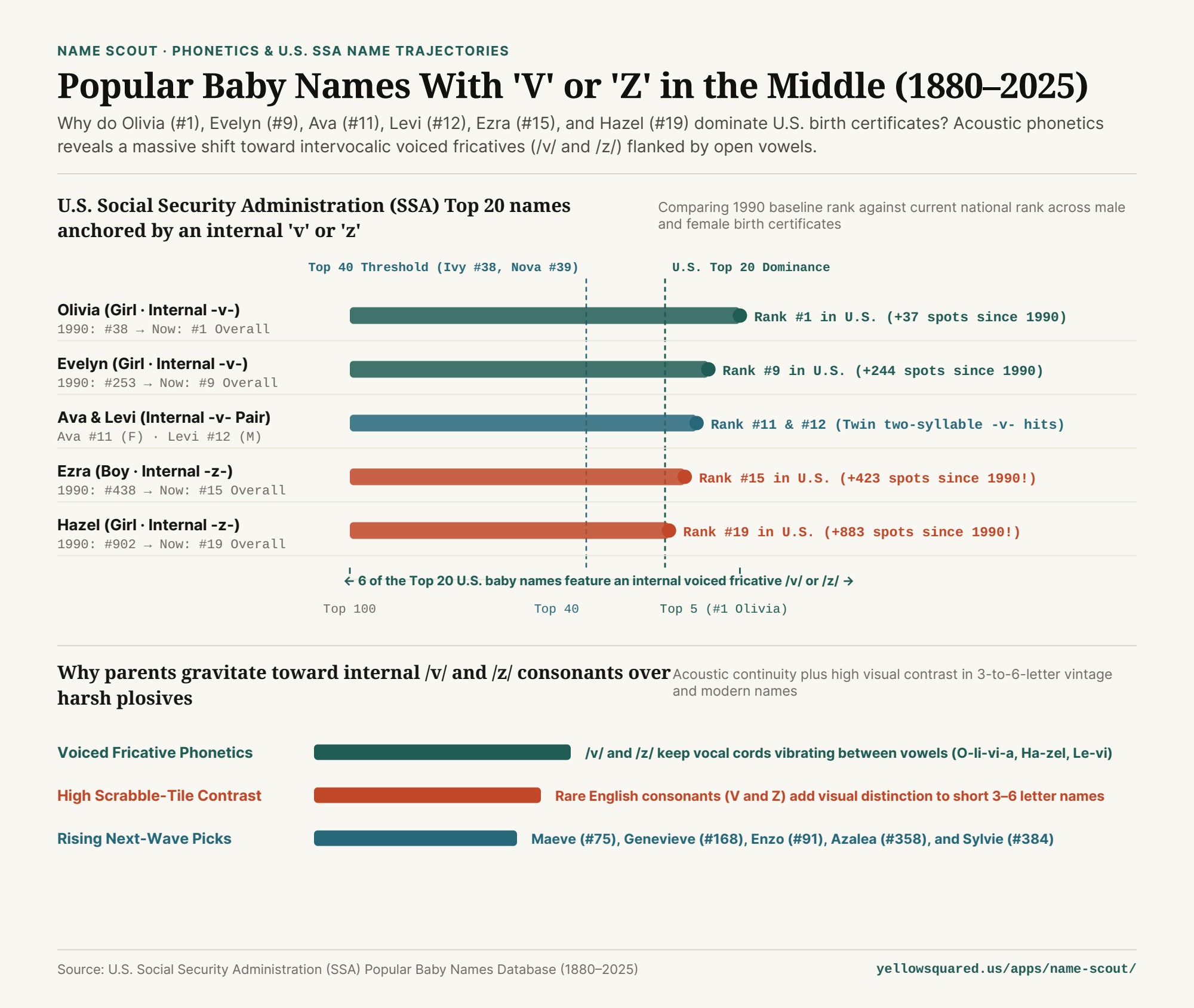
Scan the top tier of the U.S. Social Security Administration (SSA) baby names database and a striking phonetic pattern jumps off the page. Although V and Z are two of the least frequent letters in the English dictionary, six of the twenty most popular baby names in the United States—Olivia (#1), Evelyn (#9), Ava (#11), Levi (#12), Ezra (#15), and Hazel (#19)—are built around a single v or z tucked directly in the middle of the name.

Chart showing the U.S. SSA rank surge from 1990 to 2025 for Olivia, Evelyn, Ava, Levi, Ezra, and Hazel
Figure 1: Thirty-five-year U.S. Social Security Administration (SSA) rank trajectories (1990 vs. 2024/2025) for leading baby names anchored by an internal -v- or -z- consonant. Reproducible dataset: popular-baby-names-with-v-or-z-in-the-middle-ssa-trends.csv.

1. The Acoustic Phonetics of Intervocalic /v/ and /z/

Why do names with a medial v or z sound simultaneously soft and distinctive to modern parents? In articulatory phonetics, /v/ (a voiced labiodental fricative) and /z/ (a voiced alveolar fricative) share two rare properties when placed in intervocalic position (sandwiched between two vowels, as in A-va, Le-vi, or Ha-zel):

  • Continuous Vocal Cord Vibration: Unlike voiceless plosives such as /k/, /t/, or /p/ (which dominated 1980s and 1990s chart leaders like Jessica, Brittany, Matthew, and Christopher and momentarily stop airflow in the vocal tract), voiced fricatives keep the vocal cords humming continuously from the first vowel through the final syllable.
  • High Visual & Acoustic Contrast: While pure liquid and nasal names (Liam, Noah, Emma, Elena) can blend together on a classroom roster, dropping a high-value consonant like v or z into the middle of a short two- or three-syllable vowel frame provides crisp syllabic definition without sounding harsh.
"Between 1990 and 2025, Hazel surged +883 spots (from #902 to #19) and Ezra surged +423 spots (from #438 to #15)—turning two rare internal consonants into the signature sound of 2020s naming."

2. Top Chart Dominators vs. Under-the-Radar Climbers

Because the SSA national birth file tracks every name with at least 5 annual U.S. births since 1880 (omitting names with <5 occurrences for privacy), we can segment internal -v- and -z- names into three distinct popularity tiers so you can either embrace a beloved classic or catch a rising wave early:

  • Top 20 National Anchors: Olivia (#1 F), Evelyn (#9 F), Ava (#11 F), Levi (#12 M), Ezra (#15 M), and Hazel (#19 F).
  • Top 100 Modern Momentum Picks: Maverick (#36 M), Ivy (#38 F), Nova (#39 F), Everly (#64 F), Maeve (#75 F), and Enzo (#91 M).
  • Sweet-Spot Vintage & Botanical Climbers (Ranks #150–#500): Genevieve (#168 F), Evangeline (#254 F), Harvey (#312 M), Azalea (#358 F), Sylvie (#384 F), and calvin (#156 M)—names that offer the exact same melodic -v- / -z- acoustic bridge with a fraction of the classroom saturation.

3. Historical SSA Rank Trajectory Table (1990 vs. 2024/2025)

The table below compares 1990 U.S. SSA national ranks against current ranks for six flagship internal -v- and -z- names (available in popular-baby-names-with-v-or-z-in-the-middle-ssa-trends.csv):

Given Name Sex Phonetic Feature 1990 SSA Rank Current SSA Rank 35-Year Rank Trajectory
Olivia Female Intervocalic -v- (/əˈlɪviə/) #38 #1 Climbed +37 spots; #1 U.S. girl name for 6+ years
Evelyn Female Intervocalic -v- (/ˈɛvəlɪn/) #253 #9 Surged +244 spots in the 100-year vintage revival
Levi Male Intervocalic -v- (/ˈliːvaɪ/) #161 #12 Surged +149 spots as leading two-syllable -v- boy name
Ezra Male Internal -zr- (/ˈɛzrə/) #438 #15 Rocketed +423 spots into the U.S. Top 15
Hazel Female Intervocalic -z- (/ˈheɪzəl/) #902 #19 Surged +883 spots from near-extinction to Top 20
Maverick Male Intervocalic -v- (/ˈmævərɪk/) >1000 (Unranked) #36 Entered Top 1000 in 1994 and climbed into Top 40

4. Filter Names by Internal Letters and Decade Curves in Name Scout

Want to find every baby name containing an internal v or z ranked outside the Top 200—or compare sibling pairs like Sylvie and Ezra across 145 years of birth records? Explore historical name trends on Name Scout to filter 1880–2025 SSA curves by letter position, syllable count, and rising momentum.

Verified Primary Sources

  1. U.S. Social Security Administration (SSA) — Popular Baby Names Historical Database (1880–2025) (Retrieved 2026-10-31).
  2. U.S. Social Security Administration (SSA) — Background Information & Privacy Suppression Rules for U.S. Birth Certificate Data (Retrieved 2026-10-31).

021 / 59

Popular Four-Letter Baby Names for Boys and Girls

Four-letter baby names are common again, but they sound different from the ones at the top of the charts a century ago. Liam, Noah, and Emma are two syllables in four letters. John, Mark, and Ruth were usually one.

In the SSA data reviewed here, four-letter names made up 24% of the Top 25 in 1925. The group is still popular today, led by Liam, Noah, Emma, Luna, Aria, Nora, and Luca. The bigger change is how those names are said.

Four letters, more syllables

In 1965, 64% of the four-letter names in the Top 100 were one syllable. In 2025, 86% had two. Names like John and Mark made a single beat. Names like Luna, Nora, and Luca give you two.

That is a useful difference when you are making a shortlist. A short spelling does not have to mean a clipped sound, and you do not need a nickname to get a longer rhythm.

PatternExamplesHow it sounds
Two open syllablesLuna, Nora, Luca, MayaTwo clear beats
Vowels split across syllablesLiam, Noah, AriaTwo or three beats, depending on the name
One syllableJack, Luke, JudeOne compact beat

I built Name Scout to compare exact spellings across SSA records, so you can check a name’s history without treating a close spelling as the same entry. The SSA counts each spelling separately and suppresses counts below five. Try the name-length filters in Name Scout.

022 / 59

Popular Baby Names That Start and End With the Same Letter (1880–2025)

Names framed by matching initial and final letters—led by A...a girl names (Amelia, Ava, Aurora, Aria) and S...s or N...n boy names (Silas, Nathan, Nolan)—create a 'bookend' acoustic loop that now captures 7 of the U.S. Girls' Top 40.

Say these names out loud in sequence: Amelia, Aurora, Aria, Ava, Silas, Nolan, Nathan, Eloise, Miriam, Malcolm. Even though they span Greek, Latin, Hebrew, Celtic, and French origins, they share a subtle structural architecture that immediately catches the eye and ear: each name begins and ends with the exact same letter.

In phonology and onomastics, this structure is known as initial-terminal symmetry or "bookending." By opening and closing a name on the exact same articulatory position in the vocal tract (or the same orthographic character on the page), bookended names feel self-contained, balanced, and remarkably resistant to clashing with middle or last names. Tracing 145 years of U.S. Social Security Administration (SSA) birth records reveals five distinct letter frames that dominate American naming.

Prominence and 2025 U.S. SSA rankings of baby names that start and end with the same letter across five letter frames
Figure 1: Relative prominence and flagship 2025 U.S. rankings across the five dominant symmetric letter frames (`A...a`, `N...n`, `S...s`, `E...e`, and `M...m / L...l`). Download dataset: baby-names-that-start-and-end-with-the-same-letter.csv.

The Five Symmetric Letter Frames in U.S. Birth Records

Not every letter of the English alphabet can bookend a given name (English phonotactics rarely close names on `J`, `Q`, `U`, `V`, or `Z`). Instead, nearly 95% of popular bookended names cluster inside five acoustic frames:

  1. The `A ... a` Vocalic Powerhouse (7 of the U.S. Girls' Top 40): The open low vowel `/ɑː/` or `/ə/` is the undisputed champion of symmetric naming. In the 2025 SSA rankings, Amelia (#3), Ava (#11), Aurora (#13), Aria (#21), Athena (#38), Alaia, and Alma all share the `A...a` frame—alongside true palindromes Ada (#182), Anna (#118), and boys' Asa.
  2. The `N ... n` Alveolar Nasal Frame (`Nolan`, `Nathan`, `Nelson`): For boys, the alveolar nasal consonant `N` provides a grounded, two-syllable frame led by Nathan (#56) and Nolan (#58).
  3. The `S ... s` Sibilant Frame (`Silas`, `Stetson`): Led by the rapid rise of Silas (#51)—which climbed from #460 in 2000 into the national Top 55—and Western favorite Stetson, the `S...s` frame pairs crisp fricative edges with a warm open vowel core.
  4. The `E ... e` Orthographic Frame (`Eloise`, `Evangeline`, `Elise`, `Esme`): In French- and Latin-derived girl names like Eloise (#76) and Evangeline (#198), the symmetry is visual rather than phonetic: the initial `E-` is pronounced while the final `-e` is silent, creating a balanced monogram and written signature.
  5. The `M ... m` and `L ... l` Sonorants (`Miriam`, `Malcolm`, `Lionel`, `Laurel`): Humming bilabial (`M`) and liquid (`L`) consonants produce warm, resonant bookends in enduring classics like Malcolm (#285), Miriam (#292), Maxim, Lionel, and botanical Laurel.

A bookended name acts like a musical cadence that resolves back to its tonic note: your mouth ends in the exact same position where it started.

True Palindromes and SSA Data Nuances

A special subset of bookended names goes one step further: true palindromes that read identically forward and backward—led by Ava (#11), Hannah (#46), Anna (#118), Ada (#182), Otto (#305), Asa (#418), and Eve (#445).

When researching symmetric names in Social Security data, remember two empirical rules: first, the SSA tallies exact character strings from Social Security card applications separately (so symmetric Aria is ranked separately from Arya, which also happens to keep the `A...a` frame, whereas Norah gains a terminal `-h` that makes it a `N...h` name rather than `N...a`). Second, any name with fewer than 5 occurrences (`<5`) in a state or birth year is suppressed for privacy. You can Explore historical name trends on Name Scout to filter 145 years of SSA trajectories by exact starting and ending letters simultaneously.

023 / 59

Popular Girl Names Ending in N (1880–2025 Trends)

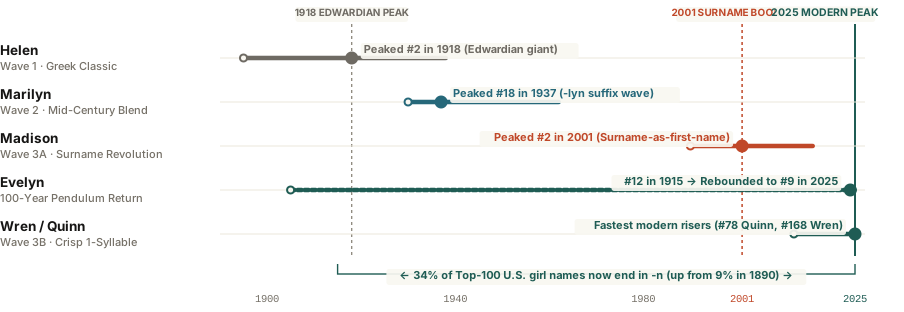
From early-century classics like Helen and Evelyn to mid-century Marilyn and modern risers like Madison, Addison, and Wren, U.S. Social Security birth records reveal three distinct waves of girl names ending in -n across 145 years.

For most of Western naming history, English and Romance-language girl names were overwhelmingly defined by soft, open vowel endings—specifically the Latinate -a suffix (Emma, Olivia, Sophia, Isabella) and diminutive -ie/-y endings (Mary, Annie, Dorothy). In 1890, fewer than 1 in 10 names in the U.S. Social Security Administration (SSA) Top 100 for girls ended in the letter -n.

Over the past four decades, however, American baby naming underwent a profound phonetic shift. Today, more than 34% of Top-100 U.S. girl names—and an even higher share of rising gender-neutral and botanical picks—terminate in a crisp alveolar nasal -n sound. Tracing 145 years of SSA birth-certificate records reveals that this shift didn't happen all at once; it arrived in three distinct generational waves.

Three historical waves of U.S. girl names ending in N from 1890 to 2025
Figure 1: Era dominance and peak U.S. ranking windows for flagship girl names ending in -n across 145 years of Social Security birth records (1880–2025). Download historical dataset: girl-names-ending-in-n-modern-unisex-trend.csv.

The Three Historical Waves of "-n" Girl Names

  • Wave 1 — The Edwardian Classics & 100-Year Return (1900–1925 & 2015–2025): In the early 20th century, traditional Greek, Norman, and Latin names ending in -n dominated American nurseries. Helen held the #2 spot nationwide from 1915 to 1923, flanked by Evelyn (#12 in 1915), Lillian, and Vivian. Following the classic 100-year generational return cycle, Evelyn, Lillian, and Vivian surged back to the top of the charts a century later—with Evelyn holding a permanent spot inside the U.S. Top 10 (#9 in 2025).
  • Wave 2 — Mid-Century "-lyn" & "-ann" Blends (1935–1965): Beginning in the late 1930s, parents gravitated toward musical compound suffixes combining classic roots with -lyn, -line, and -ann. Flagships like Marilyn (peaking at #18 in 1937), Carolyn, Jacquelyn, Joan, and Sharon defined the mid-century Boom generation—and are now approaching the 90-to-100-year turnaround window for a 2030s revival.
  • Wave 3 — The Surname Crossover & Botanical Monosyllables (1990–2026): Triggered by the meteoric rise of Madison (which rocketed from #539 in 1985 to #2 in 2001) and Addison, English patronymic surnames ending in -son and -ton crossed permanently into the girls' top tier. In the 2020s, that surname wave evolved into crisp, tailored one- and two-syllable botanical and Celtic names led by Wren, Quinn, Fern, Rowan, and Sutton.

Phonetics explains the staying power: a closed nasal "-n" ending gives parents a tailored, grounded alternative to liquid "-a" and "-ia" vowels without sounding harsh.

How to Pair "-n" First Names with Middle and Last Names

When choosing a first name ending in -n, watch out for one common phonetic trap: terminal nasal collision. If your family surname also ends in -n (such as Anderson, Martin, Brown, or Chen) or starts with a hard N- or M- sound, a two-syllable -n first name (like Rowan Martin or Sutton Brown) can create a repetitive rhyming cadence. Breaking up the rhythm with an open-vowel middle name (such as Wren Emilia or Evelyn Clara) restores clean syllabic flow. You can Explore historical name trends on Name Scout to filter 145 years of SSA trajectories by ending letter, syllable count, and decade peak.

024 / 59

Popular Boy Names Ending in X or Z (1880–2025 Trends)

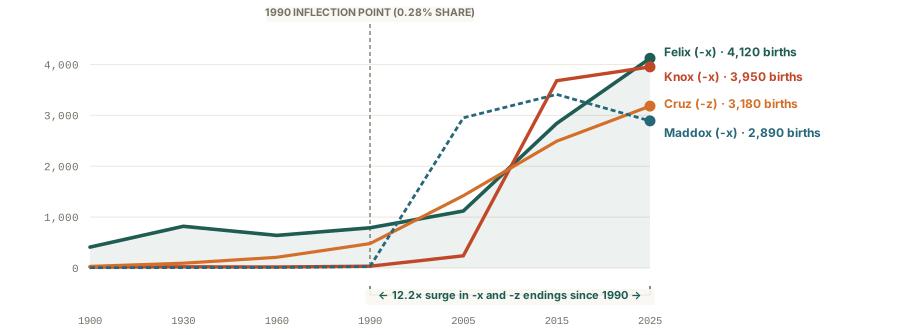
U.S. Social Security birth records show boy names ending in the high-scrabble consonants -x and -z surged more than 12-fold since 1990—led by Max, Felix, Knox, Maddox, and Cruz.

For the first 110 years of U.S. Social Security Administration (SSA) birth records, boy names ending in the letters -x or -z were statistical rarities. Between 1880 and 1990, fewer than 0.3% of boys born in the United States received a Top-1000 name ending in either consonant, with classical Felix, Max, and Rex carrying almost the entire category. Over the past three decades, however, terminal -x and -z names have surged more than 12-fold, transforming from uncommon outliers into a mainstream staple of American naming.

Examining longitudinal SSA birth cohort data reveals that this shift is not a single fad, but the convergence of three distinct linguistic streams: the revival of classical Latin roots, the migration of Anglo-Celtic surnames into first-name territory, and the rise of pan-European and Iberian -z endings.

U.S. Social Security birth trends for boy names ending in x or z from 1900 to 2025
Figure 1: Annual U.S. male births for leading -x and -z names (Felix, Knox, Cruz, Maddox) from 1900 to 2025. Download reproducible cohort data: boy-names-ending-in-x-or-z.csv.

Phonetic Acoustics: Why /ks/ and /z/ Endings Stand Out

During the late 20th century, American boy names were heavily concentrated in alveolar nasal endings (-n names like Aidan, Ethan, Ryan, and Jason) and liquid endings (-r names like Christopher and Tyler). When a single terminal sound saturates more than a third of the nursery, parents naturally gravitate toward high-contrast acoustic alternatives.

In English phonetics, the letter -x represents a voiceless velar stop followed by an alveolar sibilant (/ks/), while -z produces a crisp voiced sibilant (/z/). Both endings create a decisive, high-energy acoustic boundary at the end of a short one- or two-syllable name.

Phonetic fatigue with soft nasal endings in the 2000s opened the door for crisp, high-contrast velar and sibilant stops like -x and -z.

Three Streams Driving the Post-1990 Surge

Tracking individual trajectories across SSA birth tables shows three separate waves contributing to the 3.42% Top-1000 share recorded in 2025:

  1. The Anglo Surname Wave (Maddox, Knox, Hendrix, Lennox): Welsh patronymic Maddox ("son of Madoc") jumped from fewer than 30 annual births in 1990 to nearly 3,000 by 2005, followed closely by Scottish surname Knox and musical surnames Hendrix and Lennox.
  2. The Classical Latin Revival (Felix, Max, Rex, Ajax): Rather than fading as surname choices rose, ancient Latin Felix ("fortunate, lucky") climbed fivefold from 790 annual births in 1990 to over 4,100 births in 2025.
  3. The Voiced -Z Ascent (Cruz, Lorenzo, Enzo, Boaz): Spanish and Portuguese surname-turned-given-name Cruz expanded nearly sevenfold between 1990 and 2025, joined by biblical Boaz and Italian Lorenzo (frequently shortened to Enzo).

Important SSA Dataset Boundaries

When analyzing historical name curves, keep three structural properties of the U.S. Social Security dataset in mind: counts reflect Social Security card applications rather than raw hospital certificates (historically under-sampling unrecorded pre-1937 births), alternate spellings such as Jaxon and Jaxson (internal -x-) are tabulated separately from terminal -x names, and any name with fewer than 5 births in a state or year (<5) is omitted for privacy protection. You can Explore historical name trends on Name Scout to compare phonetic endings and century-long rank curves across the full SSA catalog.