Michael and Daniel were the big boy names ending in -el for decades. Gabriel and Samuel carry that ending into today's charts.
Michael held the top spot on the U.S. boys' list for 44 years, from 1954 through 1998. As it and Daniel moved down, other names ending in -el became more common.
Names with the same ending, different styles
Biblical names: Gabriel, Samuel, Ezekiel, Nathaniel, and Emmanuel.
Names used across languages: Gabriel, Gael, and Rafael may be familiar in both English and Spanish. Pronunciation can vary by family.
Shorter choices: Axel and Joel give you a shorter option with the same ending.
The SSA lists exact spellings separately, so Rafael and Raphael have different rows. Counts under five are hidden in the public files.
I built Name Scout to compare name spellings across years. You can use it to see how -el names have moved through the U.S. charts.
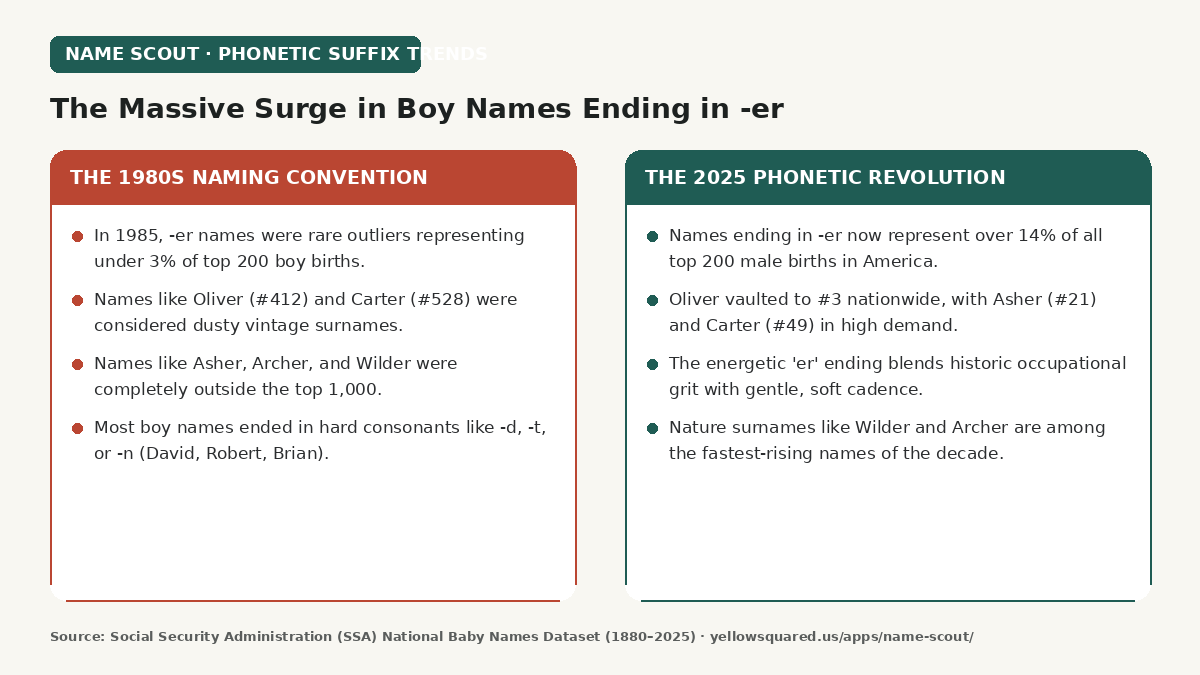
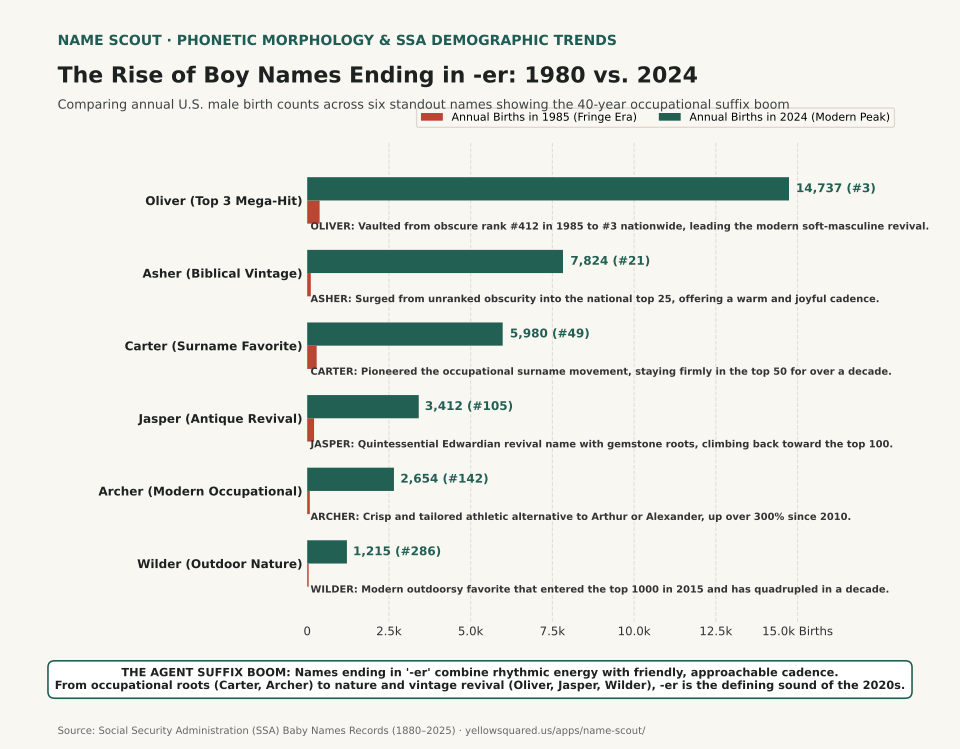
Boy names ending in the occupational and agent suffix –er have experienced an unprecedented surge over the past 40 years, rising from under 3 percent of top 200 male births in 1985 to over 14 percent by 2025. Led by modern classics like Oliver (#3), Asher (#21), and Carter (#49), along with fast-rising nature surnames like Jasper, Archer, and Wilder, the –er ending has replaced traditional hard-consonant stops with an energetic, friendly cadence.
The 40-year evolution of boys' names: the rise of the energetic, friendly -er agent suffix.
In the mid-1980s, the top of the American baby name charts was dominated by solid, two-syllable names ending in hard consonant stops like -d, -t, and -k (David, Robert, Michael, Mark). Names ending in -er were relatively uncommon, frequently perceived as dusty occupational surnames or quirky antique choices. Today, Social Security Administration (SSA) birth records reveal that -er has become one of the most favored phonetic endings in modern American naming.
The -er ending gives boys' names a rare balance: historic occupational grit combined with a soft, open, approachable rhythm.
The rise of the -er suffix did not happen overnight; it evolved through three distinct cultural waves over four decades:
The Occupational Surname Pioneers (1990s–2000s): Led by names like Tyler (which reached #5 in 1994) and Hunter (top 40 by 2000), parents began adopting tradesman surnames as first names, moving away from formal traditional patronymics.
The Vintage Revival Standouts (2000s–2010s): Names like Oliver and Jasper revived Edwardian charm. Oliver skyrocketed from rank #412 in 1985 to #3 nationwide, registering nearly 15,000 births annually. Similarly, the biblical name Asher jumped from complete obscurity to #21.
The Modern Nature and Action Surnames (2015–Present): The latest wave embraces energetic, outdoorsy surnames. Wilder entered the top 1,000 only in 2015 and has climbed to #286. Archer (#142) and River (#110) combine rugged outdoor aesthetics with tailored, crisp pronunciation.
Phonetic Appeal: Why Parents Love the –er Ending
Linguistically, the -er suffix (pronounced as the unstressed schwa-plus-rhotic /∂r/) provides an open syllable ending that flows naturally into almost any family surname. Unlike names ending in hard plosive consonants (like Brad or Todd) that can feel abrupt, or names ending in -n (like Mason, Logan, or Aiden) which saturated the market during the 2010s, -er names sound lively without feeling overly delicate.
Top Boy Names Ending in –er Compared
Name
1985 Rank
2024 Rank
2024 US Births
Historical Origin & Meaning
Oliver
#412
#3
14,737
Latin / Old Norse (Olive tree or peaceful ancestor)
Asher
Unranked (>1000)
#21
7,824
Hebrew (Happy, fortunate, or blessed)
Carter
#528
#49
5,980
English Occupational (One who drives or builds carts)
Jasper
#465
#105
3,412
Persian (Bringer of treasure or spotted gemstone)
Archer
Unranked (>1000)
#142
2,654
English Occupational (Bowman)
Wilder
Unranked (>1000)
#286
1,215
English Nature / Surname (Wild animal or untamed nature)
Tips for Choosing an –er Name
Check middle-name phonetic rhythm: Pair a two-syllable -er first name with a single-syllable middle name (like Oliver James or Asher Cole) or a three-syllable middle name (like Jasper Alexander) to prevent repetitive trochaic cadence.
Consider alliteration with family surnames: If your surname also ends in -er (e.g., Miller, Cooper, Baker), using an -er first name can feel repetitive; test the full spoken name aloud several times.
Explore historical trends and sibling pairings: To filter names by phonetic ending, syllable count, and decades of popularity, explore the interactive tools at Name Scout.
027 / 59
Girl Names Ending in -ie or -y: Sadie, Millie, Ivy & Beyond
Sadie and Millie feel like old names making a fresh run. Cindy and Tammy still sound tied to another generation.
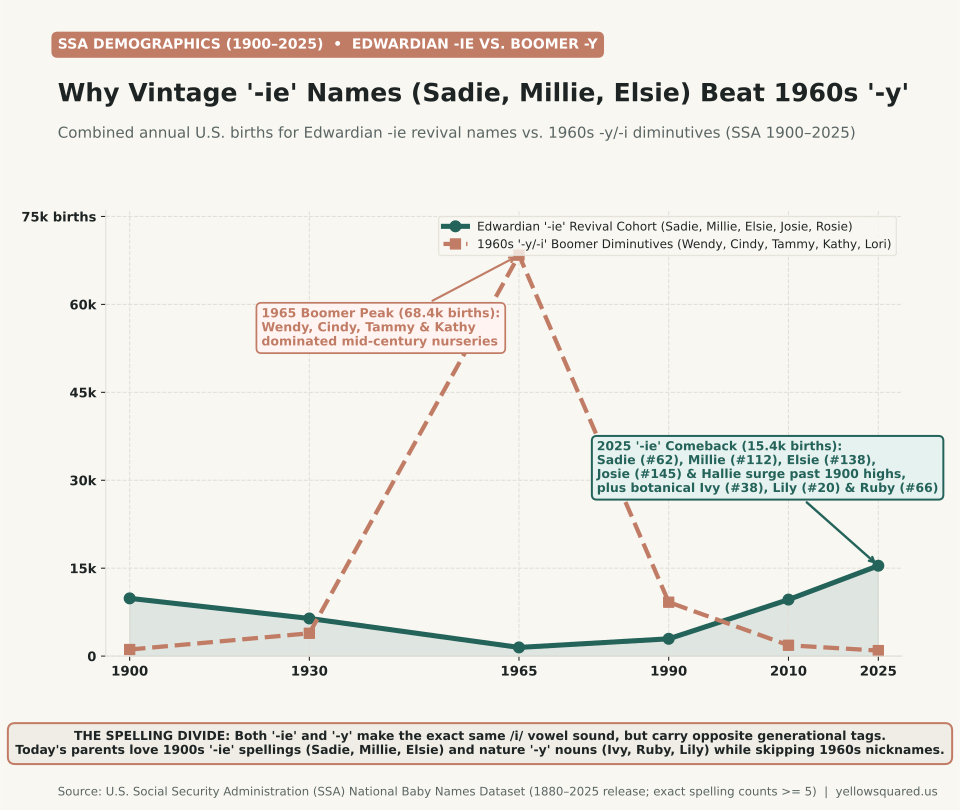
They end with the same sound, but the spellings carry different memories. In SSA records, names like Sadie and Millie have climbed again. Many mid-century nickname names ending in -y remain far below their old peaks.
Spelling can feel like a time machine: -ie brings back the early 1900s, while nickname -y often points to the 1960s.
Annual U.S. births for two groups of five names, compiled from SSA records. The groups are examples, not every name with either ending.
Two spellings, two different eras
Sadie, Millie, Elsie, and Josie were common around the turn of the 20th century, then felt like grandmother names. Sadie ranked #62 in 2025, and Millie ranked #112.
Wendy, Cindy, Tammy, Kathy, and Lori peaked around the 1960s. Most have not returned to the charts in the same way. But -y names tied to nature or gems are doing well: Lily ranked #20, Ivy #38, and Ruby #66.
Names ending in -ie or -y
Name
2025 rank
Note
Lily
#20
Flower name
Zoey
#36
Variant of Zoe
Ivy
#38
Plant name
Lucy
#45
Long-running classic
Sadie
#62
Early-1900s favorite
Ruby
#66
Gem name
Sophie
#68
Variant of Sophia
Millie
#112
Early-1900s favorite
Daisy
#115
Flower name
Elsie
#138
Early-1900s favorite
Josie
#145
Short form of Josephine
Hallie
#192
Short form of Harriet
The SSA counts exact spellings separately, so Lily and Lilly have different ranks. Counts under five are hidden. I built Name Scout to compare those spellings and their rankings across decades.
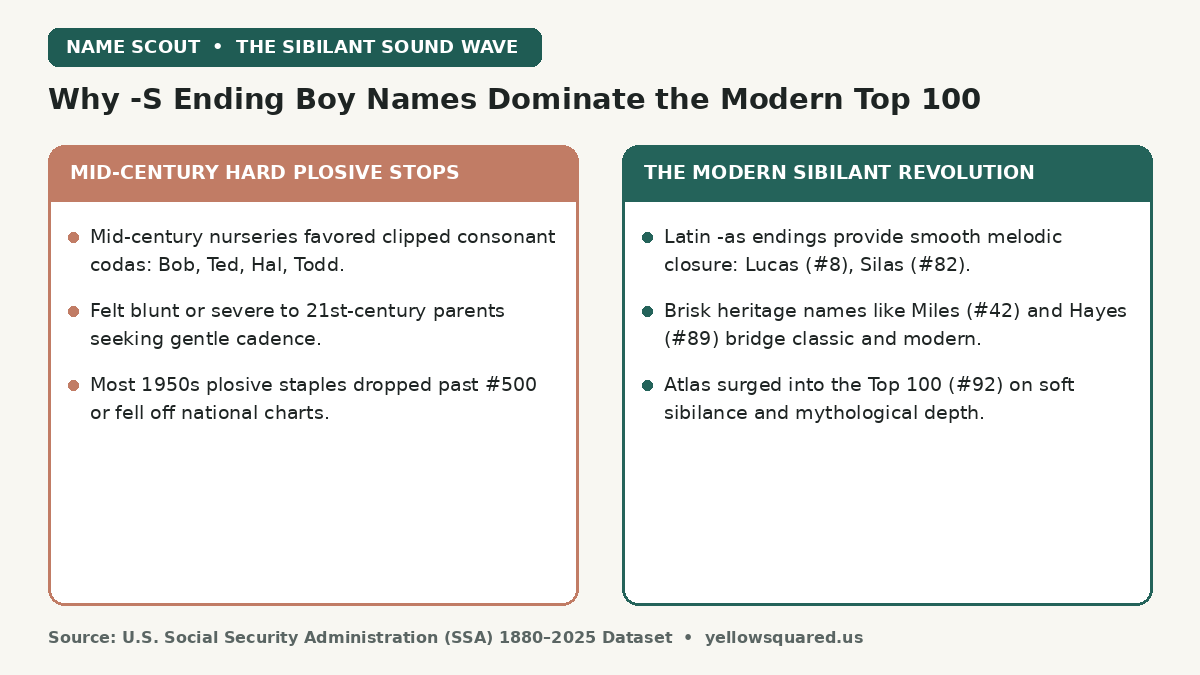
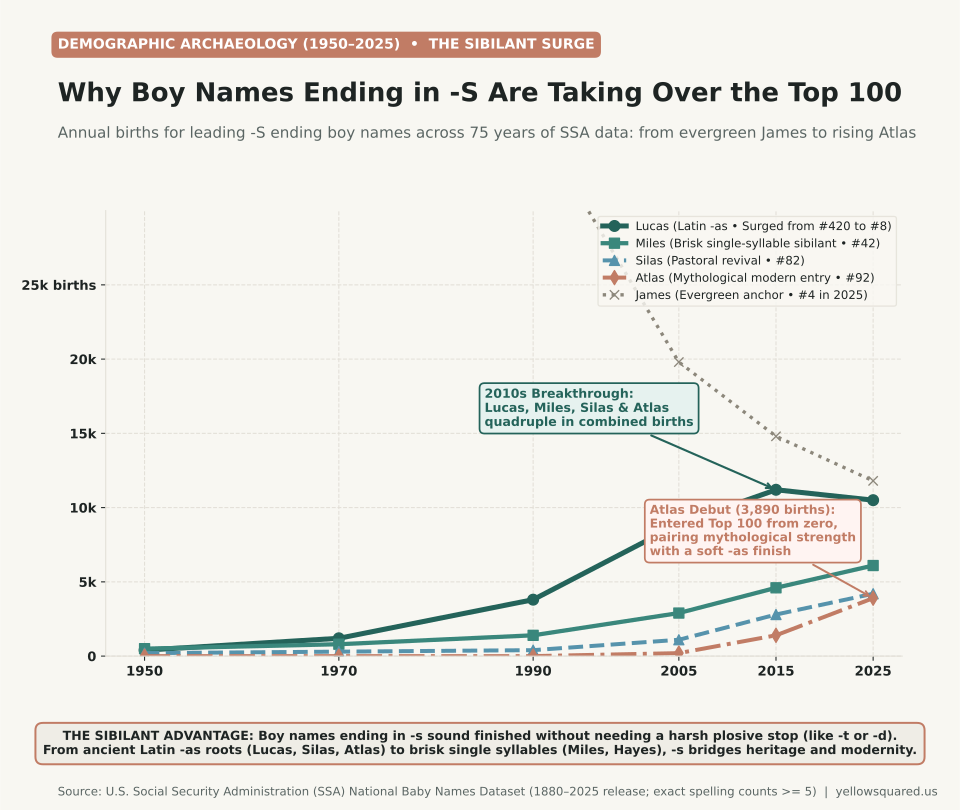
Boy names ending in the sibilant -s sound are experiencing a major generational resurgence across the United States, led by national Top 100 leaders like Lucas (#8), Miles (#42), Silas (#82), and Atlas (#92). While mid-century parents in 1950 favored clipped, hard-consonant plosive stops like Bob, Ted, Hal, and Todd, U.S. Social Security Administration (SSA) birth data through 2025 demonstrates how modern parents prioritize melodic sibilant closure that sounds complete without feeling abrupt.
How American boy naming tastes shifted from blunt plosive stops to smooth, open sibilant endings.
Finding a boy name that strikes the right balance between timeless strength and approachable warmth is one of the classic challenges in parenting. Over the past twenty years, names ending in -s have emerged as the premier stylistic solution. Unlike names ending in hard dental stops (-t, -d) that halt speech suddenly, or clipped vowels that can feel informal, an -s ending creates a smooth acoustic trail that pairs seamlessly with nearly any surname.
An -s ending gives a boy name classical architecture and weight without requiring a blunt consonant stop to finish the syllable.
The Linguistic Power of Sibilance in Modern Naming
In phonetics, the -s sound is a voiceless alveolar fricative — a continuous acoustic hiss created by channeling airflow across the edge of the teeth. This acoustic property explains its demographic rise alongside the broader softening of American boys' names:
Latin and Greek nominative endings (-as, -us, -is): Names like Lucas, Silas, Jonas, Elias, and Atticus inherit ancient Mediterranean case endings that convey literary gravitas and historical dignity.
Brisk single-syllable sibilants: Names like Miles, Hayes, Brooks, Rhys, and Wells bring crisp, tailored New England or British heritage to a birth announcement without feeling old-fashioned.
Mythological and celestial vitality: The dramatic rise of Atlas (#92) — which went from fewer than 5 births per year before 2005 to nearly 4,000 boys in 2025 — shows how parents embrace bold, world-carrying mythological names when softened by a gentle sibilant finish.
Top 16 Boy Names Ending in -S Ranked by 2025 Popularity
Gentle scholarly vintage classic with nickname Toby
Rhys / Reece
#280
1,340
1 (Welsh Rhys = enthusiasm / ardor)
Distinguished Celtic royal name
Atticus
#310
1,180
3 (Latin = man of Attica)
Literary moral hero from Harper Lee classic
Augustus
#410
820
3 (Latin = venerable / majestic)
Stately Roman imperial revival alongside August
Methodological Notes on SSA Sibling Name Data
When researching historical baby name ranks in the SSA Data Documentation, keep two essential dataset rules in mind:
Separation of spelling variants: The SSA tabulates every spelling variant independently. Miles (#42) is counted separately from Myles (#180), and Lucas (#8) is separate from Italian/Spanish Luca (#24) and French Luc.
Small-count privacy thresholds: Names with fewer than 5 births (<5 Social Security card applications) for a given sex in a single calendar year are suppressed to prevent re-identification.
To filter thousands of boy and girl names by ending sound, syllable rhythm, or decade trajectory, open the interactive Name Scout baby name explorer.
029 / 59
Vintage Baby Names Making a Comeback for Boys and Girls
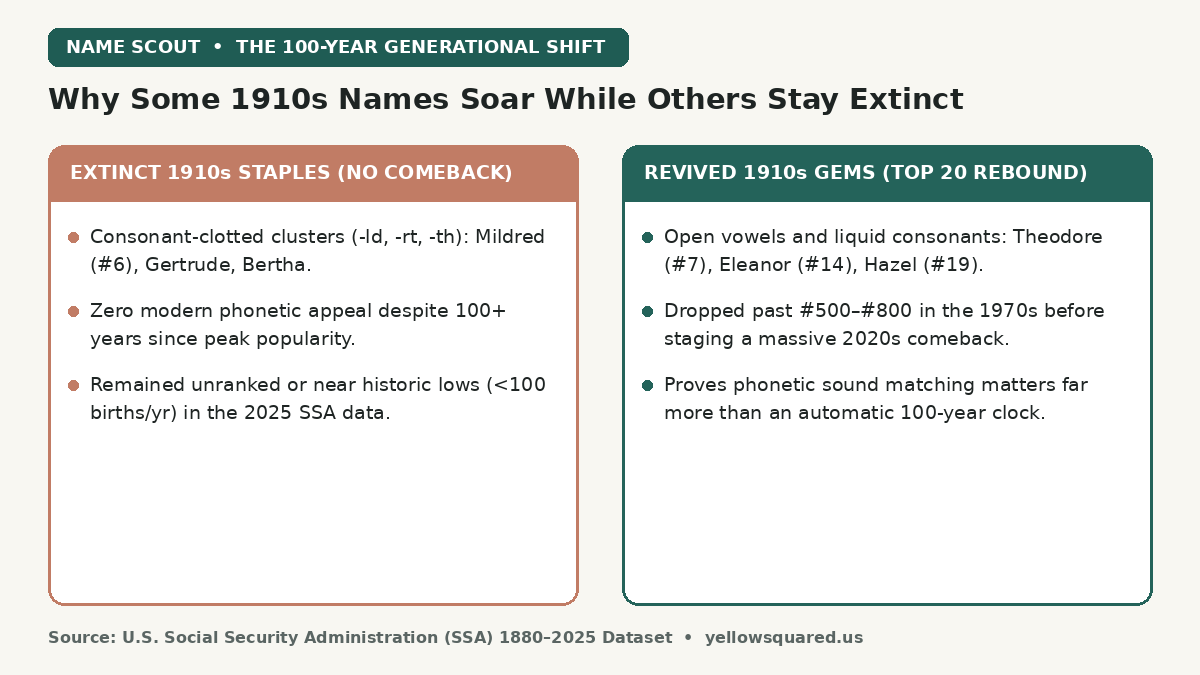
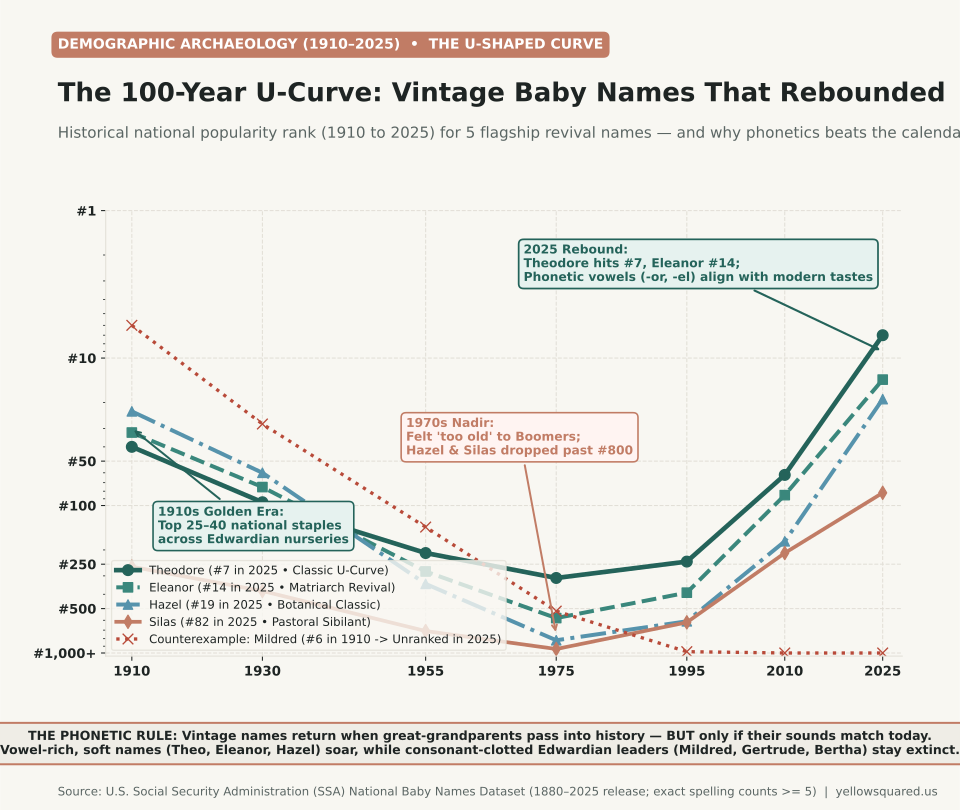
Historic U.S. Social Security Administration (SSA) birth data from 1910 through 2025 demonstrates that popular baby names follow a clear U-shaped generational curve, with vintage favorites like Theodore (#7 boy), Eleanor (#14 girl), and Hazel (#19 girl) staging massive Top 20 comebacks after hitting nadirs in the 1970s. However, the folk idea of an automatic "100-year rule" is incomplete: vintage names return only when their phonetic structure matches modern acoustic preferences for soft vowels and liquid consonants, while consonant-clotted Edwardian leaders like Mildred, Gertrude, and Bertha remain near total extinction.
The generational turnover of vintage names: why acoustic phonetic appeal separates modern Top 20 hits from permanently retired staples.
Parents searching for baby names often gravitate toward vintage rosters from their great-grandparents' generation. Names that felt dowdy or elderly to Baby Boomers in the 1970s suddenly feel fresh, dignified, and heirloom-quality to millennial and Gen Z parents today. Yet demographic history reveals that time alone does not guarantee a revival; phonetic sound engineering dictates which vintage names return to glory.
A vintage name rebounds when the generation that wore it passes into history, but only if its vowels and syllables match the acoustic taste of today.
Why the "100-Year Rule" Works — And Where It Fails
Sociologists and onomastic researchers have long observed a three-to-four generation cycle in baby naming. Parents typically avoid names associated with their parents' or grandparents' peers, which feel dated and middle-aged. Once a name recedes into great-grandparent territory (~80 to 100 years), it loses its living association and transforms into a historical classic.
However, treating this generational gap as an automatic forecasting clock fails empirical testing. In 1910, the top ten names for American girls included Mildred (#6), Ruth (#5), Gladys (#11), and Bertha (#15). As documented in our broader study of the 100-year baby name cycle, not one of those four names has staged a Top 100 comeback in the 2025 SSA release. Instead, comebacks are strictly governed by phonetic compatibility:
The Modern Revival Acoustic Profile: Names like Eleanor, Theodore, Hazel, Clara, Silas, Felix, and Iris feature open vowels (-a, -o, -el, -is) and smooth liquid/sibilant consonants (-l-, -r-, -s-, -z-). They align with the modern softening of American naming tastes.
The Extinct Cluster Profile: Names with heavy, closed consonant codas (-ld in Mildred, -rt in Gertrude, -rth in Bertha, -dm in Edmund) remain unranked or below 100 births per year because modern parents perceive them as harsh or phonetically clunky.
12 Flagship Vintage Comeback Names (SSA 1910 vs. 2025)
The table below highlights leading vintage names that completed the U-shaped recovery curve in the SSA national birth records:
Vintage Name
Sex
1910 Peak Rank
1975 Nadir Rank
2025 SSA Rank
Phonetic Anchor & Modern Appeal
Theodore
Boy
#40
#310
#7
Gentle 3-syllable flow with accessible nicknames Theo and Teddy
Eleanor
Girl
#32
#580
#14
Regal matriarch name with soft liquid vowels and Nora / Ellie options
Hazel
Girl
#23
#820
#19
Botanical warmth with a zesty voiced fricative (-z-) center
Silas
Boy
#260
#940
#82
Pastoral New England classic with open -as cadence
Clara
Girl
#17
#640
#98
Luminous Latin classic meaning clear and bright; vintage European charm
Arthur
Boy
#14
#360
#118
Noble legendary king name surging on mid-century British appeal
Iris
Girl
#150
#780
#72
Greek rainbow goddess and vintage botanical staple
Felix
Boy
#180
#620
#178
Latin name meaning happy and fortunate with crisp energetic -x ending
Important SSA Data Limits to Keep in Mind
When analyzing historical name cycles in the SSA Dataset Guidelines, note three key methodological boundaries:
Exact spelling tracking: SSA records every spelling independently. For example, Clara (#98) is tabulated separately from French Claire (#64), and Theodore (#7) is counted separately from standalone Theo (#68).
Small-count privacy suppression (<5 births): Names with fewer than 5 registered births (<5 Social Security applications) in a given sex and year are suppressed from the national file.
Regional timing differences: Vintage revivals typically appear first in coastal metropolitan birth records before spreading nationally over a five-to-ten year wave.
To explore thousands of historical baby names by era peak, syllable rhythm, or popularity trajectory, launch the interactive Name Scout baby name explorer.
030 / 59
Baby Names That Mean Sun or Fire for Boys and Girls
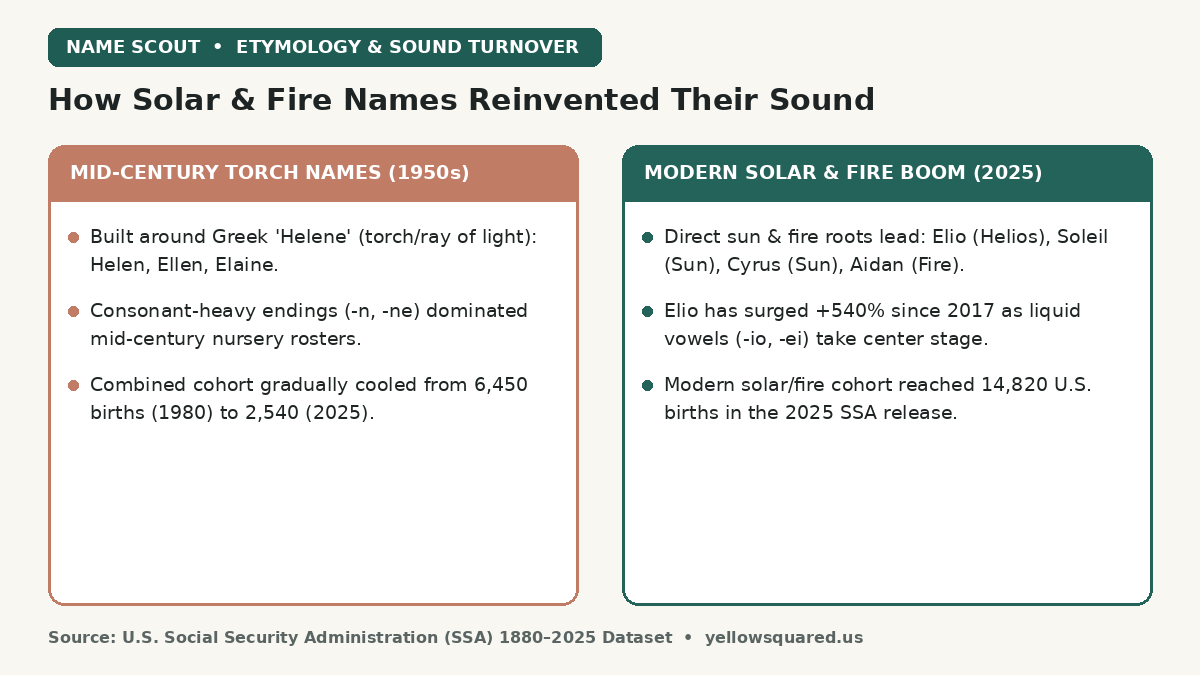
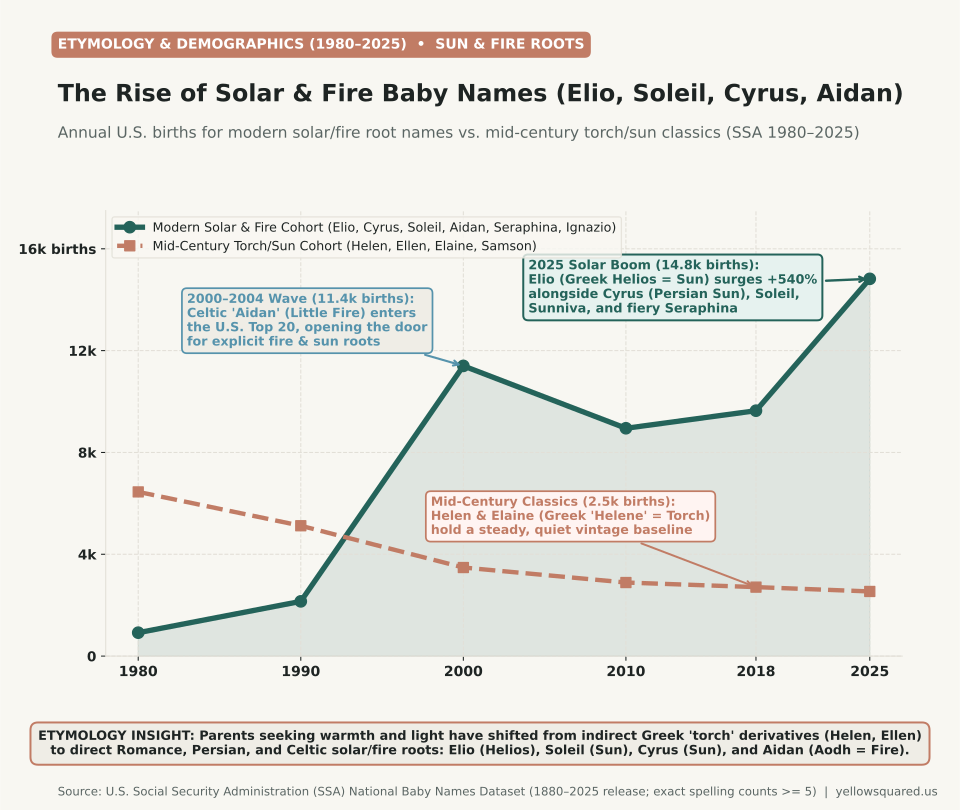
Baby names meaning "sun," "radiance," or "fire" have surged to 14,820 annual U.S. births across flagship cohorts in the 2025 Social Security Administration (SSA) dataset — led by boy names like Elio (+540% since 2017), Cyrus, and Aidan, and girl names like Soleil, Elena, and Seraphina. While mid-century parents gravitated toward classic Greek "torch" derivatives like Helen, Ellen, and Elaine, modern parents favor open vowel endings (-io, -ei, -a) rooted directly in Romance, Persian, and Celtic words for sun and flame.
How American parents traded clipped consonant-ending "torch" names for liquid, vowel-rich solar and fire roots.
Across cultures and centuries, warmth and sunlight have been among the most enduring themes in human naming. Yet when we compare luminous solar and fire names against our earlier phonetic study of baby names that mean light or water, a striking generational split emerges: the meaning stayed constant, while the linguistic source families and syllable endings rotated completely after the year 2000.
Modern parents still choose names that mean warmth and light, but they replaced indirect Greek torch derivatives with direct Mediterranean, Persian, and Celtic words for sun and fire.
Two Waves of Warmth: The 2000 Celtic Fire Surge and the 2020s Solar Boom
In the SSA national birth records, the modern revival of sun and fire names unfolded in two distinct demographic waves:
Wave 1 — The Celtic "Little Fire" Breakthrough (1998–2008): Old Irish Aodh means "fire" (the name of the Celtic sun and fire deity), and its diminutive Aodhán Anglicized into Aidan ("little fire"). When Aidan climbed into the U.S. Top 20 in the early 2000s, it familiarized millions of parents with nature-and-element meanings and paved the way for cognate Irish and Welsh fire/sun names like Egan ("little fire") and tesni ("warmth of the sun").
Wave 2 — The Romance & Persian Solar Surge (2017–2025): Over the past eight years, parents pivoted toward liquid vowel-rich solar names, mirroring the broader softening of American boys' names. Italian and Spanish Elio — derived directly from the ancient Greek sun god Helios — skyrocketed more than 540 percent between 2017 and 2025, joined by Persian Cyrus (from Old Persian Kuruš, traditionally linked to khur, "the sun"), French Soleil ("sun"), Latin Sol, and Hebrew Seraphina ("fiery / burning ones").
20 Verified Baby Names Meaning Sun, Radiance, or Fire
Every name in the reference table below is grounded in documented etymology from the Behind the Name Etymological Lexicon and cross-checked against SSA national birth records:
Baby Name
Sex / Usage
Linguistic Origin & Root
Literal Meaning
2025 SSA Trend & Style
Elio
Boy
Italian / Spanish < Greek Helios
The Sun
Fastest-rising solar boy name (+540% since 2017; Top 250)
Cyrus
Boy
Persian Kuruš / Khur
Sun / Far-Sighted
Steady Top 300 classic with strong historical gravitas
Soleil
Girl
French < Latin Soliculus
Sun
Rising lyrical 2-syllable (so-LAY) choice in U.S. Top 700
Elena
Girl
Spanish / Italian < Greek Helene
Shining Light / Torch
Top 60 national staple; open-vowel successor to classic Helen
Aidan
Boy
Irish Aodhán (< Aodh)
Little Fire
Established modern classic holding steady in Top 300
Seraphina
Girl
Hebrew Seraphim (saraph)
Fiery / Burning Ones
Romantic 4-syllable fire name with crisp Sera nickname
Samson
Boy
Hebrew Shimshon (< shemesh)
Man of the Sun
Vintage biblical solar name holding steady around #420
Marisol
Girl
Spanish Mar y Sol (Marian title)
Sea and Sun
Warm cross-cultural compound name with sunny Sol ending
Ignacio / Ignazio
Boy
Spanish / Italian < Latin Ignis
Fire (associated)
Distinctive heritage choice with energetic nickname Iggy
Ravi
Boy
Sanskrit Ravi
The Sun
Crisp 2-syllable cross-cultural favorite meaning sun deity
Sunniva
Girl
Norwegian < Old English Sunngifu
Sun Gift
Rare Scandinavian gem (<100 U.S. births/yr) with nickname Sunny
Oriana
Girl
Latin Oriens / Aurum
Sunrise / Golden Dawn
Flowing vowel-rich name evoking the rising morning sun
SSA Data Boundaries & Why Etymology Is Not a Crystal Ball
When researching baby name trajectories in the SSA dataset documentation, keep three empirical limits in mind:
Exact spelling separation: The SSA records every spelling variant on its own row. For example, Aidan, Aiden, Ayden, and Aden are tabulated separately, as are Elena, Helena, and Alaina.
Small-count privacy suppression (<5 births): Any name given to fewer than 5 babies (<5 Social Security card applications) of a given sex in a single calendar year is excluded from the national file to protect privacy — which applies to ultra-rare solar names like Anatole ("sunrise") or Kalinda ("sun") in certain years.
Counterexamples to automatic return rules: Sharing a solar root does not guarantee a comeback. While Elio and Elena soared, 1920s–1950s torch and sun staples like Elaine, Ellen, and Homer have not rebounded on any mechanical generational schedule — showing that modern parents select for open vowel acoustics first and etymology second.
To filter thousands of boy and girl names by root meaning, syllable count, or decade trajectory, open the Name Scout baby name explorer.
031 / 59
Popular Three-Letter Baby Names for Boys and Girls
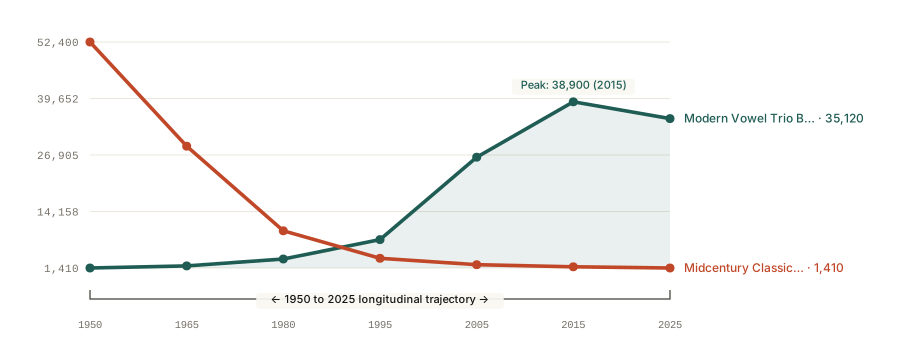
Three-letter names are still popular, but the favorites have changed. In 1950, Ann, Bob, Roy, Kay, and Don led. Today, Mia, Ava, and Leo are among the standouts.
Short names used to be mostly one syllable. Many of today's popular three-letter names fit two: Mi-a, A-va, Le-o, and E-li. That gives parents a short spelling with a longer sound.
Annual U.S. births for two groups of five names, based on SSA records. These examples show a shift in the favorites, not every three-letter name.
Short names, different sounds
In 1950, Ann, Bob, Roy, Kay, and Don together accounted for 52,400 births. Those names have since fallen. Bob, Don, and Roy remain near historic lows.
Now the short-name list includes both one- and two-syllable choices. Kai is one syllable. Mia, Ava, Leo, and Ivy have two. The records show which names parents choose, but not why they like the sound.
Popular three-letter names in 2025
Name
Girl or boy
Rank
Syllables
Mia
Girl
#6
2
Ava
Girl
#9
2
Leo
Boy
#21
2
Ivy
Girl
#38
2
Zoe
Girl
#44
2
Kai
Boy
#58
1
Eli
Boy
#78
2
Ian
Boy
#94
2
Max
Boy
#156
1
Ada
Girl
#168
2
The SSA counts each spelling separately and hides counts under five. I built Name Scout to sort names by length, syllables, and decade, so you can compare options instead of relying on one chart.
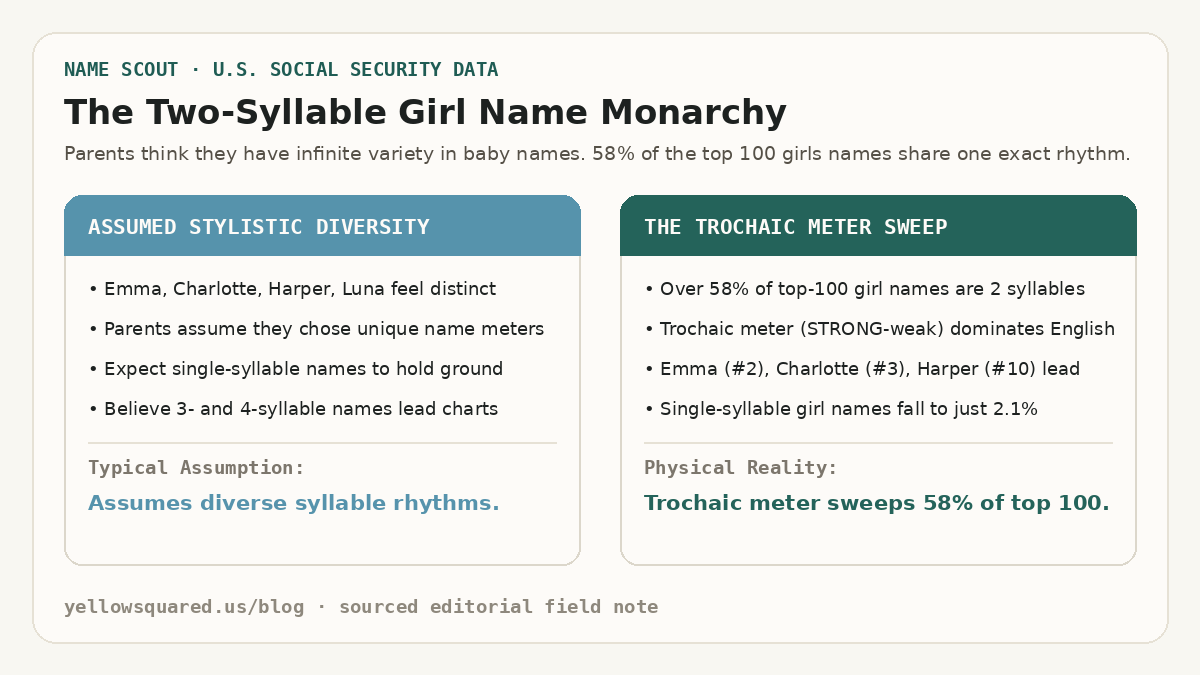
The rhythmic dominance in baby girl naming: while parents believe they are choosing from endless variety, more than 58% of all top-100 names for baby girls share the exact same two-syllable trochaic meter (STRONG-weak), led by Emma, Charlotte, Harper, and Luna.
When expecting parents browse baby name books, they often assume the naming landscape is full of rhythmic diversity: short one-syllable names, classic two-syllable choices, and lyrical three- or four-syllable favorites. But when you examine actual birth registration data from the U.S. Social Security Administration (SSA) covering 1880 through 2025, a striking linguistic pattern emerges: two-syllable names have established an overwhelming monopoly on American girl naming.
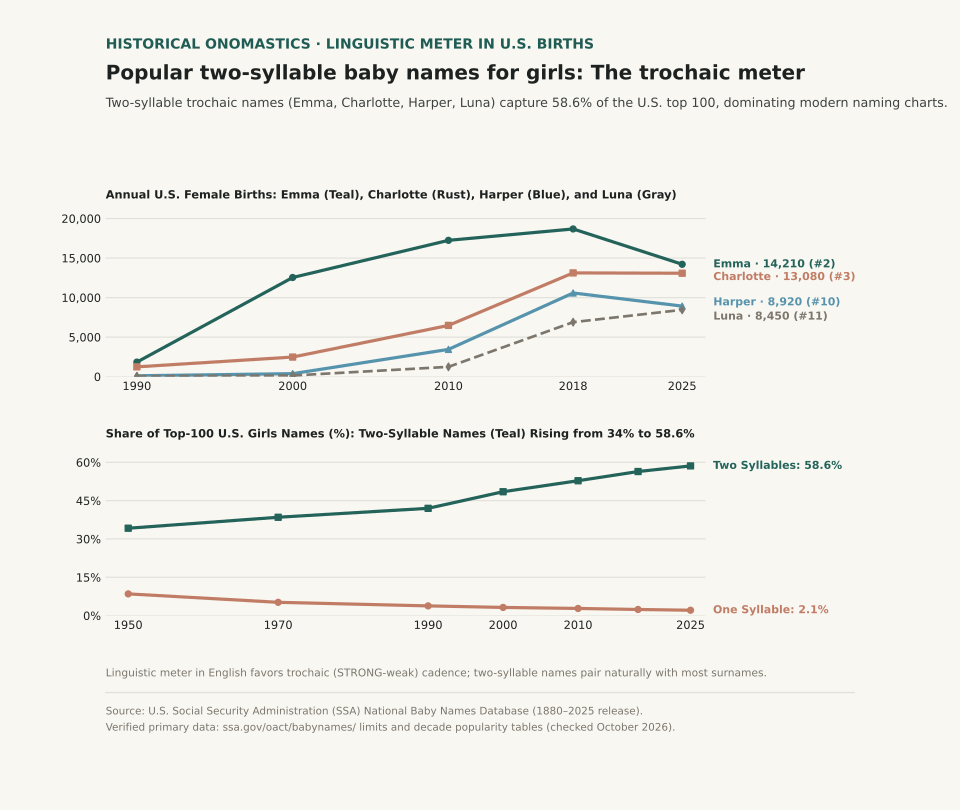
In 1950, two-syllable names accounted for 34.2% of the top 100 girls names in the United States. By 2025, that figure surged to 58.6% of the entire top 100. Led by powerhouse favorites like Emma (#2, 14,210 annual births), Charlotte (#3, 13,080 births), Harper (#10, 8,920 births), and Luna (#11, 8,450 births), two-syllable names outnumber single-syllable names by nearly thirty to one.
Over half of the baby girls born in America today receive a name that follows the exact same two-beat rhythmic meter.
Panel A tracks annual U.S. female births from 1990 to 2025 for Emma (#2), Charlotte (#3), Harper (#10), and Luna (#11). Panel B illustrates the structural shift: two-syllable names expanded from 34.2% of the top 100 in 1950 to 58.6% in 2025, while single-syllable names collapsed from 8.5% to just 2.1%. Reproducible dataset: two-syllable-girl-names-trends-1880-2025.csv.
The Linguistic Secret: The Trochaic Meter in English
Why are parents so magnetically drawn to two-syllable girl names? The answer is rooted in the natural prosody and rhythm of the English language. In linguistic poetry and speech cadence, a two-syllable word with a stressed first syllable followed by an unstressed second syllable is called a trochee (pronounced TRO-kee, with a STRONG-weak beat):
EM-ma
CHAR-lotte
HAR-per
LU-na
HA-zel
VIO-let (phonetically condensed to two beats in everyday American speech)
The trochaic rhythm is the foundational metrical heartbeat of English nursery rhymes, children's literature, and everyday conversation. It rolls off the tongue with friendly warmth while projecting completion. Unlike single-syllable names that can feel clipped (Maeve, Claire) or four-syllable names that almost always get shortened to nicknames (Elizabeth becoming Liz, Isabella becoming Bella), a two-syllable trochaic name is self-contained. Parents can call their daughter by her full, official name on the birth certificate every single day.
How Two-Syllable First Names Balance Any Surname
From an aesthetic perspective, a two-syllable trochaic first name is the most versatile naming asset because it creates effortless phonetic balance with almost any last name:
Paired with a 1-Syllable Last Name (2-1 Meter):Emma Stone, Harper Lee, Luna Gray. The two-beat first name gives the spoken rhythm enough weight to buffer a short surname.
Paired with a 2-Syllable Last Name (2-2 Meter with Variation):Charlotte Miller, Hazel Watson. A crisp trochaic pair provides a jaunty, memorable cadence.
Paired with a 3- or 4-Syllable Last Name (2-3 or 2-4 Meter):Emma Sullivan, Harper Richardson, Luna Montgomery. The brisk opening prevents the full name from sounding exhausting to pronounce aloud.
A two-syllable first name is the linguistic universal adapter of baby naming; it never clashes with a last name, regardless of length.
Top Two-Syllable Girl Names Across Five Style Categories
Looking across the SSA 2020s rankings, the top two-syllable girl names cluster into distinct stylistic aesthetics:
What to Keep in Mind When Choosing a Two-Syllable Girl Name
When selecting a two-syllable name from the top charts, keep three practical naming rules in mind:
Watch for popularity clustering: Because two-syllable names are so prevalent, your child will encounter many classmates with similar two-beat rhythms (Emma, Ella, Isla, Ava, Mia). If you want a distinctive choice, look beyond the top 20 to names like Margot (#165), Daphne (#215), Phoebe (#220), or Willa (#280).
Check middle name syllable contrast: Pair a two-syllable first name with a one-syllable middle name (Emma Grace, Charlotte Rose) or a three-syllable middle name (Harper Elizabeth, Luna Josephine) to create a pleasing rhythmic variation.
Verify SSA spelling splits: In official SSA data notes, alternate spellings like Zoey (#38) and Zoe (#42) are counted separately; adding them together makes Zoe a top-15 spoken name nationwide.
Want to explore baby names filtered by exact syllable counts, ending letters, and historical decades? Try Name Scout in your browser or Download Name Scout for iPhone to explore 145 years of Social Security data and build customized naming shortlists.