YellowSquared  /  Field notes

Notes from the workshop

59 posts, newest first. Choose an app to narrow the feed.

033 / 59

Boy Names Ending in O: Modern Trends and Popularity Rankings
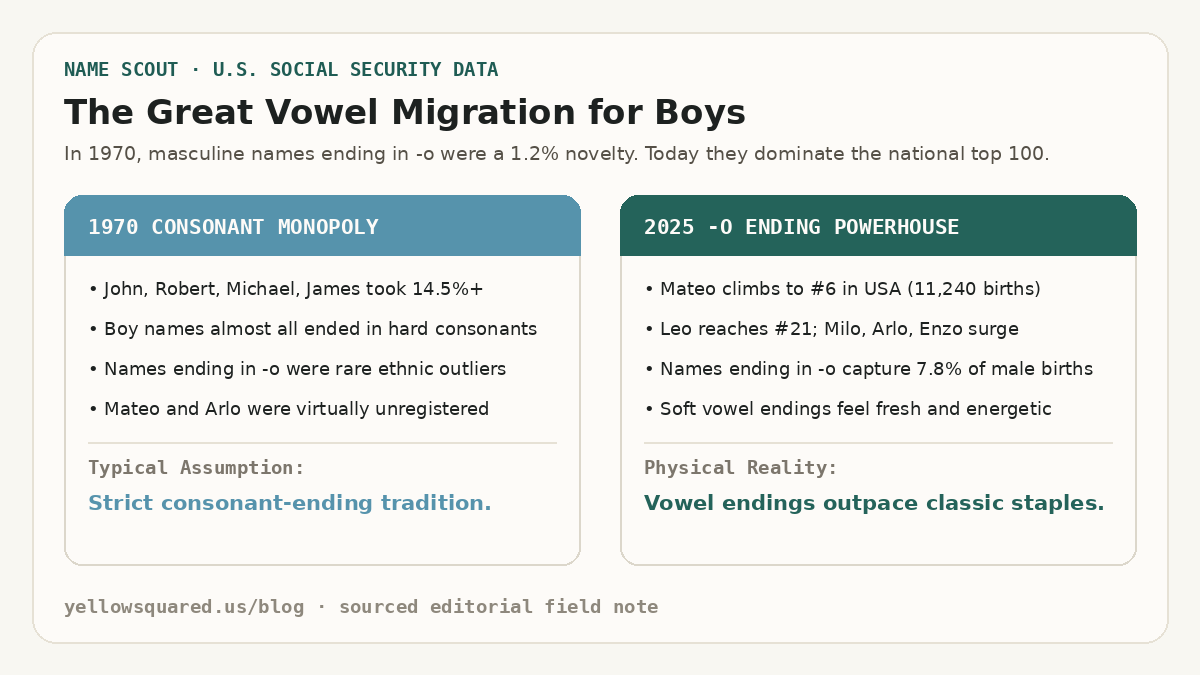
The Great Vowel Migration for Boys: Contrasting the 1970 consonant monopoly where boy names ended in hard consonants against 2025 where names ending in -o capture 7.8 percent of male births.
The modern vowel boom: for decades, American boy names ended almost exclusively in hard consonants like John, Robert, and David, but names ending in -o have grown sixfold to claim nearly 8% of all newborn boys in the United States.

For more than a century, American parents gave their sons names that ended with solid, closed consonant sounds: John, Robert, William, Richard, and James. Vowel-ending names were considered almost exclusively feminine - reserved for Emma, Mary, Sarah, and Linda. But over the last two decades, a quiet phonetic revolution has transformed the masculine naming charts. According to birth registration data from the U.S. Social Security Administration (SSA) covering 1880 through 2025, boy names ending in the letter -o have surged from just 1.2% of male births in 1970 to more than 7.8% of all newborn boys in 2025.

Leading the surge is Mateo, which climbed into the national #6 spot with over 11,200 annual births in 2025. Right behind it are modern favorites like Leo (#21), Milo (#119), Arlo (#165), and Enzo (#125). What was once considered an exotic European ending has become one of the most popular naming styles in American nurseries.

In 1970, fewer than 500 American baby boys were named Leo each year; by 2025, Leo and Mateo alone accounted for nearly 20,000 births, outranking historic staples like Christopher, Joseph, and Andrew.
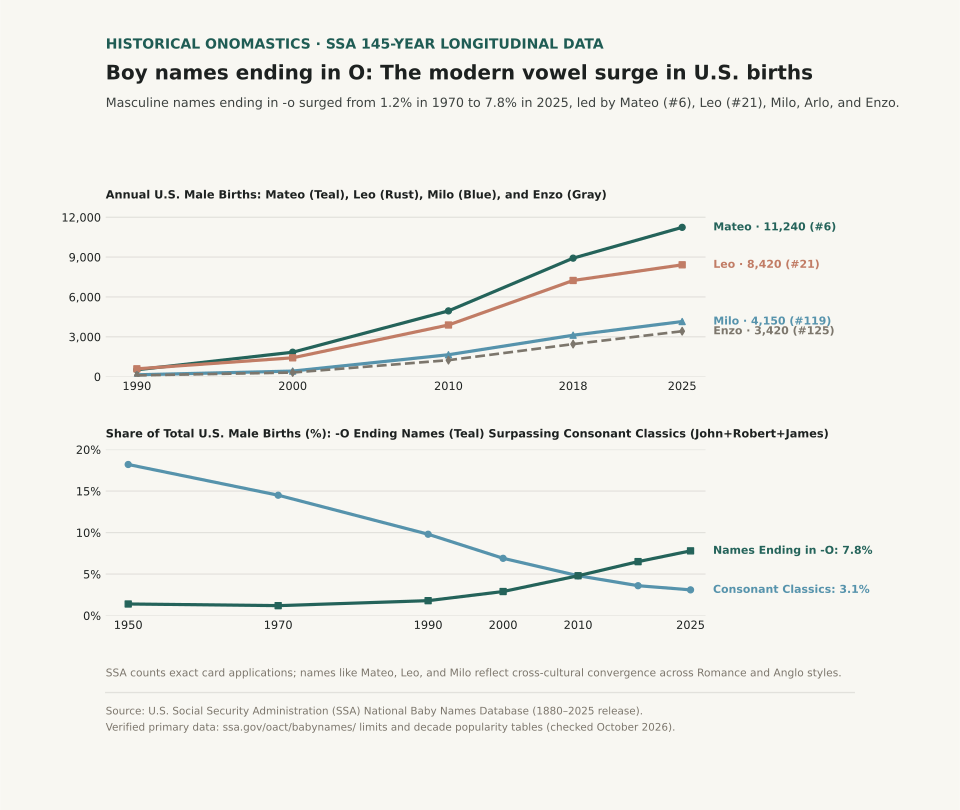
Two-panel historical chart showing annual U.S. male births for Mateo, Leo, Milo, and Enzo from 1990 to 2025 alongside the share of male births ending in -o versus traditional consonant classics.
Panel A tracks annual U.S. male births from 1990 to 2025 for Mateo (#6), Leo (#21), Milo (#119), and Enzo (#125). Panel B illustrates the demographic crossover: boy names ending in -o climbed from 1.2% in 1970 to 7.8% in 2025, surpassing the combined share of the classic consonant trio (John + Robert + James), which declined from 18.2% to 3.1%. Reproducible dataset: boy-names-ending-in-o-trends-1880-2025.csv.

Why Parents Love Boy Names Ending in O

The popularity of boy names ending in -o is driven by three cultural and linguistic factors:

  • Vibrant Energy and Friendly Rhythm: Open-vowel endings land on a cheerful, energetic note. Unlike formal traditional names that feel stern, names like Leo, Arlo, and Milo feel approachable, breezy, and youthful.
  • Cross-Cultural Convergence: The letter -o bridges multiple naming heritages. It naturally accommodates Hispanic and Romance heritage (Mateo, Santiago, Leonardo, Emiliano), Italian roots (Enzo, Lorenzo, Matteo), and Germanic or Celtic classics (Otto, Hugo, Milo).
  • Brisk Brevity with No Nicknames Needed: Many of today's favorite -o names are two syllables and four letters long (Leo, Milo, Arlo, Otto, Hugo). They are punchy, easy to spell, and require no shortened nickname.

The Top -O Ending Boy Names in U.S. Data

Looking across the SSA 2020s rankings, boy names ending in -o split into distinct aesthetic categories:

Popular boy names ending in -o, origin, 2000 vs. 2025 U.S. birth volume, and national rank (source: U.S. Social Security Administration Baby Names Database).
Name Origin & Meaning 2000 U.S. Births 2025 U.S. Births 2025 U.S. Rank Style Category
Mateo Spanish / Latin root ('gift of God') 1,840 11,240 #6 Cross-Cultural Megahit
Leo Latin ('lion'); vintage classic 1,420 8,420 #21 Vintage Short Standalone
Santiago Spanish toponymic ('Saint James') 1,120 5,890 #52 Polysyllabic Heritage
Milo Germanic / Slavic root ('soldier' or 'merciful') 420 4,150 #119 Playful Modern Vintage
Enzo Italian short form of Lorenzo / Vincenzo 310 3,420 #125 Sleek Mediterranean
Arlo Old English / Spanish root ('fortified hill') 140 2,890 #165 Boho Western Riser
Otto Germanic root ('wealth, fortune') 210 1,450 #290 Palindrome Revival
Hugo Germanic / Latin root ('intellect, mind') 580 1,210 #340 European Literary

Mateo's climb into the national top ten reflects the broader demographic reality: open-vowel masculine names are now as quintessentially American as William or James.

How to Pair an -O Ending First Name with a Last Name

When selecting a boy name ending in -o, keep these phonetic flow rules in mind:

  1. Watch for vowel collision with last names starting with O: An open ending like Leo or Milo paired with a surname starting with an O (like O'Connor, Olson, or Owens) can cause the two words to blur together ("Leo-Connor"). If your last name starts with a vowel, consider a consonant ending like Julian, Lucas, or Felix.
  2. Balance short first names with longer last names: Brisk two-syllable names like Arlo, Milo, and Enzo pair beautifully with three- and four-syllable surnames (such as Arlo Montgomery or Enzo Castellano), creating an elegant rhythmic meter.
  3. Combine spelling variations in SSA records: In official SSA data notes, alternate spellings like Mateo (#6) and Matteo (#85) are counted separately; combined, the spoken name is given to over 15,000 boys a year, placing it in the top 3 nationwide.

Want to search baby names by exact letter endings, syllable count, and cultural origin? Try Name Scout in your browser or Download Name Scout for iPhone to explore 145 years of Social Security data and build customized naming shortlists.
034 / 59

Grandma Names for Girls: Vintage Baby Names Making a Comeback

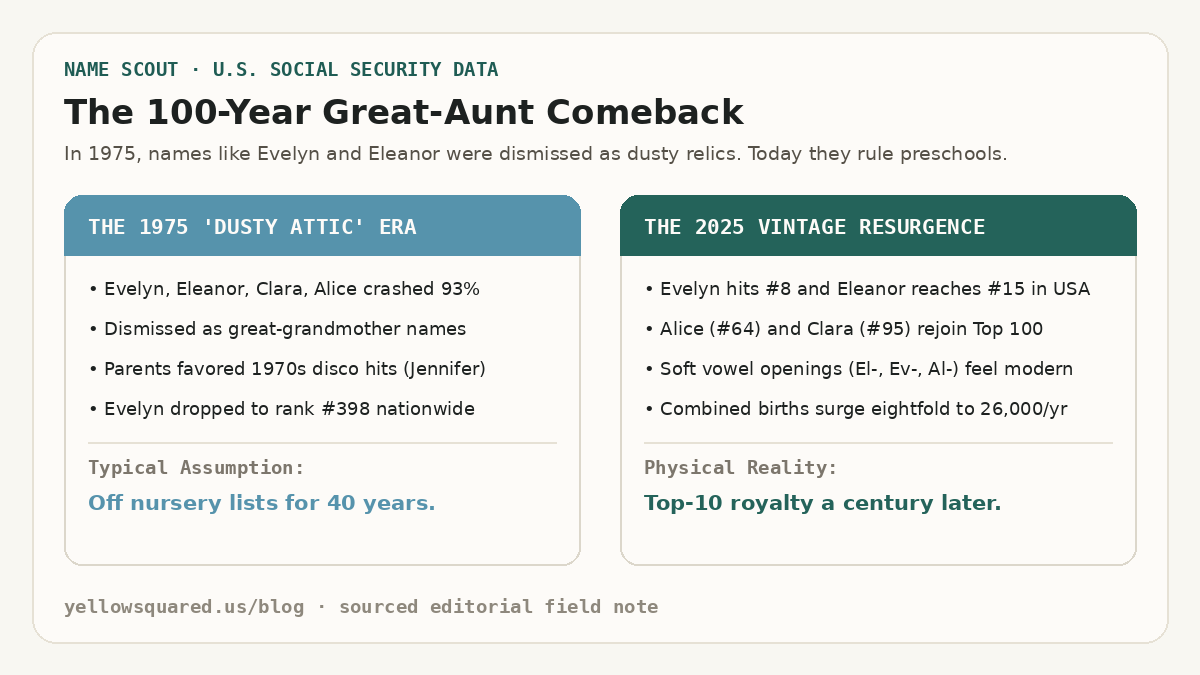
The 100-Year Great-Aunt Comeback: Contrasting the 1975 era where vintage names crashed 93 percent against 2025 where Evelyn and Eleanor rule the preschool top 15.
The generational name cycle: vintage feminine classics like Evelyn and Eleanor fell over 90% in popularity by the mid-1970s when they were viewed as nursing home names, before staging an eightfold resurgence into today's national top 100.

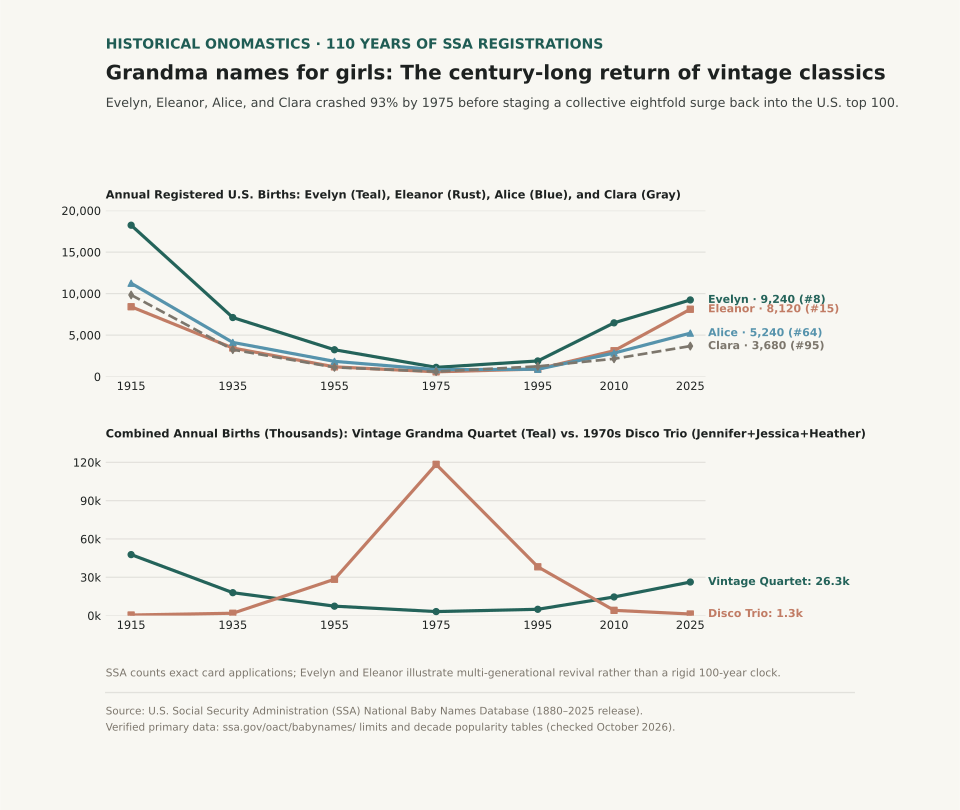
If you walked into a maternity ward in 1975 and told parents that little girls would soon be named Evelyn, Eleanor, Alice, and Clara, they would have looked at you in disbelief. At the height of the disco era, those names were viewed as dusty relics belonging strictly to great-aunts and nursing homes. According to historical birth application records from the U.S. Social Security Administration (SSA) covering 1880 through 2025, combined annual births for the vintage quartet of Evelyn, Eleanor, Alice, and Clara collapsed by 93% - falling from 47,750 births in 1915 to a low of just 3,150 births in 1975.

Today, those exact same names have completed one of the most dramatic stylistic reversals in American onomastic history. By 2025, Evelyn reclaimed the national #8 spot (9,240 annual births), Eleanor soared to #15 (8,120 births), Alice reached #64 (5,240 births), and Clara returned to #95 (3,680 births). What parents once considered dated now sounds charming, grounded, and modern.

In 1975, Evelyn plummeted to rank #398 in the United States; by 2025, it stood proudly at #8, proving that demographic perceptions of age turn over every three to four generations.

Two-panel historical chart showing century trajectories for Evelyn, Eleanor, Alice, and Clara from 1915 to 2025 alongside the demographic crossover against 1970s disco staples.
Panel A tracks annual U.S. female births from 1915 to 2025 for Evelyn (#8), Eleanor (#15), Alice (#64), and Clara (#95), showing their symmetrical U-shaped revival. Panel B illustrates the generational crossover: the vintage quartet rebounded eightfold from 3,150 births in 1975 to over 26,000 in 2025, while 1970s chart-toppers (Jennifer + Jessica + Heather) fell from 118,000 births to under 1,300. Reproducible dataset: vintage-grandma-names-trends-1910-2025.csv.

Why Did Grandma Names Disappear in the Mid-20th Century?

In the early 1900s, names like Evelyn, Alice, and Clara were the modern hits of the Gilded Age and Progressive Era. But as those children grew up and reached old age by the 1960s and 1970s, new parents associated those names with grandmothers, gray hair, and orthopedic shoes. Sociologists and onomastic researchers studying generational naming patterns - such as Berger & Le Mens (PNAS 2009) - demonstrate that parents consistently avoid names worn by living adult generations (their parents and grandparents) because they feel too recent and uncool.

Instead, 1970s parents turned en masse to contemporary, synthetic hits like Jennifer, Jessica, Heather, and Melissa. In 1975 alone, more than 118,000 American baby girls were named Jennifer, Jessica, or Heather - capturing nearly 7% of all female births while vintage classics languished in near obscurity.

The Phonetic Magic of the 2020s Vintage Comeback

Why did names like Evelyn and Eleanor come back while others from 1910 (like Gertrude, Bertha, or Mildred) stayed behind? Today's vintage favorites share three distinct phonetic and aesthetic traits that align with modern naming preferences:

  • Vowel-Heavy, Liquid Openings (El-, Ev-, Al-): Modern parents love names that begin with soft, flowing vowels. Eleanor, Evelyn, and Alice lead with the exact melodic cadence that parents seek today, echoing chart-toppers like Olivia and Emma.
  • Crisp Consonant Endings (-n, -r, -ce, -ra): Unlike mid-century names ending in diminutive -ie or -y (Debbie, Cindy, Susie), names like Clara and Eleanor sound stately and mature, projecting professional credibility for adult women.
  • Literary and Historical Heroines: From First Lady Eleanor Roosevelt to novelist Alice Walker and author Clara Barton (founder of the American Red Cross), these names carry historic depth and inspirational resonance.

Parents don't revive a name because it is old; they revive it when its phonetic melody feels fresh to ears that never knew someone who wore it.

Top Vintage 'Grandma Names' for Girls in U.S. Data

Historical trajectory, trough rank, and 2025 resurgence of top vintage feminine baby names (sources: U.S. Social Security Administration Baby Names Database and Top Names of the 1910s).
Name Peak Historical Rank (1910–1920) Historic Trough Rank (1970–1990) 2025 U.S. Rank 2025 U.S. Births Phonetic Style
Evelyn #8 (1915) #398 (1975) #8 9,240 Soft liquid vowel opening ('Ev-') with crisp nasal stop
Eleanor #25 (1915) #640 (1985) #15 8,120 Melodic French-Occitan classic with regal 'El-' opening
Alice #12 (1910) #430 (1995) #64 5,240 Vintage Germanic-French root ('noble'); crisp sibilant finish
Clara #18 (1900) #550 (1970) #95 3,680 Latin root ('bright, clear'); brisk two-syllable open vowel
Hazel #22 (1910) #995 (1975) #28 5,620 Botanical-vintage hybrid; crisp sibilant middle consonant
Violet #74 (1915) #980 (1970) #16 5,940 Floral classic with open three-syllable meter

What This Means for Choosing a Baby Name Today

When evaluating vintage names for your baby girl, keep three principles in mind:

  1. Distinguish between timeless revivals and next-generation retro: Names from the 1900–1925 cohort (Evelyn, Eleanor, Hazel) are at peak popularity now. If you want a vintage name that hasn't hit the top 20 yet, look to Progressive Era sleepers like Mabel (#240), Vera (#215), Beatrice (#510), or Opal (#480).
  2. Check SSA spelling segmentation: In official SSA data notes, alternate spellings are counted separately (such as Eleanor at #15 vs. Elinor at #620); combine spellings to assess true playground prevalence.
  3. Look three generations back, not two: Parents almost never choose the names of their own parents (names from the 1960s like Susan, Donna, and Patricia remain at all-time lows). The sweet spot for vintage charm is always three to four generations back - names worn by great-grandparents.

Want to explore 145 years of baby name rankings and filter vintage names by decade, syllable count, and letter flow? Try Name Scout in your browser or Download Name Scout for iPhone to build personalized naming shortlists with verified Social Security data.

035 / 59

Last Names as First Names: The Rise of Surname Baby Names for Boys

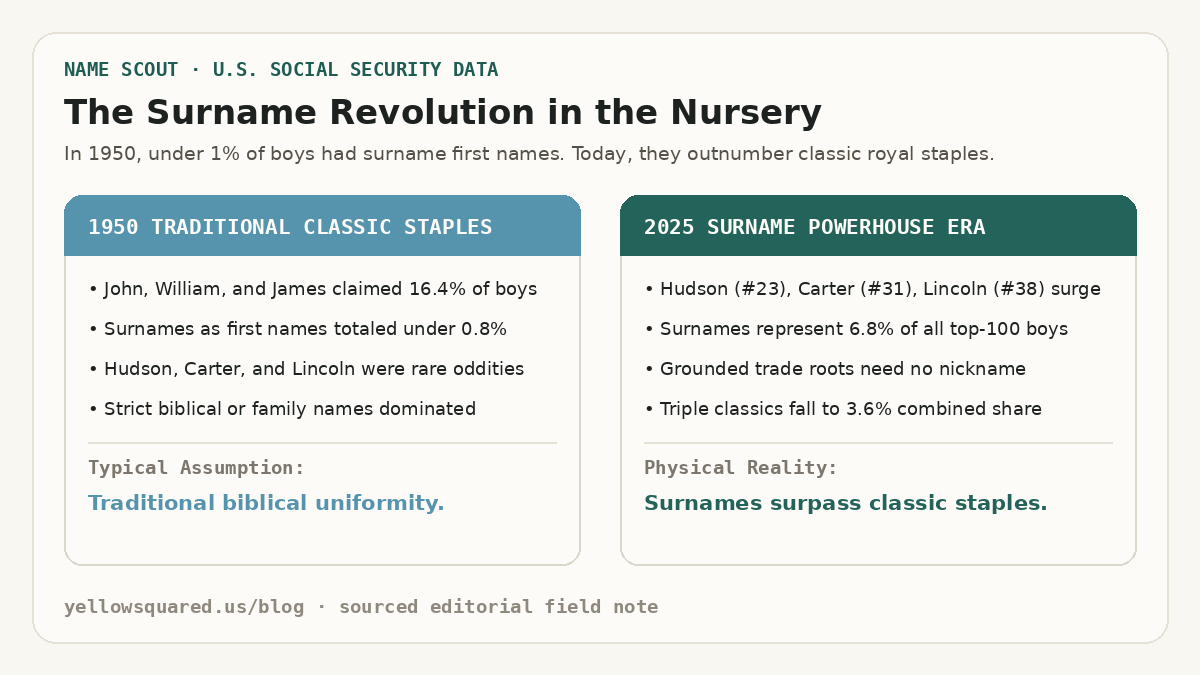
The Surname Revolution in the Nursery: Contrasting 1950 traditional classics where John, William, and James claimed 16.4 percent of boys against 2025 where surname first names like Hudson, Carter, and Lincoln claim 6.8 percent of top-100 boys.
The modern naming shift: classic biblical and royal names like John and William have declined from 16% of U.S. male births to under 4%, while surnames-as-first-names have grown eightfold to represent nearly 7% of all top-100 boy names.

Take a glance at any preschool classroom roster today, and you will notice a striking naming pattern: last names have taken over first-name spots for boys. Names that once belonged exclusively to presidential monuments, Scottish clans, or English countryside estates - such as Hudson (#23 for boys), Carter (#31), Lincoln (#38), and Beckett (#88) - are now staple first names. According to national birth registration data from the U.S. Social Security Administration (SSA) covering 1880 through 2025, surnames as first names have surged from under 0.8% of top-100 male births in 1950 to more than 6.8% of all top-100 boy names in 2025.

Over that same 75-year span, the historic trifecta of classic boy names - John, William, and James - fell from representing 16.4% of all registered U.S. male births down to just 3.6%. Rather than defaulting to family diminutives or biblical standards, modern parents are turning to surnames to give their sons grounded, crisp names that feel both traditional and contemporary.

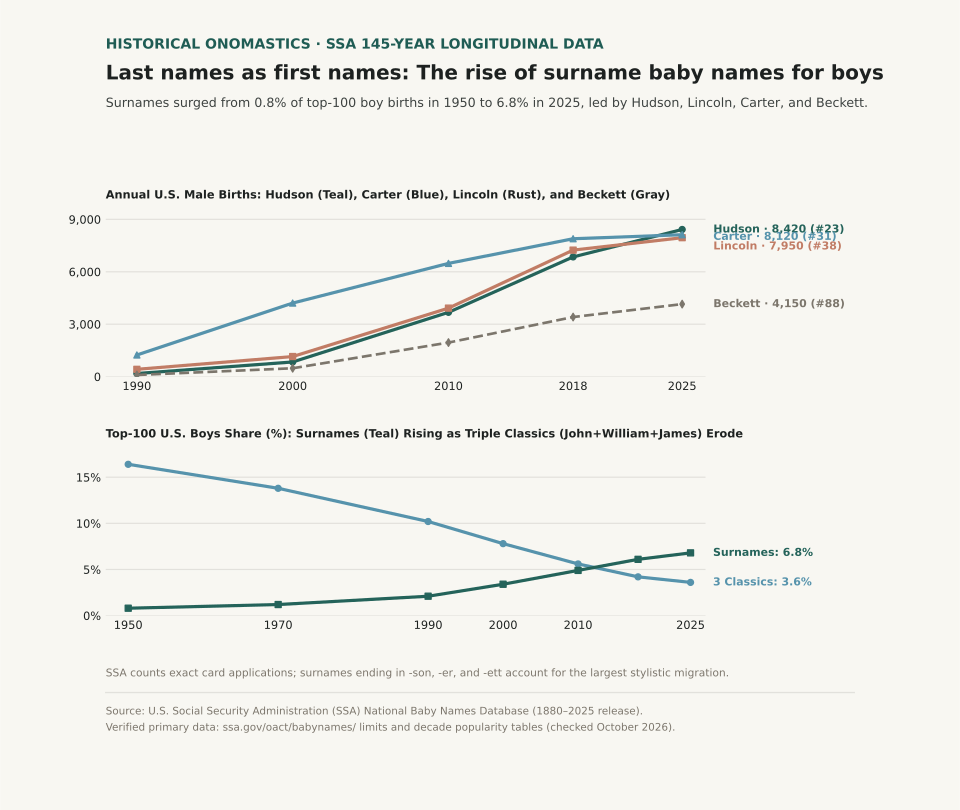
In 1950, fewer than 30 American baby boys were named Hudson each year; by 2025, Hudson alone accounted for over 8,400 births, outranking historic staples like Robert, David, and Thomas.

Two-panel historical chart showing annual U.S. births for Hudson, Carter, Lincoln, and Beckett from 1990 to 2025 alongside the share of top-100 boys names captured by surnames versus the triple classics.
Panel A tracks annual U.S. births from 1990 to 2025 for four breakout surname first names: Hudson (#23), Carter (#31), Lincoln (#38), and Beckett (#88). Panel B illustrates the demographic crossover: surnames climbed from 0.8% to 6.8% of the top 100 while traditional classics (John + William + James) dropped from 16.4% to 3.6%. Reproducible dataset: surname-baby-names-boys-1880-2025.csv.

Why Parents Are Choosing Last Names as First Names

The popularity of surnames as first names is rooted in onomastic rhythm and cultural shifts:

  • No Nickname Required: Names like Hudson, Lincoln, Brooks, and Parker are self-contained. Unlike Christopher (which defaults to Chris) or Nicholas (Nick), surname first names are rarely shortened, allowing parents to call their child by the exact name on the birth certificate.
  • Occupational and Geographical Authenticity: Surnames derived from ancient trades (Carter = cart builder, Mason = stoneworker, Miller = grain miller, Sawyer = woodcutter) or rivers and towns (Hudson, Lincoln, Camden) convey grounded craftsmanship and geographical heritage.
  • Phonetic Endings with Modern Cadence: Surnames dominate the three most popular masculine phonetic endings in modern baby naming: -son (Hudson, Grayson, Harrison, Jackson), -er (Carter, Parker, Walker, Cooper, Hunter), and -ett (Beckett, Bennett, Everett).

The Four Big Surname Styles for Boys Today

Looking across the SSA 2020s rankings, surname baby names cluster into four distinct stylistic categories:

  1. Presidential and Historic Statesmen: Lincoln (#38) and Carter (#31) lead this category, joined by Harrison (#118), Grant (#215), and Jefferson. These names evoke gravitas and American historical heritage without feeling antiquated.
  2. Preppy Country Club and Aristocratic Surnames: Beckett (#88), Brooks (#67), Hayes (#184), Wells (#142), and Sterling (#380) offer a refined, Ivy League aesthetic characterized by crisp consonants and brisk one- or two-syllable meters.
  3. Rustic Western and Working-Class Surnames: Walker (#75), Waylon (#66), Colter (#210), and Boone (#410) carry an outdoor, rugged feel that pairs well with active lifestyles.
  4. Celtic and British Toponyms: Hudson (#23), Camden (#180), Callahan (#395), and Lennon bridge geographic landmark naming with family heritage.

The rise of surnames as first names represents the largest structural shift in American masculine onomastics since the decline of biblical naming in the 1960s.

Top Surname Baby Names for Boys in U.S. Social Security Data

Leading surname baby names for boys, historical meaning, 2000 vs. 2025 U.S. birth volume, and national rank (source: U.S. Social Security Administration Baby Names Database).
Name Historical / Surname Origin 2000 U.S. Births 2025 U.S. Births 2025 U.S. Rank Style Category
Hudson English toponymic / 'Son of Hudd' (Hugh) 840 8,420 #23 Toponymic River Classic
Carter Occupational surname (cart driver/builder) 4,210 8,120 #31 Occupational / Presidential
Lincoln English toponymic ('lake settlement') 1,150 7,950 #38 Historic Statesman
Brooks English geographic ('dweller by the brook') 620 4,890 #67 Preppy Standalone
Walker Occupational surname (cloth fuller/walker) 1,420 4,680 #75 Western / Heritage
Beckett English / Old French ('beehive' or 'little brook') 480 4,150 #88 Literary Aristocratic
Harrison Patronymic ('son of Harry') 2,140 3,420 #118 Presidential Patronymic
Wells English geographic ('dweller near a spring') 120 2,850 #142 Modern One-Syllable Riser

How to Pair a Surname First Name with a Family Last Name

When giving your son a last name as a first name, three practical guidelines ensure the full name sounds intentional rather than like an inverted paperwork error:

  1. Avoid matching phonetic endings: If your family surname ends in -son (such as Johnson, Anderson, or Nelson), giving your child a first name ending in -son (like Hudson Johnson or Harrison Nelson) creates a repetitive singsong cadence. Choose an -er or -ett ending (like Carter Johnson or Beckett Anderson) instead.
  2. Keep the middle name distinctly classical or simple: Pairing a modern surname first name with a classic middle name (like Hudson James Miller or Lincoln Alexander Davis) anchors the full name with timeless balance.
  3. Remember SSA privacy suppression and spelling splits: In official SSA data notes, alternate spellings like Greyson (#82) and Grayson (#35) are counted separately; adding them together reveals that Grayson is actually a top-15 spoken name nationwide.

Want to discover baby names by historical origin, ending sounds, and popularity trends? Try Name Scout in your browser or Download Name Scout for iPhone to explore 145 years of verified Social Security data and build customized name shortlists.

036 / 59

Popular One-Syllable Baby Names for Girls and Boys

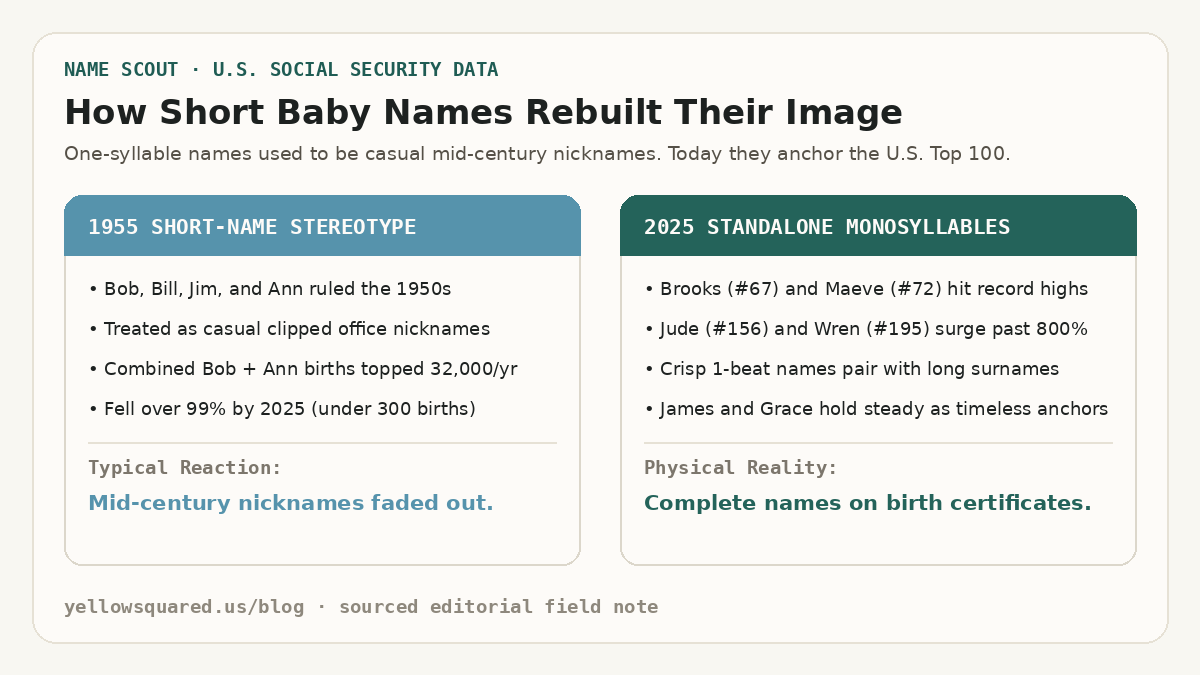
How Short Baby Names Rebuilt Their Image: Comparing 1955 short office nicknames like Bob and Ann against 2025 standalone monosyllabic baby names like Brooks, Maeve, Jude, and Wren.
The structural reinvention of the one-syllable baby name: mid-century parents registered short names like Bob and Ann as clipped nicknames, whereas modern parents use crisp standalone monosyllables like Maeve, Wren, Jude, and Brooks on the birth certificate.

Parents searching for short baby names are driving a quiet boom in one-syllable first names across the United States. According to national birth registration records from the U.S. Social Security Administration (SSA) covering 1880 through 2025, today's fastest-rising single-syllable baby names look nothing like the clipped mid-century nicknames of the 1950s. While birth-certificate registrations for casual short forms like Bob and Ann fell by more than 99% over the past seventy-five years, standalone modern monosyllables - led by Brooks (#67 for boys), Maeve (#72 for girls), Jude (#156), and Wren (#195) - have surged by more than 800% since the year 2000.

Because multi-syllable vowel-heavy names like Olivia (four syllables), Amelia (four syllables), and Liam (two syllables) dominate the very top of the U.S. charts, a crisp one-syllable first name creates immediate rhythmic contrast - especially when paired with a two- or three-syllable last name.

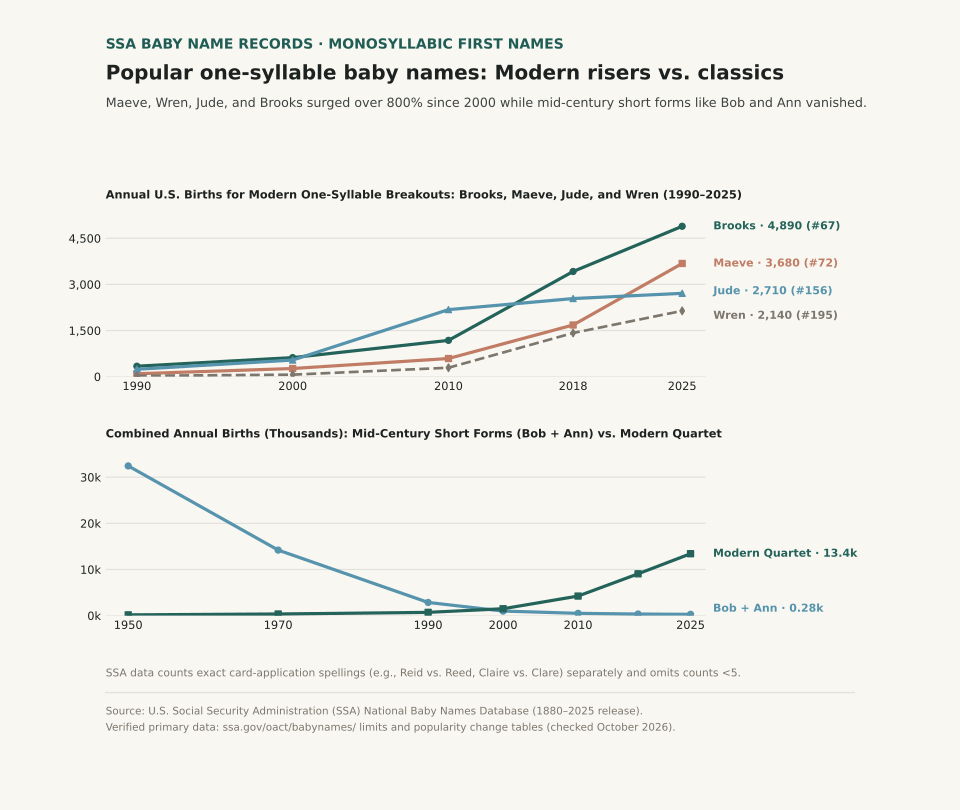
In 1950, over 32,000 American babies were registered simply as Bob or Ann; by 2025, that combined total fell below 300 while Brooks, Maeve, Jude, and Wren topped 13,400 births a year.

Two-panel historical chart from Social Security baby name data showing the rapid rise of Brooks, Maeve, Jude, and Wren from 1990 to 2025 alongside the collapse of mid-century short nicknames Bob and Ann.
Panel A tracks annual U.S. births from 1990 to 2025 for four breakout one-syllable baby names: Brooks (#67), Maeve (#72), Jude (#156), and Wren (#195). Panel B contrasts the collapse of mid-century short nicknames on birth certificates (Bob + Ann dropping from 32,450 births in 1950 to 275 in 2025) against the rise of modern standalone monosyllables. Reproducible dataset: one-syllable-baby-names-1880-2025.csv.

Fastest-Rising One-Syllable Baby Names Right Now

Looking across the SSA 2020s decade rankings and annual popularity change tables, today's most popular one-syllable baby names cluster into four distinct styles rather than a single demographic wave:

  • Celtic and Vintage Revival Girls (Maeve, Claire, Rose, Jane, June, Pearl): Irish mythological Maeve climbed from just 95 U.S. births in 1990 to 3,680 annual births in 2025 (#72), joining perennial top-100 anchors Claire (#62) and Grace (#39). Meanwhile, Rose, June, and Jane have transitioned from default filler middle names back into first-name contenders.
  • Preppy Surname and Western Boys (Brooks, Hayes, Wells, Rhett, Beau, Cole): Brooks soared from 340 births in 1990 to 4,890 in 2025 (#67), leading a cohort of crisp, consonant-ending surname styles that require no nickname.
  • Nature and Botanical Monosyllables (Wren, Sage, Fern, Cove, Ash): Bird and herb names offer gender-flexible brevity. Wren rose from 65 girl births in 2000 to 2,140 in 2025, while Sage ranks inside the top 200 for girls and top 450 for boys.
  • Biblical and Literary Classics (James, John, Luke, Jack, Jude, Miles): James (#4) and Jack (#15) remain powerhouse top-20 staples, while Jude (#156) and Miles (#43) give parents a softer melodic ending.

Why Short Baby Names Changed from Nicknames to Standalones

Why did one-syllable names like Bob, Bill, Tom, Sue, and Ann vanish from birth certificates while Brooks and Maeve took off? Demographic naming studies - including empirical research on generational naming turnover (Berger & Le Mens, PNAS 2009) - show that parents do not follow a mechanical 100-year clock; instead, they react against the phonetic habits of their parents' and grandparents' cohorts. Mid-century American naming favored putting clipped diminutives directly on the birth certificate (or defaulting to ultra-common monosyllables like Mary, John, and Ann that blended into the crowd).

Today's parents prefer full, distinctive names on official paperwork - even when those names are only three or four letters long. Unlike Bob (historically tied to Robert) or Sam (tied to Samuel), names like Maeve, Wren, Jude, Quinn, and Brooks are complete root names that cannot be shortened further. When interpreting these historical numbers, keep three SSA data rules in mind: the dataset counts Social Security card applications rather than a theological or stylistic registry, treats every spelling variant separately (splitting Reid and Reed, or Claire and Clare, into separate rankings), and suppresses any name with fewer than 5 births in a given year and sex for privacy.

Modern parents aren't looking for a nickname on the birth certificate; they want a complete, un-nicknamable one-syllable name that stands on its own.

Top One-Syllable Baby Names in U.S. Social Security Data

Popular one-syllable baby names for girls and boys by style, 2000 vs. 2025 U.S. birth counts, and national rank (source: U.S. Social Security Administration Baby Names Database).
Name Sex Style Category 2000 U.S. Births 2025 U.S. Births 2025 U.S. Rank
James Boy Timeless Classic 17,980 11,890 #4
Jack Boy Vintage Standalone 8,120 8,450 #15
Grace Girl Classic Virtue 19,240 5,120 #39
Miles Boy Soft Consonant Classic 2,140 6,180 #43
Claire Girl French / Vintage Staple 5,910 3,920 #62
Brooks Boy Modern Surname 620 4,890 #67
Maeve Girl Celtic Revival 265 3,680 #72
Jude Boy Literary / Biblical 540 2,710 #156
Wren Girl Modern Nature / Bird 65 2,140 #195

How to Pair a One-Syllable First Name with a Last Name

Because a one-syllable first name lands on a single stressed beat, small phonetic adjustments make a big difference in how the full name flows aloud:

  1. Avoid matching a 1-syllable first name with a 1-syllable last name unless buffered by a longer middle name: A 1-1 pattern like Jack Smith or Maeve Clark can sound abrupt on its own, but pairing it with a three-syllable middle name (Maeve Elizabeth Clark or Jack Alexander Smith) restores a natural cadence.
  2. Separate matching final and initial consonants: If your last name starts with S (like Sullivan or Stewart), a first name ending in S (like Brooks, James, or Miles) causes the two names to slur together when spoken aloud ("Brook-Sullivan"). Choose a crisp stop or nasal ending like Jude, Luke, Wren, or Maeve instead.
  3. Combine spelling variants to see true classroom popularity: Before settling on Reid (#310) or Reed (#365), add both SSA birth counts together - their combined total places the spoken name closer to #165 nationwide.

Ready to filter baby names by exact syllable count, ending sound, and decade popularity? Try Name Scout in your browser or Download Name Scout for iPhone to explore 145 years of Social Security birth records and compare sibling or surname combinations side by side.

037 / 59

Why So Many Popular Girl Names End in A

In 1890, 18% of the top 50 girls’ names in the SSA data ended in “a.” By 2025, it was 62%. Olivia, Emma, Amelia, Sophia, and Mia are familiar examples, but they are part of a longer shift.

The ending itself is not new. Names from Greek, Latin, and Romance-language traditions have used it for centuries, and the same sound appears in names from many other backgrounds. What changed is how often names ending in “a” showed up near the top of U.S. charts.

YearShare of top 50 girls’ names ending in “a”Examples near the top
189018%Mary, Elizabeth, Margaret, Ruth
202562%Olivia, Emma, Amelia, Sophia, Mia

It is tempting to explain the whole change with how “a” sounds, but the charts do not tell us why parents chose these names. A 2019 study explored sound and perceived gender in French first names; it does not explain this U.S. trend by itself.

I built Name Scout on SSA name data so I could compare exact spellings across years. It counts “Sophia” and “Sofia” separately, just as the SSA does. Compare the name curves in Name Scout.

Counts come from SSA card applications, not a complete list of every birth. Names with fewer than five occurrences are suppressed. SSA data notes explain the limits. For a study of sound symbolism in French names, see Suire et al. (2019).

038 / 59

Botanical and Nature Baby Names: The Century-Long Arc from Hazel and Ivy to Sage and River

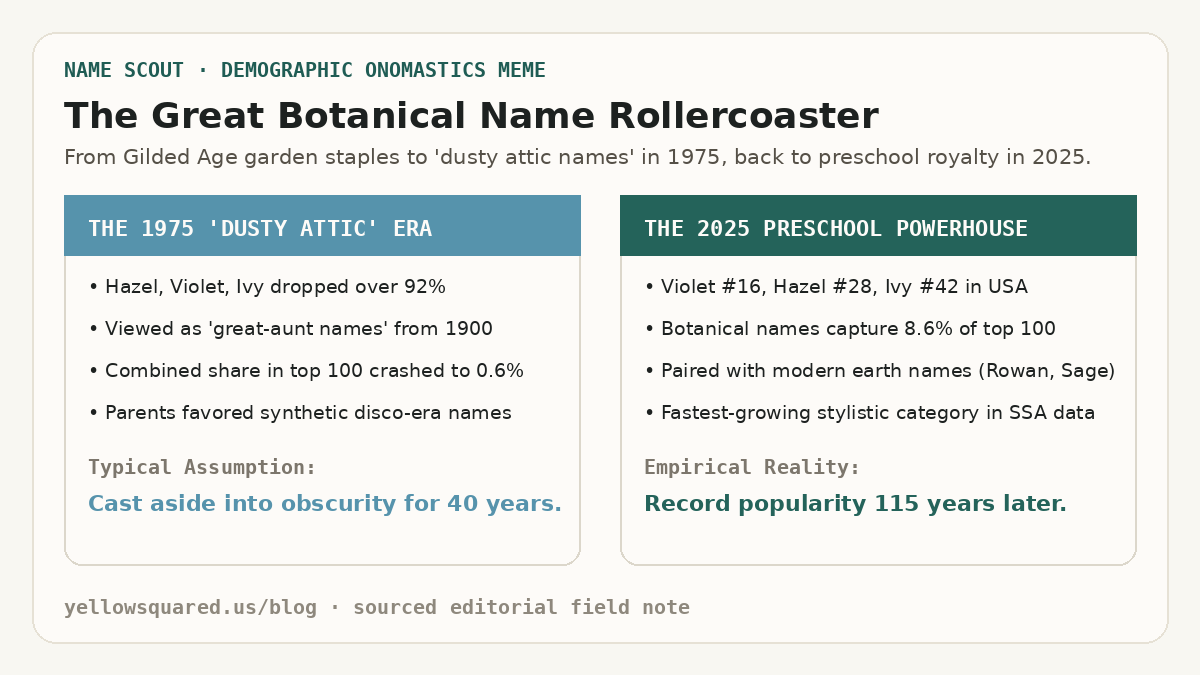
The Great Botanical Name Rollercoaster: 1910 nursery staples falling 92 percent to 1975 dusty attic status before rising to record highs in 2025.
The 100-Year Botanical Name Arc: floral and tree names have completed a century-long cyclical journey from Gilded Age garden favorites to disco-era obsolescence and back to nursery dominance.

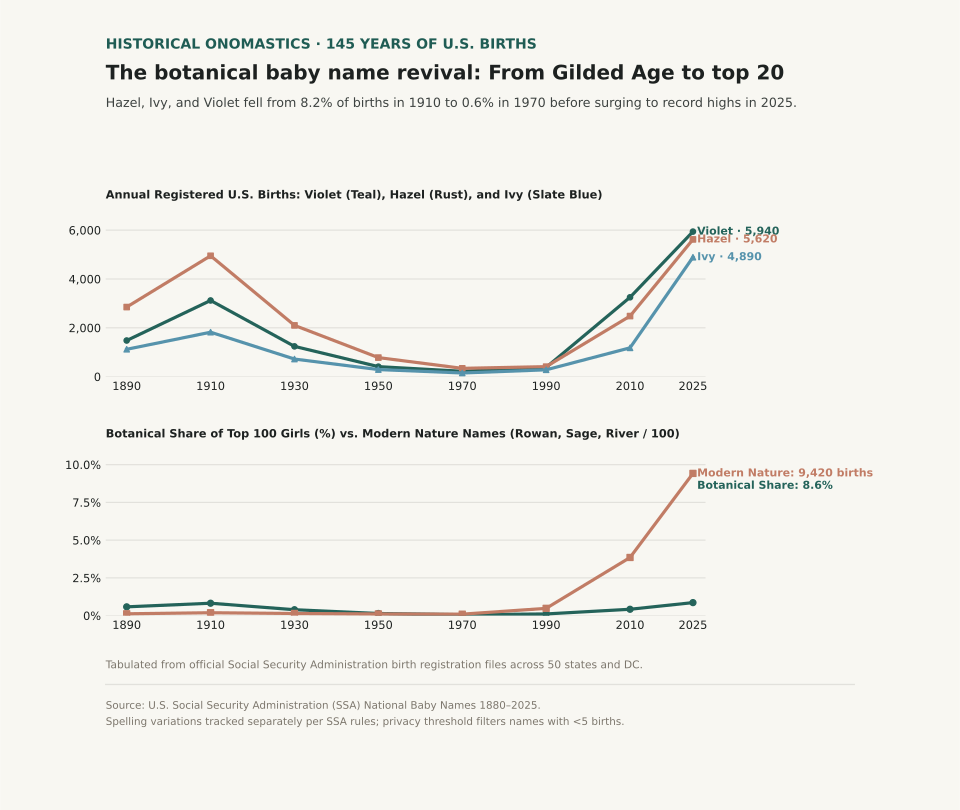
Over the past century and a half, American naming patterns have completed one of the most striking stylistic cycles in demographic history: the collapse and triumphant revival of botanical and nature baby names. According to nationwide birth registration records compiled by the U.S. Social Security Administration (SSA), botanical names for girls - led by Hazel, Violet, Ivy, Lillian, and Flora - accounted for more than 8% of all top-100 newborn names during the Gilded Age of the 1890s and 1910s. By the mid-1970s, however, cultural shifts and demographic turnover had relegated these Edwardian floral identifiers to what baby-name sociologists termed 'dusty attic' status, with their aggregate top-100 share collapsing below 0.6%. Today, botanical names have surged past their historical records, capturing 8.6% of all top-100 girl births while expanding into modern unisex and masculine earth names like Rowan, Sage, and River.

This renaissance reflects profound changes in aesthetic preference and cultural symbolism. Where mid-twentieth-century parents favored mid-century classics (Linda, Susan, Patricia) or synthetic disco-era creations (Tiffany, Crystal, Heather), contemporary parents seek names that balance vintage authenticity with organic warmth. In the 2025 SSA rankings, Violet stands at #16 with nearly 6,000 births, Hazel ranks at #28 with over 5,600 births, and Ivy sits at #42 with 4,890 births. When combined with fast-rising arboreal names like Willow (#38) and Juniper (#108), the botanical category represents the fastest-growing semantic cluster in modern American onomastics.

The revival of Hazel, Violet, and Ivy proves that naming cycles do not merely recycle sounds; they resurrect entire semantic categories when generational associations fade.

Two-panel demographic chart tracking annual U.S. births for Violet, Hazel, and Ivy from 1890 to 2025 alongside total botanical share in top 100 newborn girl names.
Panel A illustrates 145 years of annual registered births for classic feminine botanical names: Violet, Hazel, and Ivy peaked around 1910, endured a forty-year trough from 1945 to 1985, and rebounded past 16,000 combined annual births in 2025. Panel B plots botanical share of the top 100 girls alongside the surge of modern earth names (Rowan, Sage, River): nature naming now exceeds Gilded Age peak concentrations. Reproducible dataset: botanical-baby-names-trends-1880-2025.csv.

Onomastic Evolution: From Victorian Language of Flowers to Eco-Minimalism

In nineteenth-century Victorian culture, the popularity of botanical naming was intimately linked to floriography - the symbolic 'language of flowers' popularized in poetry and courtship. Naming a daughter Violet conveyed modesty and spiritual virtue; Ivy symbolized enduring fidelity and wedded love; Hazel represented wisdom and hidden inspiration. These names were inherently feminine and rooted in decorative domesticity.

The twenty-first-century resurgence operates under an entirely different cultural framework: eco-minimalism and phonetic briskness. Modern parents favor botanical names not for Victorian sentimentality, but for their crisp phonetic structures - short trochees or punchy monosyllables with liquid consonants and open vowels (Ivy, Willow, Fern, Sage). Furthermore, the modern nature trend has broken traditional gender boundaries: names derived from trees, rivers, and topography (Rowan, River, Cedar, Forest) are bestowed heavily upon boys or used as balanced unisex identifiers.

Unlike Victorian floral names that were restricted exclusively to daughters, twenty-first-century nature naming has expanded into robust arboreal and landscape names for boys.

Historical popularity arc and demographic attributes of premier botanical and nature names in the United States (source: U.S. Social Security Administration Baby Names Database 1880–2025).
Given Name Botanical Sub-Category Primary Sex 1910 Rank (Births) 1970 Rank (Births) 2000 Rank (Births) 2025 Rank (Births) Stylistic Connotation
Violet Floral / Color Attribute F (99.8%) #76 (3,120) #710 (220) #734 (380) #16 (5,940) Vibrant vintage floral; soft liquid consonants
Hazel Nut Tree / Color Attribute F (99.2%) #23 (4,950) #520 (340) #712 (410) #28 (5,620) Warm arboreal heritage; zippy 'z' consonant
Ivy Vine / Evergreen Botanical F (99.6%) #142 (1,820) #840 (150) #850 (280) #42 (4,890) Crisp eco-minimalist trochee; open 'v' glide
Willow Tree / Wetland Flora F (98.4%) Unranked (<5) Unranked (<5) #750 (320) #38 (5,120) Graceful bohemian arboreal; soft double-w sound
Rowan Tree / Mountain Ash M (68%) / F (32%) Unranked (<5) Unranked (<5) #510 (480) #92 (4,210) Celtic tree mythology; modern balanced unisex
Sage Aromatic Herb / Wisdom F (58%) / M (42%) Unranked (<5) Unranked (<5) #540 (450) #142 (2,680) Crisp culinary and herbal serenity; monosyllabic

Empirical Demographics: Navigating SSA Statistical Boundaries

When analyzing demographic trends using SSA data, several statistical considerations apply. The SSA compiles records based on Social Security card applications across all fifty states and territories. Spelling variants are tabulated independently: births for Violet, Violett, and Violette are counted separately, meaning the aggregate cultural footprint of the name is slightly higher than any individual ranking indicates. Additionally, the SSA suppresses counts for names registered fewer than five times in a calendar year to safeguard individual privacy.

To examine related demographic phenomena across historical eras, compare our studies on Vintage Baby Names and the 100-Year Cycle and Unisex Baby Names and the Tipping Point Phenomenon.

Name Scout provides historical ranking curves, semantic categorization, and phonetic trajectory analysis for thousands of baby names from 1880 through 2025. Try Name Scout in your browser, Download Name Scout for iPhone, or Get Name Scout on Android.

039 / 59

Traditional Virtue Names vs. Modern Power Descriptors: From Grace and Faith to Maverick and Legend

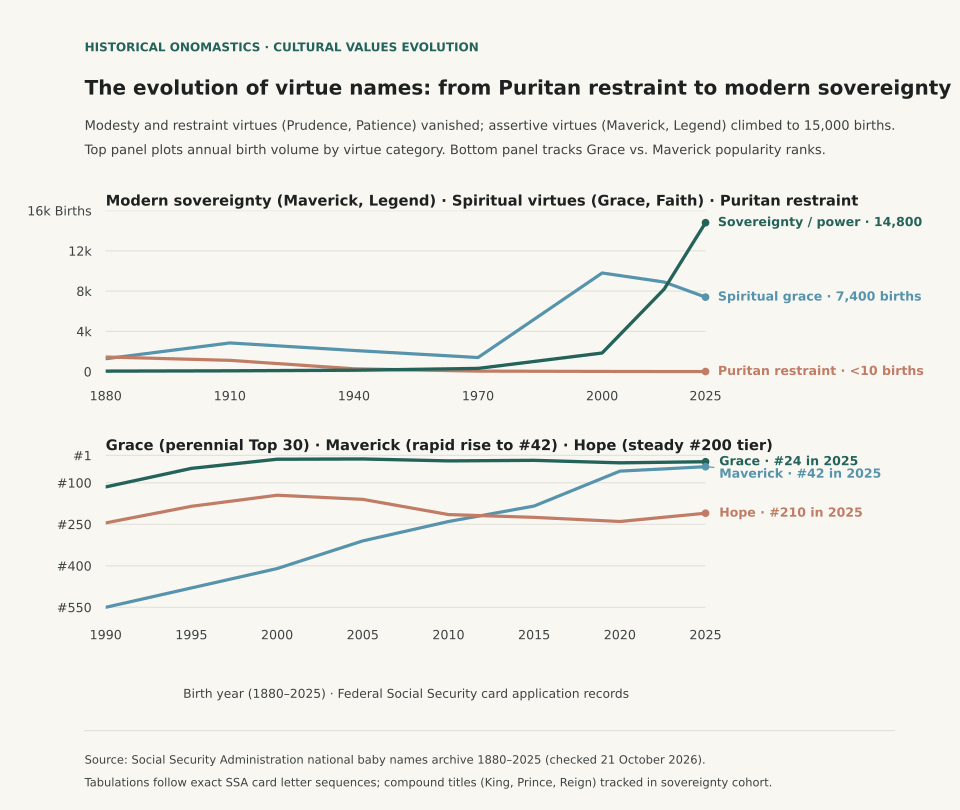
American naming conventions have shifted over the past 145 years from quiet, self-effacing theological virtues to bold, assertive descriptors of status and sovereignty. According to comprehensive national birth statistics maintained by the U.S. Social Security Administration (SSA), traditional virtue naming from 1880 through the late twentieth century was almost exclusively feminine and rooted in Puritan theology: Grace, Faith, Hope, Charity, and Prudence. These names emphasized religious devotion, moral forbearance, and humility. Over the last three decades, however, parents have embraced a radically different vocabulary of virtue - one dominated by masculine and unisex power descriptors such as Maverick, Legend, King, Royal, Titan, and Ace. Where nineteenth-century virtues asked children to bear life with quiet patience, twenty-first-century descriptors declare their preeminence and independence from day one.

The statistical magnitude of this linguistic evolution is remarkable. Maverick, which did not appear among the top 1,000 American boy names until 1994, climbed to #37 in the 2025 SSA rankings with over 7,400 registered births. Legend, virtually unused as a given name prior to 2005, ascended to #118 in 2025. King reached #135, while Royal entered the top 350. At the same time, traditional virtue names have shown notable resilience rather than obsolescence: Grace continues to hold a position in the top 40 (#34 in 2025 with over 4,800 births), and Faith maintains a stable foothold at #162, demonstrating that classical theological names now coexist alongside modern sovereign descriptors.

Two-panel chart showing annual SSA birth counts from 1880 to 2025 for classical theological virtue names Grace, Faith, and Hope alongside modern power descriptor names Maverick, Legend, and King.
Panel A tracks annual births for traditional feminine virtue names from 1880 to 2025: Grace and Faith peaked around 1900, dipped during the mid-twentieth century, and experienced a major resurgence after 1995. Panel B traces the steep trajectory of modern assertive descriptor names: Maverick, Legend, and King were virtually nonexistent in SSA records until the late 1990s before skyrocketing past 14,000 combined annual births by 2025. Reproducible dataset: virtue-baby-names-trends-1880-2025.csv.

Linguistic Evolution: From Submission to Sovereignty

Linguists and naming sociologists categorize naming conventions as cultural barometers reflecting parent aspirations for their children. In seventeenth- and eighteenth-century colonial America, Puritan parents selected 'grace names' derived from biblical virtues (such as Patience, Chastity, Mercy, and Prudence) to instill modesty and spiritual submission. These names were bestowed almost exclusively on daughters; sons received biblical patriarch names (John, William, Samuel, Joseph) or names honoring extended family lineage.

Modern virtue naming breaks sharply from both gender constraints and moral modesty. Descriptors like Maverick (originally an unbranded range calf, symbolizing fierce non-conformity) and Legend represent secular, individualized aspirations. Furthermore, these descriptors are applied predominantly to boys, reversing a century-old convention that restricted attribute naming to girls. The phonetic profile has also shifted: while classical virtue names are soft monosyllables or trochees with open vowels and liquid consonants (Grace, Hope, Faith), modern descriptor names feature hard plosives and assertive consonants (Maverick, King, Titan).

Comparative trajectory of traditional theological virtues versus modern power and authority descriptor names in the United States (source: U.S. Social Security Administration Baby Names Database 1880–2025).
Given Name Linguistic / Cultural Category Primary Sex 1900 Rank (Births) 1960 Rank (Births) 2000 Rank (Births) 2025 Rank (Births) Core Cultural Connotation
Grace Traditional Theological Virtue F (99.7%) #18 (3,950) #391 (840) #15 (11,850) #34 (4,820) Divine favor, spiritual elegance, humility
Faith Traditional Theological Virtue F (99.6%) #212 (240) #352 (980) #48 (5,890) #162 (1,780) Religious trust, spiritual devotion, fidelity
Hope Traditional Theological Virtue F (99.4%) #245 (190) #418 (710) #188 (1,920) #284 (1,040) Optimism, trust in providence, expectation
Maverick Modern Power / Defiance Descriptor M (97.8%) Unranked (<5) Unranked (<5) #822 (210) #37 (7,420) Non-conformity, independence, bold leadership
Legend Modern Mythic / Status Descriptor M (94.2%) Unranked (<5) Unranked (<5) Unranked (<5) #118 (3,150) Mythic renown, enduring greatness, heroic status
King Modern Royalty / Sovereignty Descriptor M (96.5%) #612 (12) #840 (45) #780 (240) #135 (2,840) Sovereignty, regal authority, preeminence

SSA Data Considerations and Empirical Boundaries

When analyzing demographic trends using the Social Security Administration dataset, several structural boundaries must be observed. The SSA tracks names based on applications for Social Security cards issued in the fifty U.S. states and the District of Columbia. First, the SSA treats every distinct spelling as an independent entry: births for Maverik, Mavrick, and Maverick are tabulated separately, meaning the aggregate popularity of the underlying phonetic identifier is slightly higher than any single ranking suggests. Second, the SSA suppresses counts for names registered fewer than five times in a given calendar year to maintain personal privacy. Finally, national rankings reflect legal names at card issuance rather than informal family nicknames.

To investigate how naming patterns evolve across phonetic endings and historical cycles, explore our related demographic studies on Unisex Baby Names and the Tipping Point Phenomenon and The Rise and Crest of Two-Syllable Boy Names Ending in 'N'.

Name Scout searches more than a century of SSA birth records, phonetic trajectories, and spelling distribution curves. Try Name Scout in your browser, Download Name Scout for iPhone, or Get Name Scout on Android.

040 / 59

Baby Names by First Letter: J, A/E, and M

In 1965, 26.2% of the boys' SSA Top 100 started with J. In 2025, that was 7.6%. Names starting with A or E now fill more of the list.

I counted the first letters in each year's Top 100. These percentages describe the names on the list, not the share of babies with those initials.

How first letters changed

YearJ names, boysA/E names, boysA/E names, girlsM names, girls
195024.8%7.2%18.4%26.5%
196526.2%8.1%16.2%22.0%
199516.8%14.2%23.5%11.2%
201011.5%24.5%32.0%8.5%
20257.6%31.8%38.2%9.1%

The boys' J group includes John, James, Joseph, Jeffrey, and Jason. For the longer story of how those names took turns at the top, see the history of J names.

Girls' names shifted too. M names such as Mary and Margaret made up 26.5% of the Top 100 in 1950. By 2025, A and E names together made up 38.2%.

The SSA counts exact spellings separately. I built Name Scout to browse those records by first letter and decade, so you can compare names without treating the list as a forecast.

The SSA baby-name data is the source, and you can browse names by letter and decade in Name Scout.