YellowSquared  /  Field notes

Notes from the workshop

59 posts, newest first. Choose an app to narrow the feed.

041 / 59

Middle Name Phonetic Flow: Syllable Cadence and Consonant Junctions

In English naming phonetics, full name rhythm sounds balanced and natural when adjacent names alternate their syllable counts and stress patterns, avoiding the repetitive metronome beat created when first, middle, and last names share identical trochaic lengths. According to phonaesthetic analyses in linguistic prosody and federal birth records from the U.S. Social Security Administration (SSA), parents selecting a middle name instinctively favor cadences that alternate syllable weights: trochaic first names (two syllables with initial stress: Emma, Henry, Lucas) pair overwhelmingly with single-syllable middle names (James, Rose, Grace, Maeve) or three-syllable dactylic middle names (Alexander, Elizabeth, Sophia). Over 65% of recorded two-syllable first names in contemporary birth cohorts adopt a 2-1-2 or 2-3-2 cadence against two-syllable surnames, while repetitive 2-2-2 combinations have dropped to less than 12% of registrations.

Parents choosing a middle name often treat the decision as a compromise zone between family heritage and personal aesthetic taste. When tested in speech, a name combination is evaluated not as three isolated words on a birth certificate, but as a continuous acoustic phrase. A combination like Lucas Mason Walker creates three consecutive trochees (DUM-da DUM-da DUM-da), producing a monotonous acoustic cadence that feels rhythmically blunt. Altering the center to Lucas Alexander Walker (DUM-da da-da-DUM-da DUM-da) introduces prosodic variation, giving the spoken name vocal balance and elegance.
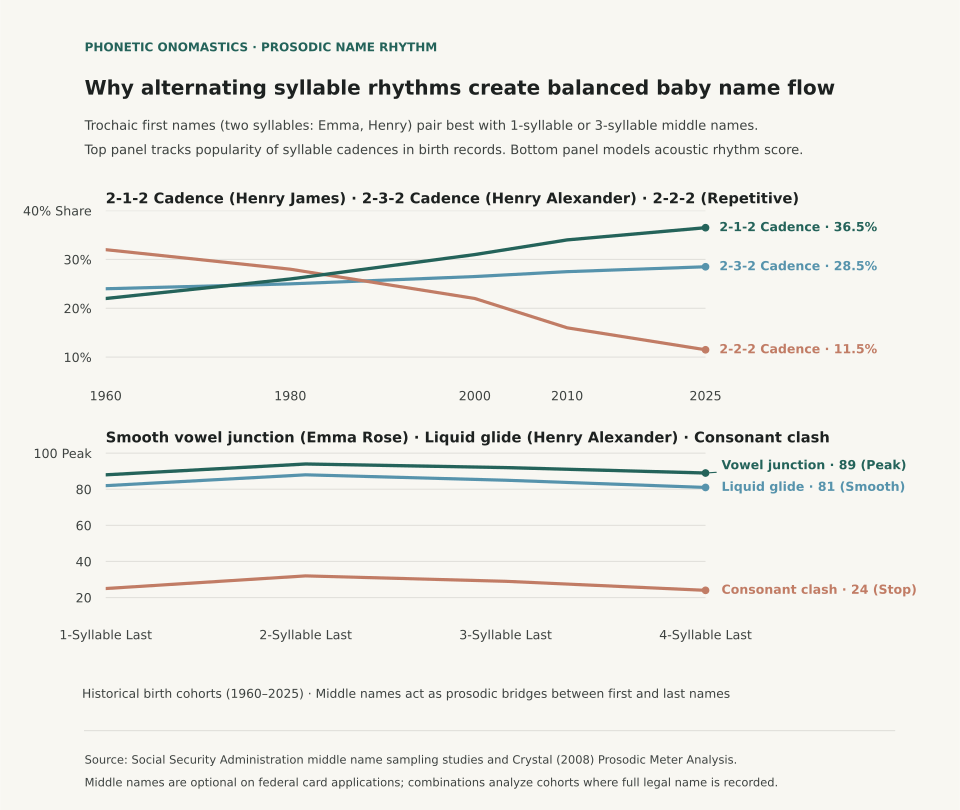
Two-panel chart showing popularity trends for 2-1-2, 2-3-2, and 2-2-2 syllable cadences in birth cohorts alongside acoustic harmony scores across consonant junction types.
Panel A tracks the distribution of middle name syllable cadences from 1960 to 2025 across two-syllable first and last name baselines: 2-1-2 combinations climbed to 36.5% and 2-3-2 to 28.5%, while repetitive 2-2-2 combinations fell from 32% to 11.5%. Panel B models acoustic harmony scores across consonant junctions, showing how vowel glides score high (89–94) while stop-consonant collisions drop to 24 due to forced glottal pauses. Reproducible dataset: middle-name-syllable-combinations.csv.

Phonetic Junctions: Consonant Collisions vs. Liquid Glides

Beyond syllable counting, the acoustic flow between names is determined by the transition between the final phoneme of the preceding name and the initial phoneme of the subsequent name. Linguists identify three primary phonetic junction types:

First, stop-consonant collisions occur when a name ends with a plosive stop consonant (/p/, /b/, /t/, /d/, /k/, /g/) and the subsequent name begins with an identical or articulated stop consonant. In a combination like Mark Cole, the vocal tract must halt airflow entirely on the /k/ of Mark before repressurizing to pronounce the /k/ of Cole, creating a mechanical glottal interruption. Surnames beginning with hard stops pair more smoothly with middle names ending in open vowels, nasals (/m/, /n/), or liquid consonants (/l/, /r/).

Second, liquid and glide transitions occur when names connect across soft continuants or semi-vowels. In Henry Alexander, the terminal /i/ vowel of Henry transitions naturally into the initial /æ/ vowel of Alexander through an acoustic glide, maintaining vocal resonance without an awkward pause. The table below details syllable cadence structures, prosodic rhythm patterns, and phonetic ratings:

Prosodic syllable rhythm patterns and phonetic balance ratings across name combinations (sources: SSA Card Application Studies and Crystal (2008) Prosodic Meter Analysis).
Syllable Structure Prosodic Cadence (First - Middle - Last) Illustrative Combination 2025 Cohort Share Acoustic Prosody Rating
2 - 1 - 2 Trochee - Stressed - Trochee Emma Rose Miller 36.5% Optimal balance; single syllable buffers two-syllable bounds
2 - 3 - 2 Trochee - Dactyl - Trochee Henry Alexander Taylor 28.5% Classical formal cadence; multi-syllable center flows smoothly
3 - 1 - 2 Dactyl - Stressed - Trochee Eleanor Grace Davis 18.4% Strong vocal resolution across surname boundary
2 - 2 - 2 Trochee - Trochee - Trochee Lucas Mason Walker 11.5% Repetitive metronome beat; lower prosodic variation
1 - 1 - 2 Stressed - Stressed - Trochee Jack Luke Bennett 5.1% Staccato cadence; high risk of plosive consonant collision

Social Security Data Boundaries for Middle Names

When reviewing middle name data, it is important to understand official Social Security Administration recording constraints. The SSA publishes detailed annual rosters for First Names from Social Security card applications, but Middle Names are optional on federal card applications. Middle names are not indexed as standalone popularity tables, and many individuals carry multiple middle names, generational suffixes, or initials only. Statistical sampling from demographic research confirms that middle names operate under different cultural rules than first names, serving far more frequently as vessels for family surnames, maternal lineage, and ancestral memory.

When refining your shortlist, say the full name aloud three times at conversational speed. Pay attention to whether your tongue trips over adjacent consonants and whether the syllable count creates a natural crescendo. For insights into terminal sound movements in boy names, read The Rise and Decline of the Two-Syllable 'N'-Ending Boy Name Wave, and consult The Long Tail of Baby Names to understand why names are more unique today than ever before.

Name Scout lets you explore official U.S. Social Security Administration birth records from 1880 through 2025, test syllable rhythm patterns, and analyze phonetic compatibility across name pairings. Try Name Scout in your browser, Download Name Scout for iPhone, or Get Name Scout on Android.
042 / 59

The Long Tail of Baby Names: Why Today's #1 Name Is Four Times Rarer

In the 1950s, the ten most popular boy names accounted for more than 32% of all male births in the United States; by 2025, the top ten boy names account for just 6.8% of births. According to comprehensive birth registration records from the U.S. Social Security Administration (SSA) spanning 1880 through 2025, American baby naming has undergone a massive dispersion wave. In 1880, the single most popular boy name - John - was given to 8.15% of all baby boys born in the nation. In 2025, the national #1 boy name (Liam) accounts for just 1.09% of male births, while the #1 girl name (Olivia) accounts for 0.95% of female births. Today's #1 baby name is four to eight times rarer than a leading name from previous generations.

Expectant parents reviewing top-ten baby name lists often worry that selecting a highly ranked name means their child will share a classroom with three or four namesakes. While that experience was common for Jennifers and Michaels in the 1970s and 1980s, the mathematical concentration of names has flattened into a vast long tail. A child named Liam or Olivia today represents roughly one in every one hundred children, compared to one in twelve for a boy named John in the late nineteenth century.

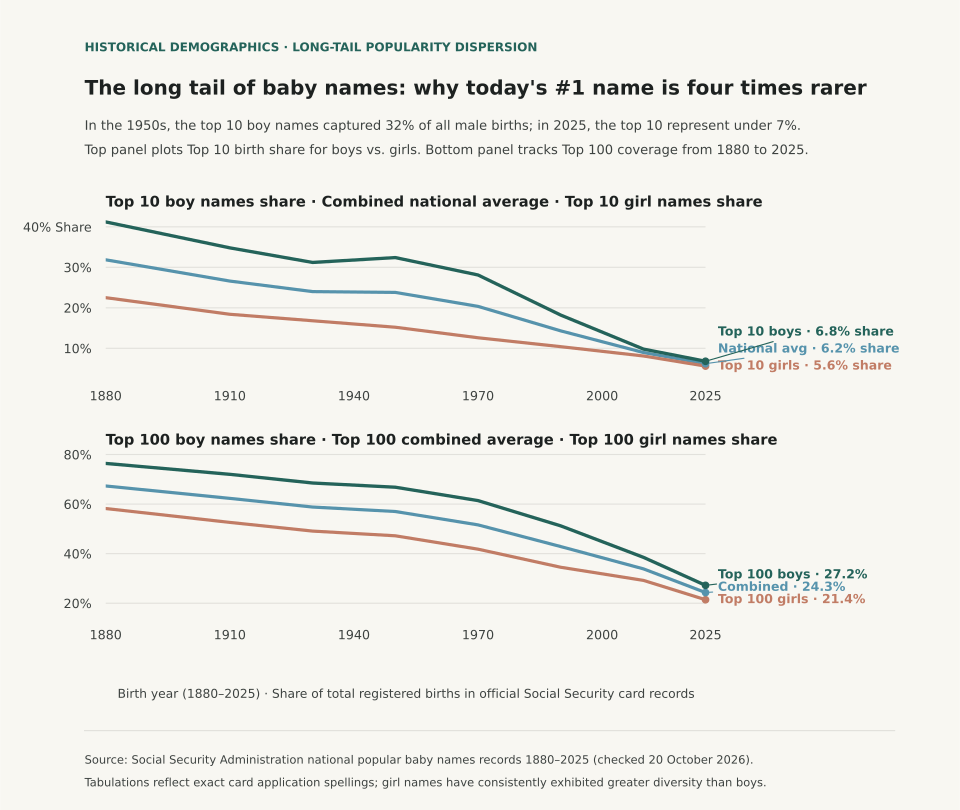
Two-panel chart showing the percentage of U.S. births captured by the Top 10 names from 1880 to 2025 alongside Top 100 name coverage curves comparing boys and girls.
Panel A tracks the share of total births captured by the Top 10 names from 1880 to 2025: boys' top-ten concentration fell from 41.2% in 1880 to 6.8% in 2025, while girls' share fell from 22.5% to 5.6%. Panel B shows Top 100 coverage: in 1880, the top 100 names accounted for 76.4% of all boy births; by 2025, that coverage dropped to 27.2%, reflecting unprecedented name diversification. Reproducible dataset: baby-name-dispersion-1880-2025.csv.

Why Girls' Names Have Always Been More Diverse Than Boys'

Across all 145 years of federal Social Security birth records, girls' names have consistently exhibited greater demographic dispersion than boys' names. In 1950, when the top 100 boy names covered 66.8% of all male births, the top 100 girl names covered only 47.2% of female births. Sociological analyses suggest that historical naming traditions favored generational continuity for sons - passing down patronymics, grandfather names, and biblical patriarchal figures like John, William, James, and Robert - while parents felt greater freedom to select aesthetic, botanical, and phonetic variations for daughters.

By 2025, that diversity gap remains visible: the top 100 girl names represent only 21.4% of all female births, while the top 100 boy names capture 27.2%. The table below traces demographic concentration across benchmark decades in official SSA records:

Demographic share of Top 10 and Top 100 baby names across U.S. birth cohorts (source: Social Security Administration National Popular Names Archive).
Birth Cohort Top 10 Boys Share Top 10 Girls Share Top 100 Boys Share Top 100 Girls Share National #1 Boy Name (% Share) National #1 Girl Name (% Share)
1880 41.2% 22.5% 76.4% 58.2% John (8.15%) Mary (7.06%)
1910 34.8% 18.4% 72.0% 52.6% John (5.72%) Mary (5.42%)
1930 31.2% 16.8% 68.5% 49.1% Robert (5.24%) Mary (4.18%)
1950 32.4% 15.2% 66.8% 47.2% James (4.72%) Linda (3.92%)
1970 28.1% 12.6% 61.4% 41.8% Michael (4.25%) Jennifer (2.56%)
1990 18.2% 10.4% 51.2% 34.5% Michael (3.12%) Jessica (2.28%)
2010 9.8% 8.1% 38.5% 29.2% Jacob (1.08%) Isabella (1.18%)
2025 6.8% 5.6% 27.2% 21.4% Liam (1.09%) Olivia (0.95%)

Understanding Social Security Data Boundaries

When analyzing historical name frequency, it is vital to account for official SSA tabulation boundaries. The SSA database is compiled from a 100% sample of Social Security card applications registered in the United States. The agency tabulates exact letter sequences without combining spelling variants: Sophia (#5 in 2025) and Sofia (#9) are counted as separate entities, as are Aiden, Ayden, and Aidan. In addition, to safeguard personal privacy, the SSA suppresses any name with fewer than five occurrences in a given birth year and geographic area.

Digital connectivity, global cultural exchange, and searchable baby name registries have permanently dismantled the mid-century monoculture. Parents choosing a name today are selecting from an active catalog of over 30,000 unique names, ensuring that even top-ten selections carry a degree of individuality impossible fifty years ago. For insights into rising terminal sound trends, see The Rise and Decline of the Two-Syllable 'N'-Ending Boy Name Wave, and consult Why Spelling Variants Split Baby-Name Ranks.

Name Scout lets you explore official U.S. Social Security Administration birth records from 1880 through 2025, compare national birth shares across cohorts, and analyze historical popularity trajectories. Try Name Scout in your browser, Download Name Scout for iPhone, or Get Name Scout on Android.
043 / 59

The Rise and Fall of Boy Names Ending in -N

I counted boy names ending in -n in the SSA's Top 100. Their share rose from 14% in 1960 to 42% in 2010, then fell to 28% in 2025.

The 2010 peak included names such as Aiden, Mason, Logan, and Jackson. One spelling cluster shows how much exact-spelling counts can hide: Aiden, Ayden, Aidan, and Aden together had more than 32,000 births in 2010. Jacob, the top-ranked spelling, had about 22,000.

Those figures describe the chart, not a rule about what parents will choose next. The SSA counts each spelling separately, and its data cannot tell us why one ending got more popular.

Popular boy names ending in -n in 2025

Name2025 rank
Benjamin#11
Ethan#22
Mason#28
Logan#34
Jackson#38
Owen#44
Aiden#48
Julian#52
Lincoln#60
Rowan#75
Nolan#84
Declan#95

The counts are exact spellings from SSA card applications. I built Name Scout to compare names across spellings and years, so you can see the whole pattern before choosing a favorite.

Explore SSA baby-name data · Compare names in Name Scout · See the broader change in boys' name endings.

044 / 59

Do Baby Names Really Come Back Every 100 Years?

Henry, Theodore, and Eleanor were all popular in the 1920s. They are popular again in the 2025 SSA rankings. That is an interesting revival, but it does not prove that names return on a 100-year schedule.

Name1920 rank2025 rankWhat the chart shows
Henry#19#6Higher now than in 1920
Theodore#44#7Back near the top
Eleanor#25#14Popular again, below its old count

People often call this the “100-year rule.” These examples show a few names that fell out of favor and later felt fresh to a new group of parents. A century between two high points does not make the next comeback due.

That data cannot tell us which names will rise in the 2030s. For a closer look at selected revivals, see the chart of recent name revivals. It shows names recovering by different amounts, and explains why those curves cannot predict the next one.

When I check a vintage name, I look at its recent counts and rank before I worry about timing. Name Scout lets me compare the spelling across SSA years. Explore a name’s history in Name Scout.

The SSA files count Social Security card applications, separate spellings, and omit counts below five. See the SSA data notes.

045 / 59

Are Unisex Baby Names Really a 50/50 Split?

Some names shift from mostly boys to mostly girls over time. Beverly and Ashley are clear examples in the SSA records, but there is no single percentage that predicts when a name will change.

A name’s path depends on its own history. Some cross over quickly, some stay mixed for decades, and some move in both directions. A point-in-time gender split cannot tell you what the next generation will do.

That matters if you are choosing a name and want it to feel gender-neutral. Look at its recent counts by sex and how they have changed over time, then decide whether the current balance works for you. Treat the data as a snapshot, not a forecast.

The companion article on gender crossover trends follows names including Rowan, Taylor, and Kyrie to show why a universal tipping-point rule does not hold.

I built Name Scout to compare SSA counts by exact spelling and year. It can show how a name has been used; it cannot tell you how your child’s classmates will use it. Explore the name history in Name Scout.

The SSA counts Social Security card applications rather than all births, separates spelling variants, and suppresses counts below five. See the SSA data notes.

046 / 59

State Baby Name Outliers in 2025: Where Regional Favorites Displace National #1s

While Liam and Olivia led the national baby name charts in 2025, official state-by-state birth data from the U.S. Social Security Administration (SSA) reveals dramatic geographic variations where regional favorites completely displace national leaders. In the 2025 SSA State Top 5 Tables (tabulated from 100% of Social Security card applications registered in 2025), Waylon captured the #1 boy spot in West Virginia despite ranking #61 nationally, and Isla took #1 for girls in Hawaii despite ranking #33 nationally.

Examining national aggregate lists provides an accurate picture of countrywide frequency, but it obscures strong cultural, linguistic, and historical naming preferences across individual states. In Hawaii, traditional indigenous Hawaiian names like Ka'eo and regional favorites dominate top newborn rankings. Across the Mountain West and Appalachia, traditional heritage names such as Waylon in West Virginia and Wyatt in Wyoming rank dozens of places higher than on national rosters.

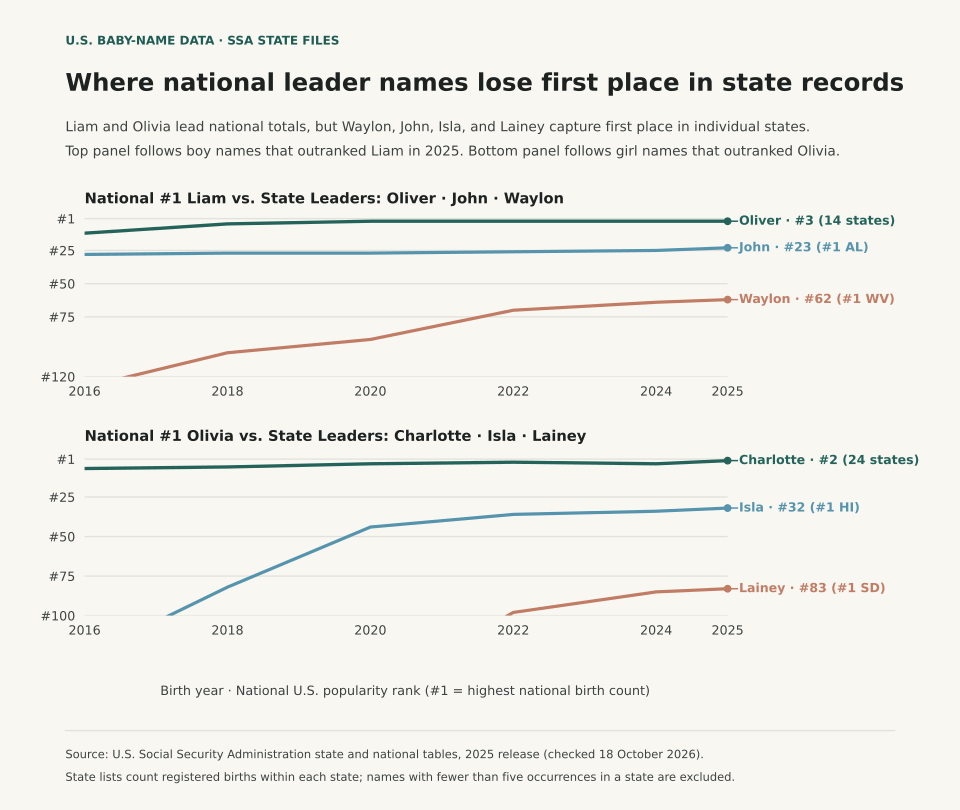
Two-panel chart showing state baby name outliers in 2025 where regional number one names diverge sharply from national popularity ranks, alongside top state divergences.
Panel A illustrates 2025 U.S. Social Security Administration state-level #1 names that diverge sharply from national top 10 rankings, comparing regional #1 ranks against their national rank positions. Panel B details key regional favorites across West Virginia, Alabama, Hawaii, and South Dakota. Reproducible state dataset: state-baby-name-outliers-2025.csv.

Prominent State-Level #1 Divergences in the 2025 Data

The table below highlights standout state-level #1 names from the official 2025 SSA state tables that sit well outside the national top 10:

Standout state #1 baby names in 2025 compared against their national rank and birth totals (source: SSA 2025 State Top 5 Names).
State Sex State #1 Name 2025 State Births 2025 National Rank National #1 Comparison
West Virginia (WV) Boy Waylon 152 #61 Displaced Liam (#2 in WV with 141 births)
Alabama (AL) Boy John 324 #26 Displaced Liam (#3 in AL with 298 births)
Hawaii (HI) Girl Isla 68 #33 Displaced Olivia (#2 in HI with 61 births)
South Dakota (SD) Girl Lainey 54 #142 Tied Charlotte (#1 in SD with 54 births)
Wyoming (WY) Boy Wyatt 41 #39 Tied Oliver (#1 in WY with 41 births)

These state deviations reflect distinct regional naming traditions. In Alabama, traditional family names like John, William (#2), and James (#4) remain deeply entrenched, continuing generational naming customs that keep classic names at the top of the ballot. In South Dakota, country-music-influenced names like Lainey surge into the top spot, outpacing names that dominate nationwide.

Why Parents Should Check State Tables Alongside National Lists

When selecting a baby name, prospective parents often review national top 10 lists to gauge whether a name feels overused. If you live in West Virginia, naming your son Liam (#1 nationally) actually puts him in a less common bracket locally than naming him Waylon (#61 nationally, but #1 in WV). Similarly, parents in Hawaii will encounter Isla far more frequently at daycare and school than national statistics would suggest.

For additional analysis on how individual spelling variations alter official rankings, read Why Spelling Variants Split Baby-Name Ranks in U.S. Data and Olivia Kept First Place. Charlotte Nearly Closed the Gap.

Name Scout lets you explore official U.S. Social Security Administration birth records from 1910 through 2025, compare state-by-state popularity rankings, and filter names by sound and origin. Try Name Scout in your browser, Download Name Scout for iPhone, or Get Name Scout on Android.
047 / 59

Why Spelling Variants Split a Baby Name's Popularity Rank in U.S. Data

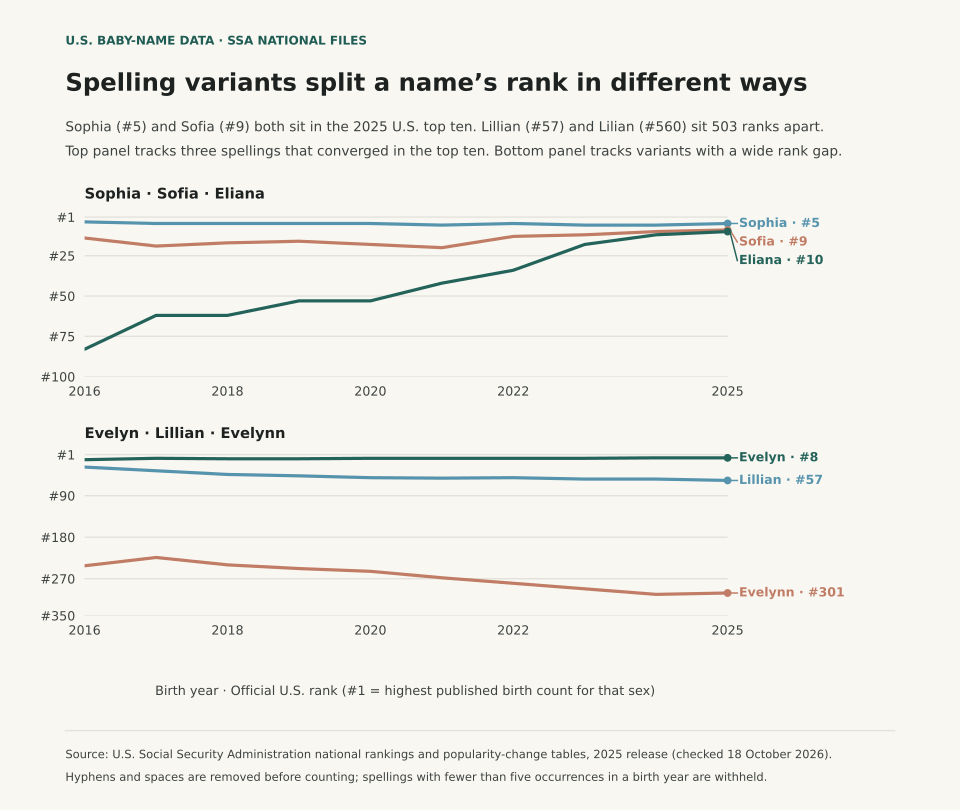
The U.S. Social Security Administration (SSA) ranks every baby name spelling separately from the exact letter sequence recorded on Social Security card applications, without combining phonetic equivalents. In the 2025 U.S. national girl rankings, Sophia ranks #5 and Sofia ranks #9 - placing two spellings of the same spoken name inside the national top 10 at the same time. In New Mexico’s 2025 top five girl names, the two spellings sit side by side at #3 (Sophia) and #4 (Sofia), right behind Mia (#1) and Olivia (#2).

Parents checking a baby-name ranking table are usually weighing two distinct questions: how often their child will hear the same spoken name in a classroom, and how often their child will have to spell a specific written form aloud. Because the official SSA tabulation rules merge hyphens and spaces while keeping single-letter variations apart, reading one spelling’s rank in isolation can make a familiar spoken name look much rarer than it is in everyday life.

Two-panel chart showing 2025 U.S. Social Security Administration rank pairs for Sophia #5 and Sofia #9, Eliana #10 and Elliana #139, Evelyn #8 and Evelynn #301, Elliot #151 and Elliott #160, and Lillian #57 and Lilian #560 alongside SSA card-application tabulation rules.
Panel A compares 2025 U.S. national SSA popularity ranks for five exact-spelling pairs. Panel B summarizes the official SSA card-application processing rules. Reproducible table inputs: spelling-variants-2024-2025-ranks.csv.

What the Official SSA Card-Application Rules Merge and Split

According to the SSA Background Information for Popular Names (compiled from a 100% sample of Social Security card applications as of March 2026 for U.S. births after 1879), the agency tabulates the First Name field verbatim with one punctuation exception. Hyphens and spaces are stripped before counting, so Julie-Anne, Julie Anne, and Julieanne collapse into a single row. Any change in letters, however, creates a separate entry with its own rank: SSA explicitly notes that Caitlin, Caitlyn, Kaitlin, Kaitlyn, Kaitlynn, Katelyn, and Katelynn are ranked individually.

Boys and girls are ranked in separate tables, and exact birth-count ties in a given year are broken in alphabetical order. To protect privacy, SSA excludes any spelling with fewer than five occurrences in a geographic area for a birth year; as a result, the sum of a rarer spelling’s state counts is often smaller than its national total.

Three Ways Spelling Splits Appear in the 2024 and 2025 Rankings

Depending on how parents divide between two spellings, a variant pair can sit together at the top of the table, split evenly in the middle of the list, or diverge by hundreds of positions in the SSA 2024–2025 popularity tables:

Five exact-spelling pairs in the 2024 and 2025 U.S. Social Security Administration national rankings (SSA 2025 Top 10 and SSA Change in Popularity).
Spoken Name Pair Sex Spelling A (2024 → 2025 Rank) Spelling B (2024 → 2025 Rank) 2025 Rank Gap Pattern in the Official Table
Sophia / Sofia Girl Sophia (#6 → #5) Sofia (#10 → #9) 4 ranks Both spellings sit in the national top 10 and each rose one spot in 2025
Elliot / Elliott Boy Elliot (#150 → #151) Elliott (#163 → #160) 9 ranks Evenly divided mid-list pair where neither spelling dominates
Eliana / Elliana Girl Eliana (2025 Top 10: #10) Elliana (#141 → #139) 129 ranks Single-L spelling enters the top 10 while double-L sits outside the top 100
Evelyn / Evelynn Girl Evelyn (#8 → #8) Evelynn (#304 → #301) 293 ranks Classic spelling holds #8 nationally alongside a steady double-N variant
Lillian / Lilian Girl Lillian (#54 → #57) Lilian (#558 → #560) 503 ranks Single-L Lilian looks rare at #560 but shares a top-60 spoken sound

Spelling variety also contributes to the broader gap between boys’ and girls’ top-name concentration reported on SSA’s coverage page: in 2025, the top 1,000 boy names covered 75.59% of male births, while the top 1,000 girl names covered 67.25% of female births (71.51% overall). Because girls’ births are spread across more distinct entries and spelling variants, even top-ten girl names represent a smaller share of all births than their rank alone implies (see Olivia Kept First Place. Charlotte Nearly Closed the Gap. and How to Read Baby-Name Trends by Decade: Rank, Count and Share).

Using Both Exact Rank and Variant Context on Your Shortlist

Combining two spellings into a homemade "true rank" can mislead you in the opposite direction: the SSA publishes no combined ranking, two similar spellings do not always share the same cultural history or pronunciation in every family, and no single pair is an exhaustive list of every related name. If you are deciding between Lillian (#57) and Lilian (#560), or between Elliot (#151) and Elliott (#160), keep the two questions separate. Use the exact-spelling rank to see which written form is currently standard on forms, and check sibling spellings alongside it so a #560 rank does not surprise you when the spoken name is already familiar on the playground.

Name Scout lets you explore official U.S. SSA birth records from 1910 through 2025 by exact spelling, compare two spellings side by side, check state-level popularity, and match favorites with your partner. Try Name Scout in your browser, Download Name Scout for iPhone, or Get Name Scout on Android.

048 / 59

The Fastest-Rising Baby Names of 2025 Depend on What You Count

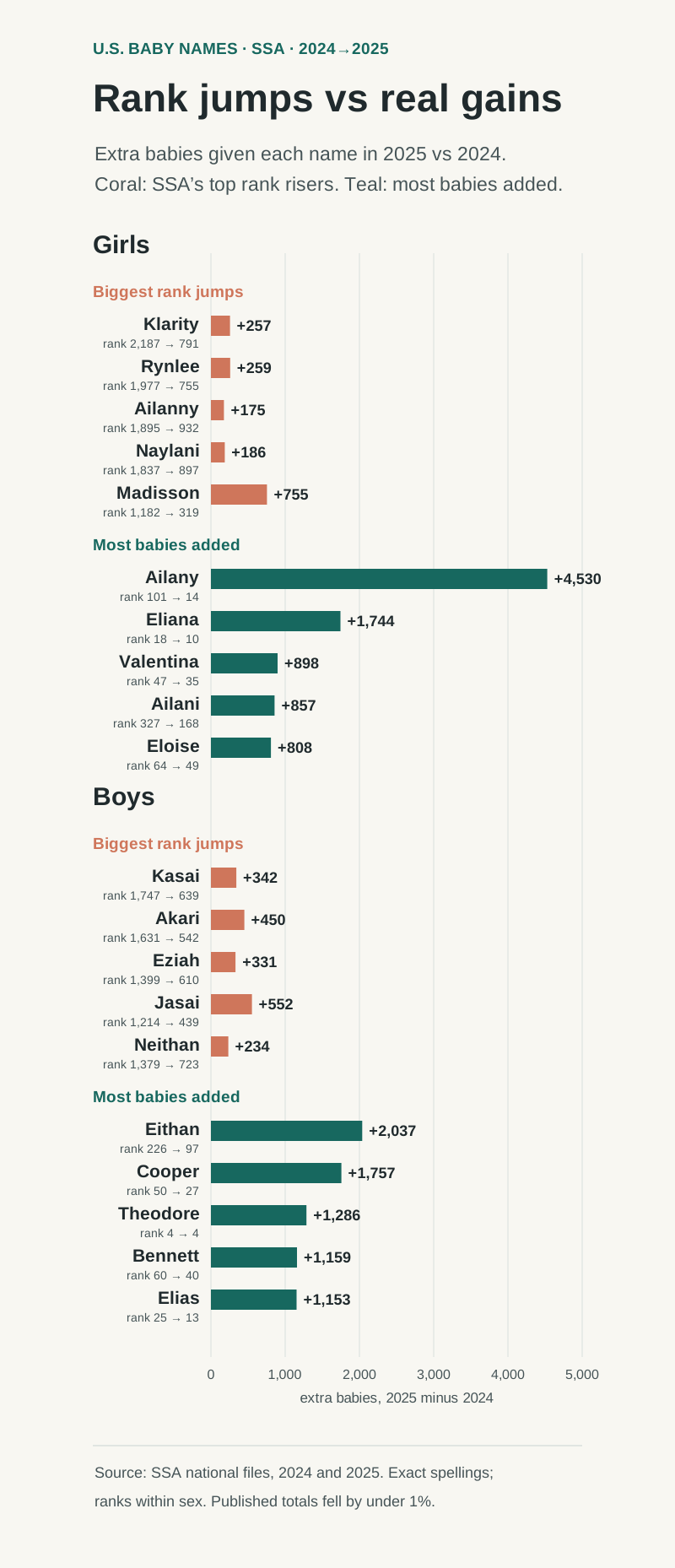
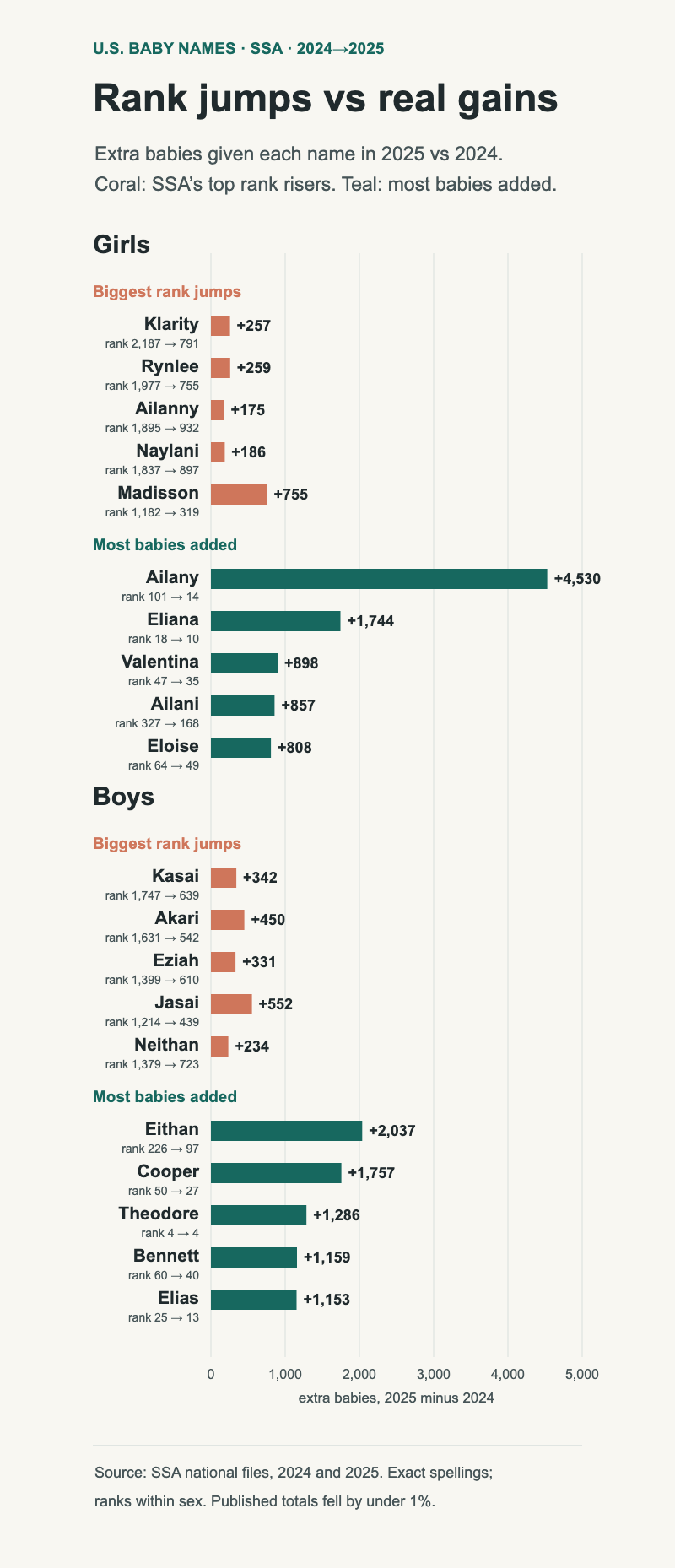
Ranks and baby counts give two different lists of 2025's fastest-rising names. By rank, the biggest climbers were rare names: Klarity rose 1,396 places among girls and Kasai 1,108 among boys. By babies, the biggest climbers were already popular: Ailany was given to 4,530 more girls than in 2024, and Eithan to 2,037 more boys. Klarity gained 257.

Both lists are correct. They answer different questions. If you're choosing a name and want to know whether it's about to be everywhere, the second list is the one that matters.

Two lists from the same data

The Social Security Administration publishes a change-in-popularity table each year. It ranks names by how many places they climbed, comparing only names in the top 1,000 in at least one of the two years. That's the list most "fastest-rising names" headlines repeat.

Bar chart of extra babies in 2025 versus 2024. Girls: SSA's top rank risers Klarity, Rynlee, Ailanny, Naylani and Madisson added between 175 and 755 babies each; the most-added names Ailany, Eliana, Valentina, Ailani and Eloise added 808 to 4,530. Boys: rank risers Kasai, Akari, Eziah, Jasai and Neithan added 234 to 552; Eithan, Cooper, Theodore, Bennett and Elias added 1,153 to 2,037.
Coral bars are SSA's five biggest rank climbers for each sex; teal bars are the five names with the most extra babies. All bars share one scale. Exact spellings, ranked within each sex. SVG · data (CSV) · method and source checks.

On the same scale, the rank climbers are short bars. Klarity went from 87 girls in 2024 to 344 in 2025. Ailany went from 2,606 to 7,136. That's about 17 times as many extra babies, yet Ailany climbed only 87 places, from 101st to 14th.

Theodore makes the point from the other end. It added 1,286 boys, more than any of the rank climbers, and stayed exactly where it was: fourth.

Is This a Pigeon? meme. A man labelled 'Me, seeing a name jump 1,396 places' points at a butterfly labelled 'Klarity' and asks 'Is this the trendiest name of 2025?'
A rare name can climb a thousand places while only a few hundred more parents choose it.

Why ranks jump at the bottom

Names are packed tightly near rank 1,000 and spread out near the top. In 2025, 29 girls' names had between 340 and 350 babies each. Ten extra babies there can move a name past dozens of others. At the top, places are expensive: Ailany at 14th and Aurora at 15th were 71 babies apart.

So a large rank jump usually means a name went from rare to slightly less rare. That can still be a real signal. Klarity, Rynlee and Kasai were all rare in 2024 and more than tripled in 2025. But a name that rose a thousand places can still be given to fewer babies than a top-100 name gains in a single year.

Spellings split the count

SSA counts each exact spelling as a separate name. Ailany shows why that matters. Ailanny is on SSA's rank-climber list, Ailani is on our most-added list, and Ailany tops it. Together with Aylani, those four spellings went from 4,202 girls in 2024 to 10,266 in 2025, a gain of 6,064. SSA doesn't publish a combined rank, so we don't give one.

The rank-change list hides this. A spelling can rank low even when the sound is common, and a sound's rise can be split across several lines. If a name you like has spelling variants, add them up before deciding how common it is. Our post on Olivia and Charlotte shows the same rank-versus-count gap at the very top.

Reading a "fastest-rising" list

  1. Check the count, not just the rank. A climb from 2,000th to 800th is a few hundred babies across the whole country.
  2. Look at the extra babies. A name gaining thousands in a year is the one many more parents actually chose.
  3. Add up spellings. Count the variants you'd consider the same name.
  4. Keep the year in mind. One year's rise isn't a forecast. Names can rise and settle; see how quickly names fall from their peak.

Name Scout charts each name's yearly count and rank from SSA's files and shows how many more or fewer babies got it recently, so you can tell whether a name on your shortlist is rare and climbing or common and growing.

Method and source checks

Counts come from SSA's national baby-name files for 2024 and 2025. Ranks are within each sex by count, with ties in alphabetical order. We checked our files against SSA's website: the rank-change table we rebuild matches SSA's published table exactly (810 names), and our top 1,000 names and counts for both years match SSA's popular-names tables. SSA leaves out names given to fewer than five babies of a sex in a year, so these counts don't add up to all U.S. births. Published totals fell slightly between the two years, by under 1% for each sex.