YellowSquared  /  Field notes

Notes from the workshop

47 posts, newest first. Choose an app to narrow the feed.

009 / 47

What Is a 'Fifth Freedom' Flight? How to Fly Emirates and Singapore Airlines Without Visiting Their Home Hubs

If you search for a nonstop transatlantic flight from New York (JFK) to Frankfurt (FRA), you expect to see German flag carrier Lufthansa or US carriers like Delta and United. Yet sitting right at the top of the schedule is Singapore Airlines Flight SQ25/SQ26—and on the route from New York (JFK) to Milan (MXP) or Newark (EWR) to Athens (ATH), you can book a standalone ticket aboard an Emirates widebody jet without ever setting foot in Singapore or Dubai. In international aviation law, these routes are known as Fifth Freedom flights. As documented in the MyFlightRoutes 2026 Fifth Freedom route directory, Mainly Miles's guide to Singapore Airlines fifth freedom routes, Point Hacks, and Skyplus, fifth freedom routes are among the highest-value sweet spots in points and miles travel.

Why did 20th-century aviation treaties create nine distinct "Freedoms of the Air," why do ultra-long-haul aircraft still fly multi-stop tag routes in 2026, and why do these specific legs offer markedly better Business and First Class award availability than legacy hub monopolies? Here is the complete regulatory and route breakdown.

1. The Nine Freedoms of the Air: How 5th Freedom Differs from Technical Stops and Cabotage

Established under the framework of the 1944 Chicago Convention on International Civil Aviation, commercial airspace rights are negotiated between governments using nine standardized Freedoms of the Air. As outlined by Point Hacks and Skyplus, understanding the difference between the Second, Fifth, Sixth, and Eighth Freedoms explains which flights you are legally allowed to book:

  • First & Second Freedoms (Transit & Technical Refueling): The First Freedom grants the right to fly over a foreign country's airspace without landing. The Second Freedom grants the right to make a technical stop in a foreign country solely for refueling or maintenance—without boarding or deplaning local passengers.
  • Third, Fourth & Sixth Freedoms (Standard Hub-and-Spoke Traffic): The Third and Fourth Freedoms allow an airline to carry passengers from its home country to a foreign country and back (e.g., Emirates flying DXB ↔ JFK). Combining the two creates the Sixth Freedom: carrying passengers between two foreign countries via a connection in the airline's home hub (e.g., flying New York to Bangkok via a layover in Dubai).
  • Fifth Freedom (Foreign-to-Foreign Tag with Local Traffic Rights): The Fifth Freedom of the Air allows an airline to carry revenue and award passengers solely between two foreign countries on a flight that originates or terminates in the airline's own home country. Because all three nations (Home Country A, Stopover Country B, and Destination Country C) must sign off on the bilateral treaty rights, fifth freedom routes are relatively rare.
  • Seventh, Eighth & Ninth Freedoms (Standalone Foreign & Domestic Cabotage): The Seventh Freedom operates between two foreign countries without touching the home hub at all. The Eighth Freedom ("consecutive cabotage") allows a foreign carrier to pick up local domestic passengers between two cities inside the same foreign country on an international extension. As Point Hacks notes, when Qantas operated its famous Sydney (SYD) → Los Angeles (LAX) → New York (JFK) tag flight, the US government denied Qantas Eighth Freedom cabotage rights—meaning nobody could buy a standalone LAX ↔ JFK ticket unless they were connecting onto a Qantas flight to or from Australia.
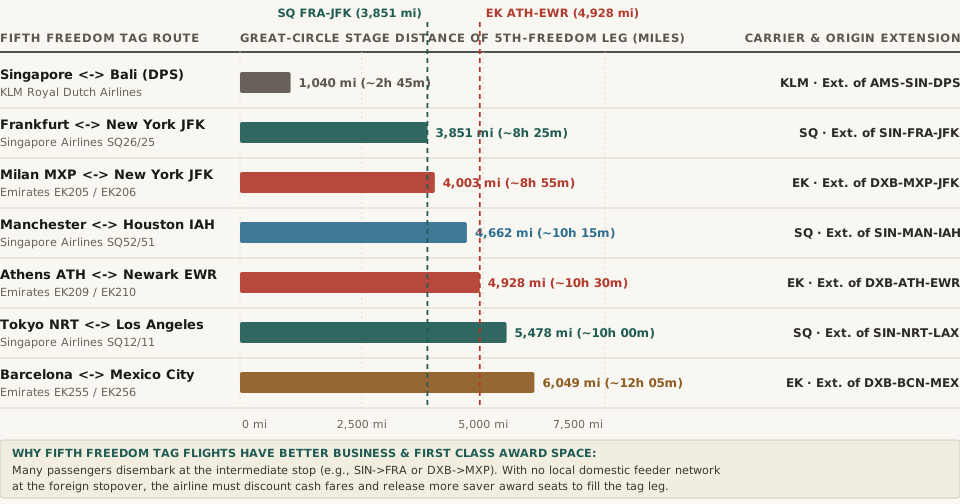
Chart comparing great-circle stage distances (in miles) across seven flagship Fifth Freedom routes operated by Singapore Airlines, Emirates, and KLM, from Singapore-Bali (1,040 mi) and Frankfurt-JFK (3,851 mi) to Tokyo-LAX (5,478 mi) and Barcelona-Mexico City (6,049 mi)
Figure 1: Great-circle stage distance and block time of flagship Fifth Freedom tag legs operated by Singapore Airlines, Emirates, and KLM (MyFlightRoutes 2026; Mainly Miles).

2. Why Airlines Still Fly Fifth Freedom Routes—And Why Seats Are Easier to Book

In the mid-20th century, fifth freedom stops were an engineering necessity: a Boeing 707 or early 747 could not fly nonstop from Singapore to New York or from Dubai to Mexico City without stopping to refuel. Today, aircraft like the Airbus A350-900ULR can fly 9,500+ miles nonstop—yet airlines deliberately keep flagship fifth freedom routes alive for three strategic reasons documented by MyFlightRoutes and Skyplus:

  1. High-Altitude & Range Physics (e.g., Mexico City at 7,349 feet): Mexico City International Airport (MEX) sits at an elevation of 7,349 feet (2,240 meters). Thin high-altitude air reduces wing lift and engine thrust on takeoff, preventing a fully loaded Boeing 777 from flying nonstop all the way to Dubai. By routing Dubai (DXB) → Barcelona (BCN) → Mexico City (MEX) (6,049 miles on the BCN–MEX leg), Emirates solves the hot-and-high weight restriction while capturing the lucrative Spain-to-Mexico market.
  2. Filling Empty Seats After Hub Passengers Disembark: On a flight like Singapore Airlines SQ26 (SIN → FRA → JFK) or Emirates EK205 (DXB → MXP → JFK), a large share of passengers boarding at the home hub get off at the intermediate European city. Without Fifth Freedom rights, the widebody jet would fly across the Atlantic half-empty.
  3. Zero Local Domestic Feeder Network = Better Award Space & Fares: When Lufthansa flies Frankfurt → New York, it feeds that Boeing 747 with connecting passengers from 50 European spoke cities. When Singapore Airlines flies the exact same FRA → JFK (3,851 miles) route, it has zero European domestic feeder flights—it must attract local point-to-point travelers in Frankfurt and New York. As Skyplus highlights, that lack of local hub feed forces fifth-freedom carriers to release significantly more saver-level Business and First Class award inventory and price promotional cash fares up to 30%–50% below legacy hub monopolies.

"Because the airline is essentially 'passing through' rather than operating out of a primary hub, these flights often have less demand from local loyalists, leading to better award availability for savvy travelers using points and miles."

3. Complete Data Table: Flagship Emirates, Singapore Airlines & KLM Fifth Freedom Routes

The reproducible table below—matching the companion CSV dataset (fifth-freedom-flights-emirates-singapore-airlines-route-distances-and-freedoms.csv)—lists the stage distances, flight numbers, and booking sweet spots verified in MyFlightRoutes and Mainly Miles:

Fifth Freedom Tag Route Carrier & Flight No. Full Hub Routing Stage Distance Block Time Why Points & Cash Flyers Target This Leg
Singapore (SIN) ↔ Bali (DPS) KLM (KL835 / KL836) AMS → SIN → DPS 1,040 mi ~2h 45m Long-haul Boeing 777 World Business Class lie-flat seats on a short intra-Asia hop
Frankfurt (FRA) ↔ New York (JFK) Singapore Airlines (SQ26 / SQ25) SIN → FRA → JFK 3,851 mi ~8h 25m Book KrisFlyer / Aeroplan Business Class across the Atlantic with low carrier surcharges
Milan (MXP) ↔ New York (JFK) Emirates (EK205 / EK206) DXB → MXP → JFK 4,003 mi ~8h 55m Flagship Airbus A380 First Class Shower Spa & onboard lounge nonstop US-to-Italy
Manchester (MAN) ↔ Houston (IAH) Singapore Airlines (SQ52 / SQ51) SIN → MAN → IAH 4,662 mi ~10h 15m Airbus A350-900 nonstop between Northern England and Texas; strong saver award space
Athens (ATH) ↔ Newark (EWR) Emirates (EK209 / EK210) DXB → ATH → EWR 4,928 mi ~10h 30m Only year-round nonstop from the New York area to Greece; 3-cabin Boeing 777-300ER
Tokyo Narita (NRT) ↔ Los Angeles (LAX) Singapore Airlines (SQ12 / SQ11) SIN → NRT → LAX 5,478 mi ~10h 00m Consistently higher Business Class award seat counts than ANA or JAL transpacific
Barcelona (BCN) ↔ Mexico City (MEX) Emirates (EK255 / EK256) DXB → BCN → MEX 6,049 mi ~12h 05m 2-class Boeing 777-200LR bypassing 7,349-ft Mexico City altitude constraint

4. How to Maximize Cent-per-Point Value on Fifth Freedom Award Redemptions

When booking fifth freedom flights with transferable credit card points (such as Chase Ultimate Rewards, American Express Membership Rewards, Capital One Miles, or Wells Fargo Rewards), two redemption rules protect your cent-per-point yield:

  • Compare Partner Distance Bands vs. Dynamic Carrier Surcharges: Singapore Airlines passes zero fuel surcharges on its own KrisFlyer program and on partner Air Canada Aeroplan redemptions for FRA ↔ JFK (3,851 miles, falling neatly inside Aeroplan's ≤ 4,000-mile transatlantic distance band). By contrast, Emirates levies substantial carrier-imposed surcharges on MXP ↔ JFK and ATH ↔ EWR, so always deduct cash taxes and fees from the retail fare before calculating your net cent-per-point value.
  • Check fifth-freedom schedules during shoulder season: Because airlines use fifth freedom tags to absorb excess long-haul widebody capacity, Business Class saver releases on MAN ↔ IAH, FRA ↔ JFK, and NRT ↔ LAX frequently open 2 to 4 seats per flight during autumn and winter shoulder months.

Before transferring bank points to KrisFlyer, Aeroplan, or Skywards for a fifth-freedom redemption, Compare award tax valuations on Pointsuno to calculate your exact net cents-per-point return after carrier surcharges and transfer bonuses.
010 / 47

What Is Skiplagging (Hidden-City Ticketing) and Why Do Airlines Ban It?

Search for a one-way non-stop flight from New York (JFK) to a major airline fortress hub like Charlotte (CLT), Dallas/Fort Worth (DFW), or Atlanta (ATL) on two weeks' notice, and the airline may quote you $380 in economy. Then search the exact same airline on the exact same morning for a flight from New York to Orlando (MCO) with a layover in Charlotte—putting you in the exact same seat on the exact same New York-to-Charlotte airplane, plus a second flight to Florida—and the total price drops to $145.

That counterintuitive pricing inversion is the economic engine behind hidden-city ticketing, widely known as skiplagging (after the metasearch engine Skiplagged founded by Aktarer Zaman in 2013): buying a cheaper connecting itinerary where your real destination is the layover city, walking out of the airport at the connection with a backpack, and throwing away the final segment. Here is why airlines price longer connecting flights cheaper than shorter non-stop flights, what U.S. and European courts have ruled in airline lawsuits, and the five operational traps that can turn a $235 savings into a $500 travel disaster.

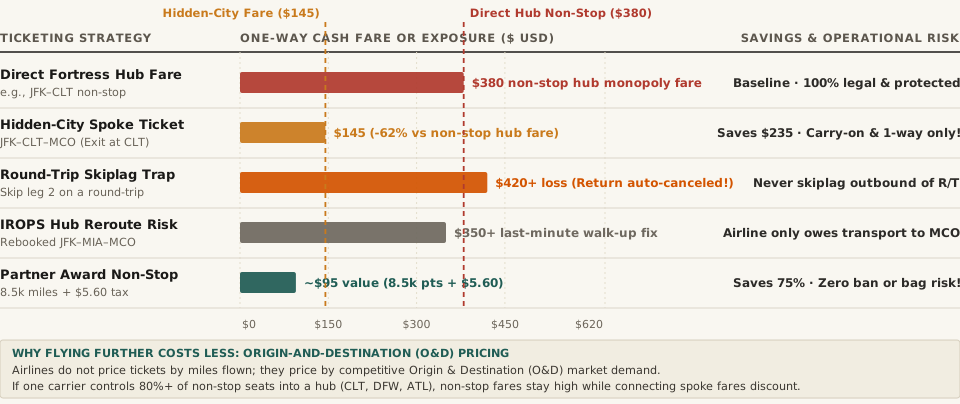
Horizontal bar chart comparing one-way cash fares and financial exposure across a $380 direct fortress hub ticket, a $145 hidden-city spoke ticket, a $420+ round-trip auto-cancellation loss, an IROPS reroute penalty, and a $95 partner award redemption
Figure 1: Illustrative one-way cost and financial exposure ($ USD) comparing a non-stop fortress hub cash ticket ($380) against a hidden-city connecting ticket ($145), the round-trip cancellation trap, irregular-operations rerouting, and a legal partner award ticket. Download the full dataset: skiplagging-hidden-city-ticketing-hub-fare-savings-vs-airline-penalties.csv.

1. Why Flying Further Costs Less: Fortress Hubs vs. O&D Competition

To a first-time traveler, charging $145 for two flights (JFK → CLT → MCO) while charging $380 for just the first flight (JFK → CLT) looks like a computer glitch. In reality, it is a deliberate cornerstone of airline revenue management known as Origin-and-Destination (O&D) pricing.

Airlines do not price tickets on a cost-plus basis per mile flown; they price each city pair according to willingness to pay and competitive alternatives:

  • The Non-Stop Fortress Hub Monopoly (JFK → CLT): At a “fortress hub” where a single legacy carrier controls 75% to 90% of all gates and takeoffs, corporate travelers flying into the hub for banking, legal, or consulting meetings strongly prefer a fast non-stop flight and have few competing airlines to choose from. Revenue-management algorithms hold those non-stop seats in higher fare buckets ($300–$500+).
  • The Competitive Spoke-to-Spoke Leisure Market (JFK → MCO): Between New York and Orlando, half a dozen airlines (including low-cost carriers JetBlue, Spirit, Frontier, and Southwest) fly non-stop for $110 to $150. If the legacy carrier wants to fill empty seats on its Charlotte flights with price-sensitive leisure passengers heading to Florida—who actually face the inconvenience of a layover compared to a non-stop flight—it must discount the connecting JFK → CLT → MCO itinerary to $145 to match the market!

2. Is Skiplagging Illegal? What Courts Ruled in United and Lufthansa Lawsuits

Airlines often use ominous language to deter hidden-city ticketing, leading many passengers to wonder if walking out of an airport at a layover is against the law. As documented in Wikipedia's legal review of airline booking ploys and aviation consumer law analyses, the distinction between criminal/statutory law and private contract law is crystal clear:

  1. Not a Crime or Federal Offense: In the United States and Europe, deciding not to board the second leg of a domestic flight is completely lawful under criminal and aviation safety statutes.
  2. A Civil Breach of the Airline's Contract of Carriage: Almost every major airline explicitly prohibits hidden-city ticketing in its Contract of Carriage (the terms and conditions you click “Agree” to at checkout), classifying it as purchasing a ticket for a city you have no intention of flying to in order to circumvent the carrier's fare structure.
  3. What Happened When Airlines Sued: In November 2014, United Airlines and Orbitz sued Skiplagged founder Aktarer Zaman in federal court in Chicago seeking $75,000 in lost revenue; the court dismissed the case on jurisdictional grounds in 2015 (and in 2023–2024, American Airlines pursued trademark and contract claims against Skiplagged in Texas). Even more notably, in 2019 Lufthansa sued an individual passenger in Germany for €2,112 after he skipped the final Oslo–Frankfurt–Seattle return leg to Berlin; as noted on Wikipedia, Germany's Federal Court of Justice ruled in 2025 that Lufthansa's surcharge clause lacked transparency under consumer law, while confirming that airlines have the contractual right to refuse further carriage and penalize repeat violators.

“Skiplagging is not a crime, but it violates almost every airline's Contract of Carriage—giving carriers the contractual power to cancel your remaining itinerary, confiscate your frequent-flyer miles, and ban repeat offenders.”

3. The Five Operational Traps That Catch Skiplaggers—and the Legal Award Alternative

Before you ever consider booking a hidden-city ticket, look at the five ways the tactic backfires in real life—and compare it with the 100% legal frequent-flyer alternative:

Ticketing Route or Scenario Sample One-Way Cost Savings vs. Direct Hub Baggage & Return Ticket Outcome Contract of Carriage & Operational Risk
Direct Fortress Hub Fare (JFK → CLT) $380 one-way 0% (Baseline) Full checked bag & PNR protection 100% compliant; zero reroute or account risk
Hidden-City Spoke Ticket (JFK → CLT → MCO) $145 one-way 61.8% (−$235) Personal item / backpack ONLY Breaches Contract of Carriage; never attach your frequent-flyer number
Round-Trip Outbound Skiplag Trap $420+ loss 0% (Return voided!) Entire return ticket auto-canceled! Skipping any segment triggers automatic cancellation of all remaining flights
Gate-Checked Roller Bag Trap $145 + lost bag 0% usable Bag flies to Orlando (MCO)! If overhead bins fill up in Boarding Group 7, your bag is tagged to the final city
Weather / IROPS Hub Reroute $350+ rebook 0% arrival in CLT Rebooked via Miami (JFK → MIA → MCO) Airline's legal contract is to get you from JFK to MCO, not via Charlotte!
Partner Award Ticket (JFK → CLT) ~$95 (8.5k pts + $5.60) ~75% savings Full checked bag & IROPS rights 100% legal: partner award charts price by distance, bypassing hub cash gouging

Why Partner Award Tickets Beat Skiplagging Without Breaking a Single Rule

Notice the bottom row of the table: if an airline wants $380 cash for a short 540-mile non-stop flight into its fortress hub, you don't need to risk having your roller bag sent to Florida or your frequent-flyer account shut down. Because alliance partner award charts (such as booking an American Airlines non-stop flight using British Airways Avios or Qantas points, or booking a United hub flight using Air Canada Aeroplan or Avianca LifeMiles) often price short-haul flights by distance band (7,500 to 10,000 points + $5.60 in september 11 security fees) whenever saver space is open, you can fly the exact non-stop hub flight legally with a checked bag and full irregular-operations protection.

Compare Cash Hub Fares Against Partner Award Sweet Spots on Pointsuno

When a non-stop cash ticket into a hub spikes above $350, checking whether your transferable bank points unlock a low-tax non-stop award seat is always safer than rolling the dice on a hidden-city connection. Compare award tax valuations on Pointsuno to calculate exact cents-per-point returns and out-of-pocket taxes across airline loyalty programs.

011 / 47

How Does the 24-Hour Flight Cancellation Rule Actually Work? (And the 7-Day Exception)

Almost every frequent flyer knows that U.S. federal law gives you 24 hours to cancel a flight for a full refund without penalty—even if you purchased a non-refundable Basic Economy ticket or locked in a non-refundable international award redemption. Yet every week, travelers get burned by a surprise $99 to $400 cancellation penalty or a non-refundable travel credit because they unknowingly stepped into one of the regulation's three structural loopholes: booking fewer than 7 days before departure, booking through a third-party online travel agency (OTA), or clicking “Change Flight” instead of “Cancel Flight” during the first 24 hours.

Here is the exact legal mechanics of the U.S. Department of Transportation (DOT) 24-Hour Reservation Requirement codified at 14 CFR § 259.5(b)(4), how it applies to foreign carriers and frequent-flyer miles, and how to avoid the three traps that void your statutory refund right.

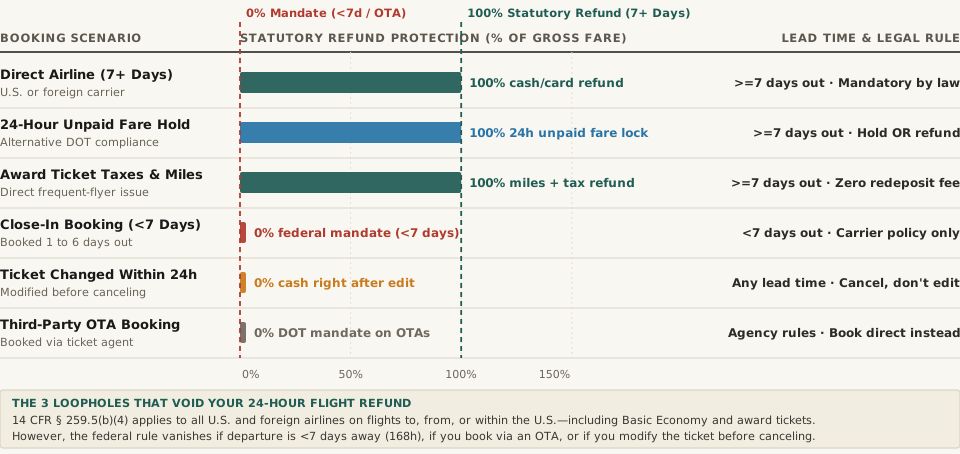
Horizontal comparison chart of U.S. DOT 14 CFR 259.5(b)(4) 24-hour flight cancellation protections versus the 7-day advance purchase cutoff, itinerary modification trap, and third-party OTA exception
Figure 1: Statutory refund protection under U.S. DOT 14 CFR § 259.5(b)(4) across six booking scenarios, contrasting direct bookings made 7+ days before departure (100% original-payment refund) against close-in bookings (<7 days), modified itineraries, and third-party OTAs. Download the full dataset: us-dot-24-hour-flight-cancellation-rule-14-cfr-259-5-and-airline-policies.csv.

1. What 14 CFR § 259.5(b)(4) Actually Mandates: Hold or Refund

Enacted as part of the U.S. Department of Transportation's consumer rule “Enhancing Airline Passenger Protections” (76 Fed. Reg. 23110, April 25, 2011) and clarified in the DOT Office of Aviation Enforcement and Proceedings May 31, 2013 Guidance Notice, 14 CFR § 259.5(b)(4) requires every U.S. and foreign air carrier operating scheduled passenger service to, from, or within the United States to adopt a Customer Service Plan that commits the airline to one of two options for any ticket booked at least seven days prior to scheduled departure:

  1. Option A (24-Hour Penalty-Free Cancellation & Full Refund): Allow the passenger to cancel a paid reservation within 24 hours of purchase and receive a 100% full refund in the original form of payment (including base fare, carrier-imposed fuel surcharges, and government taxes) with zero cancellation fee; or
  2. Option B (24-Hour Unpaid Fare Hold): Allow the consumer to hold a reservation at the quoted gross fare for 24 hours without payment before the ticket is issued.

As emphasized in both the DOT's enforcement guidance and airline compliance breakdowns, airlines are only required to offer one of those two mechanisms—not both. Historically, American Airlines complied by offering a free 24-hour unpaid hold (Option B) rather than a 24-hour post-purchase refund, before switching to the standard 24-hour post-purchase refund model (Option A) now used across virtually all major airlines.

“Under U.S. DOT May 2013 enforcement guidance, an airline violates 14 CFR § 259.5(b)(4) and commits an unfair and deceptive trade practice under 49 U.S.C. § 41712 if it pre-selects an airline travel voucher as the default refund choice instead of returning cash to the original form of payment.”

2. Foreign Airlines, Basic Economy, and Frequent-Flyer Award Tickets

Three myths frequently confuse travelers booking complex international or points itineraries:

  • Myth 1: “Foreign airlines don't have to follow the U.S. 24-hour rule.” False. If a flight touches a U.S. airport (departing from or arriving in the United States) and is booked directly through a channel marketed to U.S. consumers, foreign carriers—from British Airways, Air France, and Lufthansa to Singapore Airlines and Cathay Pacific—are legally bound by 14 CFR § 259.5(b)(4). (By contrast, intra-European flights that never touch the U.S. are governed by EU Regulation 261/2004 for delays and carrier cancellations, which does not include a mandatory 24-hour buyer's-remorse cooling-off rule.)
  • Myth 2: “Non-refundable Basic Economy fares are excluded.” False. The DOT rule applies to all fare classes, including the most restrictive Basic Economy and Saver fares, provided you book directly with the airline at least 7 days before departure.
  • Myth 3: “Award tickets booked with miles can charge a redeposit fee within 24 hours.” Under the DOT's 2013 enforcement notice and subsequent carrier customer service plans, frequent-flyer award tickets booked 7+ days out qualify for penalty-free cancellation within 24 hours with 100% of miles and taxes/fees refunded to the original account and card.

3. The Three Traps That Void Your 24-Hour Refund Right

Before relying on the 24-hour rule to speculatively lock in a cash fare or award seat, compare how the rule behaves across all seven real-world booking scenarios:

Booking Scenario or Carrier Policy Advance Purchase Lead Time Protected Cancellation Window Statutory Refund Share (%) Legal & Operational Rule (14 CFR § 259.5(b)(4))
Direct Airline Booking (≥7 Days Out) ≥168 hours (7+ days before flight) 24 hours from booking timestamp 100% to original payment Mandated by U.S. DOT 14 CFR § 259.5(b)(4) for U.S. & foreign carriers
Direct Airline Free 24-Hour Hold Option ≥168 hours (7+ days before flight) 24-hour unpaid price lock 100% protected ($0 charged) DOT allows carriers to offer EITHER a 24h free hold OR a 24h paid refund
Delta / United / American (<7 Days Out) 24 to 167 hours (1–6 days out) 24 hours (Voluntary extension) 100% (Voluntary policy) Major U.S. legacy carriers voluntarily waive the 7-day cutoff on most direct tickets
Close-In Booking Under Strict DOT Rule (<7 Days) <168 hours (<7 days before flight) 0 hours federal mandate 0% statutory cash refund Spirit, Frontier, JetBlue & many foreign carriers strictly enforce the 7-day cutoff
Modified Ticket Within 24 Hours (Change Trap) ≥168 hours (Changed before canceling) 0 hours (Change voids right) 0% cash guarantee DOT guidance allows carriers to deny 24h cash refund if itinerary was modified first
Online Travel Agency (OTA / Third-Party) ≥168 hours (Booked via OTA) 0 hours under 14 CFR § 259.5 0% federal DOT mandate 14 CFR § 259.5(b)(4) binds air carriers directly, not third-party ticket agents

Trap 1: The 7-Day (168-Hour) Advance Purchase Cutoff

The single most common mistake travelers make is assuming the 24-hour rule applies to last-minute flights booked two or three days before departure. The plain text of 14 CFR § 259.5(b)(4) states that the mandate “applies to all reservations made seven days or more prior to the flight's scheduled departure time.” While Delta, United, and American voluntarily extend 24-hour refunds to many close-in direct bookings, carriers such as JetBlue, Spirit, Frontier, and most international airlines strictly enforce the 7-day (168-hour) cutoff. If you book a flight on Wednesday for departure on Sunday and cancel two hours later on a strict-cutoff carrier, the airline has zero federal obligation to refund your card.

Trap 2: The “Change Flight” Modification Trap

In page 5 of its May 31, 2013 Guidance Notice, the DOT explicitly addressed passengers who modify a reservation within 24 hours and then attempt to cancel the modified ticket for a cash refund. The DOT ruled that if a passenger uses the online “Change Flight” tool instead of canceling the original reservation outright, the modified booking is no longer protected by the 24-hour cash refund rule. As documented in JetBlue's contract of carriage disclosures, “Bookings that have been changed are not eligible for a refund to the original form of payment... regardless of being within 24 hours of the original booking.” Always cancel and rebook from scratch rather than modifying a ticket within the first 24 hours.

Trap 3: Booking Through Third-Party Online Travel Agencies (OTAs)

Because 14 CFR § 259.5 regulates air carriers rather than third-party ticket agents, online travel agencies (OTAs) and credit-card travel portals are not directly bound by the regulation (though major portals like Expedia and Chase Travel voluntarily offer 24-hour cancellation on most major carriers). Worse, if you book a foreign carrier through a discount consolidator or unbundled OTA, the agency can impose its own $50 to $200 administrative cancellation fee even within 24 hours.

Audit Award Taxes, Carrier Surcharges, and Refund Rules on Pointsuno

When you are comparing whether to lock in an international business-class award seat 7+ days out or pay cash across competing U.S. and foreign loyalty programs, knowing exactly which carrier-imposed fuel surcharges (YQ/YR) and government taxes are 100% refundable within 24 hours—and after 24 hours—protects your points bankroll. Compare award tax valuations on Pointsuno to model real cents-per-point yield, out-of-pocket taxes, and cancellation exposure before you ticket your next flight.

012 / 47

When Is a Card Processing Fee Worth Paying?

A card fee is worth paying only when the rewards you will actually use are worth more than the fee.

For federal taxes, the IRS lists consumer credit-card fees of 1.75% through Pay1040 and 1.85% through ACI. The fee is charged by the processor, not the IRS. Check the current rate at checkout before paying.

The quick math

Multiply the payment by the fee rate. Then compare that cost with the cash back or points value you can reasonably get.

  • $10,000 tax payment at 1.75%: the fee is $175.
  • 2% cash back: $200 in rewards, or about $25 more than the fee.
  • 1.5% cash back: $150 in rewards, or about $25 less than the fee.

For points, use your own redemption value. At 1.5 cents per point, a card earning one point per dollar returns about 1.5% before the fee. A two-point-per-dollar purchase returns about 3%, but only if you can use the points at that value. A high valuation in a chart does not guarantee a good booking.

When a welcome bonus changes the math

A large bill can help you meet a new card's minimum spend. Count the bonus only if you planned to apply anyway and can meet the terms without spending more than usual. Compare the fee with the value you expect to use, not a best-case flight price.

I use this same break-even check before paying for points: start with a real booking, then compare its value with the cash cost. Pointsuno helps compare point values and transfer options; the fee calculation above is yours to make with the rate shown by the processor.

IRS-listed fees checked November 4, 2026: Pay taxes by card or digital wallet. Rates can change.

013 / 47

How Often Can You Get a Credit Card Welcome Bonus?

There isn't one welcome-bonus cooldown for every card. The offer terms for the card you want are the rules that matter.

Before applying, check whether you already have the card, when you last earned its bonus, and whether the offer has a family rule. Issuers can change these terms, and a card approval does not guarantee that you'll receive the bonus.

What to check before you apply

Issuer or card familyCheck the current terms for
Chase SapphireWhether you've held a Sapphire card or earned its bonus before. Chase says prior card ownership or a prior bonus can affect eligibility.
Capital One Venture cardsThe current offer's lookback period. Capital One's Venture and Venture X offers currently exclude some applicants who received a bonus in the past 48 months.
CitiThe exact card and bonus language. Rules can differ between products in the same family.
American ExpressThe offer's eligibility notice and any family restrictions. Don't assume a closed account or a long wait makes you eligible.

I treat each application as its own check. Read the terms attached to the exact offer, note any bonus date the terms use, and save a copy before you apply.

For the details that come up most often, see how Chase's 5/24 rule works and the Amex once-per-lifetime language. I use Pointsuno to compare the cards' points and transfer options; it doesn't determine whether an issuer will approve a bonus.

Checked November 4, 2026. Read the current terms before applying: Chase Sapphire offer terms, Capital One card offers, and the terms shown with your American Express offer.

014 / 47

When Do Airlines Release Award Seats? How the 355-Day Partner Window Beats U.S. 331-Day Calendars

If you have ever logged into American Airlines AAdvantage or United MileagePlus exactly 331 days before a dream trip to Tokyo or Paris — hoping to grab two saver business-class seats the second the schedule opens — only to find zero availability on every single flight, you did not lose to faster fingers. You lost to a structural calendar gap: foreign alliance loyalty programs open their award calendars at 355 to 360 days before departure, giving their members an 18-to-29-day head start over U.S. airline programs.

As documented across AwardFares' Ultimate Guide to Airline Award Release Dates, Award Travel Finder's 34-Program Release Window Database, and Upgraded Points' Schedule-Open Availability Audit, most international carriers release only 1 to 2 guaranteed saver business-class seats (Class I) per flight when a new date loads into the Global Distribution System (GDS). By the time a U.S. program's 331-day or 337-day calendar reaches that date, those seats have already been exposed to foreign partner portals for nearly a month. To model which transferable credit card currencies unlock early-window partner programs at the highest cents-per-point value, Compare transfer partner valuations in Pointsuno.

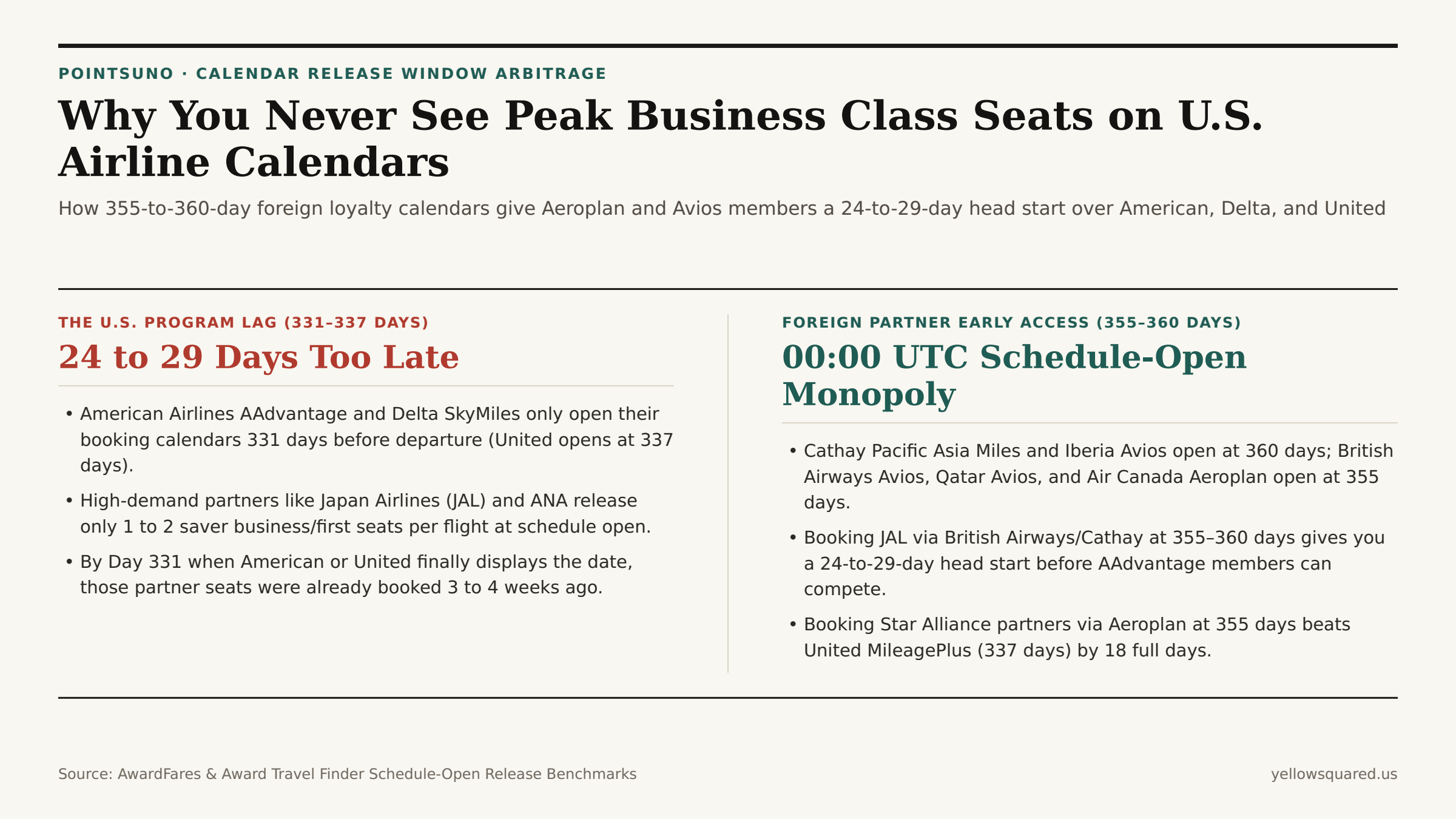
Comparison between the 331-to-337-day U.S. airline award calendar lag and the 355-to-360-day foreign partner schedule-open advantage
Because American Airlines and Delta open award calendars at 331 days (and United at 337 days), travelers using 355-to-360-day programs like Cathay Asia Miles, Avios, Aeroplan, and Flying Blue enjoy an 18-to-29-day booking monopoly.

The Three Tiers of Airline Schedule-Open Windows (360 vs. 355 vs. 331 Days)

Airlines do not load full-year schedules on a single universal clock; each Passenger Service System (Amadeus Altea vs. Sabre vs. native host systems) exposes new dates at a fixed horizon prior to departure:

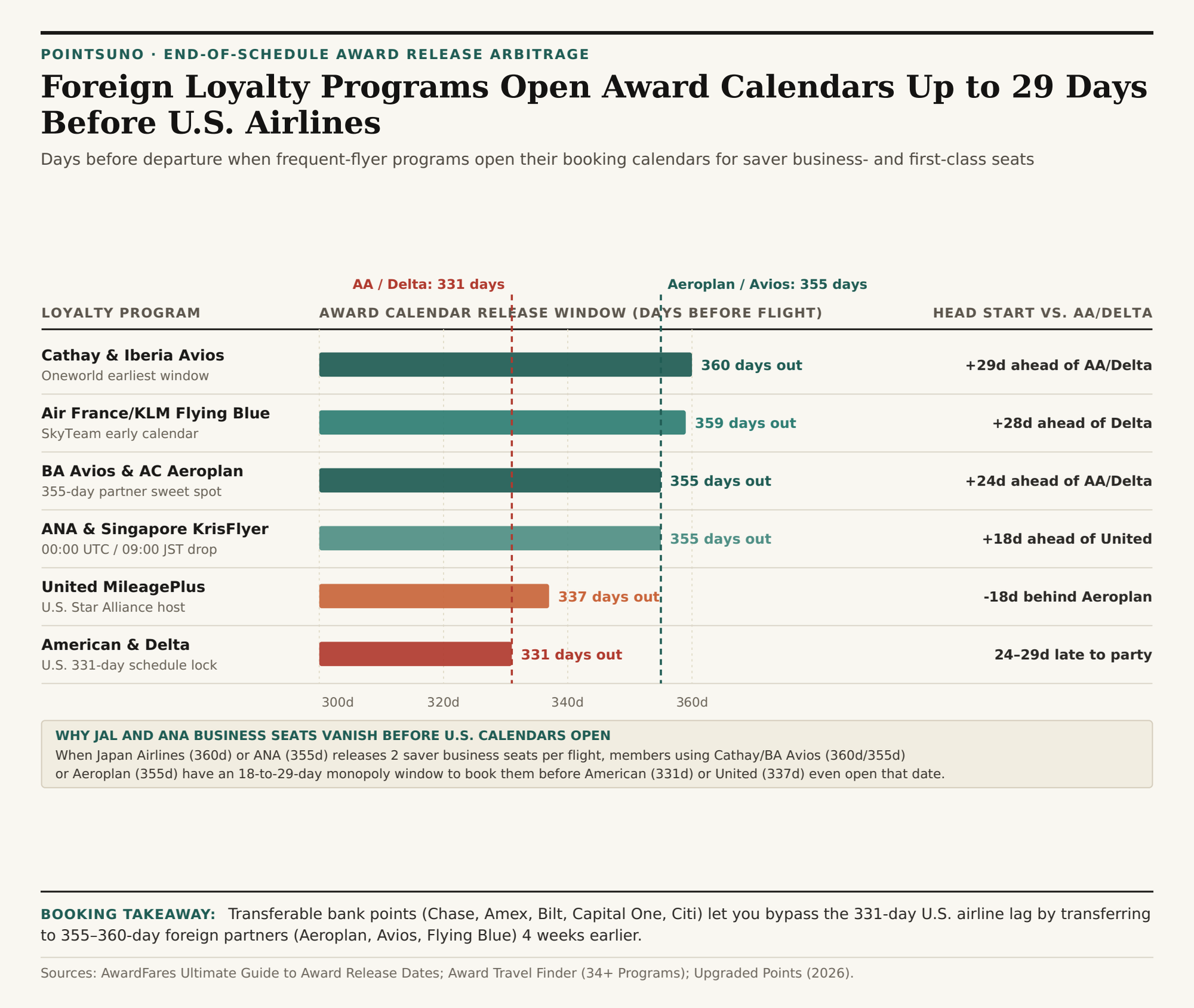
  • The 359–360 Day Pioneers (Cathay Pacific, Iberia, JAL, Air France/KLM): Cathay Pacific Asia Miles and Iberia Plus (Avios) open bookings at 360 days before departure, while Air France/KLM Flying Blue opens at 359 days. When Japan Airlines (JAL) loads its schedule at 360 days out (00:00 UTC / 09:00 JST), Cathay Pacific members can book those JAL business- and first-class seats a full 29 days before American Airlines AAdvantage members (331 days) can even click the date on aa.com.
  • The 355 Day Alliance Sweet Spot (British Airways / Qatar Avios, Air Canada Aeroplan, ANA, KrisFlyer): At 355 days out, five of the most powerful transferable-points partners open simultaneously: British Airways Executive Club (Avios), Qatar Airways Privilege Club (Avios), Air Canada Aeroplan, ANA Mileage Club, and Singapore Airlines KrisFlyer. Because Aeroplan (355 days) opens 18 days earlier than United MileagePlus (337 days), Aeroplan members get first pick of Star Alliance saver releases on ANA, EVA Air, Swiss, and Austrian.
  • The 331–337 Day U.S. Lag (United, American, Delta, Alaska): United MileagePlus opens at 337 days, while American Airlines AAdvantage, Delta SkyMiles, and Alaska Airlines Atmos Rewards open at 331 days. On routes where foreign partners only release 2 saver seats at schedule open, waiting until Day 331 means hoping for a second wave of inventory or a close-in T-14 drop two weeks before departure.
Horizontal bar chart comparing airline award calendar release windows in days before departure across major loyalty programs
Award calendar release horizons (days before departure) across Oneworld, Star Alliance, and SkyTeam programs. Download the airline award release window dataset (CSV).

Why Transferable Bank Points Beat Co-Branded U.S. Airline Cards at Schedule Open

If all of your miles are locked inside a single U.S. airline program (such as American AAdvantage or United MileagePlus), you are permanently restricted to that program's 331-day or 337-day calendar horizon — even when booking flights operated by foreign alliance partners. By holding flexible bank points (Chase, Amex, Bilt, Capital One, or Citi) that transfer 1:1 to British Airways/Iberia/Qatar Avios, Cathay Pacific Asia Miles, Air Canada Aeroplan, or Flying Blue, you can shift your booking horizon forward to 355–360 days out.

"For peak cherry-blossom Tokyo flights or June European lie-flat cabins, the difference between a 355-day Aeroplan/Avios calendar and a 331-day U.S. calendar is the difference between wide-open saver space and a sold-out cabin."

Loyalty Program Alliance Release Horizon Lead Over AA/Delta Daily Drop Time Primary Schedule-Open Sweet Spot
Cathay Asia Miles & Iberia Avios Oneworld 360 days +29 days 00:00 UTC Earliest access to JAL, Iberia & Cathay cabins
Air France / KLM Flying Blue SkyTeam 359 days +28 days 00:00 CET 4-week head start on SkyTeam Europe business
BA / Qatar Avios & AC Aeroplan Oneworld / Star 355 days +24 days 00:00 UTC Scoops up ANA, EVA, Qatar & JAL partner seats
ANA Mileage Club & KrisFlyer Star Alliance 355 days +24 days (+18d vs UA) 00:00 UTC (09:00 JST) Direct host access to Tokyo & Singapore suites
United MileagePlus Star Alliance 337 days +6 days (-18d vs AC) Rolling CST Trails Aeroplan by 18 days on partner space
American AAdvantage & Delta Oneworld / SkyTeam 331 days 0 days (Baseline) 00:00 CT / EST Best for domestic flights & close-in T-14 drops

Calculating Net Value Before You Book at 355 Days

While foreign partner programs give you a 24-to-29-day head start, they sometimes levy higher carrier surcharges or stricter change fees than U.S. programs. Before transferring points at T-355, Compare transfer partner valuations in Pointsuno to weigh early-access availability against net cents-per-point yield, and download the airline award release window CSV table.

015 / 47

What Is Phantom Award Space? Check Seats Before You Transfer

Phantom award space is a flight that appears available in an airline search but cannot be booked. It often happens when a partner’s search results do not match the operating airline’s live inventory.

It matters because most bank-to-airline point transfers cannot be reversed. Before moving points, make sure the flight is still bookable in the program you plan to use.

Check the seat before you transfer

  1. Open the exact flight and continue through the search flow to the passenger details or payment step. Stop before buying if you only wanted to verify availability.
  2. Search the same flight through another partner when possible. If it appears only once, treat that as a warning and keep checking. Partners can show different inventory, so a mismatch alone does not prove the seat is fake.
  3. For an important booking, call the program or ask whether it can hold the seat while points transfer. Holds are not available everywhere.
  4. Check how long the transfer takes and whether the seat can disappear before the points arrive.

I do not transfer points based on a calendar result alone. I check the exact flight, cabin, passenger count, and total cash fees first.

Pointsuno can help compare transfer programs and award fees, but the airline still has to confirm the seat. Read the program’s transfer and cancellation rules before moving a balance.

016 / 47

Why Does an Airline Have Award Seats on a Connecting Flight When the Nonstop Leg Is Sold Out?

Suppose you want to book a lie-flat Business Class award from Chicago (ORD) to Frankfurt (FRA) using partner miles. You search the nonstop flight—say, Flight 431—and the calendar shows zero saver seats (or a sky-high 210,000-mile dynamic price). Five minutes later, you search Chicago to Barcelona (ORD → FRA → BCN) on the exact same date. Suddenly, the airline offers 4 saver Business Class seats for 70,000 miles—putting you on the very same Flight 431 across the Atlantic that just claimed to be sold out. Welcome to Married Segment Control (MSC) and Origin & Destination (O&D) revenue management.

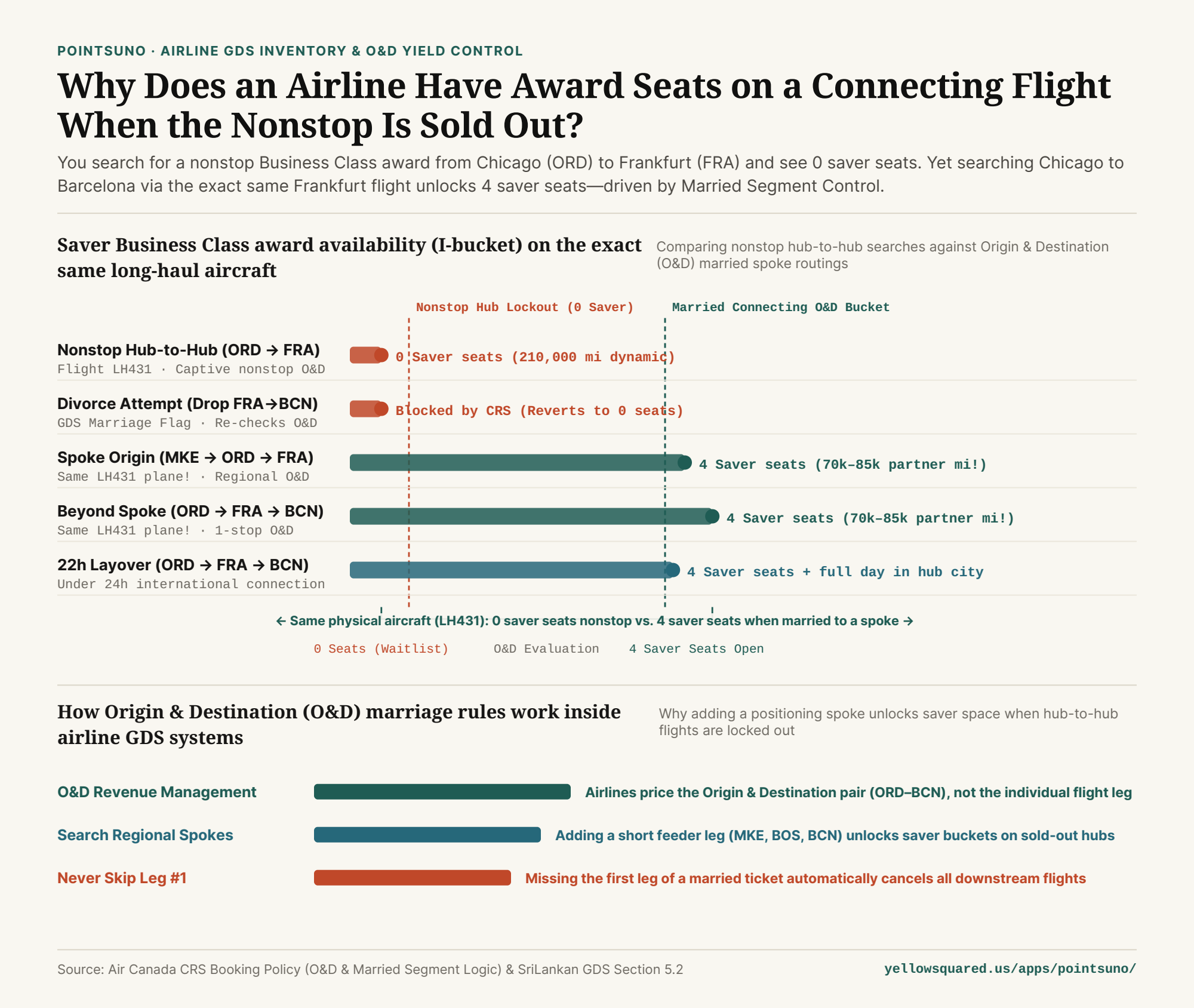
Chart showing 0 saver award seats on a nonstop ORD-FRA search versus 4 saver award seats on the exact same aircraft when searched as MKE-ORD-FRA or ORD-FRA-BCN
Figure 1: Saver Business Class award availability (I bucket) on the exact same long-haul aircraft across five Origin & Destination (O&D) search structures. Reproducible dataset: married-segment-logic-airline-award-flights-explained.csv.

1. How Origin & Destination (O&D) Inventory Control Works

Decades ago, airline reservation systems managed seat inventory flight-by-flight: if Flight 431 had 4 seats left in the I (Business Saver Award) bucket, anyone could book those 4 seats regardless of where they started or ended their trip. Modern Computerized Reservation Systems (CRS) and Global Distribution Systems (GDS) no longer work that way.

As documented in Air Canada's CRS Booking and Ticketing Policy and Section 5.2 of standard IATA GDS booking rules, airlines allocate inventory based on the passenger's complete Origin and Destination (O&D) and Point of Commencement (POC):

  • Nonstop Hub-to-Hub O&D (Captive High Yield): On a nonstop hub route like ORD → FRA or JFK → DOH, the operating airline enjoys a nonstop monopoly or duopoly. Because corporate accounts happily pay $5,000+ in cash for nonstop speed, the revenue management algorithm restricts saver award inventory on the standalone ORD–FRA O&D to 0 seats.
  • Connecting Spoke-to-Spoke O&D (Competitive 1-Stop Yield): On a connecting route like Milwaukee (MKE) → ORD → FRA or ORD → FRA → Barcelona (BCN), the passenger has to make a stop—meaning the airline is competing against half a dozen other one-stop European carriers. To fill seats without cannibalizing nonstop cash fares, the algorithm opens 2 to 4 saver award seats exclusively when Flight 431 is "married" to a feeder segment.
"Airlines don't price the physical seat on the airplane; they price the Origin-and-Destination journey. Adding a short spoke segment changes the O&D bucket from a captive nonstop monopoly to a competitive one-stop market."

2. Why You Can't Just 'Divorce' Married Segments After Booking

Once travelers discover married segment availability, their first instinct is to book ORD → FRA → BCN for 70,000 miles and then call customer service to drop the short FRA → BCN leg. In a modern GDS, those two segments carry an electronic married segment indicator. If an agent tries to cancel FRA → BCN alone, the reservation system forces a complete re-check of standalone ORD → FRA availability—which immediately returns 0 saver seats.

Instead of trying to break a married ticket (or no-showing the first leg, which triggers an automatic cancellation of your entire itinerary), use two legitimate search strategies: search from nearby regional spoke airports within a 1–2 hour drive or train ride, or book a legal 22-to-23-hour connection at the hub city (since international layovers under 24 hours are priced as part of the single connecting O&D).

3. Married Segment O&D Award Availability Table

Compare how an airline's CRS evaluates five different booking requests on the exact same long-haul aircraft (available in married-segment-logic-airline-award-flights-explained.csv):

Search Structure Example Routing CRS / GDS Evaluation Saver Business Bucket Revenue Management Logic Can You Drop a Leg?
Nonstop Hub O&D ORD → FRA High-yield nonstop O&D 0 seats (Waitlist) Protects cash nonstop demand N/A (Single flight)
Spoke Origin O&D MKE → ORD → FRA Regional 1-stop O&D 2–4 Saver seats Competes with 1-stop rivals No — skipping Leg 1 voids ticket
Beyond Spoke O&D ORD → FRA → BCN Leisure 1-stop O&D 2–4 Saver seats Fills secondary spoke capacity Forfeits checked bags & return
Call-In 'Divorce' Drop FRA → BCN leg Triggers marriage flag Blocked by CRS Prohibits O&D circumvention Re-prices at 0 saver seats
22-Hour Hub Layover ORD → FRA (22h) → BCN Valid <24h connection 2–4 Saver seats Counts as transfer, not stopover Legal full day in hub city

4. Compare Partner Transfer Ratios Before Booking in Pointsuno

Because different airline loyalty programs apply different marriage rules and fuel surcharges to the exact same flight—for instance, booking a Star Alliance married O&D via Air Canada Aeroplan versus Avianca LifeMiles or United MileagePlus—checking transfer ratios across your credit card points is essential before moving points. Compare transfer ratios in Pointsuno to calculate the lowest-point path for your next international redemption.

Verified Primary Sources

  1. Air Canada Connex — CRS Booking and Ticketing Policy: Origin & Destination (O&D) and Married Segment Logic (Retrieved 2026-10-31).
  2. SriLankan Airlines / IATA GDS Rules — Global Distribution System (GDS) Booking Policy Section 5.2: Married Segment Control (Retrieved 2026-10-31).