YellowSquared  /  Field notes

Notes from the workshop

47 posts, newest first. Choose an app to narrow the feed.

017 / 47

How Do Airline Alliance Lounge Access Rules Work? The Foreign Status Loophole

While United and American Airlines bar their own Star Alliance Gold and Oneworld Sapphire elites from domestic U.S. lounges on domestic tickets, holding the exact same alliance tier via a foreign partner unlocks complimentary U.S. lounge access with a guest.

Imagine two frequent flyers walking up to the reception desk at the United Club in Chicago O'Hare (or the American Airlines Flagship Lounge in Miami) before boarding a three-hour domestic Economy flight to Seattle. Flyer A holds top-tier United Premier 1K (or American AAdvantage Executive Platinum) status, earned by flying 100,000 miles a year with the home airline. Flyer B holds mid-tier Air Canada Aeroplan 50K (or British Airways Executive Club Silver) status.

The agent scans both boarding passes. Flyer A—the airline's own elite—is turned away at the door and told to buy a $700–$850 annual club membership. Flyer B is welcomed inside for free, allowed to bring a complimentary guest, and (at American Airlines hubs) directed straight into the international business-class Flagship Lounge with champagne and chef-carved entrees.

This counterintuitive quirk is known in frequent-flyer strategy as the Foreign Alliance Status Loophole. Understanding how Star Alliance, Oneworld, and SkyTeam enforce reciprocal lounge access rules lets you unlock hundreds of dollars in domestic airport lounge privileges without paying for a club membership card.
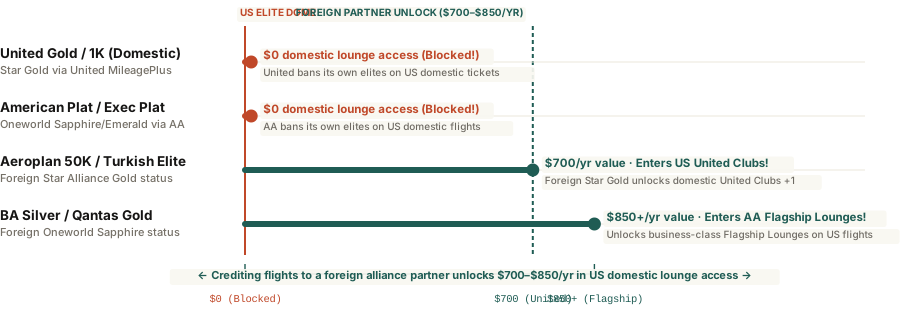
Annual domestic U.S. airport lounge value unlocked by foreign Star Alliance Gold and Oneworld Sapphire status vs domestic programs
Figure 1: Annual U.S. domestic airport lounge access value unlocked on domestic Economy tickets across U.S. legacy programs versus foreign Star Alliance Gold and Oneworld Sapphire partners. Download policy comparison table: airline-alliance-lounge-access-rules-oneworld-star-skyteam.csv.

Why United and American Block Their Own Elites on U.S. Flights

Across Europe, Asia, and Australia, earning mid-to-high frequent flyer status (Star Alliance Gold or Oneworld Sapphire / Emerald) automatically grants airport lounge access whenever you fly any member airline—even on a 45-minute domestic Economy hop from London to Manchester or Sydney to Melbourne.

In the United States, however, millions of corporate travelers and co-branded credit card holders hold elite status, and U.S. airlines generate hundreds of millions of dollars selling standalone lounge memberships (`$700/year` for a United Club membership; `$750–$850/year` for an Admirals Club membership). To protect that subscription revenue and prevent overcrowding, United Airlines, American Airlines, and Alaska Airlines wrote an explicit home-program carve-out into their terms:

  • United MileagePlus Star Alliance Golds (`Premier Gold, Platinum, 1K`): Receive zero United Club access when flying solely on U.S. domestic itineraries. They only gain lounge access when connecting to an international Star Alliance flight.
  • American AAdvantage Oneworld Sapphires & Emeralds (`Platinum, Platinum Pro, Executive Platinum`): Receive zero Admirals Club or Flagship Lounge access on purely domestic U.S. itineraries (outside of select 3-cabin transcontinental Business/First tickets).

Under global alliance treaties, U.S. airlines can restrict their own frequent flyer members on domestic flights—but they are contractually obligated to admit foreign partner elites.

How to Use the Foreign Partner Sweet Spot (Star Gold vs. Oneworld vs. SkyTeam)

Because Star Alliance and Oneworld reciprocal treaties require member airlines to honor partner status across the network, holding the alliance tier through a non-U.S. frequent flyer program bypasses the domestic exclusion completely:

  1. Star Alliance Gold via Foreign Partner (`Aeroplan 50K`, `Turkish Miles&Smiles Elite`, `Aegean Miles+Bonus Gold`): Gives you and one guest complimentary access to every United Club in the United States whenever you fly a same-day United domestic flight in any cabin (including Basic Economy).
  2. Oneworld Sapphire / Emerald via Foreign Partner (`British Airways Silver/Gold`, `Qantas Gold/Platinum`, `Qatar Platinum`, `Finnair Gold`): Gives you and one guest access not only to every American Airlines Admirals Club, but also to international-style AA Flagship Lounges (in JFK, MIA, ORD, DFW, and LAX) and Alaska Lounges when flying any same-day domestic AA or Alaska itinerary.
  3. Why SkyTeam Is the Exception: Unlike Star Alliance and Oneworld, SkyTeam (`Delta Air Lines`, `Air France-KLM`, `Korean Air`, `Virgin Atlantic`) closed the domestic loophole alliance-wide: SkyTeam Elite Plus members (regardless of whether they hold status with Delta or a foreign partner) only receive lounge access when traveling on, or connecting to, a same-day international flight.

To compare mileage earning rates, elite qualification thresholds, and transfer-partner redemptions across global airline alliances, you can Compare award tax valuations on Pointsuno before crediting your next flight.
018 / 47

What Is the Amex Once-Per-Lifetime Rule? Welcome Bonus Limits Explained

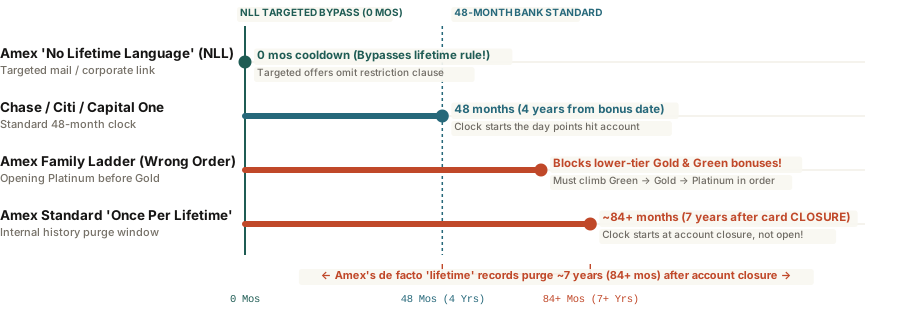
Unlike Chase and Citi's 48-month reset clocks, American Express restricts welcome bonuses to once per card—plus a top-down 'family rule' whereby opening a Platinum card first disqualifies you from later earning a Gold or Green welcome bonus.

Most major U.S. credit card issuers enforce a simple calendar timer on welcome bonuses: wait 24 or 48 months after earning a sign-up bonus on a card, and you can apply again for a fresh bonus. American Express plays by a completely different playbook. Since 2014, standard Amex consumer and business application terms have included a strict clause commonly known as the Once-Per-Lifetime Rule: "You may not be eligible to receive a welcome offer if you have or have had this Card."

Since late 2023—and continuing through 2026—American Express expanded those restrictions with a top-down Card Family hierarchy across its flagship Membership Rewards, Delta SkyMiles, Marriott Bonvoy, and Cash Magnet/Blue Cash lines. Understanding how the family ladder works, how Amex's pre-application "Pop-Up Jail" algorithm evaluates your profile, and why an Amex "lifetime" actually lasts closer to 7 years can save you over 130,000 points in forfeited bonuses.

American Express once per lifetime rule cooldowns and card family hierarchy compared to 48-month bank rules
Figure 1: Welcome bonus cooldown windows and card-family lockouts across American Express standard terms, NLL targeted offers, and 48-month bank competitors. Download rule comparison table: what-is-the-amex-once-per-lifetime-rule-welcome-bonus.csv.

The "Card Family" Rule: Why You Must Apply Bottom-Up

Previously, the Amex Green Card, Gold Card, and Platinum Card were treated as completely independent products: you could open the Platinum Card in year one, grab the Gold Card bonus in year two, and open the Green Card in year three. Under the updated Card Family terms, holding a higher-tier card disqualifies you from earning welcome bonuses on lower-tier cards in the same family:

  • Membership Rewards Charge Ladder (`Green → Gold → Platinum`): The Amex Gold Card terms explicitly state that you may not be eligible for its welcome bonus if you have or have had the Platinum Card (or the Charles Schwab / Morgan Stanley Platinum variants). Likewise, the Amex Green Card terms lock you out if you have ever held the Gold Card or Platinum Card.
  • Delta SkyMiles Co-Brand Ladder (`Gold → Platinum → Reserve`): Opening the top-tier Delta SkyMiles Reserve Card first blocks you from later earning welcome bonuses on the Delta Platinum or Delta Gold personal cards.

The strategic takeaway is absolute: always climb the Amex ladder from the bottom rung up. If you plan to earn welcome bonuses on both the Amex Gold (`60,000–90,000 points`) and Amex Platinum (`80,000–150,000 points`), you must open the Amex Gold first, earn its bonus, and only then apply for the Amex Platinum.

Product changes count against you: upgrading or downgrading into an Amex card you have never applied for still marks you as 'having had' that card, forfeiting its welcome bonus.

Pop-Up Jail, the 7-Year Reset, and "NLL" Offers

Three practical rules govern how Amex enforces its lifetime clause in practice:

  1. The Pre-Pull Eligibility Pop-Up ("Pop-Up Jail"): Since 2018, Amex's online application engine runs an automated check before executing a hard credit inquiry. If you previously held the card, violated the family ladder, or triggered Amex's internal profitability algorithm (due to low spending on existing cards), a pop-up window warns that you will not receive the welcome bonus and lets you cancel the application with zero credit score impact.
  2. How Long Is an Amex "Lifetime"? (~7+ Years After Closure): Amex does not store closed-account records forever. Empirical data points consistently show that Amex's internal welcome-bonus ledger purges closed card history roughly 7 to 8 years (84+ months) after the date the account was closed—not the date it was opened.
  3. Targeted "No Lifetime Language" (NLL) Offers: Amex frequently sends targeted email, physical mail, or in-account banner offers—especially for Business Gold and Business Platinum cards—whose fine print omits the once-per-lifetime clause entirely. If an offer contains No Lifetime Language and you do not receive a pop-up warning at submission, you will earn the full bonus even if you held the card before.

To model how card-family sequences and annual fees impact your net redemption yield, you can Compare award tax valuations on Pointsuno before submitting your next application.

019 / 47

What Is an Open-Jaw Flight? A Simple Guide to Multi-City Award Trips

An open-jaw trip flies into one city and home from another. You cover the gap between them by train, car, or a separate flight instead of backtracking to your first airport.

For example, you could fly from New York to London, travel through Europe by train, then fly home from Rome. The two flights make the ends of the trip; the part between London and Rome is on you.

Three common versions

TypeExample
Destination open-jawJFK to London, then Rome to JFK
Origin open-jawBoston to Tokyo, then Tokyo to San Francisco
Double open-jawBoston to Dublin, then Paris to New York

For cash fares, use the airline’s multi-city search and check the price against separate tickets. Fare rules differ, and an unflown gap can affect whether the flights price as one ticket.

With points, two one-way awards are often the easiest way to build the trip. They may use different programs, and the points price, fees, change rules, and availability can differ for each direction. Check both flights and the cash co-pay before transferring points.

I look at open-jaw routes when a trip ends somewhere other than where it started. Pointsuno helps compare award prices and cash fees before you book.

020 / 47

Are Airline Miles Taxable? IRS Rules for Credit Card Rewards

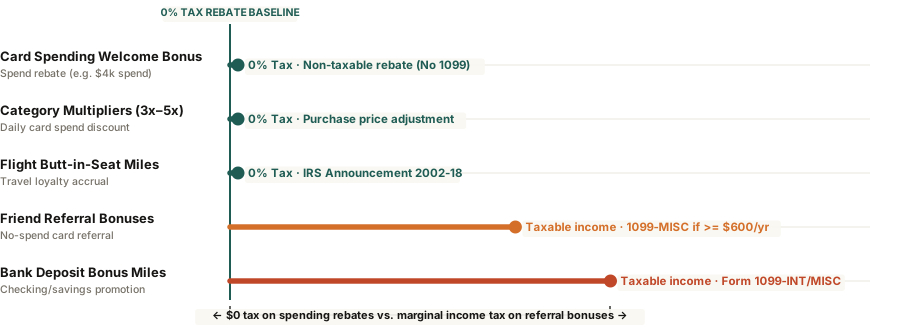
Under IRS Announcement 2002-18 and Revenue Ruling 2012-32, miles earned through credit card spending and flights are non-taxable rebates, but bank account referral bonuses and deposit promotions trigger Form 1099-MISC.

Opening a credit card that awards 80,000 airline miles or redeeming 120,000 points for a $4,500 business class seat to Tokyo is one of the most satisfying achievements in modern personal finance. Yet for award travel enthusiasts and small business owners, an uneasy question frequently emerges come tax season: does the Internal Revenue Service consider those miles taxable income, and will you receive a surprise Form 1099 in the mail?

The short answer is that the vast majority of credit card points and frequent flyer miles are 100% tax-free. However, the IRS draws a strict legal distinction between miles earned as a purchase rebate versus rewards received as miscellaneous compensation. Crossing that line can turn a seemingly harmless referral link or bank bonus into reportable taxable income.

IRS taxability matrix across credit card reward and frequent flyer earning categories
Figure 1: Taxability status of major reward earning channels under Internal Revenue Code Section 61 and IRS rulings. Download verified rule matrix: are-airline-miles-taxable-irs-rules.csv.

The Purchase Rebate Doctrine: Why Spending Bonuses Are Tax-Free

The legal foundation protecting reward points is the IRS "Rebate Doctrine," codified under Revenue Ruling 76-96 and affirmed in subsequent tax court jurisprudence. Under this principle, a discount or rebate given to a consumer upon purchasing an item is not gross income under Internal Revenue Code § 61; it is an adjustment to the purchase price of the acquired property.

When a card issuer offers 60,000 points after you spend $4,000 in your first three months, you were required to spend money to unlock the reward. The IRS treats those 60,000 points as a 15% discount on the goods and services you purchased—not earned compensation. Furthermore, in IRS Announcement 2002-18, the agency officially stated that it will not challenge the tax treatment of frequent flyer miles earned through business travel or routine card spending due to the administrative complexity of tracking valuations.

If you have to spend personal or commercial funds to earn the reward, the IRS views the points as a non-taxable rebate.

The Taxable Exceptions: Referrals and Bank Deposit Bonuses

Reward points lose their rebate protection whenever you earn them without incurring a corresponding purchase. Two common scenarios trigger taxable events:

  • Credit Card Referral Bonuses (1099-MISC): When you share your card referral link with a friend and earn 20,000 points upon their approval, you did not spend a single dollar to earn those miles. The IRS classifies referral rewards as compensation for services. Card issuers such as American Express and Chase issue Form 1099-MISC whenever an individual earns $600 or more in referral bonuses in a calendar year, typically valuing points at 1.0 cent each (e.g., 60,000 referral points = $600 of taxable income).
  • Bank Account Opening Bonuses (1099-INT): Cash or mileage bonuses earned by opening a checking account or depositing $25,000 for 90 days are categorized as interest income. Because depositing money into an account is not a consumer purchase, banks issue Form 1099-INT or 1099-MISC for bonuses exceeding $10.

When tracking your loyalty portfolio, separate your tax-free spend bonuses from referral programs that could generate 1099 filings. You can Compare award tax valuations on Pointsuno to audit redemption cents-per-point efficiency against potential tax liabilities.

021 / 47

What Is the Chase 5/24 Rule? How It Actually Works

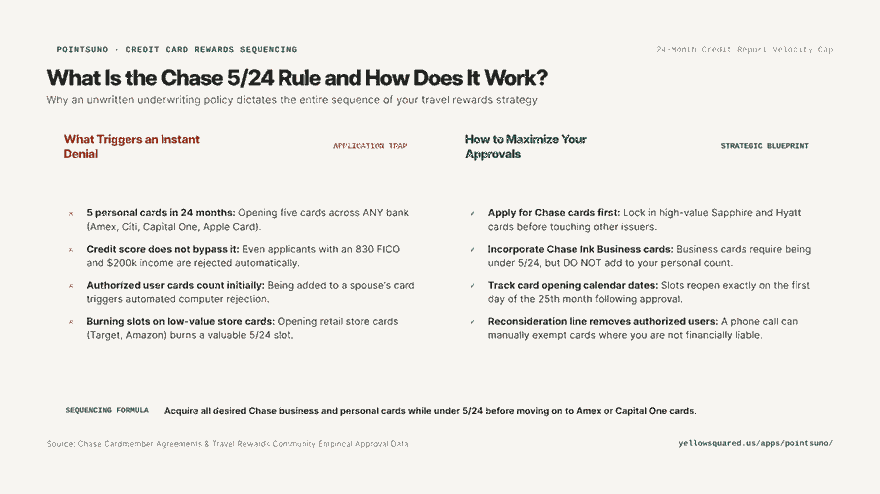
The Chase 5/24 rule is an unwritten underwriting policy stating that Chase will automatically deny any new credit card application if you have opened five or more personal credit cards across ANY bank within the preceding 24 months. Because excellent credit scores, high incomes, and six-figure bank deposits cannot override this algorithmic threshold, understanding how to sequence personal and business card applications is the foundation of travel rewards strategy.

Hook card contrasting common credit card application mistakes against the strict Chase 5/24 velocity sequencing blueprint.
The Chase 5/24 rule: why personal credit card velocity triggers automatic algorithmic denials.

First uncovered by award travel communities in early 2015, the 5/24 rule represents Chase’s primary defense against credit card “churning”—the practice of opening cards solely to collect lucrative sign-up bonuses before closing them. While other major credit card issuers enforce specific restrictions (such as American Express’s lifetime bonus rule or Citi’s 48-month cooldowns), Chase’s policy looks across your entire personal credit report at all financial institutions.

Your credit score measures whether you pay your bills; Chase 5/24 measures how fast you acquire revolving credit.

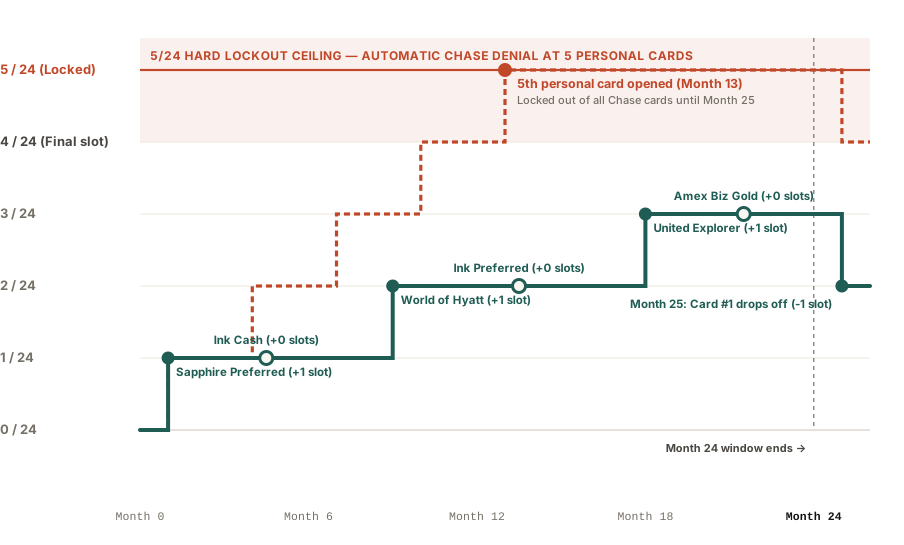
Diagram showing the 24-month 5/24 slot timeline across five card slots and explaining how Chase Ink business cards do not consume personal slots.
Figure 1: The Chase 5/24 slot pipeline across 24 consecutive months. Data verified from Chase Cardmember Agreements and empirical approval records. Download raw rule matrix: what-is-the-chase-5-24-rule-credit-cards.csv.

Which Cards Count Toward Your 5/24 Tally?

To calculate your current 5/24 standing, review your credit reports on Experian, Equifax, and TransUnion:

  1. All Personal Cards Count: Any revolving personal credit card opened with American Express, Capital One, Citi, Discover, Apple Card, or retail department stores (like Target or Nordstrom) adds one slot to your 5/24 status.
  2. Authorized User Cards: If your spouse or parent adds you as an authorized user to their personal card, that card appears on your credit report. Chase’s automated computer algorithm will flag it as an open account and deny you initially. However, calling the Chase reconsideration line allows a human analyst to manually remove authorized user cards from your tally.
  3. Business Cards Do NOT Add to 5/24: Most small business cards (including Chase Ink Business, American Express Business, and CitiBusiness cards) report strictly to commercial credit bureaus, not your personal consumer credit report. They do not consume a 5/24 slot.

The Crucial Nuance: Chase Business Cards Require <5/24 to Be Approved

While Chase Ink Business cards (such as the Ink Business Preferred, Ink Cash, and Ink Unlimited) do not add to your personal 5/24 score, you must be under 5/24 to be approved for them. If you are currently at 5/24 or 6/24, Chase will deny your business application.

This creates the primary golden rule of travel card sequencing: Apply for Chase Ink business cards while you are between 0/24 and 4/24. Each approved business card earns a substantial 75,000 to 100,000 point sign-up bonus without burning any of your precious five personal slots.

Strategic Application Sequencing Across Major Issuers

Issuing Bank & Tier Consumes 5/24 Slot? Requires <5/24 Approval? Optimal Sequencing Stage
Chase Ink Business NO YES Stage 1: Apply first while under 5/24
Chase Sapphire & Hyatt YES YES Stage 2: Fill remaining 5/24 personal slots
Amex Business Cards NO NO Stage 3: Keep velocity high without burning slots
Capital One & Citi Personal YES NO Stage 4: Save for after you exit Chase ecosystem

How to Clear a Blocked Slot

  • Know your exact 25th-month date: A card opened on October 14, 2024 will clear your 5/24 tally on November 1, 2026 (the first day of the 25th month following approval).
  • Call the reconsideration line immediately: If you are denied due to authorized user cards, call Chase reconsideration within 30 days and politely state: “Those accounts are authorized users; I am not financially responsible for the debt.”
  • Model award valuations and transfer sweet spots: To calculate whether a Chase Sapphire or Ink sign-up bonus delivers higher value than competing bank rewards, explore the calculators at Pointsuno.

022 / 47

How to Avoid Airline Fuel Surcharges on Award Flights

Airline "carrier-imposed surcharges" (coded as YQ and YR on ticket receipts) can add $900 to $1,050 in out-of-pocket cash to an award ticket that was supposed to be booked entirely with miles. However, you can legally avoid or slash these fees to under $60 by booking Star Alliance partner flights through loyalty programs that strictly ban fuel surcharges — specifically Air Canada Aeroplan and United MileagePlus — rather than booking through programs like British Airways Executive Club or Virgin Atlantic Flying Club that pass full carrier fees directly to members.

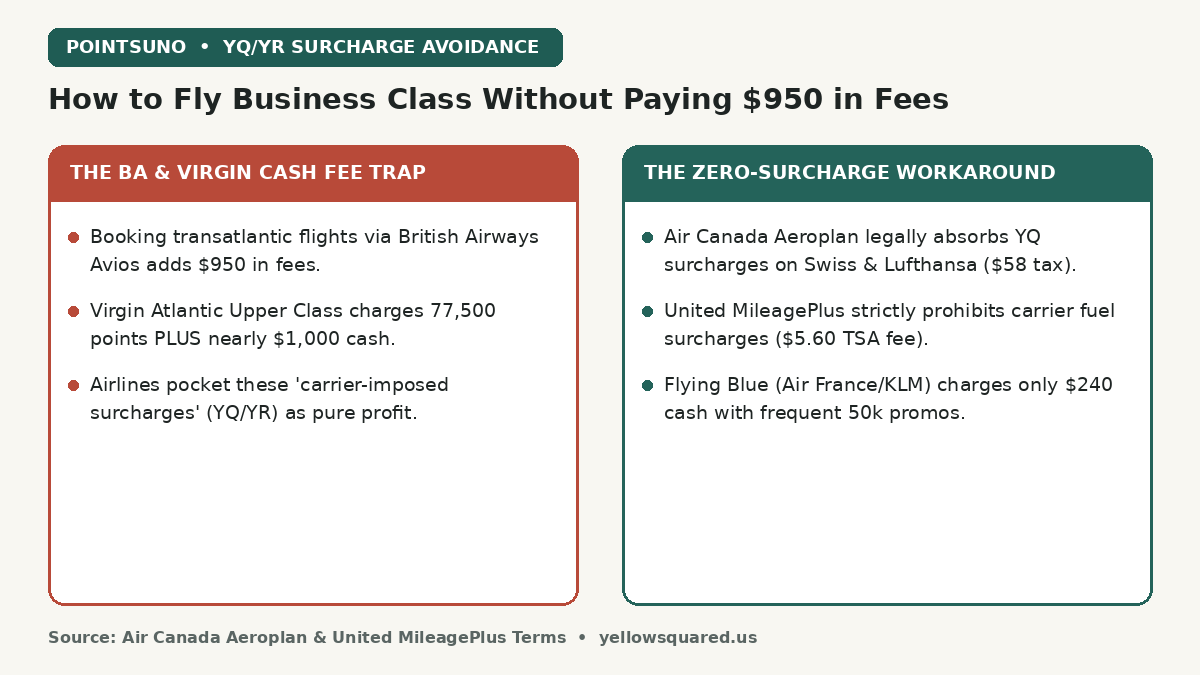
Comparison card contrasting British Airways and Virgin Atlantic high-fee award bookings against the zero-surcharge workaround using Air Canada Aeroplan and United MileagePlus.
Why cash fees on transatlantic business class awards range from $5.60 to $990 — and how choosing the right partner currency eliminates them.

There are few ruder awakenings in points and miles than earning 80,000 credit card points, transferring them to an airline partner to book a dream business class flight to London or Frankfurt, and reaching the final checkout screen only to see a cash requirement of $985.40 alongside your points balance. While genuine government departure taxes are unavoidable, massive fuel surcharges are completely optional if you route through the right booking currency.

A carrier-imposed fee (YQ/YR) is not an airport tax — it is an airline cash surcharge that only certain frequent flyer programs force you to pay.

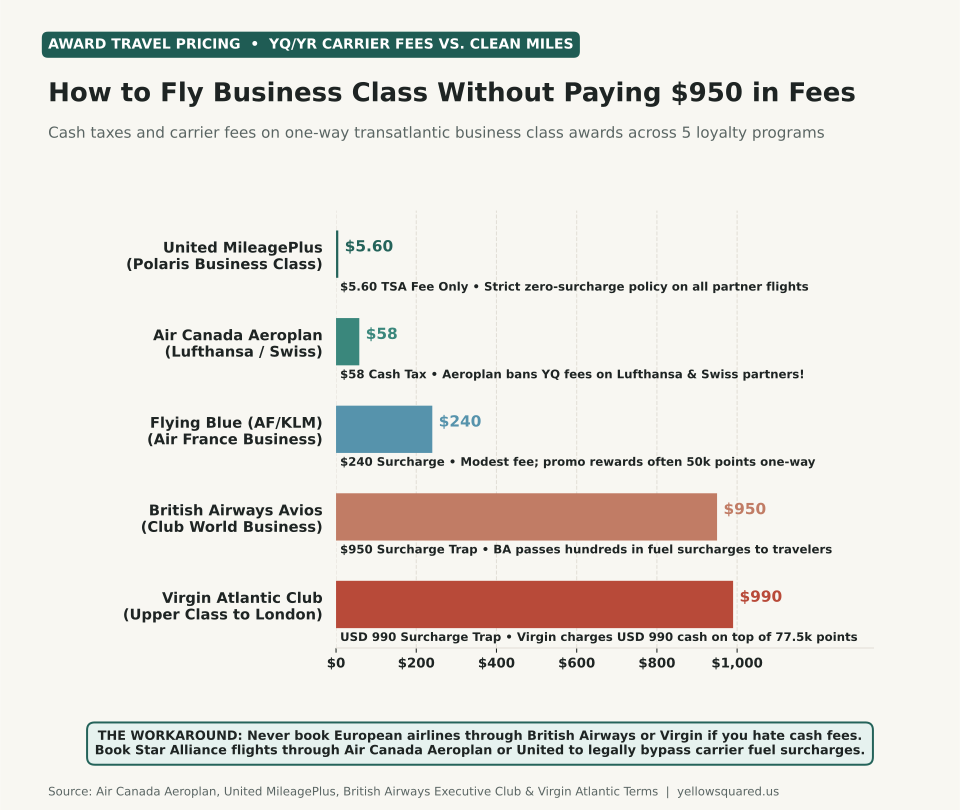
Horizontal bar chart comparing out-of-pocket cash taxes and carrier fees on one-way business class awards across five programs: United MileagePlus at 5.60 dollars, Air Canada Aeroplan at 58 dollars, Flying Blue at 240 dollars, British Airways Avios at 950 dollars, and Virgin Atlantic at 990 dollars.
Figure 1: Mandatory cash fees on a one-way transatlantic business class award flight from the U.S. East Coast to Europe across five loyalty programs. Program fee rules verified from Air Canada Aeroplan, United MileagePlus, Flying Blue, and British Airways Executive Club (Oct 2026). Download raw data: how-to-avoid-airline-fuel-surcharges-on-award-flights.csv.

The Anatomy of an Award Ticket: Government Taxes vs. YQ Fees

When you redeem miles for an airline seat, your cash bill consists of two separate components:

  1. Genuine Government & Airport Taxes: These are non-negotiable statutory fees collected on behalf of civil aviation authorities. For flights departing the United States, this includes the $5.60 TSA September 11th Security Fee per one-way segment. For flights departing the United Kingdom, it includes the UK Air Passenger Duty (APD), which charges £202 (roughly $260) for long-haul premium cabins. Every airline must collect these taxes regardless of booking method.
  2. Carrier-Imposed Surcharges (YQ / YR): Originally invented during the 1970s and 2000s oil crises as temporary "fuel surcharges," international carriers (notably British Airways, Virgin Atlantic, Lufthansa, Swiss, and Austrian Airlines) retained these fees as permanent profit centers. On a one-way business class ticket across the Atlantic, YQ surcharges alone range from $650 to $850.

Which Loyalty Programs Ban Surcharges on Partner Flights?

The crucial secret of airline alliances (Star Alliance, oneworld, and SkyTeam) is that the loyalty program you use to book determines whether carrier surcharges are passed through to you, not the airline operating the plane:

Frequent Flyer Program Alliance Carrier Surcharge (YQ/YR) Policy Typical Cash Fee to Europe (One-Way Biz)
United Airlines MileagePlus Star Alliance Banned: Never passes YQ fees on any partner flight $5.60 (U.S. departure)
Air Canada Aeroplan Star Alliance Banned: Absorbs all partner YQ fees (charges $39 CAD booking fee) $58 to $80 (CAD/USD taxes)
Avianca LifeMiles Star Alliance Banned: Zero fuel surcharges on all partner redemptions $25 to $45 (taxes only)
Flying Blue (Air France / KLM) SkyTeam Moderate: Capped internal surcharges on Air France/KLM metal $220 to $260
British Airways Executive Club oneworld Full Pass-Through: Collects maximum commercial YQ fees $950 to $1,050
Virgin Atlantic Flying Club SkyTeam Full Pass-Through: Extreme cash surcharges on Upper Class $950 to $1,020

The 3 Rules for Booking Surcharge-Free Flights

  • Rule 1 — Book Lufthansa & Swiss via Aeroplan instead of Miles & More: If you want to fly Lufthansa First Class or Swiss Business Class, never book through Lufthansa's own Miles & More program (which charges $900+ in fees). Booking that identical seat through Air Canada Aeroplan charges just 70,000 to 100,000 points and roughly $58 in cash.
  • Rule 2 — Fly out of departure-tax-friendly countries on the return: If you are visiting Europe, flying home out of London Heathrow triggers the $260 UK Air Passenger Duty. Taking the Eurostar train to Paris, Amsterdam, or Dublin before flying home cuts government taxes by more than half.
  • Rule 3 — Compare net value before transferring points: Paying 60,000 points + $240 cash with Flying Blue is often far better than spending 88,000 United miles to save $234 in cash. Use the Pointsuno award valuation calculator to model the break-even math across airline programs before transferring your credit card points.

023 / 47

How to Use Chase Ultimate Rewards for World of Hyatt Stays

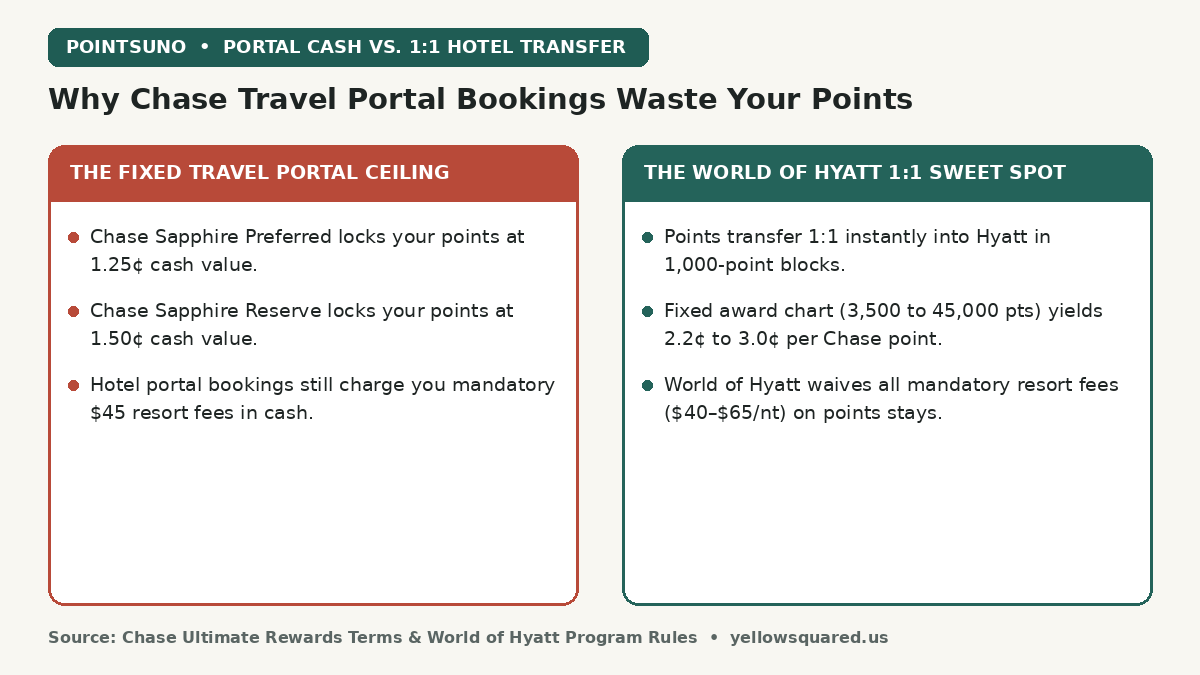
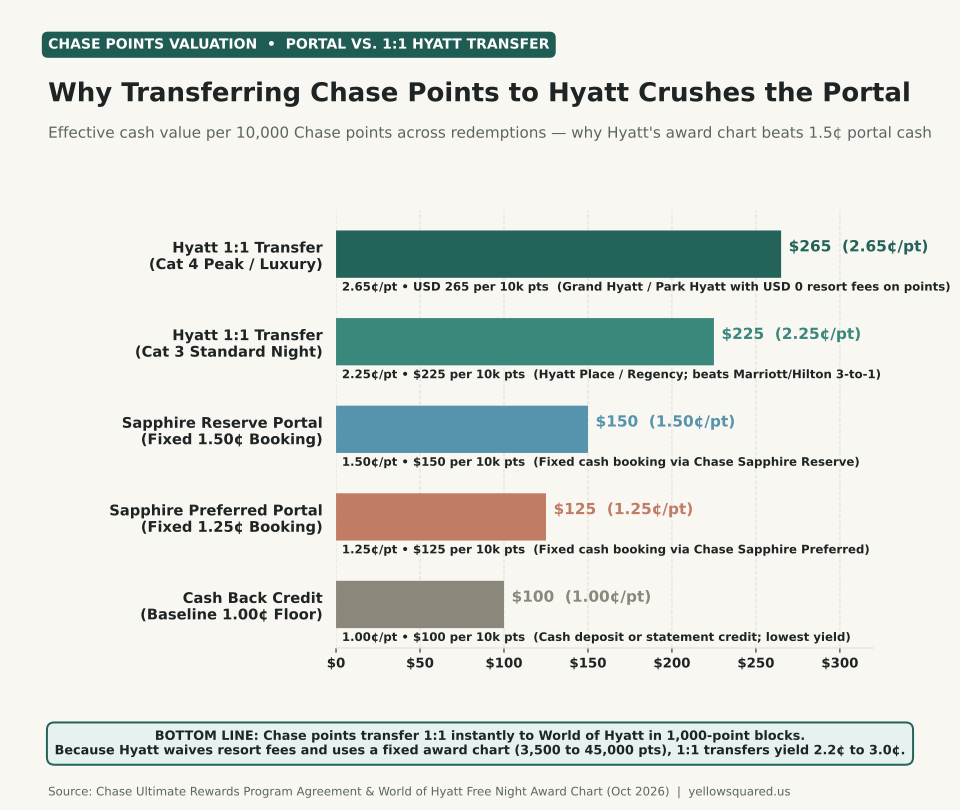
The highest-value way to redeem Chase Ultimate Rewards points is transferring them 1:1 to World of Hyatt, where points routinely yield 2.2 to 2.8 cents each — delivering up to double the value of the Chase Sapphire travel portal (which locks points at 1.25 cents for Sapphire Preferred or 1.50 cents for Sapphire Reserve). Because World of Hyatt continues to use a transparent Category 1 through Category 8 award chart and completely waives resort and destination fees on all award stays, 15,000 Chase points can unlock a $380 resort night instead of just $187 in portal cash.

Comparison card contrasting the fixed Chase travel portal redemption ceiling against the World of Hyatt 1:1 transfer sweet spot.
Why transferring Chase points directly to World of Hyatt delivers up to double the purchasing power of the Sapphire portal.

Cardholders who earn Chase Ultimate Rewards through cards like the Chase Sapphire Preferred, Sapphire Reserve, or Ink Business Preferred often rely on the in-app Chase travel portal to book hotels. While the portal is simple, it treats your points like cash at a fixed ceiling. Meanwhile, transferring those same points directly into World of Hyatt leverages one of the last remaining fixed award charts in the loyalty industry.

In the Chase portal, a $400 hotel room costs 26,600 to 32,000 points; transferred to Hyatt, that exact same room can cost as little as 12,000 to 15,000 points with resort fees waived.

Horizontal bar chart comparing effective dollar value per 10,000 Chase points across redemptions: Hyatt Category 4 peak night at 265 dollars (2.65 cents/pt), Hyatt Category 3 standard night at 225 dollars (2.25 cents/pt), Sapphire Reserve portal at 150 dollars (1.50 cents/pt), Sapphire Preferred portal at 125 dollars (1.25 cents/pt), and cash back at 100 dollars (1.00 cent/pt).
Figure 1: Real-world dollar value gained per 10,000 Chase Ultimate Rewards points across redemption options, including waived resort fees on Hyatt award stays. Program terms verified from Chase Ultimate Rewards and the World of Hyatt Free Night Award Chart (Oct 2026). Download raw data: how-to-use-chase-ultimate-rewards-for-hyatt.csv.

Why Hyatt's Fixed Award Chart Beats Dynamic Pricing

Most major hotel chains (including Marriott Bonvoy and Hilton Honors) have replaced published award charts with dynamic pricing tied directly to cash room rates. As documented in our Points Devaluation Index, dynamic pricing pegging points to roughly 0.6 to 0.8 cents per point makes it nearly impossible to score outsized redemptions.

World of Hyatt, however, retains a published Category 1 through 8 award chart. Every property belongs to a permanent category that requires a fixed number of points regardless of how high cash prices climb:

  • Category 1: 3,500 off-peak / 5,000 standard / 6,500 peak points per night (cash rates often $120 to $160).
  • Category 2: 6,500 off-peak / 8,000 standard / 9,500 peak points per night (cash rates often $160 to $220).
  • Category 3: 9,000 off-peak / 12,000 standard / 15,000 peak points per night (cash rates often $220 to $320).
  • Category 4: 12,000 off-peak / 15,000 standard / 18,000 peak points per night (cash rates often $280 to $450).
  • Category 7 & 8 (Luxury / All-Inclusive): 25,000 to 45,000 points per night at Park Hyatt or Alila resorts where cash rates exceed $1,000 per night.

The Hidden Perk: $0 Resort Fees on Award Stays

Under World of Hyatt program terms, all members — regardless of elite status — pay $0 in mandatory resort, destination, or facility fees when booking with points. At destination resorts in Hawaii, Florida, or Las Vegas where hotels charge $45 to $65 per night in mandatory fees, a four-night points stay saves $180 to $260 in out-of-pocket cash alone. When booking through the Chase travel portal or third-party OTAs, those resort fees are collected in cash at check-in.

Step-by-Step: How to Transfer Chase Points to Hyatt

  1. Open a free World of Hyatt account: Sign up at Hyatt.com and note your 9-digit member number.
  2. Verify award space first: Go to Hyatt.com, check the box for "Use Points," and search your destination dates to confirm that standard rooms are available for points.
  3. Log into Chase Ultimate Rewards: Navigate to "Transfer Points to Partners" and select World of Hyatt.
  4. Link your account and transfer: Enter your Hyatt account number. Transfers must be made in 1,000-point increments and complete instantly (under 60 seconds).
  5. Complete booking on Hyatt: Refresh your Hyatt browser tab, select your room, and complete the reservation directly with the hotel chain.

To compare live transfer partner values, bonus promotions, and break-even thresholds, launch the Pointsuno transfer calculator.

024 / 47

Are Hotel Credit Card Free Night Certificates Worth the Annual Fee?

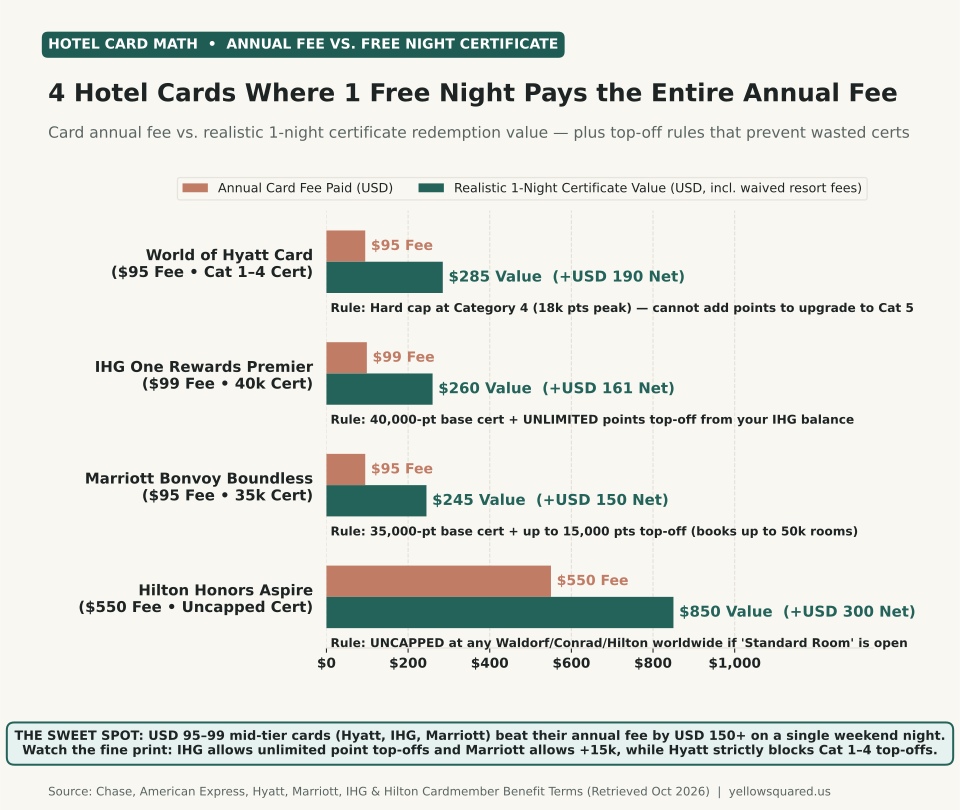
Mid-tier hotel credit cards with $95 to $99 annual fees — specifically the World of Hyatt Card, IHG One Rewards Premier, and Marriott Bonvoy Boundless — are worth keeping long-term because their anniversary free night certificates routinely unlock $245 to $285 hotel rooms, netting $150 to $190 in positive value every year. However, maximizing those certificates depends entirely on knowing which programs let you top off a certificate with extra points and which programs enforce a hard category ceiling.

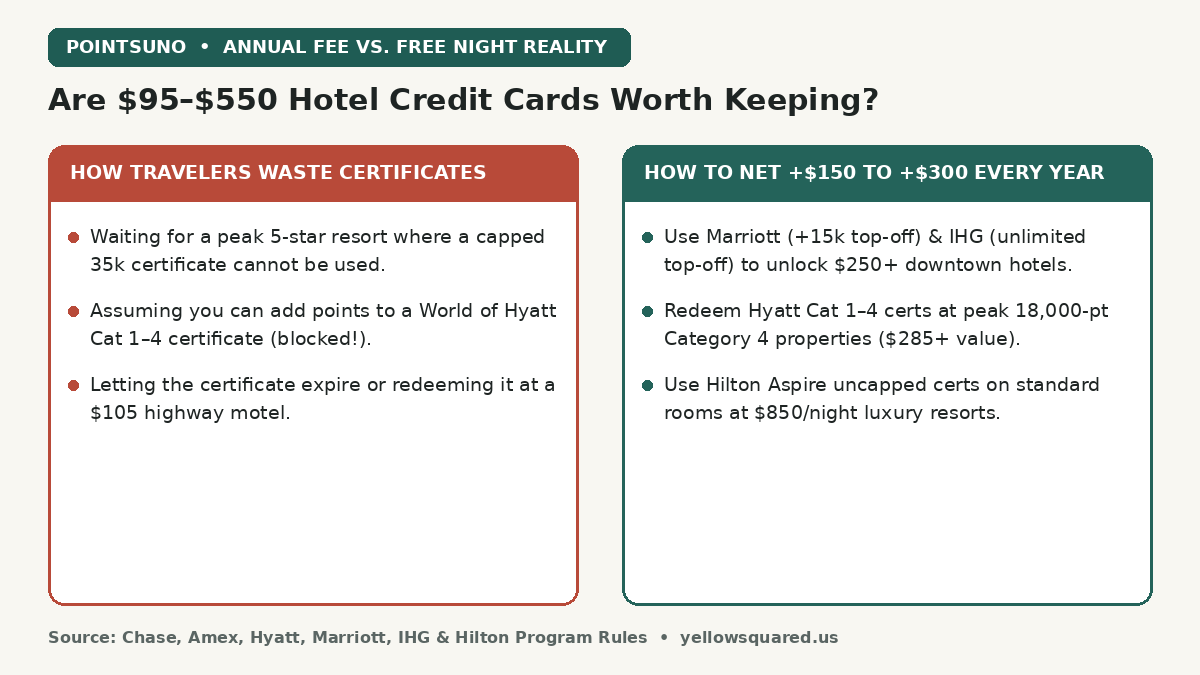
Comparison card showing how travelers waste hotel credit card free night certificates versus how to net 150 to 300 dollars every year using Marriott 15k top-offs, IHG unlimited top-offs, Hyatt Category 4 peak redemptions, and Hilton Aspire uncapped resort bookings.
Why point top-off rules and resort-fee waivers determine whether an anniversary hotel certificate is a $200+ win or an expired coupon.

Unlike airline companion tickets that require buying a cash fare first, a hotel credit card anniversary free night award (FNA) is a standalone voucher deposited into your loyalty account each year after your renewal fee posts. Yet thousands of cardholders either let these certificates expire unused or redeem them at $110 roadside hotels because they get tripped up by dynamic pricing caps. Here is how the four major hotel certificate structures compare dollar for dollar.

A $95 hotel card is not a spending card — it is a discounted subscription to one $260 hotel night per year, with resort fees waived on top.

Horizontal grouped bar chart comparing the annual credit card fee against realistic 1-night certificate redemption value across four major hotel credit cards: World of Hyatt Card (95 dollar fee vs 285 dollar value, +190 dollar net), IHG One Rewards Premier (99 dollar fee vs 260 dollar value, +161 dollar net), Marriott Bonvoy Boundless (95 dollar fee vs 245 dollar value, +150 dollar net), and Hilton Honors Aspire (550 dollar fee vs 850 dollar value, +300 dollar net).
Figure 1: Annual fee versus realistic single-night redemption value (including waived destination/resort fees) across the four flagship U.S. hotel credit card certificates. Program rules verified from World of Hyatt, Marriott Bonvoy, IHG One Rewards, and Hilton Honors terms (Oct 2026). Download raw data: are-hotel-credit-card-free-night-certificates-worth-it.csv.

The Crucial Difference: Hard Category Caps vs. Points Top-Offs

When hotel chains moved away from fixed award charts toward dynamic pricing, a 35,000-point or 40,000-point certificate risked becoming unusable whenever a downtown hotel raised its Saturday night rate to 42,000 points. As we track in our Points Devaluation Index, each hotel program solved that problem with a different rule:

  • World of Hyatt (Category 1–4 Certificate — NO Top-Off Allowed): Hyatt still uses a published award chart where a Category 4 room costs 12,000 points off-peak, 15,000 points standard, or 18,000 points peak. Your Category 1–4 certificate covers any standard room in Categories 1 through 4 even on an 18,000-point peak night. However, Hyatt strictly prohibits adding 2,000 points from your account to book a 20,000-point Category 5 hotel.
  • IHG One Rewards Premier (40,000-Point Certificate + UNLIMITED Top-Off): IHG gives you the most flexible top-off rule among $99 cards: the anniversary certificate covers up to 40,000 points, and you can add an unlimited number of IHG points from your existing balance to book a 55,000- or 70,000-point Kimpton or InterContinental property.
  • Marriott Bonvoy Boundless / Amex Business (35,000-Point Certificate + 15,000-Point Max Top-Off): Under Marriott Bonvoy's Free Night Award rules, you can add up to 15,000 Marriott points from your account to a 35,000-point certificate, expanding your booking ceiling to 50,000 points per night (or up to 100,000 points on 85,000-point luxury card certificates).
  • Hilton Honors Aspire (Uncapped Standard Room Reward): Hilton's certificate has no point cap at all, provided the property has "Standard Room Reward" inventory (rather than "Premium Room Reward" inventory). That allows a single certificate to book a 110,000- to 150,000-point room at a Waldorf Astoria or Conrad resort retailing for $800 to $1,100 per night.

Side-by-Side Comparison of the 4 Major Hotel Certificates

The table below compares annual fees, certificate ceilings, top-off flexibility, and resort-fee rules across the four programs:

Card & Loyalty Program Annual Fee Certificate Cap Points Top-Off Allowed? Resort Fees on Cert Stay?
World of Hyatt Credit Card $95 Category 1–4 (up to 18,000 pts peak) No (Hard cap at Cat 4) $0 (Waived)
IHG One Rewards Premier $99 40,000 points base Yes — Unlimited $25–$45 (Charged at some resorts)
Marriott Bonvoy Boundless $95 35,000 points base Yes — Up to +15,000 pts (50k max) $30–$55 (Charged at resorts)
Hilton Honors American Express Aspire $550 Uncapped (Any Standard Room) Not needed (Uncapped) $0 (Waived)

Three Rules to Never Lose Value on a Hotel Certificate

  1. Check the hidden resort-fee math: Both World of Hyatt and Hilton Honors waive mandatory resort and destination fees (often $40 to $65 per night) on all free night certificate stays, whereas Marriott and IHG still collect resort fees in cash at check-out.
  2. Book by the expiration date — and know which chains extend: All four certificates expire 12 months after issuance. Remember that expiration is generally a stay-by date (meaning check-out must occur before expiration), so set a calendar reminder 90 days out alongside your regular points expiration checkup.
  3. Price-check cash vs. certificate before clicking book: Never burn a $95 card certificate on a $115 airport hotel when a $275 downtown weekend stay is coming up two months later. You can model certificate break-even thresholds and transfer partner alternatives inside the Pointsuno rewards valuation calculator.