The best Bilt transfer partner is the one that has the trip you want at a price you like. I check the booking first, then move points only if the numbers work.
Bilt currently lists airline partners including Atmos Rewards, Air Canada Aeroplan, Avianca LifeMiles, United, and Flying Blue. Hotel options include World of Hyatt, Hilton, Marriott, and IHG. The partner list and transfer ratios can change, so check Bilt's current list before planning around one.
Where I would start
For a hotel stay: Compare the cash rate with the points price at World of Hyatt, Hilton, Marriott, or IHG. A high cents-per-point result only matters if you'd pay that cash rate.
For a flight: Search the airline's own program and partner programs that can book the same flight. Atmos, Aeroplan, LifeMiles, Flying Blue, and United can price partner awards differently.
For a transfer bonus: Treat the bonus as a discount on the points needed, not a reason to transfer without a booking.
Before you transfer, confirm the exact flight or room is available through the program you plan to use. Bilt says transfers cannot be reversed. Most are immediate, but it advises allowing up to 48 hours, and up to 72 hours for Southwest.
I use Pointsuno's partner comparison to see which programs share a transfer source. It does not check live award inventory, so I verify availability with the airline or hotel before moving points.
The Citi ThankYou redemption split: while cashing in points for statement credits fixes value at 1.0¢ each, transferring 1:1 to airline partners like Qatar Airways and Turkish Airlines unlocks 3.3¢ to 5.5¢ per point on international flights.
If you carry a Citi Strata Premier or Citi Prestige card, your Citi ThankYou points can be redeemed directly for cash back, statement credits, or gift cards at a flat 1.0 cent per point. For cardholders looking for simplicity, a $500 check on a 50,000-point balance sounds reasonable. But if you are using your points for flights, cashing out at 1.0¢ surrenders more than three times the travel value your points could otherwise purchase.
According to audited airline award charts and live cash fare cross-checks, transferring Citi ThankYou points 1:1 to international airline loyalty partners regularly yields 3.3 to 5.5 cents per point. With high-value partners like Qatar Airways Privilege Club, Turkish Miles&Smiles, and Virgin Atlantic, a 70,000-point balance can book lie-flat business class seats that retail for over $3,800.
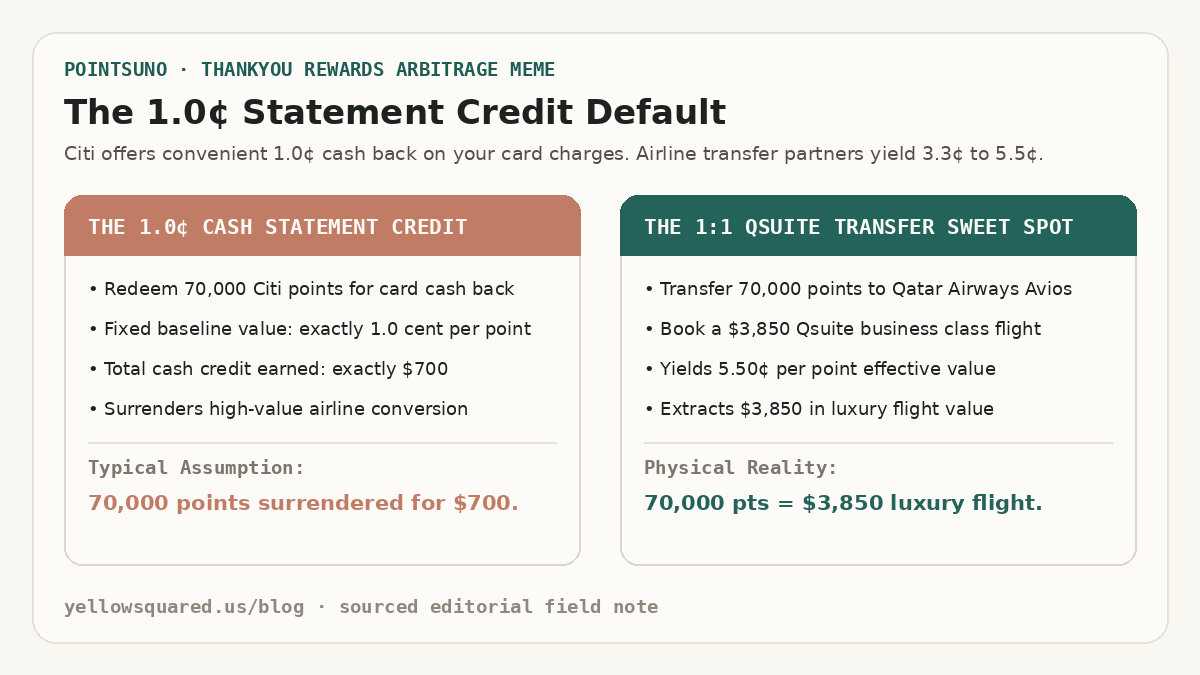
Cashing out 70,000 Citi points gets you $700 on your credit card bill; transferring those same 70,000 points to Qatar Airways books a $3,850 private Qsuite to Doha or the Maldives.
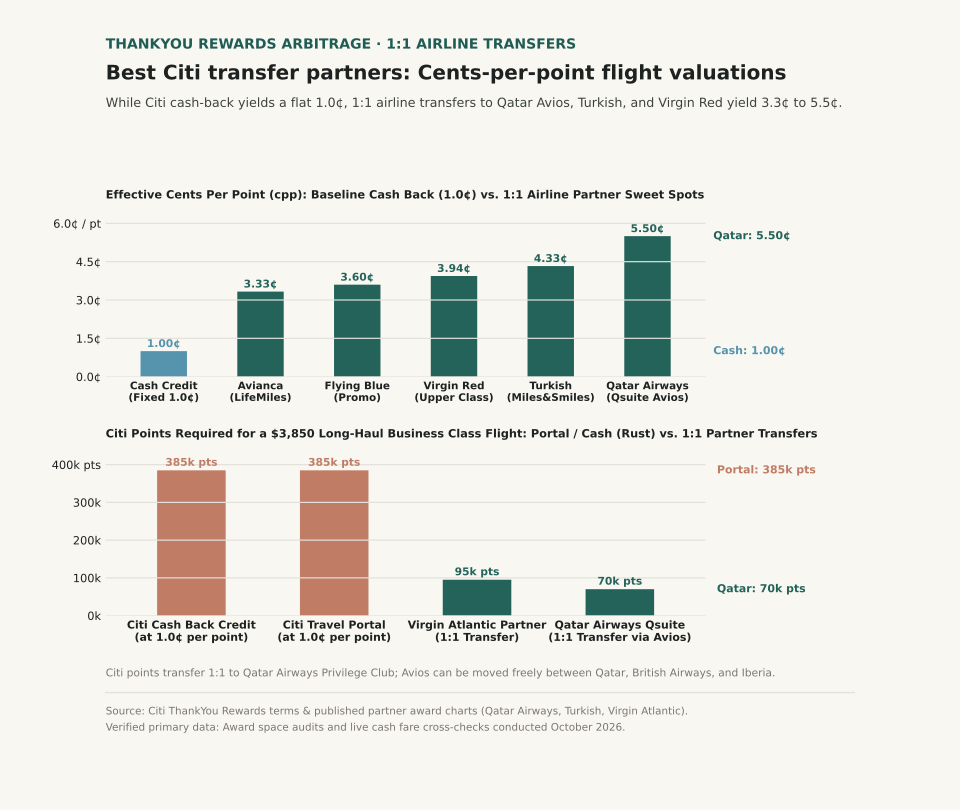
Panel A contrasts cents-per-point valuations: fixed cash-back yields 1.0¢, while 1:1 transfer partners like Avianca LifeMiles (3.33¢), Flying Blue (3.60¢), Virgin Red (3.94¢), Turkish Miles&Smiles (4.33¢), and Qatar Airways Privilege Club (5.50¢) multiply point value. Panel B shows points needed for a $3,850 business flight: 385k via cash credit vs. 70k via Qatar Airways Avios. Reproducible dataset: citi-thankyou-partner-cpp-sweet-spots.csv.
1. Qatar Airways Privilege Club: The Qsuite Avios Gateway
Citi's partnership with Qatar Airways Privilege Club is one of the most powerful moves in the points landscape. Because Qatar adopted Avios as its loyalty currency, your Citi points transfer 1:1 into Qatar Avios - which can then be linked and transferred freely at a 1:1 ratio between British Airways, Iberia, and Finnair with zero fees.
The crown jewel redemption is Qatar's world-renowned Qsuite business class (complete with closing privacy doors, double beds, and gourmet dining):
US to Doha (Nonstop Business Class): Just 70,000 Avios one-way from cities like New York, Chicago, Dallas, or Los Angeles.
US to the Maldives, South Africa, or Southeast Asia: Just 85,000 Avios one-way with a connection in Doha.
A cash Qsuite ticket from JFK to Doha routinely sells for $3,850. Booking that seat for 70,000 points yields an incredible 5.50 cents per point.
2. Turkish Airlines Miles&Smiles: United Domestic & Hawaii Sweet Spots
Because Turkish Airlines is a Star Alliance member alongside United Airlines, transferring Citi points 1:1 to Turkish Miles&Smiles unlocks the single cheapest way to book United flights in North America:
Domestic US Economy (any distance): Just 10,000 miles one-way (including coast-to-coast flights like Newark to San Francisco).
Domestic US Business / First Class: Just 15,000 miles one-way (including nonstop lie-flat flights to Hawaii from the West Coast).
While United's own MileagePlus program charges 25,000 to 50,000 miles for transcon flights, Turkish charges just 10k to 15k miles plus $5.60 in taxes, delivering 4.33 cents per point.
Citi ThankYou points transfer 1:1 instantly to Virgin Red, which connects directly to Virgin Atlantic Flying Club. Because Virgin Atlantic belongs to SkyTeam, you can book short-haul domestic Delta flights for as few as 7,500 to 11,000 Virgin miles, completely sidestepping Delta's inflated dynamic pricing.
For transatlantic flights, Virgin Atlantic Upper Class from New York or Boston to London Heathrow starts at 47,500 miles one-way, yielding nearly 4.0 cents per point even after UK departure taxes.
Citi ThankYou points give you direct access to the Avios ecosystem, Star Alliance sweet spots, and SkyTeam redemptions - all from a single credit card.
4. Avianca LifeMiles & Air France-KLM Flying Blue
For European travel, Air France-KLM Flying Blue releases monthly Promo Rewards offering one-way economy flights to Europe from 15,000 miles and business class from 50,000 miles. When booking Star Alliance flights to Europe on Lufthansa or Swiss, Avianca LifeMiles requires 63,000 miles in business class while passing along zero fuel surcharges.
Citi ThankYou 1:1 airline transfer partners, alliances, and top redemption values (sources: NerdWallet Citi Guide and published airline award charts).
Airline Partner
Alliance Network
Transfer Speed
Top Award Sweet Spot
Typical cpp Range
Qatar Airways (Avios)
Oneworld
Instant
Qsuite to Doha (70k) & Maldives (85k)
4.0¢ – 5.8¢ / pt
Turkish Miles&Smiles
Star Alliance
1 to 24 hours
United domestic: 10k econ / 15k biz
3.5¢ – 4.8¢ / pt
Virgin Atlantic / Virgin Red
SkyTeam
Instant
Delta domestic short-haul & London Upper Class
2.5¢ – 4.2¢ / pt
Air France-KLM Flying Blue
SkyTeam
Instant
Promo rewards: 15k econ / 50k biz to Europe
2.8¢ – 4.5¢ / pt
Avianca LifeMiles
Star Alliance
Instant
Zero-surcharge Lufthansa & United business
2.2¢ – 3.6¢ / pt
Citi Statement Credit Baseline
N/A (Cash Back)
Instant
Any statement purchase or bank deposit
Flat 1.00¢ / pt
How to Maximize Your Citi ThankYou Points Safely
To ensure your points deliver maximum value without booking headaches:
Confirm award seat availability before transferring: Point transfers from Citi ThankYou to airline partners are strictly irreversible. Search Qatar, Turkish, or Virgin first to verify saver award availability.
Link your Qatar and British Airways accounts: Linking your Qatar Privilege Club and British Airways Executive Club accounts lets you move Avios between them instantly, giving you combined access to Qatar, BA, Iberia, and Finnair award charts.
Watch for Citi transfer bonuses: Citi frequently offers 15% to 30% transfer bonuses to partners like Flying Blue, Virgin Red, and Avianca LifeMiles, driving redemptions well past 4.5 cents per point.
Want to track live transfer bonuses and calculate the exact cash value of your Citi ThankYou points before booking? Open Pointsuno in your browser or Download Pointsuno for iPhone to compare transfer partner award charts and maximize your credit card points.
027 / 47
Best Amex Transfer Partners: How to Maximize Membership Rewards
The Amex redemption split: while cashing in Membership Rewards points for statement credits yields a meager 0.6¢ per point, transferring 1:1 to international airline partners unlocks 2.8¢ to 6.2¢ per point on premium flights.
If you carry an American Express Gold Card or The Platinum Card from American Express, you know that Membership Rewards points pile up fast. But when it comes time to spend them, many cardholders make the mistake of using points to cover statement charges or buying merchandise. That choice gives you just 0.6 cents per point - meaning a hard-earned 50,000-point balance turns into a measly $300 credit. Even booking flights through the Amex Travel portal caps your value at 1.0 cent per point.
According to audited airline award charts and cash fare cross-checks, the single best way to use Amex points is transferring them 1:1 to airline transfer partners. By routing points into sweet spots with programs like ANA Mileage Club, Air France-KLM Flying Blue, and Virgin Atlantic, you can consistently achieve 2.8 to 6.2 cents per point on domestic and international flights.
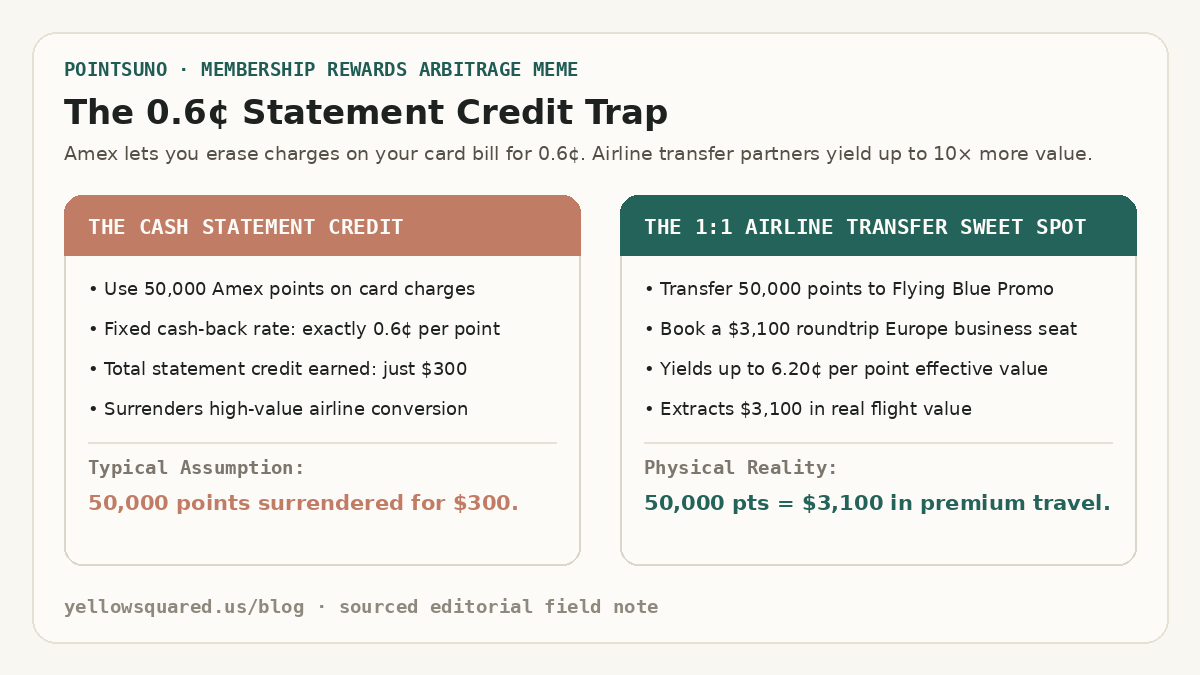
Cashing out 50,000 Amex points for a $300 statement credit throws away over $2,000 in flight value that those exact same points could book through an airline partner.
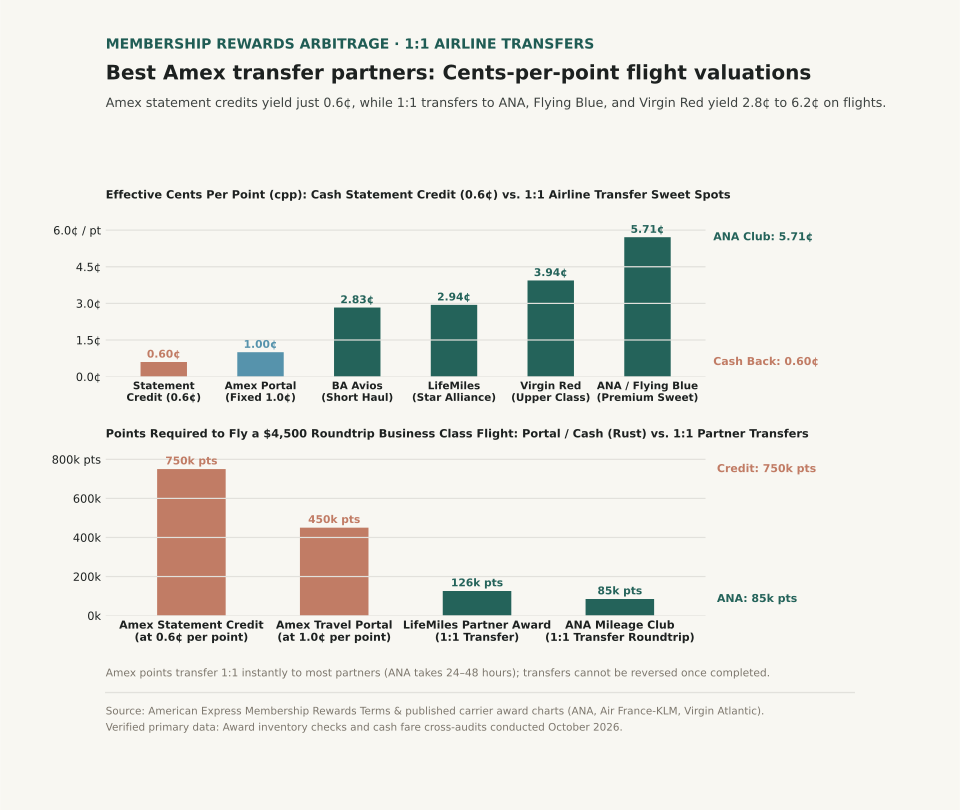
Panel A contrasts cents-per-point valuations: cash statement credits yield just 0.60¢, while 1:1 transfer partners like British Airways Avios (2.83¢), Avianca LifeMiles (2.94¢), Virgin Red (3.94¢), and ANA Mileage Club (5.71¢) multiply point value. Panel B shows points needed for a $4,500 roundtrip business flight: 750k via statement credit vs. 85k via ANA Mileage Club. Reproducible dataset: amex-transfer-partner-cpp-sweet-spots.csv.
1. All Nippon Airways (ANA) Mileage Club: The Gold Standard for Japan
For travelers planning trips to Asia, ANA Mileage Club is arguably the most lucrative transfer partner in the entire credit card landscape. Unlike U.S. carriers that price awards dynamically, ANA operates a published seasonal zone chart that offers jaw-dropping sweet spots:
Roundtrip Business Class to Japan: Just 75,000 to 88,000 ANA miles roundtrip from North America (ANA requires roundtrip bookings).
Roundtrip Business Class to Europe on Star Alliance: Just 88,000 miles roundtrip on partners like Swiss or Austrian.
A cash business-class ticket on ANA from San Francisco or New York to Tokyo routinely sells for $4,500 to $6,000. Booking that flight through ANA Mileage Club for 85,000 points yields an incredible 5.71 cents per point.
2. Air France-KLM Flying Blue: Monthly Promo Rewards to Europe
Air France-KLM Flying Blue is the easiest and most practical Amex transfer partner for European vacations. Flying Blue releases monthly Promo Rewards offering 25% to 50% discounts on award tickets, and transfers from Amex post instantly:
Economy to Europe: Regularly available from 15,000 to 20,000 miles one-way from East Coast cities like Boston, New York, and Washington D.C.
Lie-Flat Business Class to Paris or Amsterdam: Frequently bookable for 50,000 miles one-way on Promo Rewards.
Redeeming 50,000 points for a $3,100 one-way business ticket yields 6.20 cents per point, making it the best option for transatlantic comfort.
Because Virgin Atlantic is a member of the SkyTeam alliance alongside Delta Air Lines, you can transfer Amex points 1:1 to Virgin Red to book Delta flights. While Delta SkyMiles often charges 40,000 to 70,000 miles for domestic flights, Virgin Atlantic's partner chart frequently prices the exact same Delta seats at just 8,500 to 11,500 miles.
For transatlantic travel, Virgin Atlantic Upper Class awards between the U.S. East Coast and London Heathrow start at 47,500 miles one-way, delivering 3.5 to 4.2 cents per point even after accounting for UK airport departure taxes.
Never transfer Amex points to Delta SkyMiles to book domestic flights without checking Virgin Atlantic first; Virgin often charges half the miles for the exact same Delta seat.
4. Avianca LifeMiles & British Airways Avios
When booking Star Alliance flights where ANA's roundtrip rule doesn't fit, Avianca LifeMiles allows one-way bookings, passes on zero fuel surcharges, and lets you book United domestic flights without cash copays. Meanwhile, British Airways Avios shines on short-haul nonstop flights on American Airlines and Alaska Airlines, with short hops under 650 miles starting at 12,000 Avios.
Amex Membership Rewards 1:1 airline transfer partners, alliance affiliations, and top redemption values (sources: NerdWallet Amex Transfer Guide and published loyalty charts).
Airline Partner
Alliance
Transfer Time
Top Award Sweet Spot
Typical cpp Range
ANA Mileage Club
Star Alliance
24 – 48 hours
Roundtrip Japan business: 75k–88k miles
4.5¢ – 5.8¢ / pt
Air France-KLM Flying Blue
SkyTeam
Instant
Promo rewards: 15k econ / 50k biz to Europe
2.8¢ – 6.2¢ / pt
Virgin Atlantic / Virgin Red
SkyTeam
Instant
Domestic Delta short-haul & London Upper Class
2.5¢ – 4.0¢ / pt
Avianca LifeMiles
Star Alliance
Instant
Zero-surcharge Lufthansa & United business flights
2.4¢ – 3.6¢ / pt
British Airways Avios
Oneworld
Instant
Nonstop short-haul American & Alaska flights
2.0¢ – 3.0¢ / pt
Amex Statement Credit Baseline
N/A (Cash Credit)
Instant
Any card purchase (cash-back equivalent)
Flat 0.60¢ / pt
How to Transfer Amex Points Safely
To avoid stranding your points in an airline program you can't use:
Find saver award space before transferring: Point transfers from American Express to airline partners are strictly irreversible. Create free accounts with ANA, Air France, or Virgin, search for the flight, verify that seats are available at the saver rate, and only then initiate the transfer.
Account for ANA's 48-hour transfer delay: While transfers to Flying Blue, Virgin, and Avianca happen instantly, transfers to ANA take 24 to 48 hours to post. If award space is scarce, consider holding the reservation or having a backup plan.
Take advantage of Amex transfer bonuses: Amex frequently offers 15% to 30% bonus miles when transferring to partners like Virgin Atlantic, Flying Blue, or British Airways, giving you even more purchasing power.
Want to calculate the exact cash value of your Amex Membership Rewards points and track live transfer bonuses? Open Pointsuno in your browser or Download Pointsuno for iPhone to compare transfer partner award charts and maximize your points.
028 / 47
Best Capital One Transfer Partners: How to Maximize Venture Miles
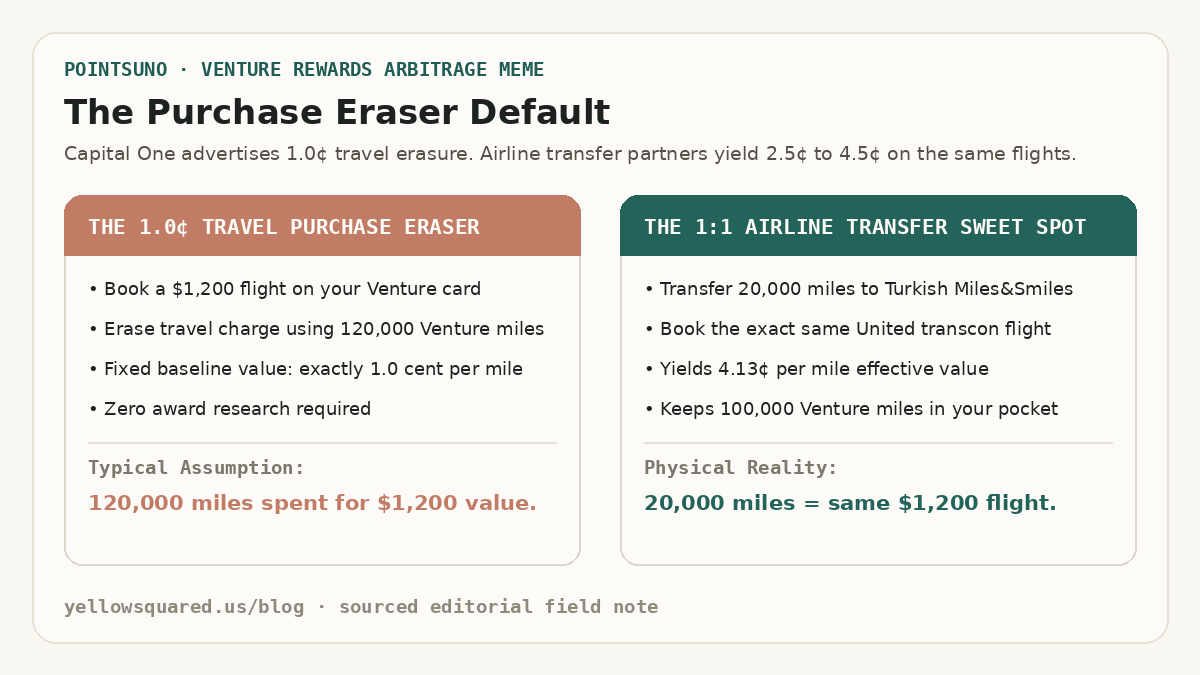
The Capital One redemption divide: while clicking 'Erase Travel Purchases' fixes miles at 1.0¢ each, transferring 1:1 to airline loyalty partners yields 2.6¢ to 4.5¢ per mile on domestic and international partner flights.
If you have a Capital One Venture Rewards or Capital One Venture X card, the easiest way to spend your miles is clicking "Cover Travel Purchases" on your monthly statement. It's painless, it requires zero award searching, and it gives you exactly 1.0 cent per mile ($500 in travel = 50,000 miles). But if you only use the purchase eraser, you are leaving more than half the value of your miles on the table. According to credit card loyalty data audited across airline award tariffs, transferring your Capital One miles 1:1 to airline transfer partners regularly delivers 2.6 to 4.5 cents per mile - turning a 50,000-mile balance into $1,300 to $2,250 worth of flights.
Capital One partners with 16 airline and 3 hotel loyalty programs. By transferring miles directly to international airline alliance partners, you can book United, American, Delta, and international business class flights for a fraction of the cash-backed eraser price.
The purchase eraser is a safety net, not a strategy; transferring 20,000 Capital One miles to an airline partner can book a transcontinental flight that would otherwise cost 120,000 miles through the statement credit.
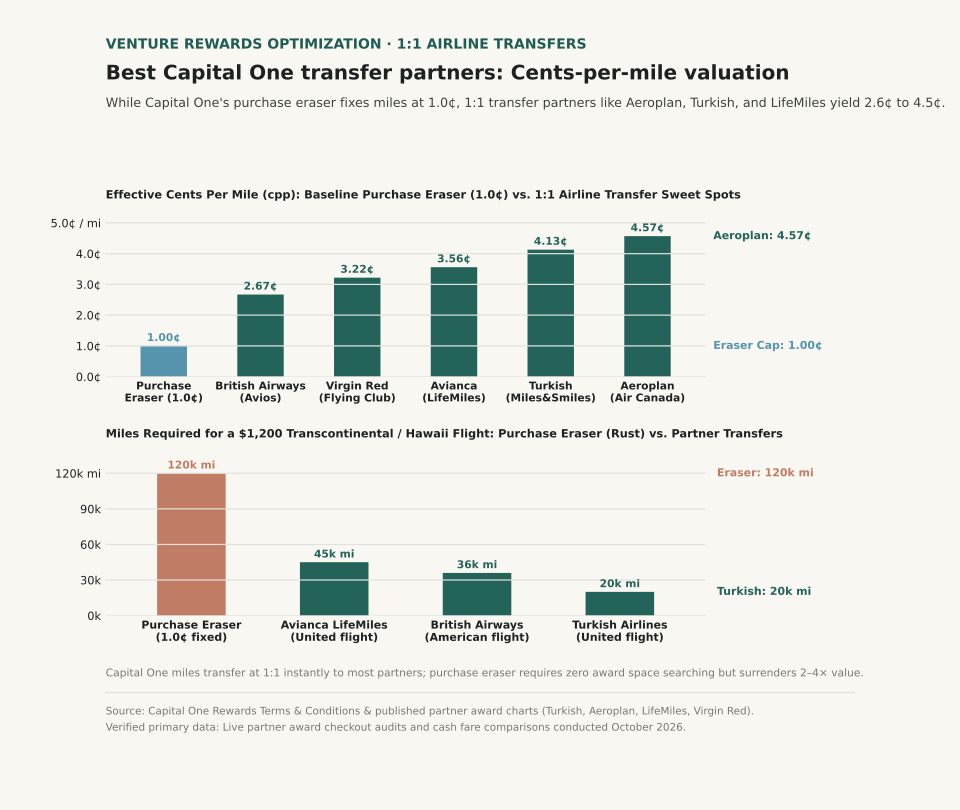
Panel A contrasts cents-per-mile valuations: the baseline travel purchase eraser yields 1.0¢, while 1:1 transfer partners like British Airways Avios (2.67¢), Virgin Red (3.22¢), Avianca LifeMiles (3.56¢), Turkish Miles&Smiles (4.13¢), and Air Canada Aeroplan (4.57¢) deliver up to 4.5× more value. Panel B shows miles required for a $1,200 transcon flight: 120k on the eraser vs. 20k–45k via partner transfers. Reproducible dataset: capital-one-transfer-partner-cpp-sweet-spots.csv.
1. Turkish Airlines Miles&Smiles (The United Domestic Sweet Spot)
Because Turkish Airlines belongs to the Star Alliance alongside United Airlines, you can transfer Capital One miles 1:1 to Turkish Miles&Smiles to book United flights. While United's own MileagePlus program charges 15,000 to 45,000 miles for a domestic one-way ticket, Turkish maintains a published zone-based award chart that prices all domestic flights within the United States - including Alaska and Hawaii - at unbelievable rates:
Domestic Economy anywhere in the U.S.: Just 10,000 miles one-way (even transcon Newark to San Francisco or Chicago to Honolulu).
Domestic First / Business Class: Just 15,000 miles one-way.
A nonstop flight from Los Angeles to Maui that retails for $620 cash requires 62,000 miles via the Capital One purchase eraser. Booking that same United seat via Turkish Miles&Smiles costs just 15,000 miles plus $5.60 in taxes - yielding 4.13 cents per mile.
2. Air Canada Aeroplan (Star Alliance Long-Haul Powerhouse)
Air Canada Aeroplan is widely considered the single most versatile transfer partner in the Capital One portfolio. Aeroplan uses a published hybrid distance-and-zone award chart, partners with over 45 airlines (including Lufthansa, Swiss, Singapore, EVA Air, and Emirates), and does not pass along carrier fuel surcharges.
Top Aeroplan sweet spots with Capital One miles include transatlantic business class from the East Coast to Europe (under 4,000 miles distance) for just 60,000 to 70,000 Aeroplan points on airlines like Swiss, TAP Portugal, or Lufthansa. On a $3,200 business class cash ticket, that redemption yields an astonishing 4.57 cents per mile.
3. Virgin Red / Virgin Atlantic Flying Club (Europe & Delta Flights)
Capital One miles transfer 1:1 instantly to Virgin Red, which links seamlessly with Virgin Atlantic Flying Club. Virgin Red unlocks two distinct sweet spots:
Virgin Atlantic Upper Class to London: Flights from New York or Boston to London Heathrow cost as few as 47,500 miles one-way (plus UK carrier surcharges), offering full lie-flat comfort across the Atlantic.
Domestic Delta Flights: Because Virgin is a SkyTeam partner with Delta, you can book short-haul domestic Delta flights for as few as 7,500 to 11,000 Virgin miles, avoiding Delta's expensive dynamic award pricing.
Booking domestic Delta flights through Virgin Red frequently costs half the miles Delta charges its own SkyMiles members.
4. Avianca LifeMiles & British Airways Avios
For Star Alliance flights where Turkish has no award space, Avianca LifeMiles provides an instant backup: it charges no booking fees, passes on zero fuel surcharges, and allows mixed-cabin pricing. Meanwhile, British Airways Avios operates a distance-based award chart that excels on short-haul flights: nonstop American Airlines and Alaska Airlines flights under 650 miles (like Dallas to Houston, or Seattle to Portland) cost as few as 12,000 Avios.
Capital One 1:1 transfer partner sweet spots, alliance networks, and effective redemption values (sources: NerdWallet Capital One Guide and published partner award charts).
Airline Partner
Alliance
Transfer Ratio & Speed
Best Redemption Sweet Spot
Typical cpp Value
Turkish Miles&Smiles
Star Alliance
1:1 (Instant to 24 hrs)
United domestic & Hawaii: 10k econ / 15k biz
3.5¢ – 4.5¢ / mi
Air Canada Aeroplan
Star Alliance
1:1 (Instant)
Transatlantic & transpacific partner business
2.8¢ – 4.8¢ / mi
Virgin Red / Flying Club
SkyTeam
1:1 (Instant)
London Upper Class & domestic Delta short-haul
2.4¢ – 3.8¢ / mi
Avianca LifeMiles
Star Alliance
1:1 (Instant)
Zero-surcharge Lufthansa & United business awards
2.2¢ – 3.6¢ / mi
British Airways Avios
Oneworld
1:1 (Instant)
Short-haul American & Alaska flights under 650 mi
2.0¢ – 3.0¢ / mi
Purchase Eraser Baseline
N/A (Cash Credit)
1:1 (Instant credit)
Any travel expense (hotels, trains, budget airlines)
Flat 1.0¢ / mi
The 3-Step Strategy to Maximize Your Venture Miles
To extract maximum value from every Venture mile without getting overwhelmed:
Check partner award space first before transferring: Never transfer miles speculatively; bank point transfers are one-way. Search Turkish, Aeroplan, or Virgin first to confirm saver award availability.
Use the Purchase Eraser for non-chain hotels, trains, and boutique rentals: When booking flights, transfer partners almost always win. But for boutique Airbnb stays, train tickets, rental cars, or flights where award space is zero, the 1.0¢ eraser is a reliable backup.
Watch for transfer bonuses: Capital One regularly runs 15% to 30% transfer bonus promotions to partners like Virgin Red, Flying Blue, and British Airways, driving effective redemption values well past 4.0 cents per mile.
How to transfer Capital One miles to a partner
Transfers move in 1,000-mile increments at the ratio listed for each partner in the table above.
Confirm saver award space: Log into the airline program and confirm award space is open for your exact dates before you transfer.
Open the transfer page: Log into your Capital One account, go to your rewards dashboard, and select "Convert Rewards / Transfer Miles."
Select the partner and enter your loyalty ID: Choose your airline and enter your frequent flyer account number. Most transfers post within minutes; the table above lists each partner's usual timing.
Book right away: Refresh your airline account balance and book the ticket before the seats disappear.
To calculate transfer values and track program changes, check the Points Transfer Index.
Want to track live transfer bonuses and calculate the exact cash value of your Venture miles before you book? Open Pointsuno in your browser or Download Pointsuno for iPhone to compare transfer partner award charts and maximize your credit card points.
029 / 47
Chase Travel Portal vs. Transfer Partners: Which Gets More Flight Value?
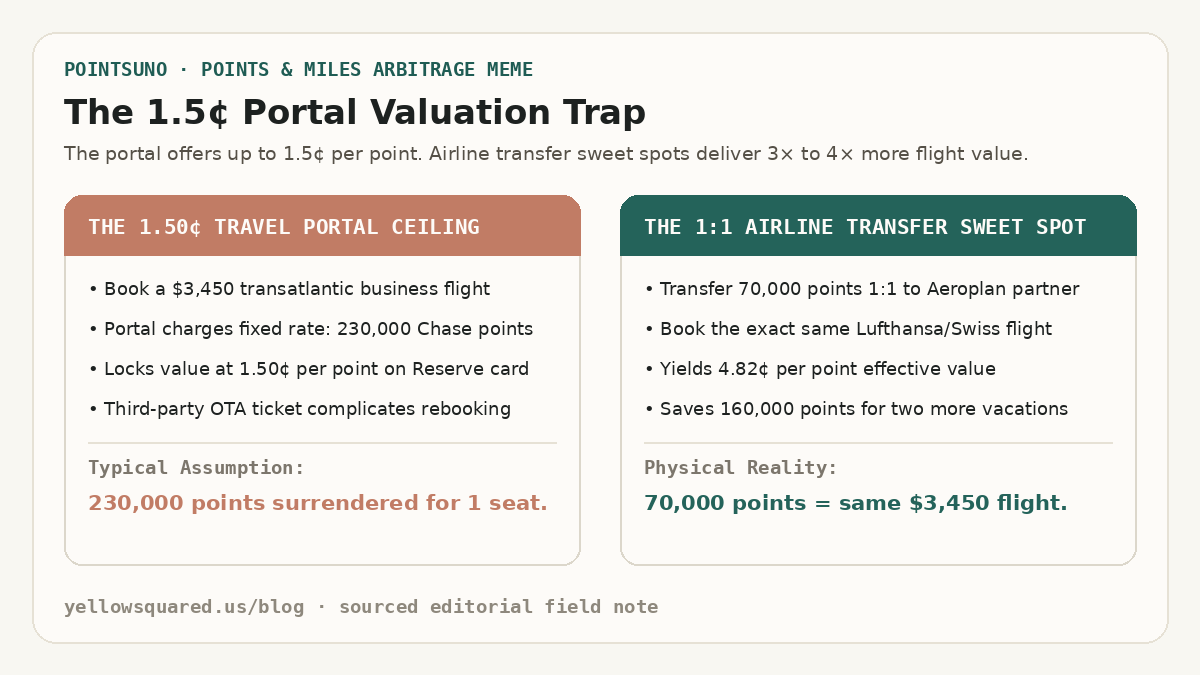
The points redemption split: booking flights through the Chase travel portal caps point value at 1.25¢ or 1.50¢, while transferring points 1:1 to airline loyalty programs unlocks 2.5¢ to 4.8¢ per point on international and premium cabin flights.
When you hold a Chase Sapphire Preferred or Chase Sapphire Reserve card, Chase advertises that your Ultimate Rewards points are worth 25% to 50% more when redeemed through the Chase travel portal. Because of that marketing, millions of cardholders assume the travel portal is the best way to book flights with points. In reality, credit card loyalty data audited across published airline tariff filings shows that the portal is often the lowest-value way to book flights. While the Chase travel portal fixes point redemptions at 1.25 cents per point (Sapphire Preferred) or 1.50 cents per point (Sapphire Reserve), transferring points 1:1 to airline transfer partners regularly unlocks 2.5 to 4.8 cents per point on long-haul business class and high-demand domestic flights.
Understanding when to use the travel portal versus when to transfer 1:1 to an airline partner is the fundamental difference between needing 230,000 points for an international flight and needing only 70,000 points for the exact same seat.
The Chase travel portal treats your points like cash with a hard 1.5-cent ceiling; transferring 1:1 to airline loyalty programs turns your points into award-chart currency that ignores expensive cash ticket prices.
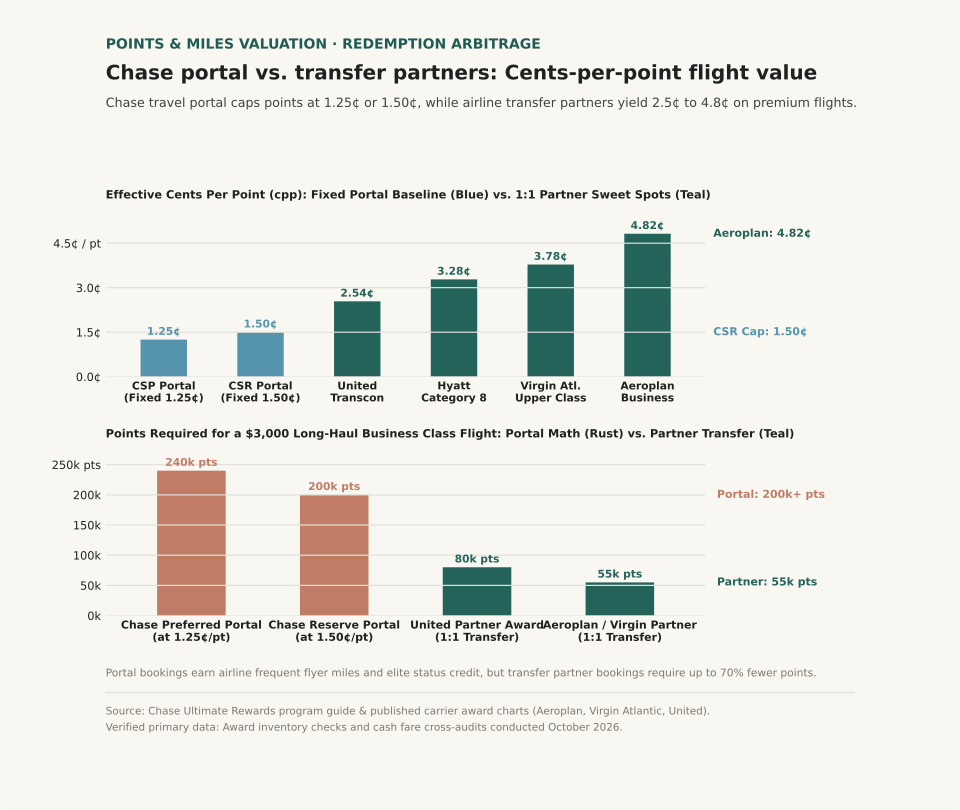
Panel A contrasts cents-per-point (cpp) valuations: fixed portal baselines yield 1.25¢ to 1.50¢, while 1:1 transfer partners like United (2.54¢), World of Hyatt (3.28¢), Virgin Atlantic (3.78¢), and Air Canada Aeroplan (4.82¢) multiply point value. Panel B plots points required for a $3,000 long-haul business flight: portal bookings demand 200,000 to 240,000 points compared to 55,000 to 80,000 points via transfer partners. Reproducible dataset: chase-portal-vs-partner-redemption-cpp.csv.
How the Chase Travel Portal Works (The Cash-Backed Rate)
When you book a flight through the Chase travel portal, Chase acts as an online travel agency (OTA, powered by cxLoyalty). The portal takes the live cash price of an airline ticket and divides it by your card's fixed point multiplier:
Chase Sapphire Preferred: Points redeem at 1.25 cents each ($100 flight = 8,000 points).
Chase Sapphire Reserve: Points redeem at 1.50 cents each ($100 flight = 6,666 points).
Chase Freedom Flex / Unlimited: Points redeem at a baseline 1.0 cent each ($100 flight = 10,000 points) unless paired with a Sapphire card.
Because portal bookings are purchased as revenue cash tickets, you earn airline frequent flyer miles and elite qualifying credit on the flight. There are no blackout dates, and if an airline has a seat for sale for cash, you can buy it with points. However, when cash ticket prices spike - such as peak summer travel to Europe or international business class - the portal's fixed multiplier forces you to pay astronomical point totals.
How 1:1 Transfer Partners Unlock 3× More Value
Chase allows Sapphire cardholders to transfer Ultimate Rewards points at a 1:1 ratio to 11 airline programs (including United, Air Canada Aeroplan, Virgin Atlantic, British Airways Avios, Air France-KLM Flying Blue, and Southwest) and 3 hotel programs (Hyatt, Marriott, IHG). When you transfer points, you leave cash ticket pricing behind and book through the airline's award chart or partner alliance network.
For example, a one-way business class seat from Boston to London on Virgin Atlantic might sell for $2,850 in cash. Through the Chase Sapphire Reserve portal at 1.5¢ per point, that ticket requires 190,000 points. But transferring points to Virgin Atlantic Flying Club lets you book the exact same seat for just 47,500 points plus taxes. That single redemption yields 3.78 cents per point and saves over 142,000 points - enough for two additional international vacations.
Booking a $3,000 flight through the Chase portal consumes 200,000 points; booking through an airline partner sweet spot costs just 55,000 to 70,000 points.
Redemption Comparison: Portal Math vs. Partner Transfers
Real-world redemption comparison of Chase travel portal bookings versus 1:1 airline and hotel transfer sweet spots (sources: NerdWallet Chase Transfer Partners Guide and published airline award charts).
Booking Route
Typical Itinerary
Cash Price
Chase Portal (1.5¢ CSR)
1:1 Partner Transfer
Points Saved
Effective cpp
Air Canada Aeroplan
New York (JFK) to Frankfurt (FRA) Business
$3,450
230,000 pts
70,000 pts
160,000 pts
4.82¢ / pt
Virgin Atlantic Flying Club
Boston (BOS) to London (LHR) Upper Class
$2,850
190,000 pts
47,500 pts (+ taxes)
142,500 pts
3.78¢ / pt
World of Hyatt
Park Hyatt Kyoto (Category 8 Luxury Hotel)
$1,150
76,666 pts
35,000 pts
41,666 pts
3.28¢ / pt
United MileagePlus
Newark (EWR) to San Francisco (SFO) Polaris
$1,280
85,333 pts
50,000 pts
35,333 pts
2.54¢ / pt
Chase Portal (Economy)
Domestic Roundtrip Economy (Any Airline)
$450
30,000 pts
30,000 pts (No award space)
0 pts
1.50¢ / pt
When You Should Use the Chase Portal vs. Transfer Partners
Use this simple rule of thumb to pick the right redemption path for your next trip:
Use 1:1 Transfer Partners for international flights, business class, and Hyatt hotels: Premium cabins and luxury hotel stays represent the highest award-chart sweet spots. If the redemption yields more than 2.0 cents per point, always transfer.
Use the Chase Travel Portal for cheap domestic economy tickets: When an airline cash fare is under $200 (such as a $120 Southwest or Delta flight), transferring points to an award program that charges 12,500 miles plus fees yields less than 1.0 cent per point. Booking via the portal for 8,000 to 9,600 points makes more financial sense and earns you frequent flyer miles.
Never transfer points until award space is verified: Bank point transfers from Chase to airline partners are strictly irreversible. Always search the airline's website, confirm the award seat exists at the saver redemption level, and only then hit transfer.
Want to calculate the exact cents-per-point value of your credit card points before you book? Open Pointsuno in your browser or Download Pointsuno for iPhone to compare live transfer bonuses, award charts, and portal cash equivalents across all your cards.
030 / 47
Do Airline Miles Expire? Expiration Rules for Every Major Airline
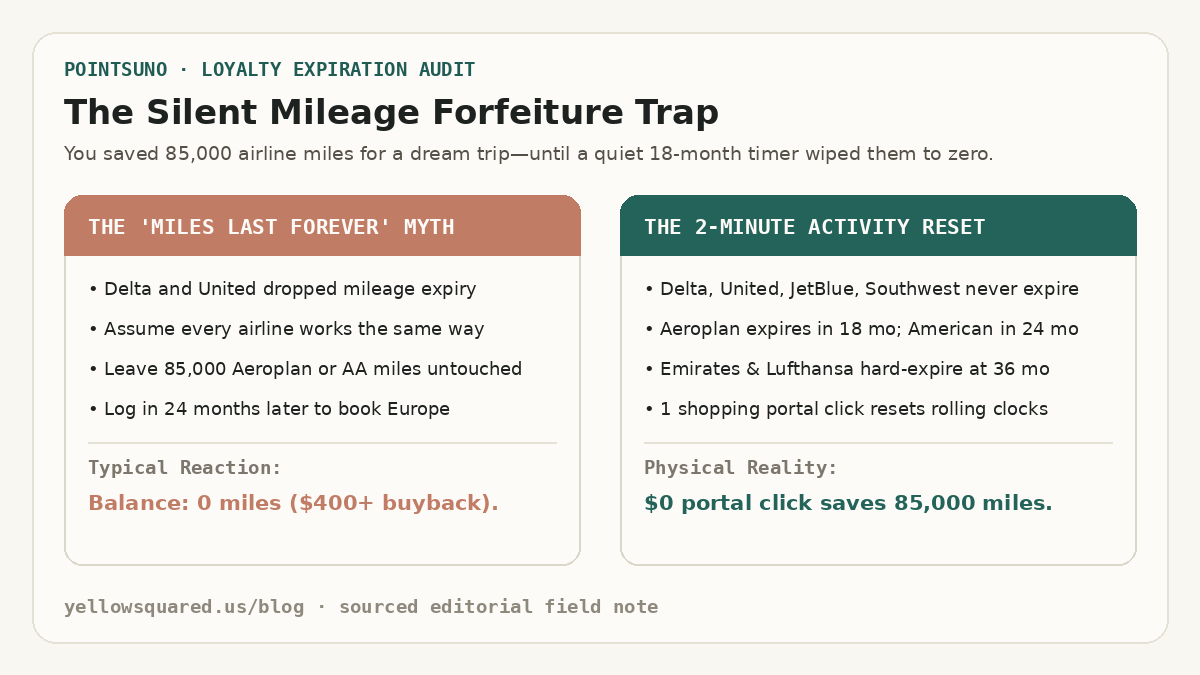
Why travelers still lose tens of thousands of points each year: five major U.S. airlines eliminated mileage expiration, lulling travelers into leaving American AAdvantage and Air Canada Aeroplan balances untouched past their 18-to-24-month forfeiture deadlines.
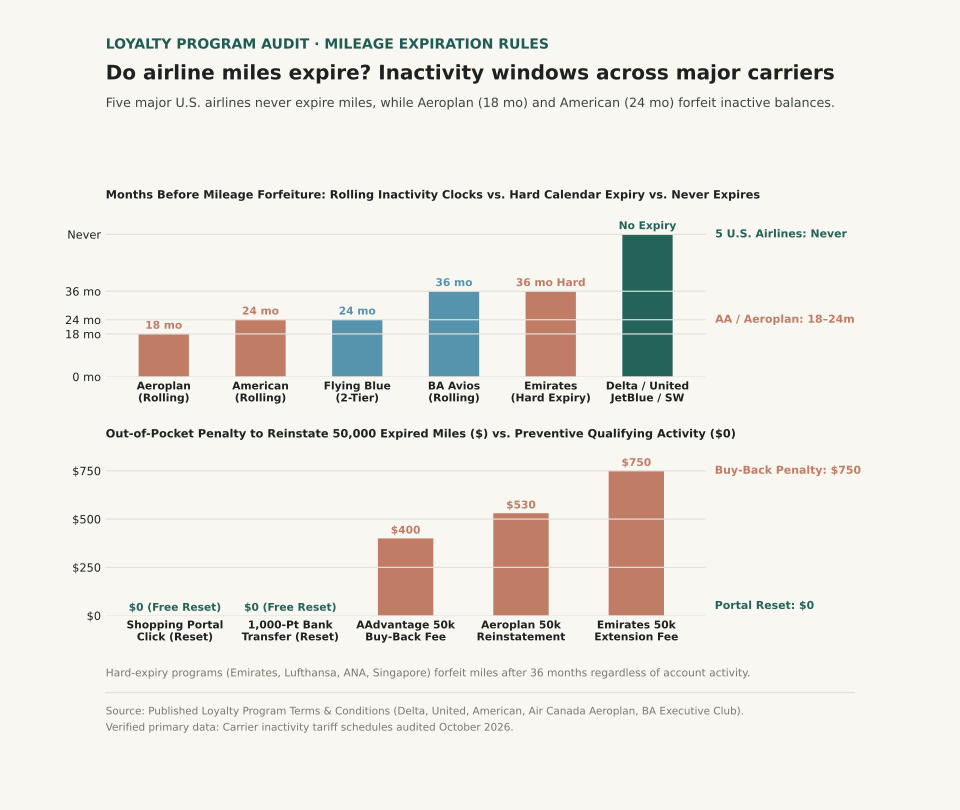
Do airline miles expire? It depends entirely on which loyalty program holds your balance. Five major U.S. carriers - Delta Air Lines, United Airlines, Southwest Airlines, JetBlue, and Alaska Airlines - eliminated mileage expiration for active accounts, meaning your points stay safe indefinitely as long as you do not close your profile. However, several of the world's most valuable award programs - including American Airlines AAdvantage (24 months), Air Canada Aeroplan (18 months), and British Airways Executive Club (36 months) - still enforce strict inactivity timers that wipe out your entire balance to zero if you do not earn or redeem at least one point before the deadline.
Even worse, loyalty programs split into three completely different expiration rules: airlines whose miles never expire, airlines with a rolling inactivity clock that resets every time you earn or spend a single mile, and foreign carriers with a hard calendar expiration date where miles expire 36 months after you earn them no matter how active your account remains.
Losing 50,000 expired American or Aeroplan miles costs $400 to $530 in reinstatement penalties - yet clicking through an airline shopping portal once every eighteen months resets the clock for free.
Panel A compares inactivity windows across major frequent flyer programs: Aeroplan forfeits inactive balances at 18 months and American AAdvantage at 24 months, while Delta, United, JetBlue, and Southwest never expire miles. Panel B contrasts the $0 cost of a preventive shopping portal or transfer reset against the $400 to $750 penalty charged to reinstate or extend 50,000 expired miles. Reproducible dataset: airline-miles-expiration-rules.csv.
Which Airline Miles Never Expire?
If your frequent flyer stash sits with one of the following airlines, your miles do not expire from ordinary inactivity:
Delta SkyMiles: Eliminated mileage expiration in 2011. Miles remain valid for the life of the member as long as the account stays open and in good standing.
United MileagePlus: Ended mileage expiration in August 2019. Existing balances never expire from inactivity.
Southwest Rapid Rewards: Ended points expiration in October 2019. Points remain valid unless you voluntarily close your account.
JetBlue TrueBlue: TrueBlue points never expire because of account inactivity.
Alaska Airlines (Atmos Rewards / Mileage Plan): Miles do not expire, though accounts with zero activity for more than two years may be locked for security until you verify your identity with customer care to reactivate the balance.
Virgin Atlantic Flying Club: Eliminated Flying Club points expiration in 2020, making it one of the few international transfer partners where stranded points never forfeit.
Airlines With 18- to 36-Month Mileage Expiration Rules
Outside those six programs, inactivity rules remain aggressive - and misunderstanding the fine print is expensive. In rolling-clock programs like Air Canada Aeroplan (18 months), American AAdvantage (24 months for members aged 21 and older without a primary co-branded credit card), and British Airways Avios (36 months), any qualifying earn, redemption, shopping portal transaction, or bank point transfer pushes the expiration date of your entire balance forward.
Two international heavyweights enforce much trickier rules. Air France-KLM Flying Blue splits your balance into two buckets with a 24-month rolling timer: flying on SkyTeam or swiping a co-branded Flying Blue credit card extends all your miles for 24 months, whereas transferring bank points from Chase, Amex, Capital One, or Citi only extends miles that originally came from bank or commercial partners - it will not extend miles earned from flying. Meanwhile, Emirates Skywards, Lufthansa Miles & More, Singapore KrisFlyer, and ANA Mileage Club impose a hard 36-month calendar expiration: each batch of miles expires three years after the month it was earned, and earning new miles does not save older ones.
Transferring flexible bank points into Emirates, Singapore KrisFlyer, or ANA starts an irreversible 36-month countdown clock that no shopping portal click can reset.
Airline Miles Expiration Chart by Carrier
Frequent flyer mileage expiration rules, qualifying reset actions, and buy-back fees across 10 major airline loyalty programs (sources: Air Canada Aeroplan, American AAdvantage, and published carrier terms).
Airline Program
Expiration Window
Policy Type
Easiest Free / Low-Cost Reset
Credit Card Exemption
50,000-Mile Buy-Back Cost
Delta SkyMiles
Never
No expiration
None needed
Not required
$0 (Never expires)
United MileagePlus
Never
No expiration
None needed
Not required
$0 (Never expires)
Southwest Rapid Rewards
Never
No expiration
None needed
Not required
$0 (Never expires)
JetBlue TrueBlue
Never
No expiration
None needed
Not required
$0 (Never expires)
Alaska Mileage Plan
Never
No expiration
Log in once every 24 mo to avoid security lock
Not required
$0 (Free reactivation)
Air Canada Aeroplan
18 months
Rolling inactivity clock
Aeroplan eStore click, dining, or 1,000-pt transfer
Yes (Primary Aeroplan cardholder)
$530 ($0.01/pt + $30 fee)
American AAdvantage
24 months
Rolling inactivity clock
AAdvantage eShopping, SimplyMiles, or dining
Yes (Primary AAdvantage cardholder & under 21)
~$400 tiered reactivation fee
Air France-KLM Flying Blue
24 months
Two-tier rolling clock
SkyTeam flight extends all; bank transfer extends partner miles
Yes (Flying Blue co-branded card)
Forfeited permanently
British Airways Avios
36 months
Rolling inactivity clock
1,000-pt bank transfer or Avios shopping portal
Yes (Active BA credit card spend)
Forfeited permanently
Emirates / Singapore / ANA
36 months
Hard calendar expiry
Cannot reset; must redeem before 36-month mark
Elite / select card exemptions only
$750 (Emirates $15/1k extension)
Easy Ways to Keep Your Airline Miles from Expiring
If you hold miles in a rolling-clock program like American AAdvantage, Air Canada Aeroplan, British Airways Avios, or Cathay Pacific Asia Miles, you never need to book a flight or pay a reinstatement fee to keep your balance alive. Use one of these three zero-cost triggers at least 60 days before your deadline:
Make a $2 purchase through the airline's online shopping portal: Buying everyday items through AAdvantage eShopping, the Aeroplan eStore, or British Airways Avios eStore posts 2 to 50 bonus miles within a week, resetting your entire balance for another 18 to 36 months.
Link a card to the airline's dining program: Registering any existing Visa or Mastercard with AAdvantage Dining or Aeroplan Dining and buying a cup of coffee at a participating local restaurant automatically triggers a qualifying earning event.
Donate 1,000 miles to charity or transfer 1,000 bank points: If your expiration deadline is less than 72 hours away and you cannot wait for a shopping portal purchase to track, transferring 1,000 points from Chase Ultimate Rewards, American Express Membership Rewards, Bilt, or Capital One (or donating 1,000 miles to an eligible charity on the airline's site) posts almost instantly and saves the rest of your stash.
Want to calculate the real cash value of your airline and credit card points before transferring them into a program with an expiration clock? Open Pointsuno in your browser or Download Pointsuno for iPhone to compare live transfer bonuses, partner award rates, and cents-per-point valuations across your cards.
031 / 47
Positioning Flights for Award Travel: Cost-Benefit Math, Risk Buffers, and Misconnect Liability
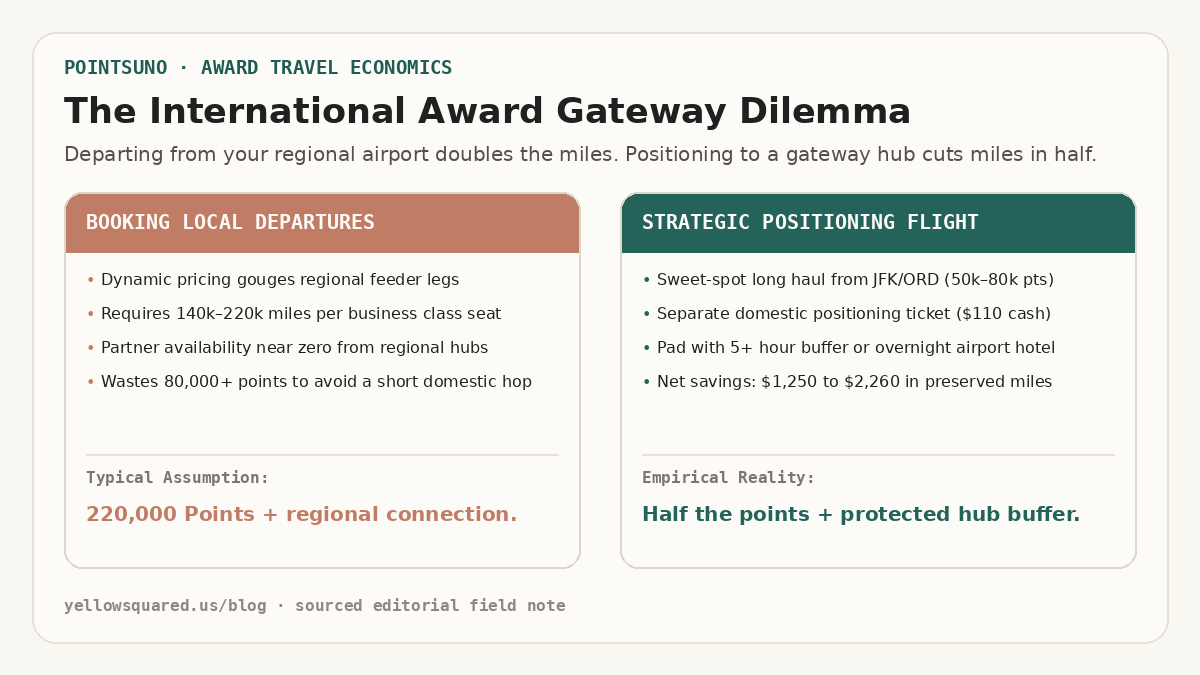
The Gateway Dilemma: booking separate domestic flights can unlock international business class for 50,000 points, but uncoordinated connections risk total ticket forfeiture.
Award travelers living outside primary gateway hubs like New York (JFK), Chicago (ORD), or San Francisco (SFO) face a chronic dilemma: redeeming miles directly from regional airports often requires double the mileage or yields zero partner availability. According to consumer ticketing guidelines from the U.S. Department of Transportation (DOT) and interline baggage rules under IATA Resolution 766, booking a separate domestic flight to reach an international departure point - known as a 'positioning flight' - transforms a single journey into two legally independent contracts of carriage. When executed with disciplined mathematical buffers, positioning unlocks redemptions like 50,000-mile transatlantic business class on Air France or 80,000-mile transpacific first class on ANA. When travelers fail to account for cash buffer expenses and misconnect liability, a delayed regional flight can forfeit the entire long-haul ticket.
To determine whether a positioning flight is worth booking, award travelers must evaluate two interrelated factors: the net cents-per-point (CPP) value preserved after subtracting all cash repositioning expenses, and the operational risk profile of separate airline tickets.
A positioning flight only creates true economic value if the points saved exceed the combined cash cost of domestic airfare, checked luggage fees, and hotel buffer insurance.
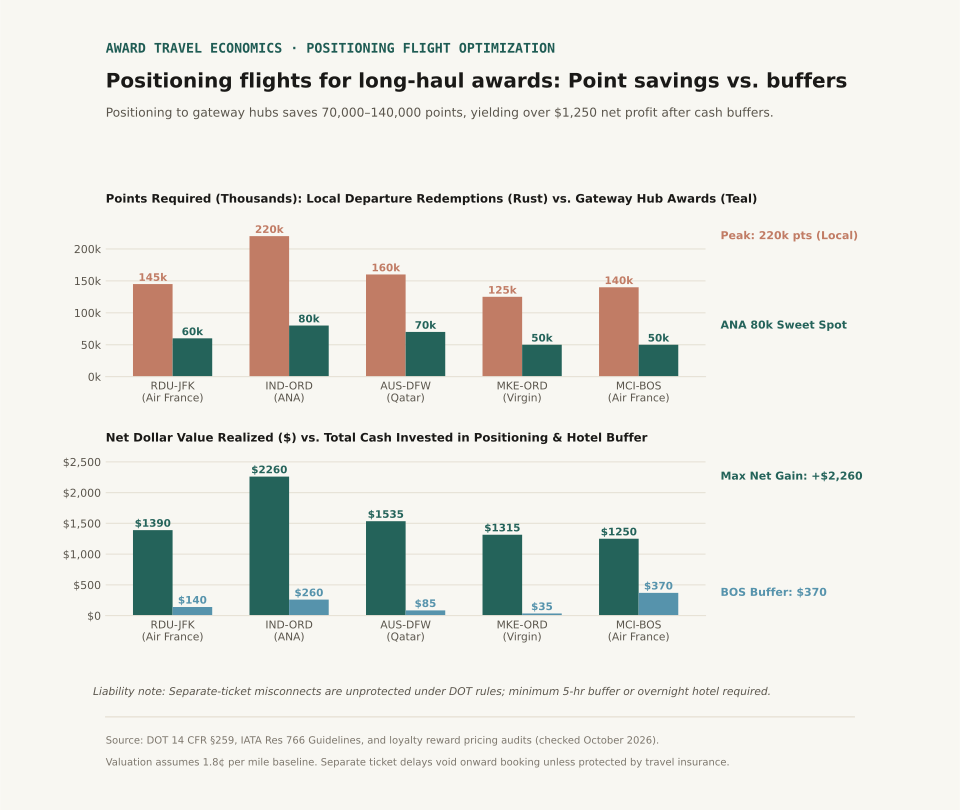
Panel A compares points required: regional departure redemptions require 125,000 to 220,000 points under dynamic pricing, while gateway sweet spots require 50,000 to 80,000 points. Panel B illustrates net financial profit after deducting cash airfare and overnight buffers. Reproducible dataset: positioning-flight-tradeoff-matrix.csv.
The Mathematical Breakeven of Repositioning
Major US airline loyalty programs (Delta SkyMiles, United MileagePlus, American AAdvantage) apply dynamic award pricing on domestic feeder segments. When booking international business class from secondary cities such as Raleigh (RDU), Indianapolis (IND), Austin (AUS), or Kansas City (MCI), the loyalty program prices the entire itinerary dynamically if partner saver space is missing on the domestic leg. A seat from Indianapolis to Tokyo on United routinely prices at 220,000 miles one-way.
Conversely, partner programs with fixed or distance-based award charts - such as ANA Mileage Club or Virgin Atlantic Flying Club - offer Chicago (ORD) to Tokyo (HND) for 80,000 miles in first class or 50,000 miles to London in business class. Because partner airlines cannot book domestic feeder legs when saver inventory is blocked, the traveler buys a separate ticket from Indianapolis to Chicago.
The net financial benefit (ΔV) of the positioning strategy equals the points saved multiplied by baseline point valuation (1.8 cents per point, illustrative model assumption) minus cash airfare, baggage fees, and hotel buffer costs. Saving 140,000 points on IND–ORD–HND represents $2,520 in preserved mileage value; subtracting a $110 regional flight and a $150 overnight airport hotel leaves a net gain of $2,260.
The Legal Reality of Separate Tickets and Misconnect Risk
The largest operational trap of positioning flights is assuming that airlines protect connecting passengers across separate reservations. Under airline contracts of carriage - including Delta's Customer Commitment and United's Contract of Carriage - a carrier's legal obligation ends once it delivers the passenger to the ticketed destination on the first reservation.
If a domestic positioning flight arrives three hours late into JFK and causes the traveler to miss a separately booked Qatar Airways flight to Doha, the onward carrier has zero obligation to rebook the passenger for free. Under standard no-show rules, the onward carrier cancels the remaining itinerary and forfeits the redeemed points.
On separate reservations, the onward airline treats an incoming flight delay exactly like an oversleeping passenger: a no-show that legally terminates the contract.
Positioning flight financial math and connection risk across international award sweet spots (sources: published airline tariff filings and U.S. DOT Air Consumer Rules; net gain calculated at 1.8¢/pt baseline).
Routing Strategy
Gateway Hub
Gateway Award
Local Award
Cash Buffer Cost
Net Gain
Buffer Window
RDU to Frankfurt (Business)
New York (JFK)
60,000 pts (Air France)
145,000 pts (Delta)
$140 (Flight only)
+$1,390
5.5 hours (Same-day min)
IND to Tokyo (First Class)
Chicago (ORD)
80,000 pts (ANA)
220,000 pts (United)
$260 (Flight + Hotel)
+$2,260
20 hours (Overnight stay)
AUS to Doha (Qsuite)
Dallas (DFW)
70,000 pts (Qatar)
160,000 pts (AA)
$85 (Flight / Drive)
+$1,535
6.0 hours (Same-day min)
MKE to London (Business)
Chicago (ORD)
50,000 pts (Virgin)
125,000 pts (United)
$35 (Coach / Amtrak)
+$1,315
4.5 hours (Ground transit)
MCI to Paris (Business)
Boston (BOS)
50,000 pts (Air France)
140,000 pts (Delta)
$370 (Flight + Hotel)
+$1,250
18 hours (Overnight stay)
Operational Rules for Positioning Risk Mitigation
Three scheduling practices protect separate-ticket award redemptions from misconnect forfeiture:
Schedule at least a five-hour buffer for same-day outbound flights, or arrive the evening prior for once-in-a-lifetime redemptions such as ANA First Class; a $150 airport hotel protects a $5,000 international seat.
Keep transferable points available to book a backup domestic flight on a competing carrier if your primary positioning flight suffers a mechanical delay before departure.
Apply tighter buffers only on the return journey home, where missing a domestic flight delays arrival by a few hours rather than voiding a long-haul vacation.
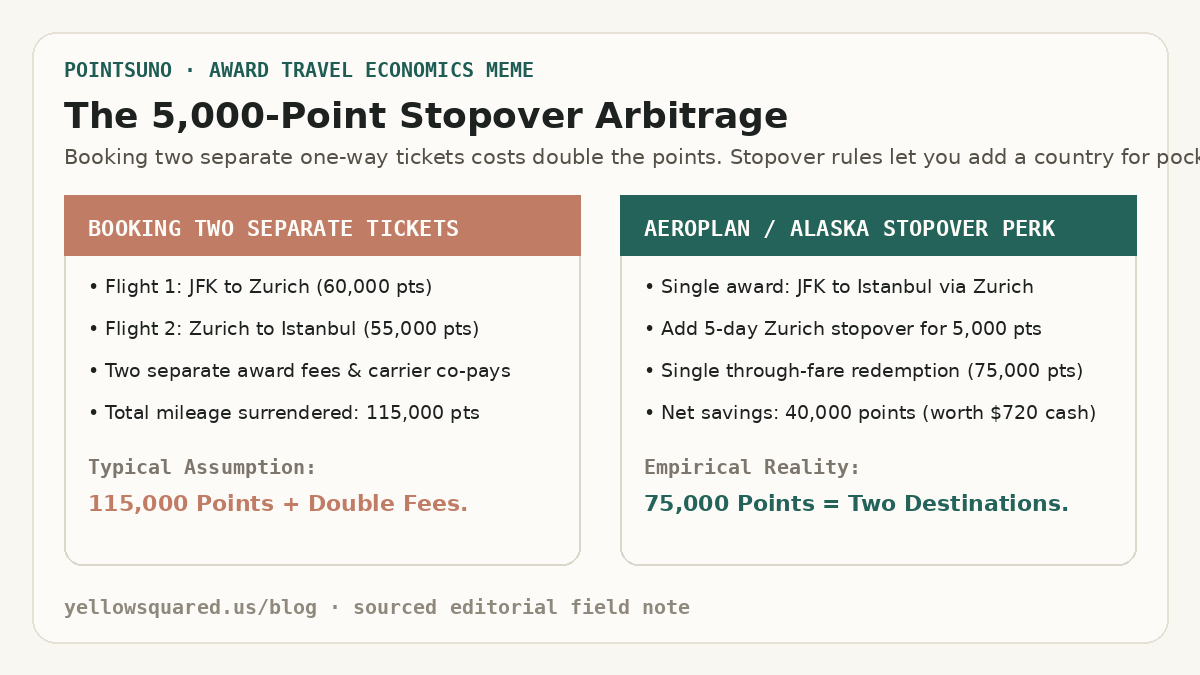
The Stopover Award Arbitrage: programs like Air Canada Aeroplan and Alaska Mileage Plan allow travelers to add a multi-day international layover for 0 to 5,000 points, turning one ticket into two complete vacations.
Travelers planning multi-city international journeys routinely make a costly award-booking error: booking two separate one-way award tickets to visit two destinations, spending tens of thousands of extra miles and double the carrier fees. According to airline tariff routing rules filed with the U.S. Department of Transportation (DOT) and the Airline Tariff Publishing Company (ATPCO), several major frequent flyer programs permit extended stopovers on one-way or roundtrip award tickets for a negligible surcharge or zero points. By exploiting programs like Air Canada Aeroplan, Alaska Airlines Mileage Plan, and ANA Mileage Club, travelers can turn an ordinary flight connection into a multi-day stayover in Tokyo, Paris, or Zurich, extracting hundreds of dollars in incremental redemption value from the exact same point balance.
The financial disparity between booking two point-to-point awards and booking a single through-ticket with a stopover perk is immense. On Star Alliance carriers, booking New York to Zurich in business class costs 60,000 to 70,000 points, while Zurich to Istanbul costs another 45,000 points - a total of 115,000 points. Booked via Air Canada Aeroplan as a single through-award from New York to Istanbul with an Aeroplan 5,000-point stopover in Zurich, the entire ticket prices at just 75,000 points. That single routing choice saves 40,000 points (worth over $720 at a conservative 1.8¢ per point valuation) while preserving identical widebody business class seats.
A stopover perk converts an airport transit layover into an authorized multi-day destination without triggering the penalizing repricing of two separate one-way tickets.
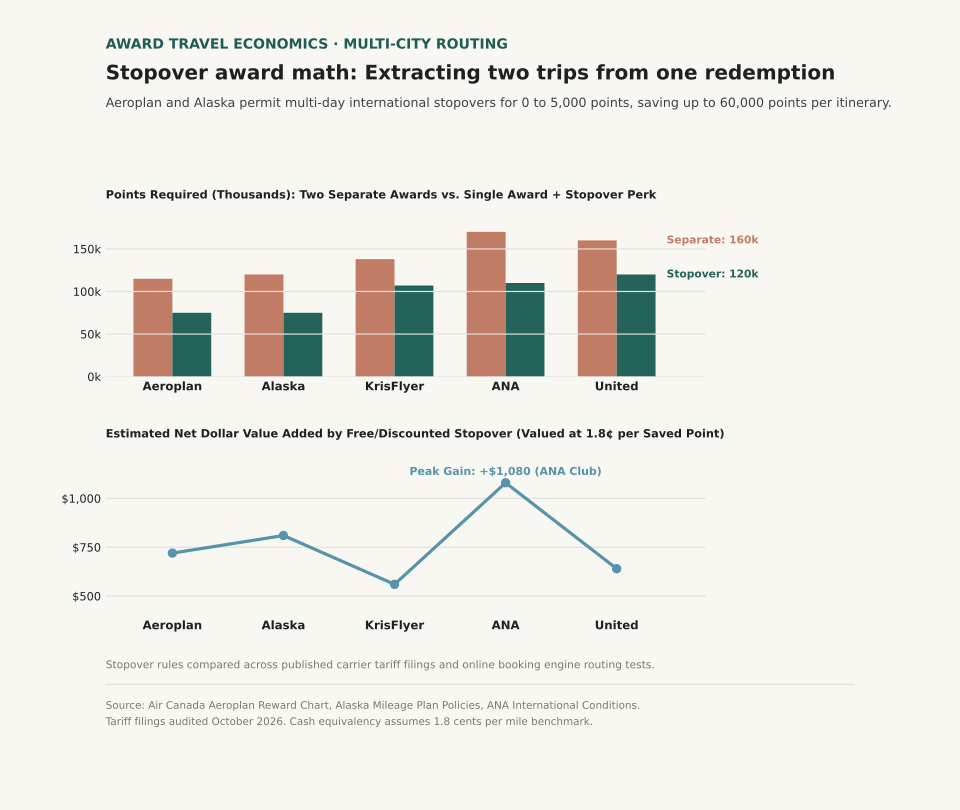
Panel A compares mileage requirements for two-destination itineraries: booking separate one-way tickets consumes 115k–170k points across major programs, whereas stopover-enabled programs price the entire trip for 75k–120k points. Panel B plots net dollar value added (at 1.8¢ per point saved): ANA Mileage Club and Alaska Airlines deliver $810 to $1,080 in direct consumer value. Reproducible dataset: airline-stopover-pricing-matrix.csv.
Comparing Stopover Architectures Across Major Loyalty Programs
Airlines define a stopover as a scheduled transit exceeding twenty-four hours on an international itinerary (or more than four hours on domestic U.S. routes). Loyalty programs handle these extended stays under three fundamentally different architectural frameworks: flat point surcharges, complimentary one-way stopovers, and roundtrip-restricted routing perks.
Air Canada Aeroplan features the industry's most flexible stopover policy: members can add a stopover of up to forty-five days on virtually any one-way award for exactly 5,000 points, even across complex partner combinations. Alaska Airlines Mileage Plan allows one free international stopover on eligible one-way awards booked with partners like Japan Airlines, Cathay Pacific, or Fiji Airways, enabling travelers to spend a week in Tokyo before continuing to Singapore or Bangkok for zero additional points. ANA Mileage Club allows one free stopover and two open jaws on roundtrip international redemptions, representing the gold standard for round-the-world award construction.
Booking an award stopover on programs like Alaska or Aeroplan unlocks premium cabin partner routing that would otherwise require multiple six-figure mileage balances.
Comprehensive policy and pricing matrix for airline award stopovers across premier global loyalty programs (sources: published carrier award rules and U.S. DOT Aviation Consumer Protection).
Loyalty Program
Alliance / Key Partners
Stopover Rule & Cost
Booking Type Allowed
Points Saved vs. 2 Tickets
Routing Sweet Spot
Air Canada Aeroplan
Star Alliance + 35 Partners
5,000 points flat per stopover
One-Way or Roundtrip
35,000 to 50,000 pts
North America to Asia via European hub (e.g., JFK–FRA–SIN)
Alaska Mileage Plan
oneworld + Starlux, Condor
Free (0 miles / 1 per one-way)
One-Way (Operating partner hub)
40,000 to 55,000 miles
US West Coast to Southeast Asia via Tokyo on JAL
Singapore KrisFlyer
Star Alliance + Virgin, Vistara
Free on Advantage; $100 Saver
One-Way ($100) / Roundtrip (Free)
25,000 to 35,000 miles
US to Bali with 4-day Singapore food stopover
ANA Mileage Club
Star Alliance
Free (1 stopover + 2 open jaws)
Roundtrip Only
50,000 to 70,000 miles
US to Asia RT with Tokyo stopover (88k–110k biz RT)
United MileagePlus
Star Alliance
Excursionist Perk (Free mid-trip)
Roundtrip / Multi-City (Same zone)
30,000 to 45,000 miles
Free intra-Europe or intra-Asia flight between long-hauls
Routing Rules and Booking Logistics
To successfully book a stopover award, travelers must respect maximum permitted mileage (MPM) limits and directional logic. Airlines prohibit backtracking: an award from Chicago to London cannot include a stopover in Tokyo because the routing breaches geographic circuity caps. When using Aeroplan's online tool, select 'Multi-city' rather than one-way, enter the origin, stopover city, and final destination, and the engine will automatically price the award at the single-zone rate plus 5,000 points.