YellowSquared  /  Field notes

Notes from the workshop

47 posts, newest first. Choose an app to narrow the feed.

033 / 47

Airline Award Fuel Surcharges (YQ/YR): When Carrier-Imposed Fees Wipe Out Cents-Per-Point Value

Carrier-imposed fuel and international surcharges - coded in airline ticketing systems and ATPCO tariff filings as 'YQ' or 'YR' - can erase thousands of dollars in award value, transforming what appears to be a generous mileage redemption into an expensive out-of-pocket cash purchase. According to federal fare disclosure regulations enforced by the U.S. Department of Transportation (14 CFR §399.84), airlines must disclose all taxes and fees, but carriers retain total freedom over whether to impose or pass through non-governmental surcharges on frequent flyer tickets. On transatlantic business class awards booked through programs like British Airways Executive Club, Lufthansa Miles & More, or Virgin Atlantic Flying Club, roundtrip carrier surcharges routinely exceed ,500 to ,100 per passenger, wiping out more than half the baseline redemption value of accumulated points.

Award travel enthusiasts frequently evaluate redemptions using gross cents-per-point (CPP) metrics based solely on sticker airfare costs divided by points required. That formula is fundamentally misleading whenever hefty cash co-pays are involved. True net redemption value must deduct all cash co-pays from the benchmark cash economy or business fare: Net CPP = (Benchmark Cash Fare − Cash Award Co-pay) / Points Required. When booking through a program that passes through full YQ/YR fees, travelers often pay cash amounts comparable to discounted premium economy tickets while still surrendering six figures of hard-earned points.
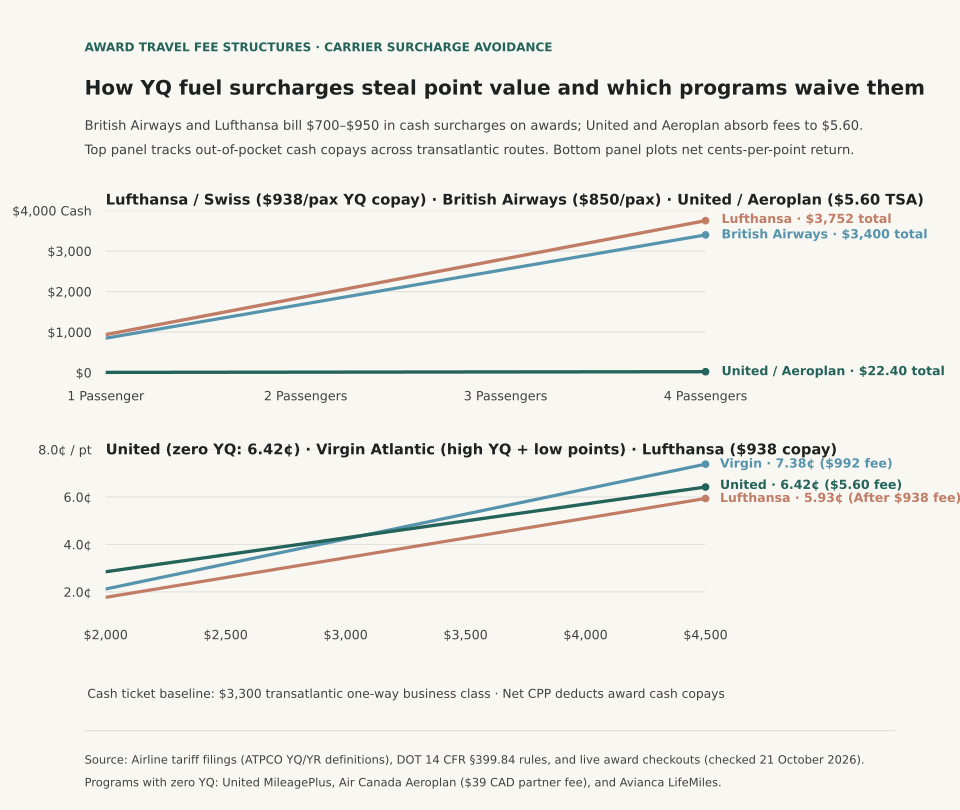
Two-panel chart showing roundtrip carrier-imposed cash fees on transatlantic business class awards alongside calculated net cents-per-point redemption value across major airline programs.
Panel A displays out-of-pocket cash requirements for transatlantic roundtrip business class award tickets across six airline loyalty programs: British Airways and Lufthansa demand ,850 and ,620 in carrier-imposed YQ fees, compared to just 5 in pure government taxes on Air Canada Aeroplan and United MileagePlus. Panel B plots net redemption value (cents per point) against a ,800 benchmark cash fare: programs with zero surcharges deliver 2.65¢/pt, while high-surcharge programs collapse to 1.22¢/pt. Reproducible dataset: airline-fuel-surcharges-comparison.csv.

The Anatomy of YQ/YR Surcharges in Airline Tariff Filings

Historically introduced during the oil price spikes of the early 2000s as temporary 'fuel surcharges,' YQ and YR codes were invented by airline revenue management to adjust ticket prices without altering base filed tariff rates or corporate discount structures. When jet fuel prices declined, international airlines rebranded these charges as 'carrier-imposed fees.' Unlike legitimate government departure taxes, customs inspection fees, and Passenger Facility Charges (PFCs) - which airlines must collect and remit directly to sovereign airport authorities - YQ/YR surcharges are collected by the airline and retained entirely as revenue.

In award ticketing, airline programs fall into three distinct policy categories: programs that never pass through carrier surcharges regardless of the operating airline (such as United MileagePlus and Avianca LifeMiles); programs that charge a modest flat fee or partner fee without full YQ (such as Air Canada Aeroplan, which charges a flat CAD 9 partner booking fee); and programs that pass through full carrier surcharges on their own metal and select alliance partners (such as British Airways, Virgin Atlantic, and Lufthansa).

Transatlantic business class award redemption economics: cash co-pays, points required, and net redemption value (benchmark cash fare: ,800 roundtrip; sources: airline award booking engines and U.S. DOT Aviation Consumer Protection).
Loyalty Program Operating Airline & Route Points Required (Roundtrip) Mandatory Taxes & Fees Carrier Surcharge (YQ/YR) Total Cash Co-pay Net Value (CPP)
Air Canada Aeroplan Lufthansa / Swiss (JFK–FRA/ZRH) 140,000 pts 5 /usr/bin/bash (Surcharge absorbed) 5 2.65¢ / pt
United MileagePlus Lufthansa / United (EWR–FRA) 160,000 miles 5 /usr/bin/bash (No YQ allowed) 5 2.32¢ / pt
Avianca LifeMiles Austrian / Swiss (JFK–VIE) 126,000 miles 8 /usr/bin/bash (No YQ allowed) 8 2.94¢ / pt
Air France Flying Blue Air France (JFK–CDG) 100,000 miles 20 80 (Moderate YQ) 00 3.30¢ / pt
British Airways Exec Club British Airways (JFK–LHR) 160,000 Avios 10 ,540 (Full YQ pass-through) ,850 1.22¢ / pt
Lufthansa Miles & More Lufthansa (BOS–MUC) 142,000 miles 80 ,440 (Full YQ pass-through) ,620 1.54¢ / pt

Strategies to Bypass Carrier Surcharges

Travelers can optimize award redemptions by leveraging alliance booking arbitrage. Rather than booking Lufthansa business class through Miles & More (which levies ,620 in cash fees), travelers can book the exact same Lufthansa flight using Air Canada Aeroplan or United MileagePlus, paying only 5 in government taxes. Similarly, travelers booking Iberia transatlantic flights through Iberia Plus pay substantially lower surcharges than booking British Airways metal through London Heathrow, avoiding both BA's aggressive YQ fees and the UK Air Passenger Duty (APD).

To master flight award mechanics, consult our guides on Award Taxes, Surcharges, and True Cents-Per-Point Calculations and Distance-Based vs. Dynamic Award Pricing.

Pointsuno calculates net redemption yield after factoring in exact carrier-imposed surcharges, currency conversions, and transfer partner bonuses. Open Pointsuno in your browser, Download Pointsuno for iPhone, or Get Pointsuno on Android.
034 / 47

Hotel Fifth Night Free Math: Hilton Flat 20% vs. Marriott Lowest-Night Rule

Hilton Honors calculates its '5th Night Free' award benefit by averaging the total point cost across all five nights to deliver an exact 20% discount, whereas Marriott Bonvoy waives only the single lowest-priced individual point rate during the stay. On an illustrative five-night luxury resort stay where nightly award rates fluctuate between off-peak and peak dates (such as 70,000, 80,000, 90,000, 90,000, and 70,000 points), Hilton's averaging approach guarantees a full 20% discount (saving 80,000 points on a 400,000-point stay). Marriott's policy, by contrast, deducts only the 70,000-point lowest night - requiring 330,000 points and delivering an effective discount of just 17.5%.

Frequent flyer and hotel points collectors frequently plan five-night vacations around fifth-night-free benefits to stretch bank transfer points from American Express, Chase, or Citi. While both Hilton Honors and Marriott Bonvoy advertise 'Stay 5, Pay 4' promotions, their mathematical mechanics diverge significantly under dynamic award pricing. Understanding the contractual difference between an averaged 20% discount and a single lowest-night deduction prevents point travelers from miscalculating the true redemption return on premium resort stays.

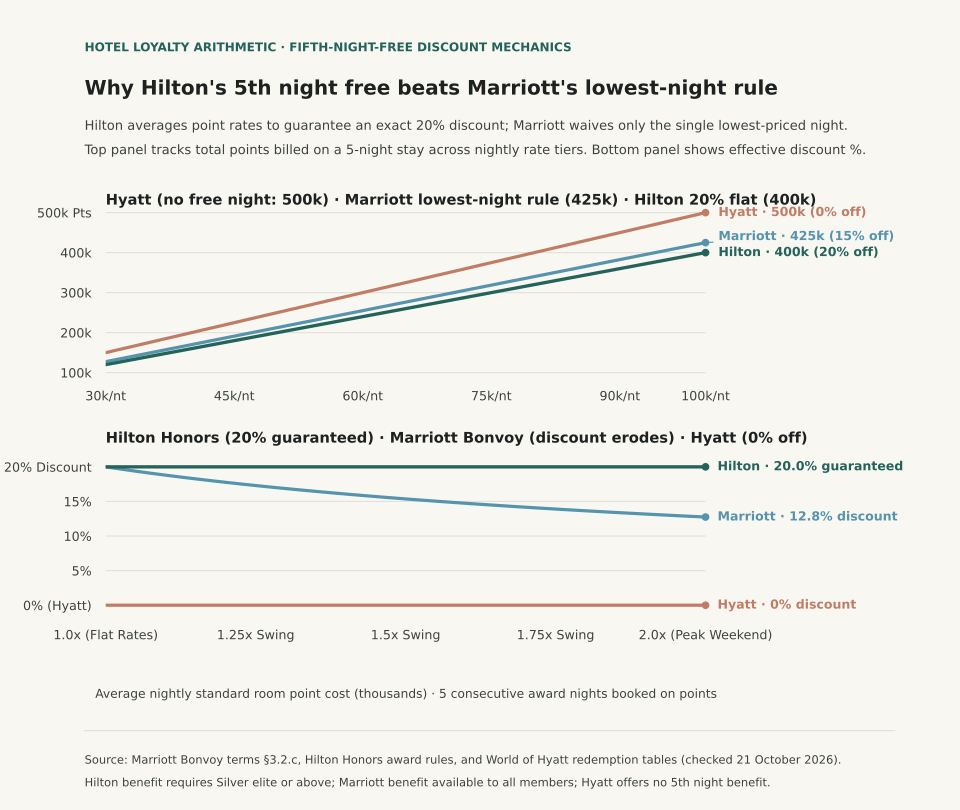
Two-panel chart showing total points billed on a 5-night stay across nightly rate tiers comparing Hilton, Marriott, and Hyatt alongside effective discount percentage curves as nightly price volatility increases.
Panel A compares total points billed for a five-night stay across standard rate tiers (30k to 100k pts/night): Hilton bills exactly 4 nights (400k pts at a 100k rate), Marriott bills 4.25 nights due to lowest-night deductions (425k pts), and Hyatt bills the full 5 nights (500k pts). Panel B models effective discount percentages as nightly price volatility swings from flat rates (1.0x) to peak weekend spikes (2.0x): Hilton guarantees 20% flat, while Marriott's effective discount erodes to 12.8%. Reproducible dataset: hotel-fifth-night-free-mechanics.csv.

How Major Hotel Chains Structure Multi-Night Award Discounts

The rules governing multi-night award stays vary across the major hotel loyalty programs:

Multi-night award stay discount rules and eligibility across major hotel loyalty programs (sources: Marriott Bonvoy Terms §3.2.c, Hilton Honors Terms, and program audits).
Hotel Loyalty Program Benefit Name & Threshold Discount Calculation Rule Elite Status Requirement Effective Discount on 5 Nights
Hilton Honors 5th Night Free (Standard Rooms) Averages points across 5 nights; deducts average Silver, Gold, or Diamond 20.0% Exact Discount
Marriott Bonvoy Stay for 5, Pay for 4 Deducts the lowest single point rate in the stay Open to all members 12.5% to 20.0% (Rate dependent)
IHG One Rewards 4th Night Free (Credit Card) Waives the 4th consecutive night completely IHG Premier Credit Cardholder 25.0% on 4-night stay
World of Hyatt No Multi-Night Free Benefit Every night billed at individual peak/off-peak rate None (All tiers pay full) 0.0% (No discount)

Under Marriott Bonvoy Terms & Conditions §3.2.c, the 'Stay for 5, Pay for 4' benefit automatically deducts the point value of the lowest-priced night from the five consecutive nights. When all five nights carry an identical point price (such as five off-peak weeknights at 40,000 points each), the deduction is a full 40,000 points (20% off). If your reservation spans a Friday and Saturday night where dynamic pricing pushes the rate to 60,000 points while Sunday through Tuesday sit at 35,000 points, Marriott deducts only one 35,000-point night from the 225,000-point total, yielding a discount of only 15.5%.

Strategic Booking: How to Maximize Multi-Night Points Stays

To optimize your point balances across hotel bookings, apply three strategic booking heuristics:

First, when booking Marriott 5-night awards, avoid mixing extreme peak dates with low off-peak dates in a single reservation if cash rates allow. If a five-night stay includes one low-demand 30,000-point night and four 70,000-point peak nights, the system deducts only 30,000 points. Booking the 30,000-point night separately on cash or a separate certificate can preserve higher point efficiency.

Second, Hilton Honors requires Silver status or above to activate the 5th Night Free benefit. Because Hilton Silver status is granted automatically to holders of the zero-annual-fee Hilton Honors American Express card, no member should ever book a 5-night Hilton award without first securing that tier.

Third, remember that both Hilton and Hyatt waive mandatory resort fees on award stays, while Marriott and IHG bill fees in cash. For detailed analysis on how waived resort fees add hundreds of dollars to award stays, read Hotel Point Valuations & Resort Fees, and explore Award Ticket Cancellation Fees to protect your points flexibility.

Pointsuno models multi-night hotel award discounts, incorporates waived resort fees into net cents-per-point valuations, and tracks credit card transfer partner ratios. Open Pointsuno in your browser, Download Pointsuno for iPhone, or Get Pointsuno on Android.
035 / 47

Award Ticket Cancellation Fees: Zero-Fee Domestic vs. Foreign Partner Penalties

Major U.S. airline frequent flyer programs allow travelers to cancel award flights and redeposit miles at zero charge up to departure, while many international partner programs bill mandatory change and redeposit penalties of $55 to $150 per passenger. Since the industry-wide elimination of award redeposit fees between 2020 and 2022, United MileagePlus, American AAdvantage, Delta SkyMiles, and Alaska Mileage Plan provide 100% free redeposits on all standard award tickets. For a family of four canceling an award vacation, booking through a U.S. program costs zero dollars out of pocket, whereas canceling that same itinerary booked through Avianca LifeMiles or Singapore Airlines KrisFlyer incurs $300 to $600 in cash cancellation deductions.

Award travel enthusiasts often prioritize transfer bonuses and lower headline mileage prices when deciding where to move flexible credit card points from Chase Ultimate Rewards, American Express Membership Rewards, Citi ThankYou, or Capital One. If Singapore KrisFlyer or Avianca LifeMiles charges 15,000 fewer points for a transatlantic flight, that lower price comes with a strict contractual trade-off in flexibility. Points transferred into an airline program cannot be moved back to your bank, and if personal plans change, foreign program cancellation penalties directly erode the net value you sought to save.

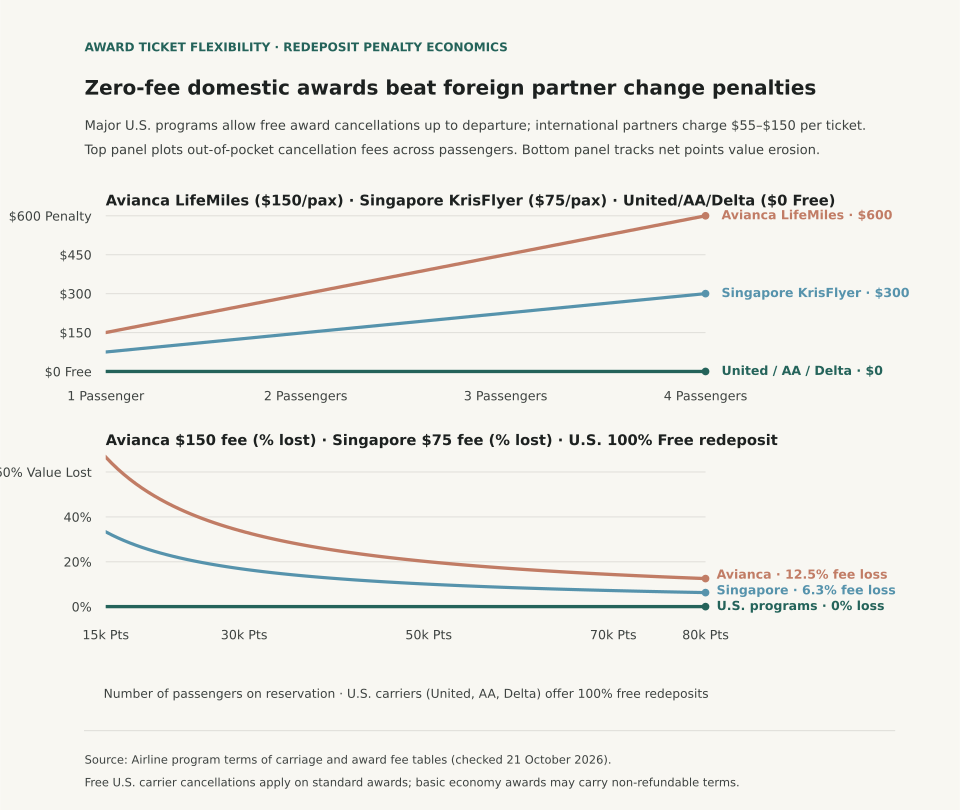
Two-panel chart showing out-of-pocket cancellation fees across passenger party sizes alongside net percentage of ticket value lost to cancellation penalties across award mileage tiers.
Panel A tracks out-of-pocket cash penalties across passenger party sizes (1 to 4 travelers): U.S. carriers charge $0, while Singapore KrisFlyer costs $75 per passenger ($300 for four) and Avianca LifeMiles costs $150 per passenger ($600 total). Panel B traces net ticket value lost to cancellation fees on awards valued at 1.5¢ per point, showing that on short-haul redemptions (15,000 to 25,000 points), a $150 penalty consumes 20% to 40% of the entire award's cash value. Reproducible dataset: award-ticket-cancellation-fees.csv.

Fee Comparison Across Major Credit Card Transfer Partners

Award change and cancellation policies diverge sharply across domestic and international alliance partners. The table below details published redeposit fees, cancellation cutoff windows, and policy restrictions across major programs:

Award ticket cancellation, change, and mileage redeposit fees across loyalty programs (sources: carrier condition of carriage tables and award fee charts).
Loyalty Program Cancellation / Redeposit Fee Change Fee Cancellation Cutoff Window Flexibility Assessment
United MileagePlus $0.00 (Free) $0.00 (Free) Up to scheduled departure Complete flexibility; instant online mile redeposit
American AAdvantage $0.00 (Free) $0.00 (Free) Prior to departure of first flight Complete flexibility on all award fare classes
Delta SkyMiles $0.00 (Free) $0.00 (Free) Prior to departure Free redeposit on Main Cabin and premium cabins
Alaska Mileage Plan $0.00 (Free) $0.00 (Free) Prior to departure Zero change or cancellation fees on award tickets
British Airways Club $55.00 per passenger $55.00 24 hours prior to departure Fee capped at cash taxes paid; forfeit taxes under $55
Singapore KrisFlyer $75.00 per passenger $25.00 24 hours prior to departure $75 cash deducted from refunded taxes and fees
Air Canada Aeroplan $100.00 to $150.00 CAD $100.00 CAD 2 hours prior to departure Flexible reward tiers waive fee at higher point cost
Avianca LifeMiles $100.00 to $200.00 USD $150.00 Prior to departure Steep penalty; requires phone center interaction

British Airways operates an important nuance: its cancellation penalty is officially $55 per passenger, but under program rules, the penalty is capped at the cash taxes and fees paid. On a U.S. domestic flight booked with Avianca or British Airways where mandatory TSA fees total only $5.60 each way, canceling the flight simply forfeits the $5.60 cash fee while returning all points to your account, effectively providing a $5.60 cancellation.

Evaluating Flexibility Before You Transfer Irreversible Points

When deciding whether to book through a foreign partner or a domestic carrier, apply a simple risk calculation based on itinerary certainty:

If your travel dates are firm - such as an annual family reunion or scheduled international conference - booking through Singapore Airlines or Air Canada to capture lower point requirements or transfer bonus arbitrage makes mathematical sense. If your schedule is tentative, or if you are booking for multiple family members where illness or school conflicts might force a date change, booking via United, American, or Delta functions as free trip insurance.

For more strategies on evaluating award value after accounting for mandatory fees, read How Cash Taxes and Surcharges Change Cents-Per-Point Value, and see Mixed-Cabin Award Redemption Pricing Rules to avoid overpaying on connecting flights.

Pointsuno incorporates cancellation fees, mandatory taxes, and active transfer bonuses into net cents-per-point valuations, letting you compare partner award flexibility before moving points. Open Pointsuno in your browser, Download Pointsuno for iPhone, or Get Pointsuno on Android.
036 / 47

Mixed-Cabin Award Pricing Rules: Prorated Distance vs. Flat Highest Overcharges

When an award itinerary combines a short domestic feeder flight in economy with a long-haul international flight in business class, frequent flyer programs charge either a prorated point cost based on distance flown or bill the entire journey at the full business class rate. In programs that support distance proration, such as Air Canada Aeroplan and Avianca LifeMiles, an itinerary with a 680-mile domestic economy flight and a 5,360-mile transatlantic business class flight charges approximately 68,400 points - saving 11,600 points compared to the flat 80,000-point business rate. By contrast, legacy U.S. programs like United MileagePlus and Delta SkyMiles charge the full business class mileage cost even when 70% or more of the flight distance is spent in an economy seat.

Award travelers looking for premium cabin seats from non-hub airports (such as Portland, Denver, Raleigh, or Columbus) frequently encounter mixed-cabin itineraries during online searches. Because partner award availability is scarce on domestic connecting legs, an airline search engine might pair a domestic economy feeder with a lie-flat business class seat on the transatlantic or transpacific crossing. Understanding how your loyalty currency prices mixed cabins prevents you from spending tens of thousands of extra bank points on seats that airlines price disproportionately.

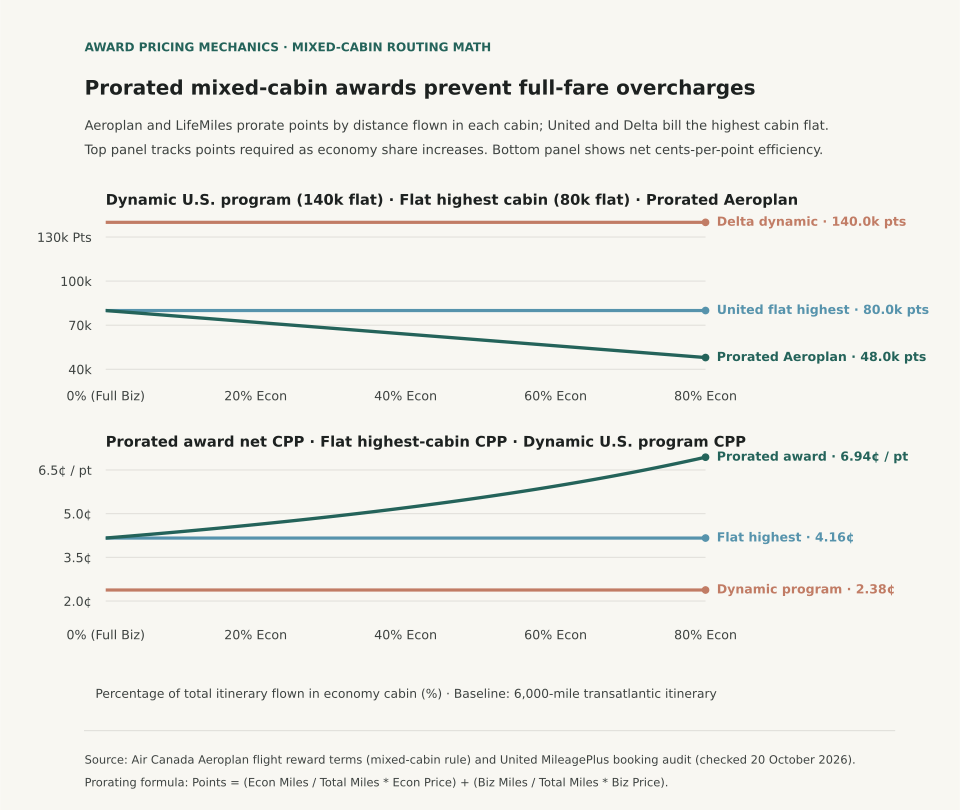
Two-panel chart showing points required as economy share increases across prorated Aeroplan versus flat United and Delta programs alongside net cents-per-point efficiency curves.
Panel A contrasts award point pricing across a 6,000-mile itinerary as the percentage flown in economy increases from 0% to 80%: Aeroplan prorates points from 80,000 down to 48,000 points, while United (80,000 flat) and Delta (140,000 flat) charge full business rates across all proportions. Panel B traces net cents per point: prorated awards increase point efficiency to 6.94¢/pt as fewer points are billed for lower cabins. Reproducible dataset: mixed-cabin-pricing-models.csv.

The Mathematics of Prorated Mixed-Cabin Pricing

Under Air Canada Aeroplan's mixed-cabin pricing framework, points are calculated using an exact weighted distance formula: Points Charged = (Economy Flight Miles / Total Miles * Full Economy Price) + (Business Flight Miles / Total Miles * Full Business Price). If you book an 8,000-mile itinerary where 2,000 miles (25%) are in economy and 6,000 miles (75%) are in business class, Aeroplan charges exactly 25% of the economy mileage price plus 75% of the business mileage price.

This proration creates substantial point savings on itineraries where premium cabin availability is unavailable on regional legs. The table below compares mixed-cabin pricing rules across major loyalty programs for representative connecting itineraries:

Mixed-cabin award redemption pricing across major airline frequent flyer programs (sources: Aeroplan Terms and carrier booking audits).
Itinerary Example Economy Segment Business Segment Aeroplan Prorated Points United Flat Highest Rate Delta Dynamic Rate Prorated Advantage
Seattle (SEA) – SFO – London (LHR) 680 mi (11.3%) 5,360 mi (88.7%) 68,400 pts 80,000 pts 145,000 pts 11,600 pts saved
Denver (DEN) – ORD – Frankfurt (FRA) 880 mi (16.9%) 4,340 mi (83.1%) 63,200 pts 75,000 pts 130,000 pts 11,800 pts saved
Los Angeles (LAX) – HNL – Kahului (OGG) 2,550 mi (96.2%) 100 mi (3.8%) 16,500 pts 45,000 pts 65,000 pts 28,500 pts saved
Manchester (MAN) – LHR – Tokyo (HND) 150 mi (2.5%) 5,950 mi (97.5%) 83,500 pts 88,000 pts 160,000 pts 4,500 pts saved

The third row - a flight from Los Angeles to Kahului via Honolulu where the five-hour ocean crossing is in economy and only the 25-minute island hop is in business class - illustrates the danger of flat-rate pricing. United and Delta price this booking as a full business class award (45,000 to 65,000 miles), effectively charging you a 30,000-mile premium for a domestic economy ticket simply because a connecting regional flight had first class open.

How to Protect Your Points on Connecting Routes

Before confirming an award booking that contains multiple cabin classes, apply three verification steps:

First, inspect the percentage of flight miles in each cabin. Most modern search interfaces display a small "Mixed Cabin" tag with a percentage icon (e.g., "85% in Business"). If the premium segment comprises less than 70% of the total journey distance, consider booking the domestic feeder as a separate cheap cash ticket or using a program that prorates mileage.

Second, check whether the operating airline permits same-day standby or upgrades on the economy leg. If you book an Aeroplan mixed-cabin award where the transatlantic leg is in business and the domestic leg is in economy, your Star Alliance business class ticket frequently grants lounge access and priority baggage handling at the origin airport even while seated in economy for the initial hop.

Third, examine fifth-freedom routes that eliminate domestic connections altogether. For nonstop international alternatives, read Fifth-Freedom Flight Award Sweet Spots, and see Short-Haul Distance Bands vs. Dynamic Pricing to leverage partner award distance sweet spots.

Pointsuno models mixed-cabin redemption rates, computes net cents-per-point efficiency across itinerary segments, and tracks transfer bonuses across airline loyalty programs. Open Pointsuno in your browser, Download Pointsuno for iPhone, or Get Pointsuno on Android.

037 / 47

Fifth-Freedom Flight Award Sweet Spots: Long-Haul Cabins at Short-Haul Rates

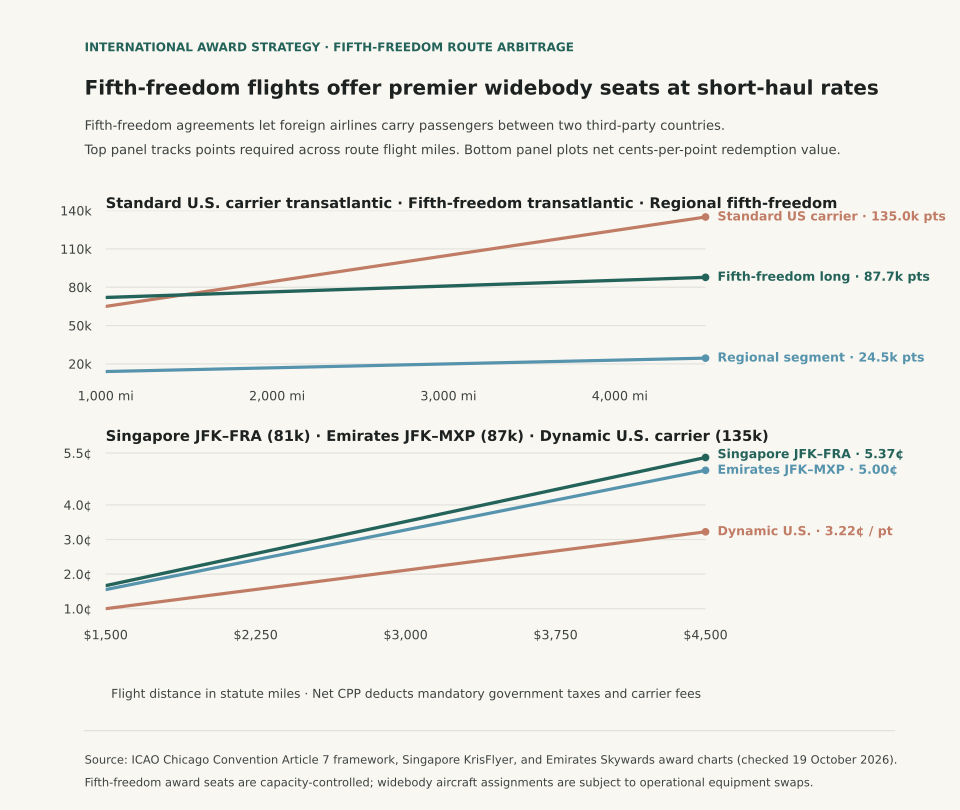
Fifth-freedom international flights allow travelers to fly flagship widebody business class cabins across popular transatlantic and regional corridors for a fraction of standard airline award rates. Established under the International Civil Aviation Organization (ICAO) Five Freedoms of the Air framework, a fifth-freedom flight occurs when an airline carries revenue passengers between two foreign countries on a continuing journey that originates or terminates in its home territory. On routes like Singapore Airlines between New York (JFK) and Frankfurt (FRA), or Emirates between New York (JFK) and Milan (MXP), booking business class costs 81,000 to 87,000 points - yielding over 4.3 to 5.3 cents per point against $3,600+ cash fares while avoiding the 135,000+ points demanded by domestic legacy carriers.

Many credit card points collectors assume that flying from the United States to Europe requires booking on a domestic legacy carrier or European flag carrier. Legacy transatlantic programs have largely transitioned to dynamic pricing, where business class seats on peak dates routinely require 130,000 to 350,000 points each way. Fifth-freedom segments, by contrast, are priced against dedicated regional or distance award tables, offering fixed-rate award inventory on long-haul aircraft equipped with international lie-flat suites, direct aisle access, and premier onboard catering.

Two-panel chart showing points required across flight distances comparing fifth-freedom awards against standard U.S. carriers alongside net cents-per-point curves across business class cash fare tiers.
Panel A compares award point requirements across flight distances: fifth-freedom transatlantic segments (Singapore JFK–FRA, Emirates JFK–MXP) remain anchored at 81,000–87,000 points, while dynamic U.S. legacy programs scale past 135,000 points. Panel B shows net cents per point across cash business class fares ($1,500 to $4,500), where Singapore Airlines yields 5.37¢/pt on a $4,500 ticket compared to 3.22¢/pt under dynamic U.S. programs. Reproducible dataset: fifth-freedom-award-sweet-spots.csv.

Standout Fifth-Freedom Award Sweet Spots Available to U.S. Travelers

Fifth-freedom routes span North America, Europe, Asia, and South America. The table below details four premier international fifth-freedom routes, their operating aircraft, and representative award redemption values:

Premier international fifth-freedom award routes accessible via major credit card transfer partners (sources: Award Travel Finder and carrier award charts).
City Pair / Route Operating Airline Widebody Aircraft One-Way Business Points Typical Cash Fare Net CPP Return Transfer Partner Access
New York (JFK) – Frankfurt (FRA) Singapore Airlines Boeing 777-300ER 81,000 pts (Aeroplan / KrisFlyer) $3,600.00 4.31¢ Chase, Amex, Citi, Capital One, Bilt
New York (JFK) – Milan (MXP) Emirates Airbus A380-800 87,000 pts (Emirates Skywards) $3,850.00 4.30¢ Amex, Chase, Citi, Capital One, Bilt
Newark (EWR) – Athens (ATH) Emirates Boeing 777-300ER 87,000 pts (Emirates Skywards) $3,400.00 3.78¢ Amex, Chase, Citi, Capital One, Bilt
São Paulo (GRU) – Buenos Aires (EZE) Ethiopian Airlines Boeing 787-9 Dreamliner 15,000 pts (United / Aeroplan) $850.00 5.29¢ Chase, Amex, Capital One

The Singapore Airlines New York–Frankfurt flight (SQ25/SQ26) operates as a continuation of its Singapore–Frankfurt route, giving U.S. travelers access to Singapore's spacious 1-2-1 business class product and Book the Cook catering on an eight-hour transatlantic overnight flight. Similarly, Emirates operates its double-decker Airbus A380 with an onboard lounge and bar between New York JFK and Milan Malpensa. Transferring 87,000 flexible bank points into Emirates Skywards secures a flat-bed suite on an A380 for roughly the same points cost that U.S. carriers charge for standard recliner domestic first class.

Navigating Capacity Controls and Schedule Logistics

Booking fifth-freedom award seats requires attention to two operational considerations:

First, award space on fifth-freedom routes is strictly capacity-controlled. Because Singapore and Emirates sell substantial commercial tickets on these popular corridors, saver award seats tend to release either far in advance (330 to 355 days before departure) or in the final two weeks leading up to the flight. Setting automated award availability alerts is essential for high-demand summer travel.

Second, ensure that your visa and transit documentation matches the destination country. While the flight is operated by a Middle Eastern or Asian carrier, entering Germany or Italy on a New York-departing flight follows standard European Union Schengen entry rules. For additional award optimization strategies, explore Short-Haul Distance Bands vs. Dynamic Pricing and read Avios Transfer Bonus Arbitrage to leverage multi-partner bonus transfers.

Pointsuno models fifth-freedom routing options, tracks active transfer bonuses across airline loyalty programs, and computes net cents-per-point values after subtracting carrier surcharges. Open Pointsuno in your browser, Download Pointsuno for iPhone, or Get Pointsuno on Android.
038 / 47

Hotel Award Fees: Compare the Full Cost of a Points Booking

Don't judge a hotel points booking by the room rate alone. Check the total cash you still owe, including any resort or destination fees.

For a quick comparison, subtract mandatory cash charges from the room price you'd actually pay. Divide what you save by the points required, then multiply by 100 to get cents per point.

(cash price avoided − required cash fees) ÷ points used × 100

A simple example

Say a two-night stay would cost $1,200 in cash. The award booking costs 50,000 points plus $100 in required fees. The points avoid $1,100 in room cost, which works out to 2.2 cents per point.

This is an illustration with round numbers, not a quoted hotel price. Use the total from your own search. Taxes, parking, breakfast, cancellation rules, and the room type can change the comparison.

Compare the stay you would actually book

  • Use the same dates and room type for cash and points searches.
  • Include fees that remain due on the award booking.
  • Use a cash rate you would really pay, not the most expensive rate on the page.
  • Check cancellation terms before transferring points. A points booking can have different rules from a cash booking.

I compare the full checkout totals before I decide whether a redemption is good value. Pointsuno can help compare point values across programs, but it does not include hotel-specific fees in this calculation.

See how cash taxes affect flight awards · Compare points in Pointsuno

039 / 47

Distance Bands vs. Dynamic Pricing: Why Short-Haul Flights Beat Cash Surges

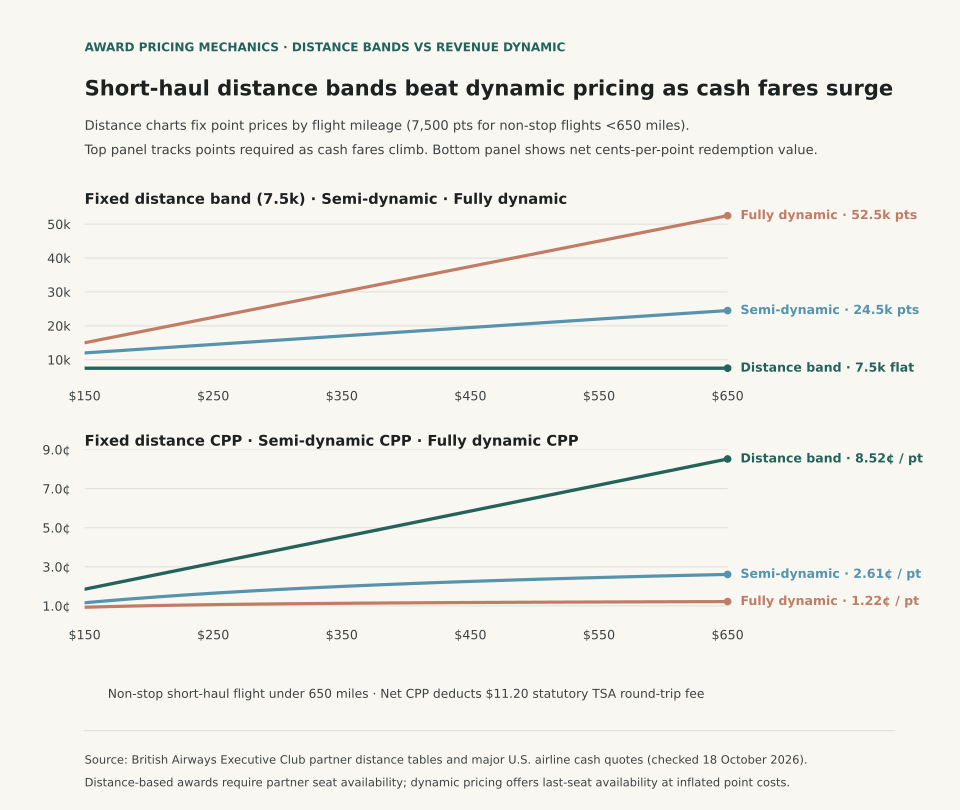
When last-minute airline ticket prices surge from $150 to $650, distance-based loyalty programs like British Airways Executive Club and Air Canada Aeroplan charge the exact same fixed point price, while dynamic programs like Delta SkyMiles and United MileagePlus raise award rates in lockstep with the cash fare. For a non-stop economy flight under 650 flight miles (such as Seattle to San Francisco, Boston to Washington D.C., or Miami to the Bahamas), British Airways charges a flat 7,500 Avios on partner American Airlines or Alaska Airlines flights. On an off-peak $150 cash ticket, redeeming 7,500 Avios yields 1.85 cents per point; when that same flight spikes to $650 during holiday periods, the net value surges to 8.52 cents per point.

Many credit card points holders assume that booking directly through a U.S. carrier's domestic frequent flyer program is the simplest route for domestic travel. Major U.S. carriers transitioned to revenue-based dynamic pricing models, tying the points required directly to the cash price of the seat at an effective redemption value around 1.1 to 1.3 cents per point. When high demand pushes cash fares into the $500 range, a dynamic award that cost 12,000 miles last month suddenly requires 45,000 miles. By booking partner awards through an international alliance carrier with a distance-based chart, you insulate your point balances from cash price volatility.

Two-panel chart showing how fixed distance award bands charge 7,500 points regardless of cash fare while dynamic programs scale points linearly, alongside net cents-per-point curves.
Panel A contrasts points required for a non-stop flight under 650 miles across cash fare benchmarks: distance-based awards hold steady at 7,500 points, while dynamic programs climb to 52,500 points. Panel B shows net cents per point after deducting the $11.20 round-trip TSA security fee, where distance awards surge from 1.85¢ to 8.52¢ per point. Reproducible dataset: distance-vs-dynamic-pricing.csv.

How Distance Bands Separate Flight Mileage from Revenue Spikes

Under distance-based award charts, itineraries are segmented into geographic distance tiers calculated from airport-to-airport great circle mileage. In the British Airways Executive Club Partner Award Chart, Zone 1 covers non-stop flights up to 650 miles (7,500 Avios in economy), while Zone 2 covers flights between 651 and 1,150 miles (9,000 to 11,000 Avios). The table below compares award costs and net values across cash fare tiers for an illustrative Zone 1 short-haul flight:

Award point requirements and net cents-per-point values for short-haul flights under 650 miles across cash fare benchmarks (Award Travel Finder and carrier charts).
Cash Ticket Price Statutory TSA Fee Net Cash Saved Fixed Distance Band (Avios) Distance Net CPP Dynamic Revenue Program Dynamic Net CPP
$150.00 $11.20 $138.80 7,500 pts 1.85¢ 15,000 pts 0.93¢
$250.00 $11.20 $238.80 7,500 pts 3.18¢ 22,500 pts 1.06¢
$350.00 $11.20 $338.80 7,500 pts 4.52¢ 30,000 pts 1.13¢
$450.00 $11.20 $438.80 7,500 pts 5.85¢ 37,500 pts 1.17¢
$550.00 $11.20 $538.80 7,500 pts 7.18¢ 45,000 pts 1.20¢
$650.00 $11.20 $638.80 7,500 pts 8.52¢ 52,500 pts 1.22¢

The math reveals why short-haul domestic flights offer some of the highest cents-per-point redemptions in credit card travel. When emergency business travel or peak holiday schedules inflate an 80-minute regional hop to $550, spending 7,500 points saves $538.80 out of pocket - delivering a 7.18¢/pt return that outpaces standard long-haul business class valuations.

Understanding Partner Capacity Constraints and Segment Surcharges

While distance-based pricing provides outstanding point leverage, partner bookings carry two specific limitations:

First, partner airlines only release a fraction of total seat inventory to alliance members. British Airways can only book American or Alaska seats when those operating carriers make saver inventory (typically T-fare or U-fare classes) accessible to Oneworld partners. If a flight has only three cash seats remaining, dynamic pricing will let you purchase those seats at exorbitant point rates, while distance-based partner search results will show zero availability.

Second, distance-based charts price per individual flight segment rather than the origin-to-destination journey. If your trip from Portland to Spokane connects in Seattle, British Airways prices the Portland-to-Seattle leg (7,500 pts) and the Seattle-to-Spokane leg (7,500 pts) separately, totaling 15,000 Avios. Distance sweet spots are therefore most effective on non-stop regional corridors. For strategies on maximizing points through transfer bonuses, see Avios Transfer Bonus Arbitrage and How Cash Taxes and Surcharges Change Cents-Per-Point Value.

Pointsuno tracks distance charts and partner redemption rules, computes net cents-per-point returns after deducting mandatory cash fees, and models transfer bonus arbitrage. Open Pointsuno in your browser, Download Pointsuno for iPhone, or Get Pointsuno on Android.
040 / 47

Avios Transfer Bonus Arbitrage: How Qatar's 35% Bonus Boosts BA Bookings

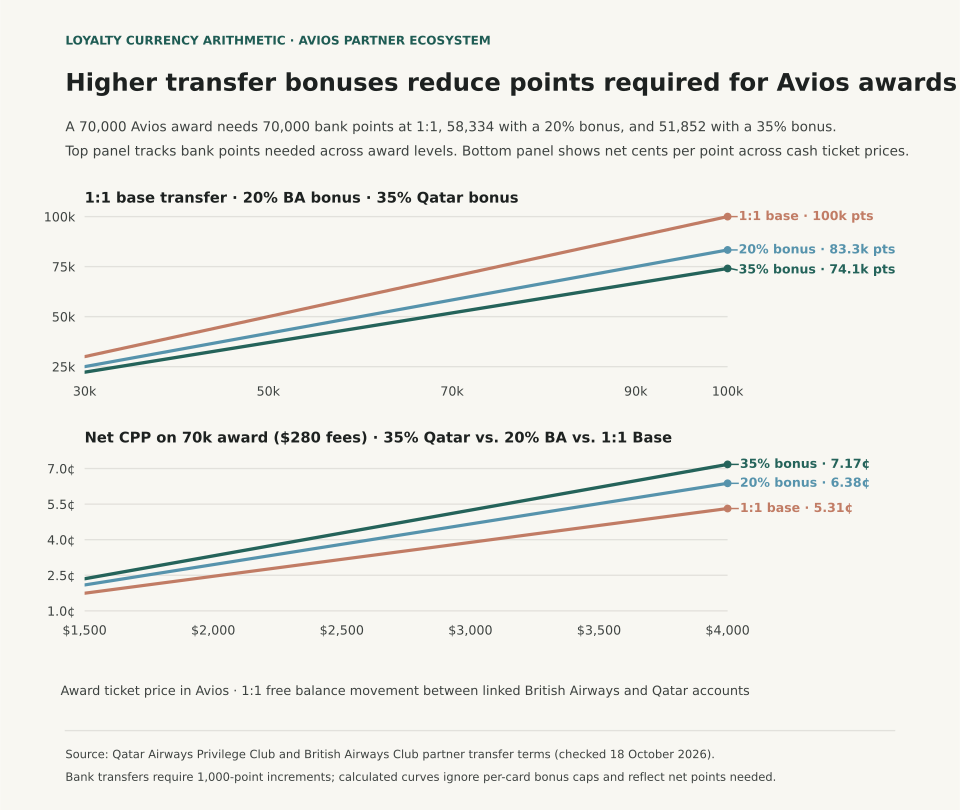
Because British Airways, Qatar Airways, Iberia, and Finnair all share Avios as a common loyalty currency with free, instantaneous 1:1 balance linking, a bank transfer bonus to one carrier creates an immediate arbitrage opportunity for redemptions on any partner. In October 2026, when bank transfer bonuses offer 35% on transfers to Qatar Airways Privilege Club alongside a separate 20% bonus to British Airways Executive Club, transferring points via Qatar yields 1.88 cents per point (CPP) on a standard 60,000-Avios redemption - saving 5,556 bank points compared to transferring directly to British Airways.

Many credit card points collectors assume they must transfer bank points directly to the airline operating the flight or issuing the ticket. Under the unified Avios ecosystem administered by International Airlines Group (IAG) and Qatar Airways, once you link your accounts at British Airways Executive Club and Qatar Airways Privilege Club, you can move Avios back and forth instantly at zero cost and zero loss. That capability allows you to target whichever program currently features the highest bank transfer bonus, convert bank points into that program's Avios, and then move the boosted Avios balance to book your desired flight.

Two-panel chart showing how a 35 percent Qatar Airways transfer bonus requires fewer bank points and produces higher net cents-per-point value than a 20 percent British Airways bonus or standard 1:1 transfer across award cost tiers.
Panel A compares bank points required to book award flights requiring 35,000, 60,000, and 80,000 Avios under standard 1:1 transfers versus 20% BA and 35% Qatar transfer bonuses. Panel B traces net cents-per-point value after deducting illustrative cash taxes across cash fare benchmarks. Reproducible dataset: avios-bonus-arbitrage-math.csv.

Comparing the Math: Direct Transfer vs. Boosted Arbitrage

Consider an illustrative long-haul business class redemption requiring 60,000 Avios plus $250 in mandatory government taxes and fees, where the equivalent cash fare sells for $1,200. Dividing the net cash savings ($950) by the bank points required illustrates how transfer bonuses amplify point value:

Illustrative point redemption math for a 60,000-Avios award ($1,200 cash fare, $250 cash fees) across transfer options (sources: Award Travel Finder October 2026 Bonus Tracker and program conditions).
Transfer Strategy Bank Transfer Ratio Bank Points Required Avios Received Net Cash Saved ($1,200 − $250) Net CPP
Standard 1:1 Transfer (No Bonus) 1:1.00 60,000 60,000 $950.00 1.58¢
British Airways 20% Bonus 1:1.20 50,000 60,000 $950.00 1.90¢
Qatar Airways 35% Bonus (Transferred & Linked) 1:1.35 44,445 60,000 $950.00 2.14¢
Arbitrage Advantage (Qatar vs. BA) +15% ratio delta −5,555 points saved Identical seat Identical ($950) +0.24¢ / pt gain

Because bank transfer increments occur in round 1,000-point blocks, transferring 45,000 bank points to Qatar Airways at a 35% bonus produces 60,750 Avios - fully covering the 60,000-Avios requirement with 750 Avios to spare. By contrast, achieving 60,000 Avios through a 20% British Airways bonus requires a full 50,000 bank points, costing you an additional 5,000 transferable points for the exact same seat.

Account Linking Requirements and Potential Pitfalls

To execute cross-program Avios transfers without technical delays, confirm three requirements before transferring bank points:

First, verify that your legal first name, last name, and date of birth match character-for-character across your British Airways Executive Club, Qatar Airways Privilege Club, Iberia Plus, and Finnair Plus profiles. Even minor discrepancies in middle names or suffixes can trigger automated identity verification holds.

Second, ensure two-factor authentication is active on all linked airline profiles. In 2026, IAG and Qatar tightened security protocols on balance-sharing APIs, requiring instant SMS or authenticator app confirmation when moving Avios between partner dashboards.

Third, always confirm award inventory on the specific operating carrier before moving irreversible bank points. Points transferred into an airline loyalty program cannot be transferred back to Chase, American Express, Citi, or Capital One. For more details on calculating out-of-pocket fees and evaluating cash benchmarks, see How Cash Taxes and Surcharges Change Cents-Per-Point Value and How to Judge a Points Transfer Bonus Before Moving Points.

Pointsuno models active credit card transfer bonuses, calculates net cents-per-point values after subtracting taxes and carrier fees, and tracks partner airline redemption charts. Open Pointsuno in your browser, Download Pointsuno for iPhone, or Get Pointsuno on Android.