YellowSquared  /  Field notes

Notes from the workshop

59 posts, newest first. Choose an app to narrow the feed.

057 / 59

Olivia Kept First Place. Charlotte Nearly Closed the Gap.

Olivia remained the leading girls’ name in the U.S. in 2025, but Charlotte was only 144 published occurrences behind. In 2024 the gap was 2,175. The number-one position stayed the same while the distance between these two names changed substantially.

Two movements narrowed the gap: Olivia’s count fell by 1,228, while Charlotte’s rose by 803. Together they reduced the difference by 2,031. Looking only at Olivia’s rank would miss both changes.
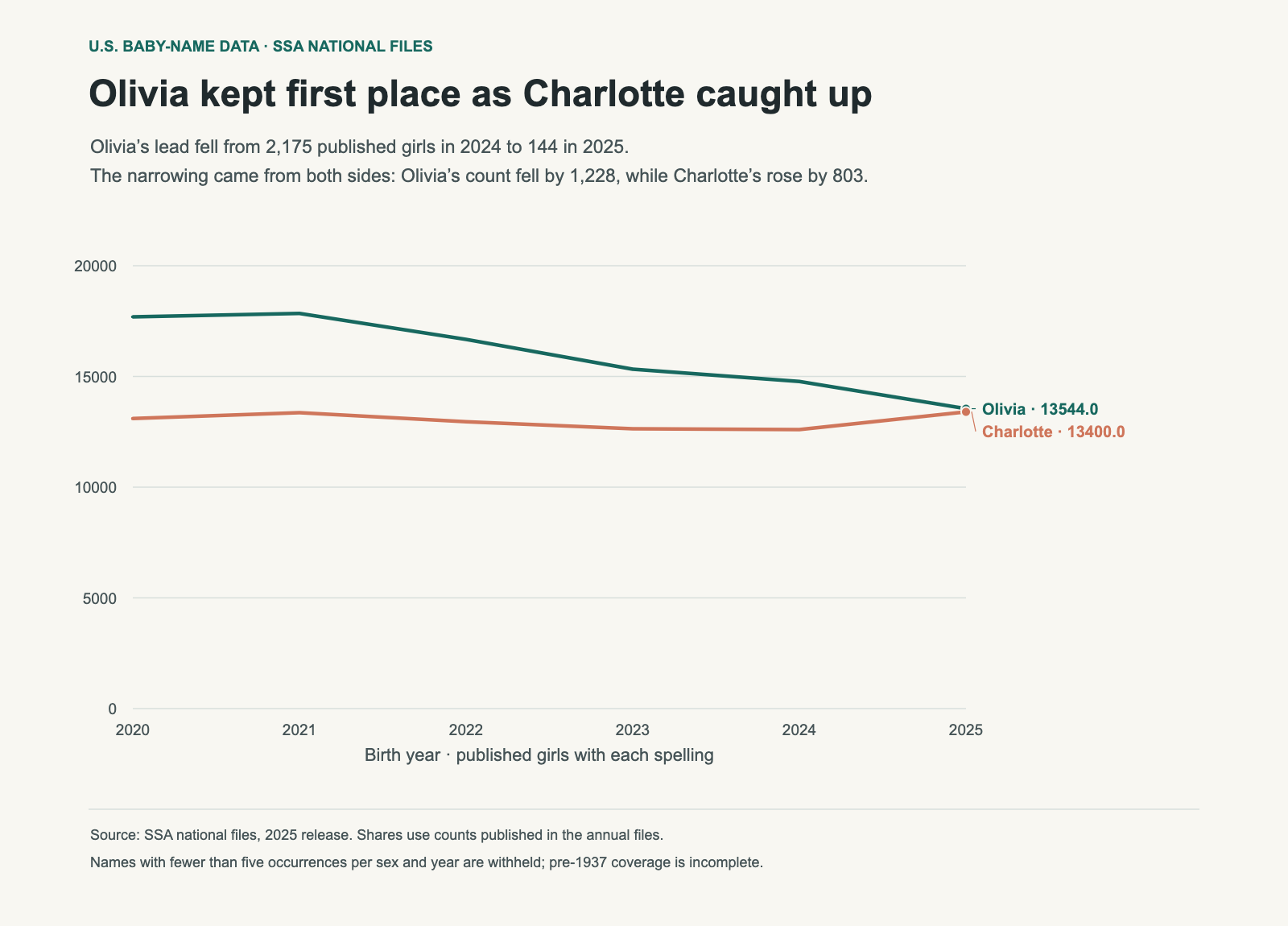
Annual counts for Olivia and Charlotte from 2020 through 2025 converge, leaving a gap of 144 in 2025.
These lines count girls with each exact spelling in the pinned SSA release. In 2025, Olivia appears 13,544 times and Charlotte 13,400. A small count difference still produces two separate ranks.

The gap changed more than the leading rank

Name2024 count · rank2025 count · rankCount change
Olivia14,772 · #113,544 · #1−1,228
Charlotte12,597 · #413,400 · #2+803

Charlotte’s move from fourth to second place is visible in the ranking. Olivia’s decline in count is not: it retained first place. A name can remain first because all the names below it also have lower counts, even when its own use falls.

The 2025 difference is about 1.1% of Olivia’s count. It does not predict a switch next year; future counts could rise or fall in either direction.

The longer view changes the interpretation

Olivia’s count was 17,691 in 2020 and 13,544 in 2025. Charlotte’s was 13,100 in 2020 and 13,400 in 2025. Over that longer comparison, Olivia’s decline did more to close the gap than Charlotte’s relatively small net increase.

Charlotte’s path was also uneven. Its count fell from 13,368 in 2021 to 12,597 in 2024 before rising in 2025. A single latest-year increase should not be described as an uninterrupted climb.

Counts, shares and ranks answer different questions

A count tells you how many occurrences are published. A share places that count within the year’s published girls’ total. A rank puts the names in order.

Olivia accounted for 0.84% of the published female count in 2025; Charlotte accounted for 0.83%. Their positions near the top do not mean either name belongs to a large fraction of every local classroom. State patterns, nearby spellings and the size of the group matter too.

How to use a close contest when choosing a name

  1. Compare several years. A short series separates a persistent direction from one annual change.
  2. Check the exact spelling. Related spellings have separate counts, even when their sound is similar.
  3. Look at local use. National figures describe the whole published file, not your neighbourhood.
  4. Keep preference in the decision. A difference of one rank is rarely a sufficient reason to choose a name you like less.

For a wider historical view, read how to compare decades. The top-ten concentration analysis explains why being first today represents a smaller share than it did in many earlier cohorts.

Data and method

All counts and ranks above are calculated from the SSA’s 2025 national release, including its files for earlier birth years. Counts can be revised between releases, so using one bundle keeps the comparison consistent. Shares divide each count by all published female counts that year; names with fewer than five occurrences are omitted from the files.

Download the six-year comparison (CSV), or consult the SSA files and documentation.
058 / 59

How to Read Baby-Name Trends by Decade: Rank, Count and Share

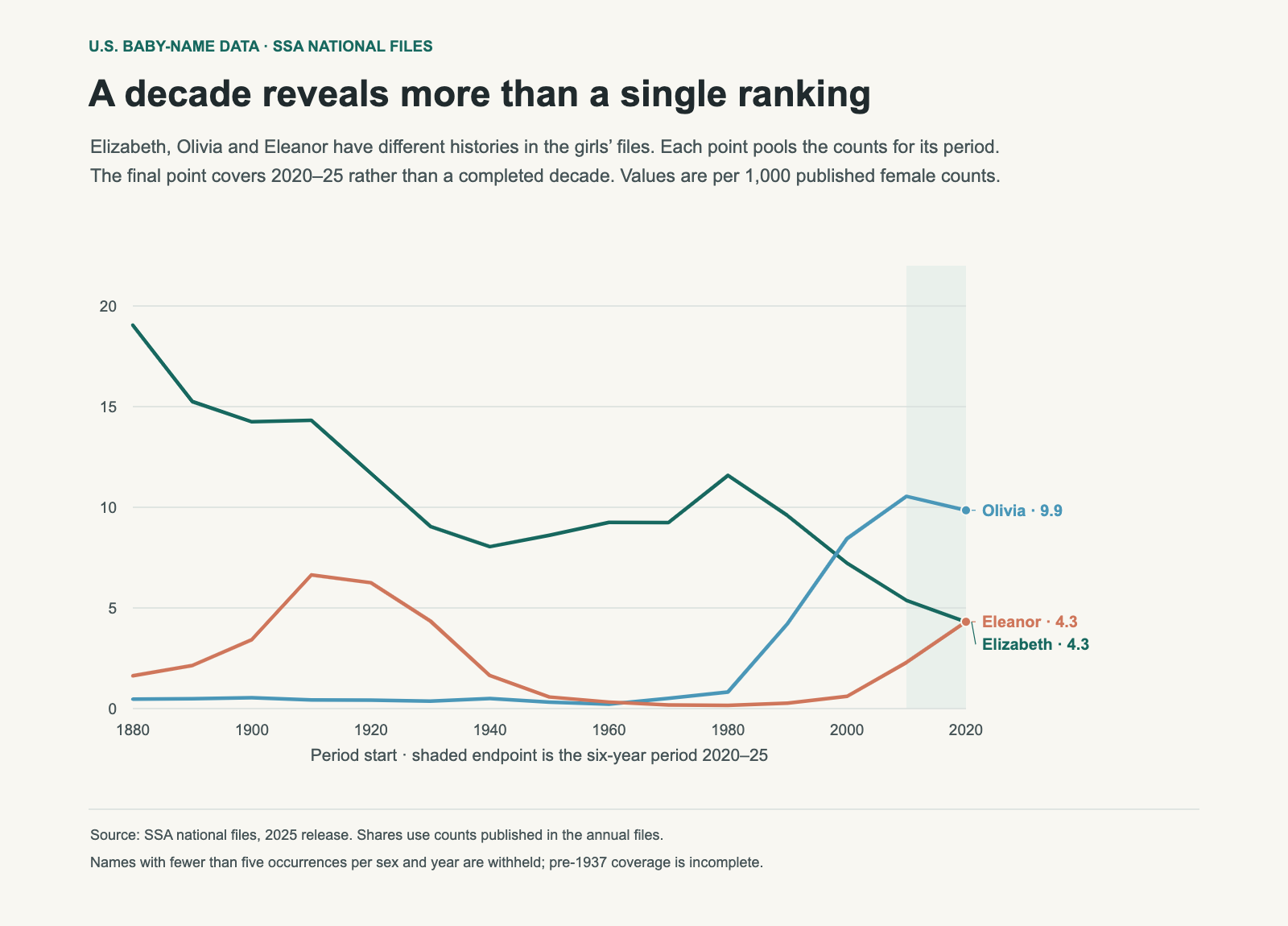
A decade chart can distinguish a long-lasting presence from a recent rise or a revival. Elizabeth, Olivia and Eleanor all ranked in the girls’ top twenty in 2025, but they arrived there by different paths. Their histories make a more useful comparison than the latest ranking alone.

A decade also smooths over annual changes. That helps reveal a broad pattern, while hiding some of the latest movement. Read the long view first, then return to the individual years near the end.

Three lines show pooled decade shares per 1,000 published female counts for Elizabeth, Olivia and Eleanor, including the partial 2020–25 period.
A value of ten means ten recorded girls with that exact spelling per 1,000 published female counts in the period. Each point pools the period’s counts; it does not average the yearly ranks. The shaded endpoint covers six years, 2020–25.

Three names, three histories

Elizabeth illustrates a sustained presence near the front of the rankings. It remains prominent across the record even though its share and count change. “Stable” should mean a continuing presence, not a promise that its use is flat.

Olivia illustrates a strong modern rise followed by a recent retreat in count. It reached first place and remained there through 2025, while its annual count fell from 17,691 in 2020 to 13,544 in 2025. A high rank can coexist with falling use.

Eleanor illustrates a revival. It was prominent in the early twentieth century, became less common, and returned to rank twelve in 2025. Its current share remains below its early peak even though it has become familiar again.

Choose the measure before interpreting the line

MeasureQuestion it answersUseful caution
RankWhere is this name in the ordered list?It hides the gaps between names.
CountHow many occurrences are published?The cohort size changes between years.
ShareHow much of this year or period does it represent?Use the same denominator in comparisons.

Adding a decade’s counts answers how often a spelling appears across that period. Dividing by the period’s published total makes decades of different cohort sizes easier to compare. Averaging ranks answers a different question and can hide how much use separates neighbouring ranks.

A decade can conceal a turning point

A name could rise through the first half of a decade and decline through the second. Its pooled decade share would combine both movements. If you want to know whether it is currently rising, inspect recent annual values rather than inferring direction from the decade average.

The unfinished 2020s need a clear endpoint too. A 2020–25 point is a summary of six observed years, not a forecast of 2020–29. Compare it with a complete decade for context, while keeping the difference in observation windows visible.

Use national history beside local context

National rankings describe a broad population. A state can have a different balance, and a particular school can differ again. The SSA’s 2025 state tables offer a first look at that variation; its downloadable state files provide a wider list.

Related spellings also affect familiarity. A name can have a modest exact-spelling rank while sounding similar to several more common entries. Keep exact spellings separate when reading the files, then consider the sound of the group when thinking about everyday use.

A practical shortlist review

  1. Write down why you like each name before opening the rankings.
  2. Check the long shape: sustained presence, rise, decline or recovery.
  3. Read the last few annual counts and shares.
  4. Check local use and spellings that may sound similar.
  5. Discuss which of those facts actually changes your preference.

For an example of ranks hiding a close result, see Olivia and Charlotte. For selected revivals, read why old names can return without a universal clock. The partner guide keeps the comparison connected to a shared decision.

Data and method

The chart uses the SSA’s pinned 2025 national release. Each decade’s selected-name count is divided by all published female counts for the same period, then multiplied by 1,000. Counts below five are suppressed; records before 1937 are incomplete. Download period totals, years and shares (CSV). Source: SSA national name files.

059 / 59

How to Choose a Baby Name With Your Partner

Separate finding names from choosing one. If every new suggestion starts a debate, both people can become cautious about saving anything. Independent lists give each person room to discover what they like before explaining it.

Then compare the lists at an agreed time. The useful result is a shortlist you can return to, with a reason for each candidate. You do not need to settle every disagreement in the first conversation.

Start with a small independent list

Each person can save five to ten names and a short note about the appeal: sound, family connection, meaning or a familiar association. These notes help distinguish liking a specific name from liking a feature that several names could offer.

For example, one person might like Anna because it is short and familiar, while the other likes Eleanor because it has a longer formal version and several possible everyday forms. Those preferences are clearer starting points than arguing that one name is simply better.

A worked example

Imagine these two lists. They are invented examples for the process, not recommendations or popularity data.

Person APerson BFirst conversation
AnnaEleanorShort everyday form versus longer formal name
ClaraClaraShared candidate: keep it for a full-name check
LucyJosephineWhat matters: sound, nickname or family connection?
AliceAliceShared candidate: compare with Clara

Start with Clara and Alice because both people already chose them. Give the other names a later discussion slot. That preserves the shared candidates while allowing each person’s favourites to be heard.

Agree on constraints before ranking favourites

Discuss pronunciation, spelling, family traditions and whether any naming rules are essential. If a family name is required, identify it early. If one person has a difficult association with a candidate, make room for that without requiring a case to be argued in public.

Agree on a way to pause a name as well as reject one. A “maybe later” list prevents every hesitation from becoming a permanent veto. If either person can veto a final choice, make that rule shared and explicit.

Check finalists in ordinary use

  1. Say the full name at a normal pace, including the surname.
  2. Write the initials and any everyday short form you expect to use.
  3. Try introducing someone with the name and calling it across a room.
  4. Check pronunciation in the languages your family uses.
  5. Discuss whether you would be comfortable with common spelling corrections.

These checks reveal practical issues; they do not produce an objective score. A name can be slightly harder to spell and still have a family connection that makes it the preferred choice.

Bring in popularity after you know what you like

National rank, counts and local history can answer a specific concern about familiarity. They cannot guarantee that a name will be unique at school or remain at the same rank. Ask which fact would actually change your choice before spending another evening looking at lists.

If a candidate has risen recently, read its last few annual counts. If it feels vintage, look at the longer history. Our decade guide explains those comparisons, and Olivia and Charlotte show why adjacent ranks can be very close.

Leave with a next step

End the conversation with two or three candidates and one unresolved question for each. That might be pronunciation, a family association or a preference you want time to consider. Schedule another discussion after you have answered those questions.

This is a practical process rather than a proven formula for agreement. Adapt it to your family. A shared note, paper list or naming tool can hold the candidates; Name Scout can supply historical context when the data would help.