YellowSquared  /  Field notes

Notes from the workshop

60 posts, newest first. Choose an app to narrow the feed.

049 / 60

Can You Refrigerate Bananas? Start With Their Ripeness

Let green bananas ripen at room temperature. Once they are ripe, refrigeration is an option if you need a little more time to eat them. The peel may turn brown in the fridge while the flesh remains cream coloured. That change in appearance can make a usable banana look older than it is.

The useful question is what stage the banana reached before it went cold. A green banana and a ripe banana need different handling. This guide covers ordinary dessert bananas; plantains and other cooking varieties have different uses.
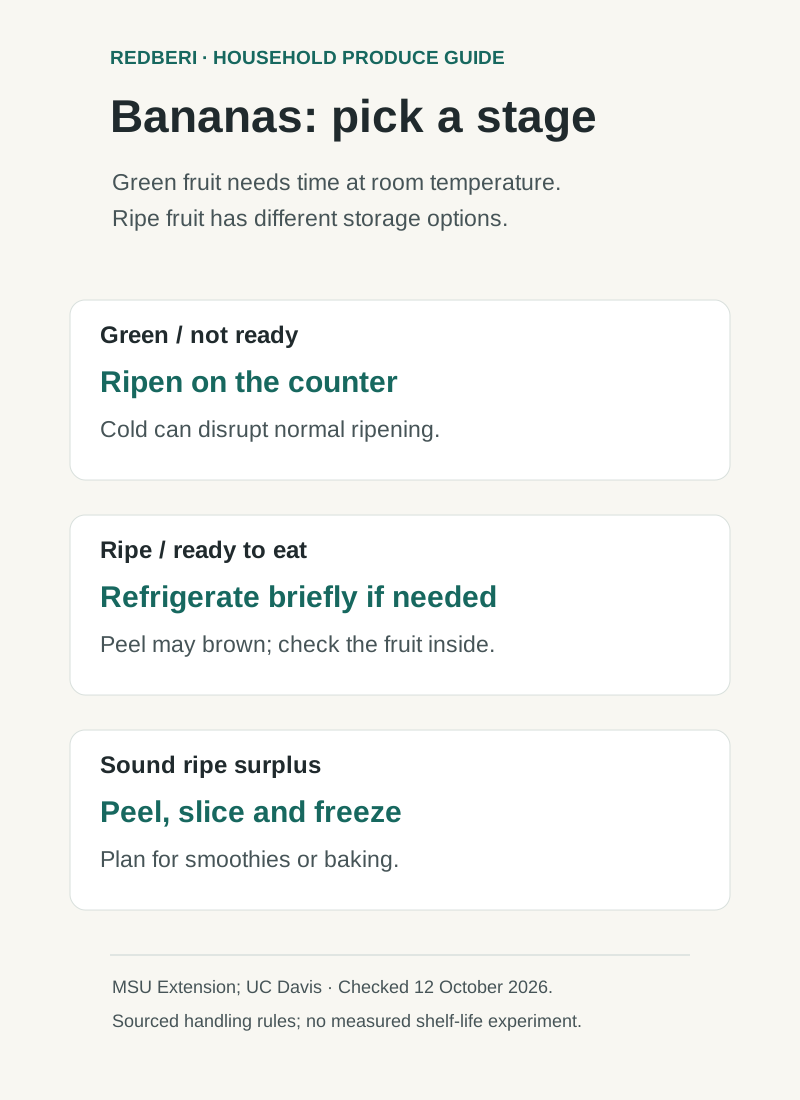
Three banana handling choices: green bananas ripen on the counter; ripe bananas may be refrigerated briefly; surplus sound ripe bananas can be peeled and frozen.
A stage-based decision chart from Extension guidance. These are handling categories, not a test of your fruit or a guaranteed shelf life. Download the chart inputs and sources (JSON).

Green bananas: give them room to ripen

Mississippi State University Extension advises against refrigerating bananas before they ripen. Cold storage can interfere with normal ripening. Its shopping advice distinguishes yellow fruit for nearer meals from fruit with some green for later use. Read the Extension banana guide.

For an illustrative shopping plan, buy a few yellow bananas for the next breakfast and a few greener ones for later. That gives the fruit different starting points; it does not guarantee that each banana will be ready on a particular day. Check the bunch as your plans change.

Ripe bananas: cold storage changes the peel

The same Extension guide gives a short refrigerator window of two to three days for ripe bananas and warns that the skin browns while the flesh stays cream coloured. Treat that as household guidance, with the fruit's starting condition in mind. Refrigeration cannot restore a banana that has already spoiled.

UC Davis identifies bananas as sensitive to chilling. Its Cavendish fact sheet describes discolouration, failure to ripen and, in severe cases, flesh browning. The response depends on maturity, temperature and exposure. Its commercial transport recommendations describe controlled conditions, so they should not be read as a home-fridge shelf-life promise. See the UC Davis banana fact sheet.

A dark peel alone therefore gives an incomplete answer. Consider when the fruit was refrigerated and inspect the flesh when you open it. Discard fruit showing decay or mould; brown skin is not a blanket assurance that the inside is sound.

More ripe fruit than you can use: plan a freezer batch

For sound ripe fruit intended for smoothies or baking, Extension suggests freezing slices in a single layer, then transferring the frozen pieces to a labelled freezer bag. Choose that use before freezing rather than expecting the thawed fruit to behave like a fresh snack banana.

Use storage advice with a meal in mind

Redberi's produce detail includes storage stages. That structure helps you turn a shopping choice into a next action: allow ripening, use soon, or prepare for a later recipe. General day ranges still need judgement about the actual fruit; this chart uses Extension guidance rather than treating an app estimate as a freshness guarantee.

For the wider pattern, see which fruits ripen on the counter. For another fruit where appearance needs interpretation, read why a crisp Asian pear can already be ripe.

No household storage experiment was performed for this article.
050 / 60

When to Wash Strawberries: Before Eating or Before Storage?

For whole strawberries you plan to keep, refrigerate them unwashed and wash the portion you are about to eat or prepare. Washing adds surface moisture, so the timing matters. Keeping berries unwashed during storage is a quality practice; it does not replace cleaning them before eating.

Start with a meal plan rather than washing the entire box automatically. If you need six berries for breakfast, prepare six. Leave the rest for their own preparation step. This is an example of how to apply the guidance, not a measured claim about days saved.

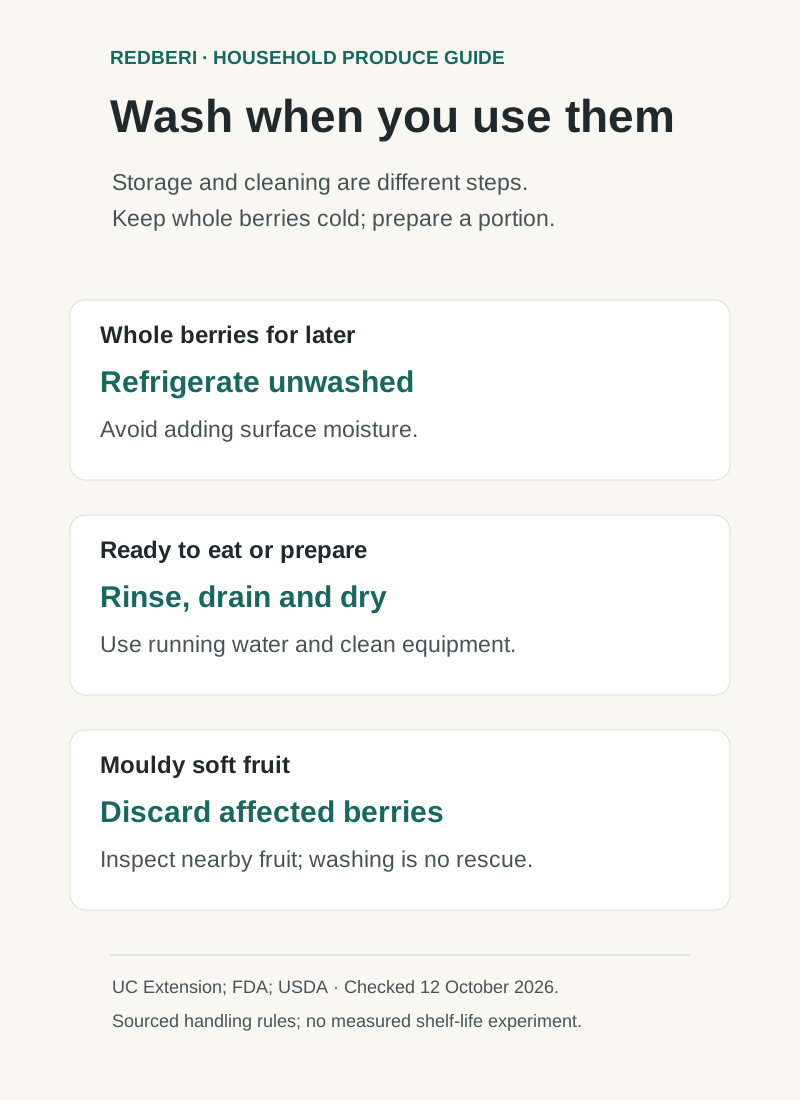
Strawberry handling sequence: store whole berries unwashed in the fridge; rinse and dry before use; discard mouldy soft fruit.
The chart separates storage, preparation and spoilage decisions. It does not measure bacterial removal or predict a fixed storage life. Download the sourced chart categories (JSON).

Before storage: keep extra moisture out

University of California Cooperative Extension's strawberry guidance recommends refrigerator storage and delaying washing until eating or preserving. The starting ripeness and condition affect how long the berries keep. A published maximum under good conditions is not a countdown that makes every box usable until its final day. Read the UC strawberry guide.

Check the fruit before putting it away. A plan to eat berries later should include a second look when that meal arrives. Avoid making an entire week's menu depend on a package remaining unchanged.

Before eating: rinse, drain and dry

Use cool running water, drain the berries and pat them dry with a clean towel. UC's guide advises against leaving strawberries in a sinkful of standing water. The FDA also recommends running water for produce and advises against soap or produce washes. See the FDA's cleaning advice.

Wash your hands before preparing food. Use clean utensils and keep berries separate from raw meat and its preparation equipment. Store strawberries in a refrigerator at 40°F (4°C) or below, checking with a thermometer. The FDA's produce-handling guide covers these precautions.

If you have already washed the whole box

Drain and dry the fruit, then return it to the refrigerator. Plan to use it promptly rather than assigning it a new shelf life because it was washed. Cleaning is a preparation step; it does not reverse damage or ageing.

For a practical example, a washed portion might go into today's breakfast, while the remaining sound fruit becomes the next item you plan to use. The choice depends on its condition and your meal, not on an assumed number of extra days.

Mould changes the decision

Discard mouldy strawberries. Cutting off a visible patch is not the recommended treatment for soft fruit, where contamination can extend below the surface. Inspect nearby fruit too. Washing should not be used to rescue mouldy berries. USDA explains mould on soft foods.

Keep the storage question separate from ripening

Redberi's strawberry record has a refrigerator storage stage, and its produce details organise selection and storage advice. Use that distinction when deciding which groceries need attention first. Generic storage ranges cannot certify a particular box as safe or fresh.

Strawberries also differ from fruit bought to soften at home. Our counter-ripening guide explains why waiting is not a reliable way to improve an underripe strawberry.

This article summarises household guidance; it reports no washing or shelf-life experiment.

051 / 60

How to Store Cut Melon: Rind Washing, Cold Storage and Serving

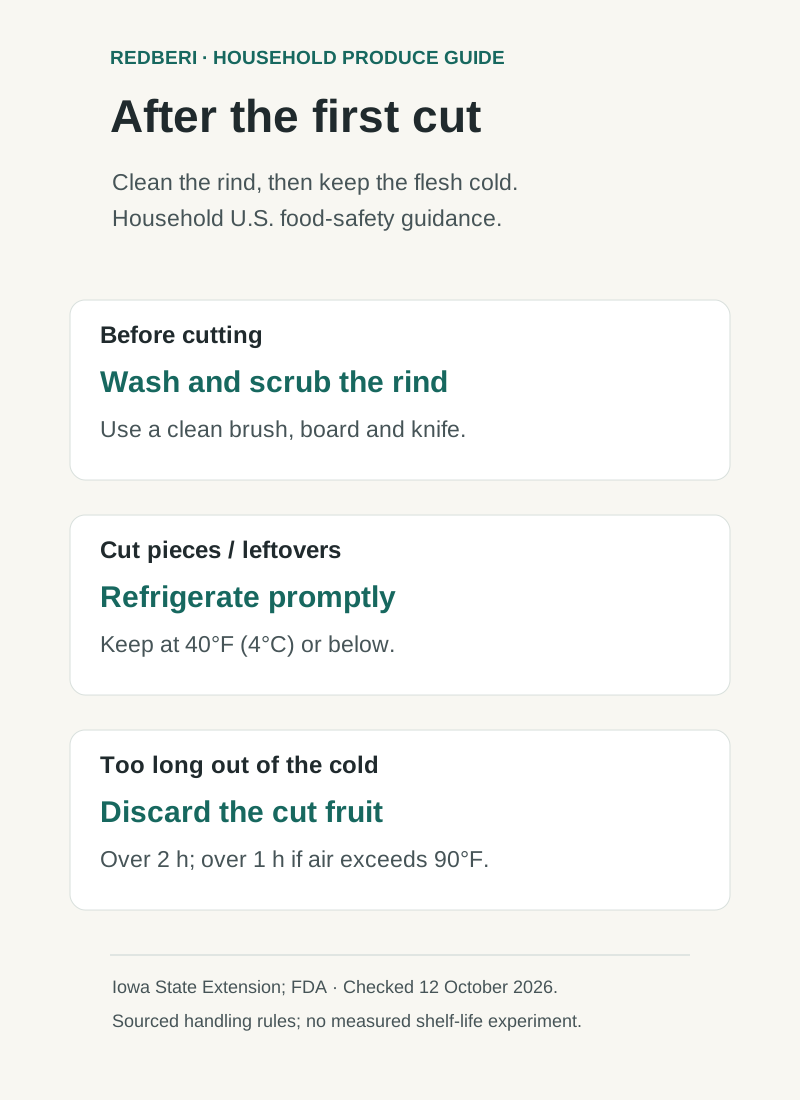
Wash a melon's rind before cutting, use clean equipment, and refrigerate the cut fruit promptly. Buying a good melon and handling it after cutting are separate tasks. An intact rind does not make the flesh immune to contamination when a knife passes through it.

This guide concerns household preparation of watermelon, cantaloupe and honeydew. It answers the question that starts after choosing the fruit: how to prepare a portion and keep the remainder cold.

Cut melon handling: wash and scrub the rind before cutting; refrigerate cut fruit at 40 degrees Fahrenheit or below; discard after exceeding the room-temperature limit.
A household handling sequence, not a bacterial-growth model. The time limits are safety guidance, not a guarantee that a particular melon is uncontaminated. Download the chart's rules and sources (JSON).

The rind needs washing even when you will discard it

The knife can carry material from the rind to the flesh. Iowa State University Extension recommends washing the exterior with cool water and a vegetable brush, as well as starting with clean hands. The FDA recommends a clean brush for firm produce such as melons. Read Iowa State's melon preparation advice and the FDA's cleaning guidance.

Set out the clean board, knife and storage container before cutting. This makes it easier to put the extra portion away while you prepare the serving you need. Keep produce equipment separate from equipment used for raw meat.

Cut fruit belongs in the refrigerator

Put extra melon into a covered food-safe container and refrigerate it promptly. Iowa State's guidance recommends refrigerator storage at 40°F or below. Plan to use the fruit soon and follow the package's storage instructions. Refrigeration does not make a damaged or poorly handled melon safe.

For pre-cut melon, choose a package held cold at the store and keep it refrigerated at home. The FDA recommends buying pre-cut produce refrigerated or on ice and refrigerating it after purchase. See the FDA's produce-shopping guidance.

At a picnic, plan for time and temperature

Keep the refrigerator at 40°F (4°C) or below. FDA household guidance limits the time foods requiring refrigeration spend at room temperature to two hours, or one hour when the air is above 90°F (32°C). Cut melon is a perishable food: refrigerate it promptly and discard it if those limits have been exceeded. Do not use taste or smell to certify safety. Read the FDA's food-storage rules.

Imagine serving melon outside on a hot afternoon. Bring out a small portion and keep the rest chilled until needed. Track how long the serving has been out; moving it back into the fridge does not undo its earlier warm exposure. The limits are a reason to organise serving, rather than a target for leaving fruit out as long as possible.

A date label helps with the next meal

Write the preparation date on the container so another person can understand when it was cut. This is a simple household workflow suggestion, not a substitute for temperature control or the package's instructions.

Redberi separates produce selection and storage information. That structure helps with meal planning, but a general fruit-stage estimate cannot assess contamination or replace food-safety guidance for cut produce. Use the public rules above for this preparation step.

For the earlier shopping decision, read how to choose watermelon or how to choose cantaloupe.

Household U.S. guidance; food businesses should follow their applicable food code. No storage experiment was performed.

052 / 60

Why Asian Pears Stay Crisp: When to Eat, Wait or Refrigerate

A crisp Asian pear can be ready to eat. It does not need to become soft like a ripe Bartlett. Asian pears generally ripen on the tree and are usually sold ready to eat. Common European dessert pears, including Bartlett and Anjou, can finish ripening after harvest. Knowing which kind you bought helps you decide whether to wait or refrigerate it.

This matters when a bowl contains several kinds of pear. Waiting for every fruit to develop the same texture can mean holding an Asian pear longer than necessary. Putting every firm pear straight into storage can also postpone the softer texture you wanted from a European pear. Start with the variety label, then choose your eating preference.

Two pear types, different expectations

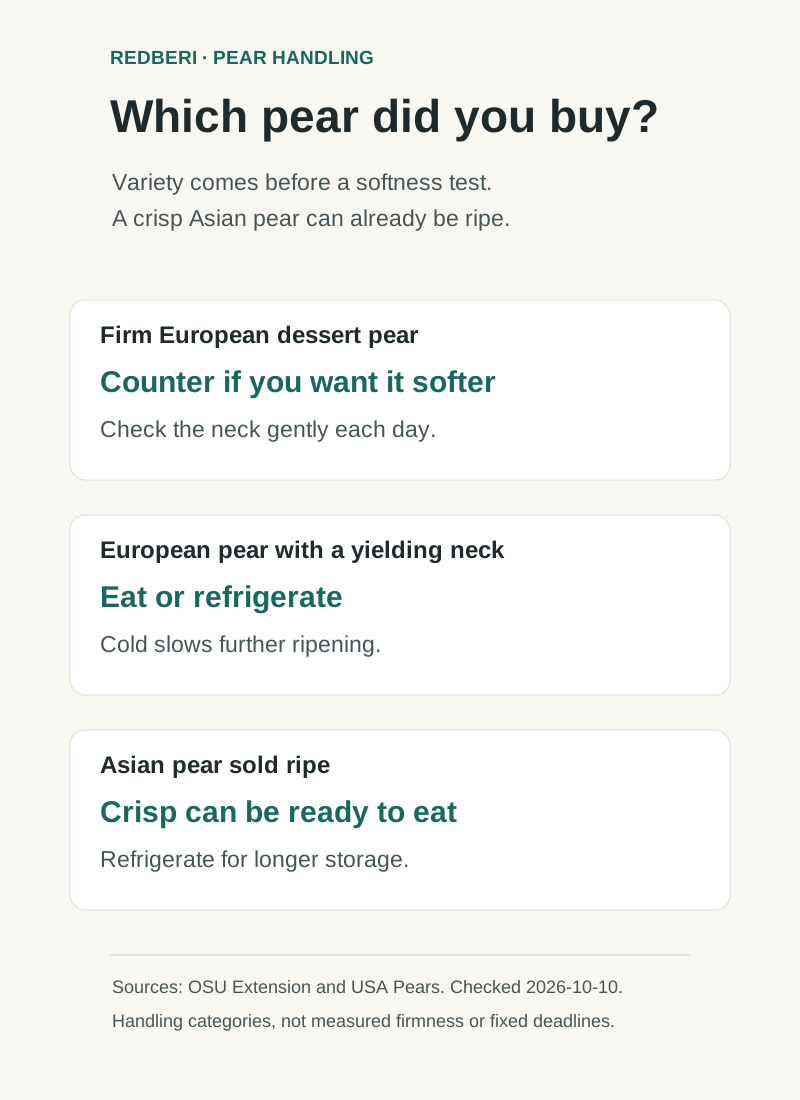
Three sourced pear decisions: firm European pears can ripen on the counter, European pears with a yielding neck can be eaten or refrigerated, and ripe Asian pears stay crisp.
A qualitative decision chart for common dessert pears, based on Oregon State University Extension and USA Pears guidance. These are handling categories, not measured firmness scores or guaranteed ripening times. Download the categories and source links.

The apple-like shape of many Asian pears is a useful clue, but a name on the label is a better starting point than shape alone. Varieties differ in appearance and texture. Oregon State University’s Asian pear guidance describes fruit that ripens on the tree and is normally sold ripe; its crispness is not evidence that it needs a counter-ripening treatment.

European pears offer a different progression. USA Pears describes a firmer eating stage suitable for a crunchy snack or salad, followed by a juicier stage as the neck softens. You can prefer either. “Ready for my salad” and “ready for a soft dessert” need not mean the same texture.

For a softer European pear, check near the stem

Use gentle pressure at the neck near the stem. If it yields, the pear has reached a softer eating stage. If you want that texture and the neck remains firm, leave the fruit at room temperature and inspect it daily. Once it reaches your preferred stage, refrigerate it to slow further ripening.

Handle it gently rather than repeatedly squeezing the whole fruit. A pressure test is a cue about texture, not a measurement of sweetness or a guarantee that the interior is perfect. Check the fruit when you cut it, too.

For a practical example, imagine buying a firm Anjou for later in the week and an Asian pear for lunch. The Anjou can stay out while you monitor its neck; the Asian pear does not need to join that waiting process. This is an illustrative shopping decision, not a timed experiment with particular fruit.

Why a home-grown pear may need another step

A pear from a tree and a pear from a commercial packing house may have different storage histories. OSU Extension explains that winter European varieties such as Anjou, Bosc and Comice need cool conditioning before ripening correctly, while commercially packed pears should be ready to ripen.

That distinction matters if a home-grown winter pear stays hard. Adding more counter time is not a substitute for knowing its variety, harvest maturity and conditioning history. Ask your local Extension service for guidance suited to the tree and region. The conditioning periods vary; they are not a countdown that starts when you buy a grocery-store pear.

Choose storage for the fruit you have

Starting decisions for common pears; adjust to the fruit’s condition and your preferred texture.
What you haveWhat to doWhat to avoid assuming
Firm European dessert pearKeep at room temperature if you want it softer; check daily.Every pear will be ready after an identical number of days.
European pear at your preferred softnessEat it or refrigerate to slow ripening.Refrigeration restores fruit that has already deteriorated.
Asian pear sold ripeEnjoy its crisp texture; refrigerate for longer storage.It must develop a soft neck before eating.

Use a produce guide without losing the variety

Redberi brings produce selection and storage information together, which helps with the shopping decision before fruit reaches the counter. Keep the variety label with that decision: a general pear entry cannot replace the distinction between a crisp Asian pear and a European pear you want to soften.

For other fruit in the same bowl, see which fruits ripen on the counter. If you are choosing between snacks, the apples and pears guide covers the broader comparison. This page answers the narrower question of why a pear may be crisp and ready to eat.

Sources and scope

Sources: OSU Extension’s Preserving pears, its Asian pears publication (revised May 2024, hosted by UC Agriculture and Natural Resources), and the grower organization USA Pears’ ripening and storage guidance. The chart summarizes those recommendations; it does not report an original firmness, sugar or shelf-life measurement. Harvest maturity, variety and prior handling affect the result.

053 / 60

How to Tell if a Cantaloupe Is Ripe: 4 Signs to Check

A ripe cantaloupe smells sweet at the stem end, has a beige-to-golden background beneath raised netting, and has a clean, slightly sunken stem scar. Avoid fruit with soft wet spots, mould or a fermented smell.

CheckGood signPass on it when
Stem scarSmooth, rounded and slightly sunkenA stubborn stem stub remains or the area is damaged
SkinDense raised netting over a warm beige or golden backgroundThe background is distinctly green, or there are soft dark spots
AromaSweet, floral scent at the stem endNo aroma at all, or a winey, fermented smell
FeelFirm overall with only slight give at the blossom endSoft, wet, bruised or leaking

Start with the stem scar

Cantaloupe-type muskmelons can separate from the vine at maturity, leaving a neat scar known as full slip. That is a useful clue for common slip-type cantaloupes, not an absolute guarantee of flavor. Varieties and commercial harvest practices differ; do not apply the slip test to honeydew. When the choice is between a clean scar and a jagged, forced-looking stem, choose the clean scar.

Then use your nose

Lift the melon and smell the stem end. A ripe cantaloupe should have a distinct fragrance. A fermented smell means it has gone too far; a completely scentless melon is often less ready to eat. Do not squeeze the sides: that makes bruises without giving a reliable answer.

Can cantaloupe ripen on the counter?

It can continue to soften and develop aroma at room temperature. Its sugar, however, does not keep accumulating after harvest, so a better melon at purchase is usually a better melon at dinner. Once it reaches the texture you want, refrigerate it and use it soon.

Choose for tonight, not just for appearance

If two sound melons look similar, use aroma and gentle feel to decide which is closer to eating. A fragrant melon with slight give suits a nearer meal; a firmer one may need time to soften. Waiting can change texture and aroma, but cannot replace sugar that should have developed on the plant.

Wash the rind under running water and scrub it with a clean produce brush before cutting. The knife can carry material from the rind into the flesh. Refrigerate cut melon promptly; the FDA's produce-cleaning guide explains the preparation steps.

For the broader ripening rule, see which fruits ripen on the counter. For a different melon that needs to be chosen ripe, read how to choose watermelon.

Sources

University of Minnesota Extension and University of Maryland Extension describe melon harvest maturity and postharvest ripening behavior.

054 / 60

How to Tell if a Peach Is Ripe: Color, Feel & Aroma

A ripe peach has a warm cream or yellow background colour, a sweet aroma and a little give near the shoulders. Red blush is not the deciding factor. A peach can be bright red on the sunny side and still be hard or immature.

SignalRipe or nearly ripeNot ready or past it
Background colourCream, gold or warm yellow under the blushGreen around the stem and shoulders
FeelSlight give under gentle palm pressureRock-hard, deeply soft, wrinkled or bruised
AromaClearly fragrant at the stem endOdourless or fermented

Ignore the blush first

Red blush depends on variety and growing conditions, including sun exposure. Turn the peach over and look for its underlying colour, especially near the stem cavity. For common yellow- and white-fleshed varieties, a yellow or cream background is more useful than redness alone. The expected background still depends on the cultivar. A strong green cast means the fruit may be immature, not merely firm.

Use your whole hand, not one finger

Pressing with one fingertip makes a bruise efficiently. Cradle the peach in your palm and apply gentle pressure near the shoulders. A peach for today should yield slightly. One for tomorrow can be firmer if its colour and aroma are promising.

Buy for the day you need it

For tonight, look for fragrance and slight give. For later, a mature-looking but firmer peach gives you more time. A deeply soft spot is damage or advanced softening, not proof of extra sweetness. Handle each fruit once with a gentle palm test, then leave it unbruised for the next shopper.

Ripen on the counter, then refrigerate

Leave firm peaches at room temperature in a single layer until they smell fragrant and give slightly. Once ripe, refrigeration buys a little time. Peaches are climacteric fruit, so they can soften and develop aroma after harvest, but an immature peach cannot recover quality it missed on the tree.

Compare the snack nutrition in peaches vs. apples, or read the counter-ripening guide for the broader ethylene rule.

Sources

University of Florida IFAS explains climacteric stone-fruit ripening and why color, aroma and careful handling matter.

055 / 60

Which Fruits Ripen on the Counter? A Practical Ethylene Guide

Avocados, bananas, mangoes, peaches, pears and cantaloupes can continue ripening on the counter. Watermelon, grapes, citrus, pineapple and most berries should be bought ready to eat: they will not become sweeter at home.

Usually ripens on the counterBuy ripe; it will not improve much
Bananas, avocados, pears, peaches, plums, mangoes and common cantaloupe typesStrawberries, blueberries, grapes, citrus, pineapple, watermelon and common honeydew types

Ripening is more than becoming soft

A fruit can soften without becoming sweeter or developing the quality of a mature harvest. Cantaloupe illustrates the distinction: counter time can improve texture and aroma, while sugar accumulation largely ended at harvest. Common honeydew types should be selected mature; melon behaviour varies by type, as University of Maryland Extension explains.

What ethylene actually does

Ethylene is a natural plant hormone that helps climacteric fruit soften, change colour and release aroma. A loose paper bag keeps some ethylene near the fruit and can speed the process. Add a ripe banana or apple if you need a small boost, then check the bag daily. Hachiya persimmons also ripen on the counter, but only once they are very soft; see fuyu vs hachiya persimmons.

A mature but firm peach can soften and become fragrant; a sour strawberry mostly becomes a softer sour strawberry. Buy non-climacteric fruit at its peak, then eat it promptly.

How to use the counter without wasting fruit

  1. Sort fruit into “eat now,” “ripen here” and “refrigerate later.”
  2. Keep ripening fruit in a shallow bowl or loose paper bag, never a sealed plastic bag.
  3. Check daily. Once the fruit reaches the texture you want, refrigerate it to slow the clock.

Fruit-specific exceptions worth knowing

Avocados are unusual because they do not soften on the tree; mature fruit ripens after harvest. Cantaloupe can soften and become more aromatic after harvest, but its sugar does not keep increasing. Watermelon does not ripen significantly after harvest, so choose it well in the store rather than waiting it out at home.

Use our guides for avocados, mangoes, peaches and watermelon. The seasonal fruit guide helps with the earlier decision: buying fruit when it has a better chance of tasting good.

Sources

USDA AMS, Iowa State University Extension and University of Minnesota Extension cover ethylene and ripening behavior.

056 / 60

How to Tell if an Avocado Is Ripe: Feel, Colour & Storage

A ripe avocado gives slightly under gentle pressure without feeling mushy. For a Hass avocado, dark green to nearly black skin is a useful clue, but firmness is the better test. If you need it today, choose one that yields a little; if you need it later, choose firm fruit and let it ripen at room temperature.

When you need itWhat to chooseWhat to avoid
TodayGives lightly when cradled in your palmVery soft areas, dents or loose skin
Soon, with daily checksMostly firm with a little giveHard fruit with obvious shrivelling
Later this weekFirm, heavy for its size and free of damageFruit with damaged areas or deep softness

Skin colour depends on the variety

Hass avocados usually darken as they ripen, which is why colour can help in a typical supermarket display. Green-skinned varieties do not follow the same rule. Use colour as a first pass, then assess the whole fruit with a gentle palm press.

Keep the test gentle

Cradle the whole avocado and apply light palm pressure. Removing stem caps in the store damages fruit and still cannot reveal the entire interior. Leave the cap in place and reject visible dents, shrivelling or unevenly mushy areas.

Two equally firm avocados can ripen at different speeds. Room temperature, maturity and variety affect the timing, so a “ready in two days” label is an estimate. Check daily and buy a mix of firmness levels when you need fruit across several meals.

How to ripen an avocado at home

Avocados are unusual: they mature on the tree but soften after harvest. Leave firm fruit on the counter. A loose paper bag with a banana or apple can speed ripening because those fruits release ethylene. Once your avocado yields slightly, refrigerate it to slow further softening.

Why a hard avocado may never become good

An avocado must be mature when harvested to ripen properly. An immature avocado can stay rubbery, shrivel or develop poor flavor instead of becoming creamy. That is why no colour chart can guarantee the inside; buy from a store with steady turnover and plan for one backup avocado.

For the underlying fruit science, read which fruits ripen on the counter. Redberi's produce guide keeps ripeness and storage notes together when you are deciding what to buy.

Sources

UC Davis Postharvest Research and Extension Center and UC Riverside's Avocado Variety Collection cover avocado ripening, storage and maturity.