YellowSquared  /  Field notes

Notes from the workshop

19 posts, newest first. Choose an app to narrow the feed.

009 / 19

Why Do We Underestimate How Long Tasks Take? The Planning Fallacy and Hofstadter's Law Explained

You sit down on Monday morning to scope a software feature, a research report, or a home renovation project. In your head, the steps look completely straightforward: you estimate three days under normal conditions, and to be extra conservative, you pad the schedule to five days as your “99%-certain worst-case scenario.” Yet Friday evening arrives and you are barely halfway done—even though you have written similar code or reports dozens of times before, and every single one of those past projects also took longer than you expected.

Why do smart, experienced professionals repeatedly underestimate task durations even when they know their past estimates were too optimistic? In 1979, two landmark works—psychologists Daniel Kahneman and Amos Tversky's paper introducing the Planning Fallacy and cognitive scientist Douglas Hofstadter's book Gödel, Escher, Bach introducing Hofstadter's Law—diagnosed this exact cognitive blind spot. Here is the empirical data from project-completion experiments and the three-step protocol that eliminates schedule overruns.
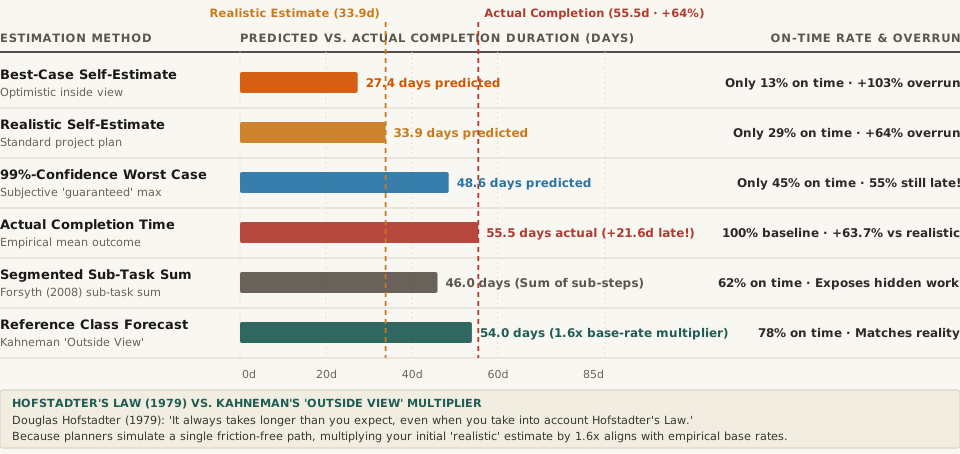
Horizontal bar chart comparing predicted versus actual project completion times in days across best-case, realistic, and 99%-confidence estimates versus actual completion (55.5 days), task segmentation, and reference class forecasting
Figure 1: Predicted versus actual project completion durations (days) from Buehler, Griffin & Ross (1994) and de-biasing interventions (Forsyth 2008; Kahneman & Flyvbjerg Reference Class Forecasting). Download the full dataset: planning-fallacy-kahneman-tversky-thesis-predictions-and-reference-class-forecasting.csv.

1. The 1979 Double Discovery: Kahneman & Tversky's Planning Fallacy and Hofstadter's Law

Remarkably, the two most famous formulations of human time-estimation failure were published in the exact same year (1979) from two different fields:

  • The Planning Fallacy (Kahneman & Tversky, 1979): Working on intuitive judgment and decision-making under uncertainty (work later recognized with Kahneman's 2002 Nobel Memorial Prize in Economic Sciences and expanded with Dan Lovallo in 2003), Kahneman and Tversky defined the planning fallacy as the systematic tendency for people and organizations to underestimate the time, costs, and risks of future actions—even when they possess direct conscious knowledge that past tasks of the exact same nature took substantially longer than planned.
  • Hofstadter's Law (Douglas Hofstadter, 1979): On page 152 of his Pulitzer Prize-winning book Gödel, Escher, Bach: An Eternal Golden Braid (originally discussing why computer chess researchers kept predicting a world-champion chess program was “10 years away” for decades until Deep Blue defeated Garry Kasparov in 1997), Hofstadter coined his famous self-referential law:

“Hofstadter's Law: It always takes longer than you expect, even when you take into account Hofstadter's Law.”

2. The Empirical Proof: Why 55% of People Miss Their Own “99%-Certain” Deadline

How severe is the Planning Fallacy when measured in controlled real-world studies? In a classic 1994 study by Roger Buehler, Dale Griffin, and Michael Ross (alongside confidence-interval replication studies cited in Wikipedia's review of empirical planning fallacy evidence), psychology researchers tracked university students completing their senior honors theses and asked them to estimate when they would finish under three distinct scenarios: if everything went as well as possible, their realistic expected date, and their worst-case date (even if everything went wrong).

The empirical gap between prediction and reality was staggering:

Prediction Method or Confidence Level Estimated vs. Actual Duration (Days) Share Finished On Time (%) Mean Schedule Overrun (%) Empirical Study & Cognitive Mechanism
Best-Case “Everything Goes Right” 27.4 days predicted 13% (at P50 confidence) +102.6% overrun Buehler, Griffin & Ross (1994); focalism ignores all friction
Standard “Realistic” Self-Estimate 33.9 days predicted 29% on time +63.7% overrun Planners equate “realistic” with only slightly padded best-case
99%-Confidence “Worst-Case” Estimate 48.6 days predicted 45% on time (55% missed!) +14.2% mean overrun Even at 99% subjective certainty, more than half missed their deadline!
Actual Empirical Completion Time 55.5 days actual mean 100% (Ground-truth outcome) 0.0% (Actual baseline) Took +21.6 days (+63.7%) longer than realistic estimate
Segmented Sub-Task Sum (Forsyth 2008) 46.0 days (Sum of micro-steps) 62% on time +20.7% overrun Decomposing into small sub-tasks exposes hidden integration work
Reference Class Forecast (Outside View) 54.0 days (1.6× multiplier) 78% on time +2.8% variance Kahneman & Flyvbjerg outside-view base-rate calibration

Look closely at the third row: in confidence-calibration experiments, when participants gave a completion date they were 50% sure they would beat, only 13% finished on time; at 75% confidence, only 19% finished on time; and even when participants named a deadline they were 99% sure they would meet, only 45% actually finished on time (meaning a 99% subjective confidence interval was actually a 45% coin toss!).

3. Why Our Brains Ignore Past Overruns: Focalism and Asymmetric Attribution

Why doesn't experience automatically cure the Planning Fallacy? Cognitive psychology research points to three mechanisms that trap us in what Kahneman calls the “Inside View”:

  1. Focalism (Singular Scenario Simulation): When you estimate a future task, your brain constructs a single mental movie of the steps required to succeed. Because there is only one straightforward way for a project to go right, whereas there are thousands of low-probability ways for unexpected interruptions to occur (a sick child, a broken API dependency, a slow code review, a hardware bug), your mental simulation assigns near-zero weight to each individual disruption—even though the probability that at least one disruption occurs is nearly 100%.
  2. Self-Serving Asymmetric Attribution: When Buehler and colleagues asked people why their past projects ran late, participants blamed external, one-off flukes (“the server crashed that week,” “the client changed the spec”) and therefore discounted their own historical track record as unrepresentative of the next project.
  3. Memory Compression of Past Effort (Roy et al., 2005): Retrospective memory studies show that people also systematically remember past completed tasks as having taken less time than they actually logged on the calendar.

How to Beat the Planning Fallacy: Segmentation + The 1.6× Outside View

Two evidence-backed techniques reliably close the gap between planned and actual completion times:

  • Exploit the Segmentation Effect (Forsyth, 2008): Never estimate a project that takes more than half a day as a single number. As shown in Forsyth's 2008 experiments on the segmentation effect, breaking a project into granular 30-to-90-minute sub-tasks (including setup, edge-case testing, formatting, and review) produces a sum that is dramatically closer to actual duration than a holistic top-down guess.
  • Apply Reference Class Forecasting (The 1.6× Multiplier): Switch from the Inside View (simulating today's task steps) to Kahneman and Bent Flyvbjerg's Outside View: look up the actual calendar duration of your last 5 to 10 similar tasks, compute your empirical overrun ratio (in Buehler's study, 55.5 / 33.9 = 1.64×), and multiply your realistic estimate by that base-rate factor before committing to a deadline.

Calibrate Your Personal Estimation Multiplier and Daily Streaks in Timeli

The fastest way to replace optimistic inside-view guesses with accurate reference-class data is to log your daily execution blocks and see how many sessions each milestone actually requires over time. Track habit automaticity curves on Timeli to turn ambitious multi-week projects into repeatable daily execution streaks with zero deadline slippage.
010 / 19

Does the 25-Minute Pomodoro Technique Actually Work? (25/5 vs. 52/17 vs. 90-Minute Blocks)

In the late 1980s, an Italian university student named Francesco Cirillo was struggling to focus on his sociology and computer science textbooks. Picking up a mechanical, tomato-shaped kitchen timer (pomodoro is the Italian word for tomato), he challenged himself to study for just 10 uninterrupted minutes—and eventually settled on the interval that became the world's most famous productivity system: the Pomodoro Technique, built around 25 minutes of single-task focus followed by a 5-minute break (and a longer 15 to 30-minute break after every four pomodori). Decades later, millions of students and knowledge workers swear by the 25/5 timer—while just as many software engineers and writers complain that a 25-minute alarm rings right as they finally get into "the zone."

Why does a 25-minute countdown work like magic when you are procrastinating on a dreaded task, why does that same 25-minute cutoff backfire during complex architecture or long-form writing, and how do you choose between 25/5, 52/17, and 90/20 focus blocks? Here is the cognitive ergonomics breakdown—and how to log and analyze your focus intervals in Timeli.

How the Classic 25/5 Pomodoro Architecture Works (Cirillo's 5 Rules)

As documented in Wikipedia's overview of the Pomodoro Technique, Cirillo's original methodology is more than just setting an alarm; it is a strict single-tasking protocol designed to eliminate internal and external context switches:

  1. One Atomic Unit (1 Pomodoro = 25 Minutes Work + 5 Minutes Rest): A pomodoro is indivisible—there is no such thing as "half a pomodoro." If you abandon the task to check a message at Minute 14, the pomodoro is voided and reset.
  2. The "Inform, Negotiate, Call Back" Interruption Shield: When an internal distraction pops into your head (e.g., "I need to pay that invoice") or a colleague interrupts you, you jot it on an Unplanned & Urgent inventory sheet and immediately return to the current 25-minute block until the bell rings.
  3. The 4-Pomodoro Set Reset (2 Hours = 100 Min Work + 30–45 Min Rest): After completing four consecutive 25/5 cycles, you take a longer 15 to 30-minute restorative break away from your desk to clear working-memory fatigue.
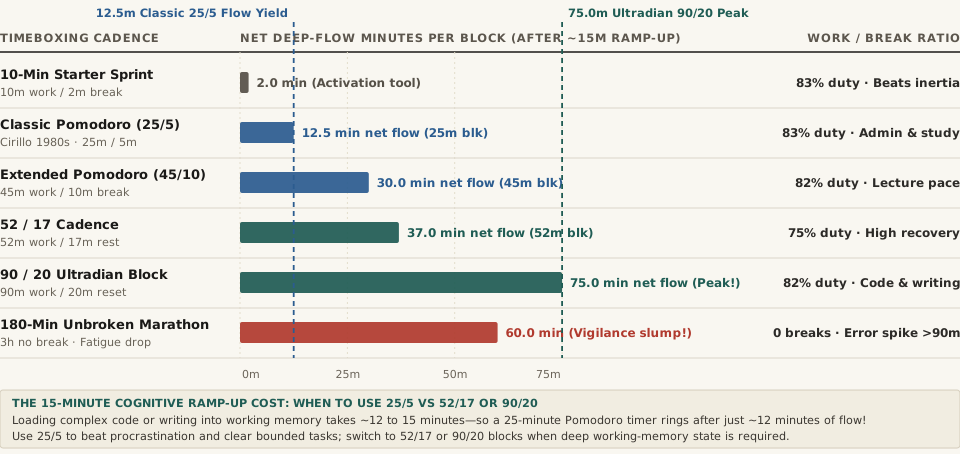
Horizontal bar chart comparing net uninterrupted deep-flow minutes per block (after subtracting ~15 minutes of cognitive ramp-up) across focus cadences: 10-Min Starter Sprint (2m), Classic Pomodoro 25/5 (12.5m), Extended Pomodoro 45/10 (30m), 52/17 Cadence (37m), 90/20 Ultradian Block (75m), and 180-Min Unbroken Marathon (60m due to fatigue).
Figure 1: Net uninterrupted deep-flow time per block (in minutes, after accounting for ~12–15 minutes of cognitive context loading) across classic 25/5 Pomodoro sprints, 52/17 intervals, and 90/20 ultradian blocks. Source: Wikipedia — Pomodoro Technique & Francesco Cirillo.

The Cognitive Tradeoff: Activation Friction vs. Ramp-Up Overhead

Why do some tasks thrive on 25/5 while others stall? Because every cognitive task carries two opposing forces—activation friction (how hard it is to start) and context-loading ramp-up time (how long it takes to load the problem into working memory):

  • When Activation Friction Is High (Procrastination, Admin, Studying, Bug Triage) → Use 25/5: When a task feels overwhelming or tedious, your brain triggers task-aversion resistance because it perceives an endless, unbounded slog. Promising yourself "I only have to work on this for 25 minutes until the bell rings" shrinks the psychological horizon, while the 5-minute break prevents time-on-task vigilance decay and boosts spaced memory consolidation.
  • When Context-Loading Ramp-Up Is High (Software Architecture, Math, Long-Form Writing) → Use 52/17 or 90/20: Workplace interruption studies show that loading a complex codebase, financial model, or multi-section argument into human working memory takes roughly 12 to 15 minutes. If your timer forces a mandatory stop at Minute 25, you spend the first 13 minutes warming up and get only ~12 minutes of peak flow before the alarm breaks your concentration!

A 25-minute Pomodoro solves the hardest part of productivity—starting—by shrinking the horizon to 25 minutes; but once you are inside a complex codebase that takes 15 minutes to load into working memory, a 52/17 or 90/20 block gives you 3x to 6x more net deep-flow time per session.

How to Scale Timeboxing: The 3-Tier "Adaptive Pomodoro" System

Instead of forcing every task into a single timer length, high-output engineers, researchers, and writers match the interval to the cognitive mode:

  • Tier 1 — The 10/2 or 25/5 Ignition Block (83.3% Duty Cycle): Use for morning startup when you feel resistance, clearing email/PR reviews, studying flashcards, or breaking down a vague project into concrete sub-tasks.
  • Tier 2 — The 52/17 Sustainable Work Cadence (75.4% Duty Cycle): Popularized by empirical time-tracking analyses of top-decile knowledge workers, 52 minutes provides nearly 37 minutes of post-ramp-up flow followed by a genuine 17-minute walk or screen-free reset.
  • Tier 3 — The 90/20 Ultradian Deep-Work Block (81.8% Duty Cycle, or "Triple Pomodoro"): Aligns with Nathaniel Kleitman's 90-minute Basic Rest-Activity Cycle (BRAC), delivering 75 minutes of uninterrupted deep flow before cognitive vigilance drops (whereas pushing past 90 minutes into a 3-hour unbroken marathon leads to rising error rates and afternoon exhaustion).

Complete Comparison Table of Focus Timeboxing Cadences

The table below compares work/break durations, duty cycles, context-loading overhead, and net deep-flow yield across six focus cadences (full dataset in pomodoro-25-5-vs-52-17-and-90-minute-focus-block-cadences.csv):

Focus Timeboxing Cadence Work Sprint Break Length Work Duty Cycle Ramp-Up Cost Net Deep-Flow Yield & Best Use Case
10-Minute Micro-Sprint (10/2) 10 min 2 min 83.3% Low-context tasks ~2 min flow; beats severe task-initiation inertia
Classic Pomodoro (25/5) 25 min 5 min (15–30m / 4) 83.3% (76.9% net) ~12.5 min 12.5 min flow; best for study, admin & bounded tasks
Extended Pomodoro (45/10) 45 min 10 min 81.8% ~15.0 min 30.0 min flow; matches academic lecture cadence
52 / 17 Empirical Cadence 52 min 17 min 75.4% ~15.0 min 37.0 min flow; high recovery prevents afternoon slump
90 / 20 Ultradian Deep Work 90 min 20 min 81.8% ~15.0 min 75.0 min flow; ideal for coding, math & deep writing
180-Min Unbroken Marathon 180 min 0 min 100% nominal Fatigue after 90m ~60.0 min effective; vigilance decay & error spike

Want to log your focus blocks with one tap and see whether 25-minute sprints or 90-minute deep-work sessions fit your daily rhythm best? Track habit automaticity curves on Timeli to build consistent, high-focus daily routines.

011 / 19

What Is the Planning Fallacy? Use Past Projects to Plan the Next One

I think of the planning fallacy as trusting the plan in my head more than my track record. Reviews, interruptions, and the parts I forgot can all stretch the calendar.

In a 1994 study, 33 psychology students estimated how long their honours theses would take. Their best estimates averaged 33.9 days. They took 55.5 days on average, and fewer than one third finished by their estimate.

The students also gave optimistic and pessimistic estimates. The optimistic average was 27.4 days, and 10.8% finished by then. The pessimistic average was 48.6 days, and 48.7% finished by that date. This was one small study of thesis projects, not a universal multiplier for every kind of work.

The useful lesson is to look outside the plan. Check how long your last few similar projects actually took, including review and waiting time. That history is often a better starting point than replaying the steps of the next project in your head.

Use your own past projects

  1. Write down your first estimate before you start.
  2. Find a few similar projects and compare their actual calendar time with the estimate.
  3. Use that range to set the next deadline, then keep some shared buffer for surprises.

I use Timeli to log when I start and finish a work block. After a few similar projects, those timestamps give me a better reference than a generic 1.6× rule.

The numbers above come from Buehler, Griffin, and Ross, “Exploring the Planning Fallacy” (1994). The study also found that observers made greater use of past experience when estimating another person’s completion time.

012 / 19

Parkinson’s Law: Put a Clear Edge Around Your Work

Parkinson’s law is the familiar idea that work can expand to fill the time available. Give a small task a week with no clear finish line, and it is easy to spend the week polishing it.

I use the idea as a scheduling check, not a rule that every task will grow. A deadline that is too tight creates rushed work. A deadline with no shape invites extra rounds of tweaking.

Where the law comes from

On November 19, 1955, British naval historian Cyril Northcote Parkinson opened an essay in The Economist with a sentence that became one of the most cited lines in organizational economics: "Work expands so as to fill the time available for its completion" (Parkinson's Law - Wikipedia; C. Northcote Parkinson - Britannica). People often quote it as a witty line about procrastination. Parkinson backed it with headcount records from the British Royal Navy (1914–1928) and the British Colonial Office (1935–1954) (C. Northcote Parkinson - Wikipedia).

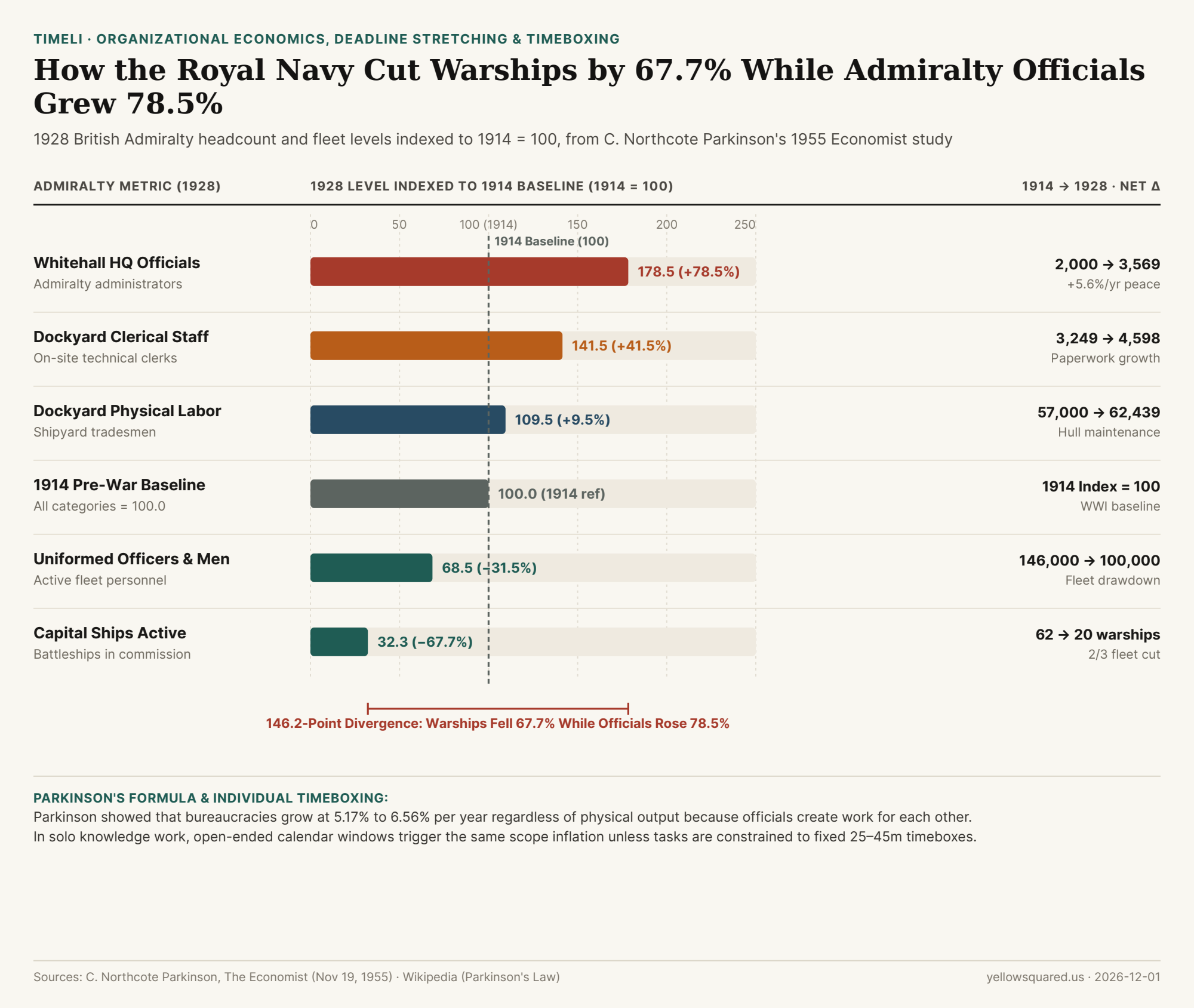
Chart showing 1928 British Admiralty officials, clerks, dockworkers, sailors, and commissioned battleships indexed to 1914 = 100
Figure 1: British Royal Navy and Whitehall Admiralty metrics in 1928 indexed to 1914 = 100, from C. Northcote Parkinson's November 19, 1955 study in The Economist. Data: parkinsons-law-1914-1928-british-admiralty-and-timeboxing-expansion-data.csv (Parkinson's Law - Wikipedia).

The Admiralty dataset, 1914–1928

To test whether administrative effort scales with physical workload, Parkinson audited official Navy Estimates between 1914, the eve of World War I, and 1928, after the Washington Naval Treaty disarmed much of the battlefleet. Active capital ships fell by about two-thirds, while the Whitehall headquarters staff grew. Parkinson dryly called the result "a magnificent navy on land". Dockyard laborers at Portsmouth, Devonport and Chatham rose only modestly.

Parkinson then checked the Colonial Office from 1935 to 1954, a 19-year span in which British imperial territory shrank as India, Pakistan, Burma and Ceylon gained independence. Headquarters staff still more than quadrupled, from 372 officials to 1,661.

"An elderly lady of leisure can spend the entire day writing and dispatching a postcard to her niece at Bognor Regis—an enterprise that would occupy a busy person for three minutes."

Two forces behind the growth

Parkinson named two mechanisms (Parkinson's Law - Wikipedia):

  1. The Law of Multiplication of Subordinates: An official who feels overworked never hires a peer rival; instead, they hire at least two subordinates so neither can challenge their seniority. Once those two subordinates complain of overwork, the department expands to seven people.
  2. The Law of Multiplication of Work: Seven people in a chain spend most of their day drafting, routing, editing and initialing memos for one another, creating internal busywork even when no external deliverable ships.

The figures in one table

British Admiralty / Colonial Metric Initial Baseline Final Outcome Net Change (%) Annual Compound Rate Operational Mechanism
1. Whitehall Admiralty Officials 2,000 (1914) 3,569 (1928) +78.45% +4.22%/yr (5.6% peace) Subordinate & memo review multiplication
2. Dockyard Clerical & Tech Staff 3,249 (1914) 4,598 (1928) +41.52% +2.51%/yr Administrative reporting overhead
3. Colonial Office Staff (1935–54) 372 (1935) 1,661 (1954) +346.51% +8.20%/yr Headquarters grew as colonies shrank
4. Dockyard Industrial Laborers 57,000 (1914) 62,439 (1928) +9.54% +0.65%/yr Physical shipyard maintenance
5. Royal Navy Officers & Sailors 146,000 (1914) 100,000 (1928) −31.51% −2.67%/yr Post-WWI fleet demobilization
6. Capital Ships in Commission 62 ships (1914) 20 ships (1928) −67.74% −7.76%/yr Washington Naval Treaty disarmament

Why it happens in solo work

For personal productivity, the law works through subjective complexity inflation. If I give a specification or a refactor four hours when it needs 40 minutes of core work, the remaining 3 hours and 20 minutes fill with premature optimization, bikeshedding (Parkinson's related Law of Triviality) and low-leverage polishing. The fix I use is a hard, timestamped block of 25 to 45 minutes with a fixed deadline, where the scope has to shrink to fit.

Give the task a clear edge

  1. Write down what “done” means before you start.
  2. Set a focused block that fits the work, with a short break if you need one.
  3. For a longer project, split it into a few milestones instead of stretching every task to the final due date.
  4. Keep one shared buffer near the end for review and surprises.

If you finish early, stop polishing or move to the next useful task. I use Timeli to note when a focus block starts and ends, then compare that with similar tasks later. Log daily focus blocks and moments in Timeli.

A frequently cited 2002 study by Ariely and Wertenbroch compared deadline schedules. PubMed now marks that paper as retracted, so I have left its performance figures out of this advice. PubMed retraction record.

013 / 19

What Is the Zeigarnik Effect? A Plan for Unfinished Tasks

When an unfinished task keeps popping back into your head, write down the next step and when you'll do it. A plan can make it easier to set the task aside.

The Zeigarnik effect is the idea that unfinished work can stay active in your thoughts. One familiar account about a Berlin waiter is an anecdote. A later experiment gives a clearer example: Masicampo and Baumeister found that making a specific plan reduced intrusive thoughts about unfinished goals in their studies.

That does not mean every open task will bother everyone, or that a list fixes stress. It gives you a small thing to try when your brain keeps bringing the same task back.

A three-minute end-of-day note

  1. Write down the unfinished task in one line.
  2. Name the next action, small enough to start in five minutes.
  3. Choose when you'll start it, then close the note.

My practical takeaway: don't just write “finish the deck.” Write “open the slides and fix the first chart tomorrow at 9.” A next step gives you somewhere to begin.

Sources: Masicampo and Baumeister's study on plans and unfinished goals · research on the stories behind Zeigarnik and von Restorff.

014 / 19

How to Get Back to Work After an Interruption

A quick reply can turn into a long detour. Here are three ways I make it easier to return to the task I was doing.

You answer one Slack message, notice another, then open your inbox. The original task is still there, but you have to remember where you left off.

A few small steps can make it easier to get back to work

  1. Write down the next step. Before you switch, leave a short note such as “check the null case in this function.” When you come back, you have somewhere to start.
  2. Open only the message you need. Reply from search or a focused thread if you can. The full inbox makes it easy to pick up another task by accident.
  3. Batch what can wait. Close chat and email during a work block, then check them at a time that works for your day. You do not need a perfect 90-minute block for this to help.

What the “23-minute rule” actually says

The often-quoted 23 minutes and 15 seconds comes from observations Gloria Mark described in a 2006 Gallup interview. It is not a fixed recovery timer for every person or interruption. A separate lab study found that interrupted participants worked faster to make up time, but reported more stress and frustration.

I built Timeli to log moments over time. If you want, note when you start and stop a focus block for a few days and see what tends to interrupt it.

Sources: Gloria Mark’s interview with Gallup and Mark, Gudith, and Klocke’s CHI study.

015 / 19

Is 90 Minutes the Best Focus Block?

A 90-minute work block can be useful, but there is no proven timer that works for everyone. Try a shorter block and take a break when your focus starts to slip.

Some productivity advice treats 90 minutes as a biological limit, followed by a mandatory recovery break. The evidence does not support that as a rule for every person or kind of work.

Ericsson and colleagues studied how expert violinists practiced. That work can tell us something about deliberate practice, but it did not test a universal 90-minute cycle for office workers. Research on the proposed waking “basic rest-activity cycle” has also questioned whether the sleep rhythm continues through the day.

Pick a block you can actually use

Start with 25 or 45 minutes if that fits your day. If you are still focused, keep going. When you begin rereading the same line or jumping between tabs, step away for a few minutes.

A break does not need a special routine. Stand up, get water, or look away from the screen. If scrolling leaves you feeling more scattered, leave the phone aside for that break.

I built Timeli to log moments over time. You can note when a work block starts and ends, then see what length tends to work for you.

Sources: Ericsson, Krampe, and Tesch-Römer on deliberate practice and a study questioning a waking 90-minute rhythm.

016 / 19

Habit Stacking: A Simple “After I…” Plan

Habit stacking means tying one small action to something you already do. Try: “After I make coffee, I will write one sentence.”

The existing routine is the reminder. Choose an anchor that happens reliably, then make the new action small enough to do even on a busy day.

Write one simple plan

  1. Pick an anchor: “After I brush my teeth…”
  2. Choose one small action: “…I will stretch for one minute.”
  3. Try it for a while: If the anchor is easy to miss, choose a more reliable one. If the action feels like a chore, make it smaller.

Start with one new action. A long chain of new routines can fall apart when one step gets skipped. You can add another later if the first one fits your day.

I designed Timeli to keep a timeline of your check-ins, including the days a routine doesn't happen. That gives you a record to look at without turning one missed day into a broken streak.

Source: BJ Fogg's Tiny Habits recipe card. See Timeli.