YellowSquared  /  Field notes

Notes from the workshop

56 posts, newest first. Choose an app to narrow the feed.

009 / 56

Why Did Kazakhstan Switch to One Single Time Zone (UTC+05:00) in 2024?

For 96 years—from the Soviet time-zone decrees of the 1920s until Leap Day 2024—the Republic of Kazakhstan divided its vast territory across two time zones: UTC+05:00 in the west and UTC+06:00 across the central and eastern regions, including the capital Astana and largest city Almaty. Then, at midnight between February 29 and March 1, 2024, twelve regions and three major cities turned their clocks back one hour from 00:00 to 23:00, placing the world's largest landlocked country onto a single nationwide time zone (UTC+05:00) with zero Daylight Saving Time. As documented in civil timekeeping records for Kazakhstan, Time and Date's March 2024 reform dispatch, and operating-system TZDB advisories, the reform solved a long-standing solar-clock skew in Astana and Almaty while igniting a fierce debate in East Kazakhstan.
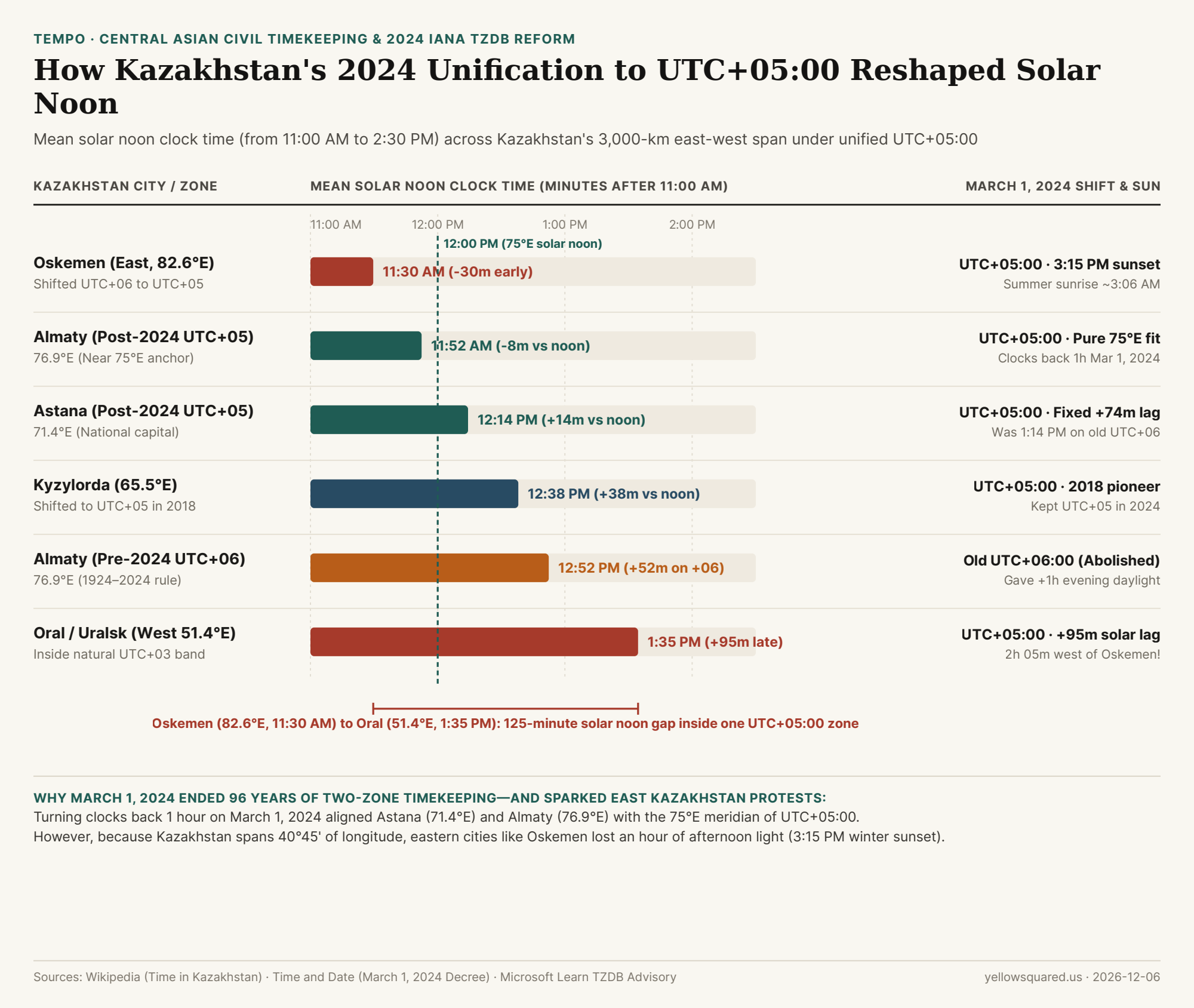
Chart comparing mean solar noon clock times across Oskemen, Almaty, Astana, Kyzylorda, and Oral in Kazakhstan under unified UTC+05:00
Figure 1: Mean solar noon clock time (minutes after 11:00 AM) and longitudinal skew across Kazakhstan's major cities following the March 1, 2024 unification to UTC+05:00. Data: Wikipedia (Time in Kazakhstan) and Time and Date (download CSV).

Why Astana (71.4°E) and Almaty (76.9°E) Belonged Geometrically in UTC+05:00 All Along

In the international 24-zone meridian system, each 1-hour offset spans 15° of longitude (4 solar minutes per degree), meaning the natural UTC+05:00 time zone is centered dead on the 75°00'E meridian (covering 67.5°E to 82.5°E). When chronobiologists and astronomers appointed by Kazakhstan's Ministry of Trade and Integration and Ministry of Ecology and Natural Resources audited the country's geography in 2023, they pointed out a striking anomaly:

  • Astana (71°26'E = 71.43°E): Located 3.57° west of the 75°E meridian, Kazakhstan's capital sits squarely inside the geographic UTC+05:00 band. Under the pre-2024 UTC+06:00 rule (anchored to 90°E), Astana was running 74 minutes ahead of solar time (mean solar noon at 1:14 PM). Shifting to UTC+05:00 brought Astana's mean solar noon to 12:14 PM.
  • Almaty (76°54'E = 76.90°E): Situated less than two degrees east of the 75°E meridian, Almaty's true solar noon sat at 12:52 PM under UTC+06:00. On UTC+05:00, Almaty's mean solar noon arrives at 11:52 AM—within 8 minutes of 12:00 PM clock noon.
  • Kyzylorda's 2018 Precedent (65.50°E): On December 20–21, 2018, Kyzylorda Region successfully shifted from UTC+06:00 to UTC+05:00 after residents complained of dark winter mornings when solar noon fell at 1:38 PM.

"Because Kazakhstan stretches 40°45' from west to east—a 2-hour-and-43-minute solar span—fixing the clock for Astana (71.4°E) meant pushing winter sunsets to 3:15 PM in eastern Oskemen (82.6°E)."

The 40°45' Longitude Dilemma: Oral in the West vs. Oskemen in the East

While unifying onto UTC+05:00 eliminated domestic flight and rail clock jumps and placed Astana and Almaty near solar noon, Kazakhstan's 2,960-kilometer east-west breadth spans nearly three natural solar time zones (from 46°30'E near the Volga delta to 87°20'E in the Altai Mountains):

  1. East Kazakhstan's Early Dawn and 3:15 PM Winter Dusk (Oskemen, 82.61°E): In Oskemen (Ust-Kamenogorsk) and Semey near the Chinese and Russian Altai border, local solar time sits 30 minutes ahead of the 75°E meridian. Dropping from UTC+06:00 to UTC+05:00 pulled mean solar noon back to 11:30 AM—meaning June summer sunrises break around 3:06 AM while December winter sunsets fall around 3:15 PM. Despite a 2024 public petition on E-Petition.kz titled "Turn the Time Back" from eastern residents wanting evening daylight back, the government upheld the unified UTC+05:00 zone while encouraging flexible regional work hours.
  2. West Kazakhstan's Late Solar Afternoon (Oral, 51.37°E): At the opposite end of the country, Oral (Uralsk) and Atyrau (51.88°E) sit geographically inside the natural UTC+03:00 (45°E) zone, yet have remained on UTC+05:00 since 2005—placing mean solar noon in Oral at 1:35 PM (+94.5 minutes after clock noon, and 2 hours and 5 minutes later than solar noon in Oskemen!).
Kazakhstan City Longitude Pre-March 2024 Post-March 2024 Solar Noon (UTC+05) Solar Skew vs. 12:00 PM Daylight & Administrative Impact
Oskemen (East) 82.61°E UTC+06:00 UTC+05:00 11:30 AM -30.4 min (Early) June dawn ~3:06 AM; Dec dusk ~3:15 PM
Almaty (Post-2024) 76.90°E UTC+06:00 UTC+05:00 11:52 AM -7.6 min (Ideal fit) Sits just 1.9° east of 75°E meridian
Astana (Capital) 71.43°E UTC+06:00 UTC+05:00 12:14 PM +14.3 min (Ideal fit) Eliminated old +74 min morning lag
Kyzylorda 65.50°E UTC+05:00 UTC+05:00 12:38 PM +38.0 min Switched from UTC+06 in Dec 2018
Almaty (Pre-2024) 76.90°E UTC+06:00 Historical 12:52 PM (on +06) +52.4 min 96-year standard ended Mar 1, 2024
Oral / Uralsk (West) 51.37°E UTC+05:00 UTC+05:00 1:35 PM +94.5 min (Late) Natural UTC+03 longitude; 1:35 PM noon

How to Check Unified Kazakhstan Time Against Europe, India, and North America

Since March 1, 2024, every city in Kazakhstan—whether wired to Asia/Almaty, Asia/Qostanay, Asia/Aqtobe, Asia/Atyrau, or Asia/Oral in the IANA Time Zone Database—shares the exact same UTC+05:00 offset as Tashkent and Karachi (sitting 30 minutes behind India's UTC+05:30 and 3 hours Behind Beijing's UTC+08:00). Open Tempo in your browser to compare live meeting windows between Astana, Almaty, London, and New York without outdated UTC+06:00 tables.
010 / 56

Why Does Chile Keep Punta Arenas and Magallanes on Permanent Daylight Saving Time (UTC-03:00)?

If you trace the 71°W meridian down the globe from Boston and Miami to South America, it passes directly through Santiago (70°40'W) and Punta Arenas (70°55'W) at the southern tip of Patagonia. By pure solar geometry, every major city in mainland Chile belongs inside the UTC-05:00 time zone centered on the 75°W meridian—the exact same winter clock used by Lima, Bogotá, and New York. Yet as documented in historical civil timekeeping records for Chile and the Wikivoyage Chile regional time guide, Chile operates three distinct official time zones, and its southernmost regions—Magallanes and Chilean Antarctica (America/Punta_Arenas) and Aysén (America/Coyhaique)—never turn their clocks back in winter, remaining locked on permanent Daylight Saving Time (UTC-03:00) all year long.

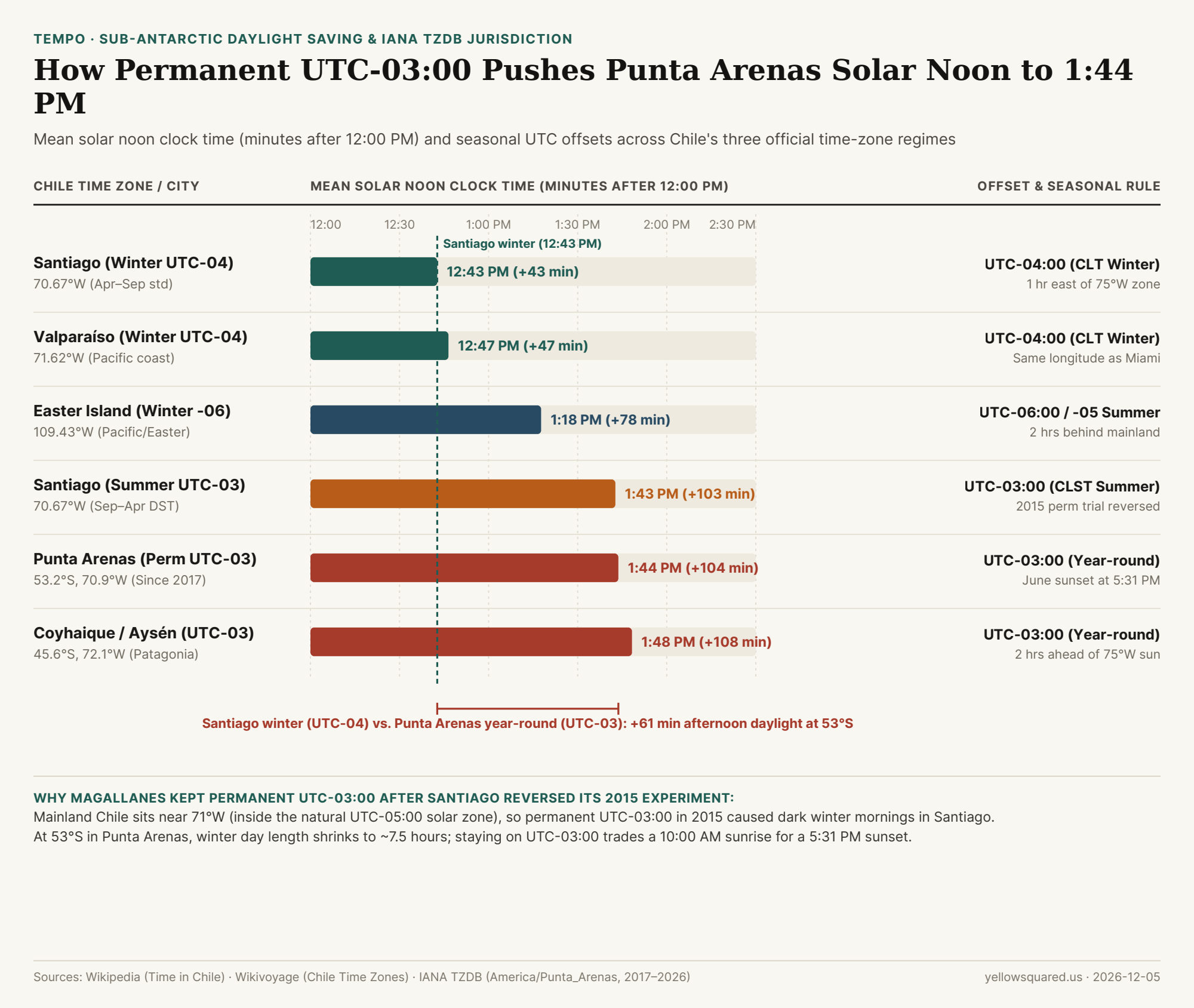
Chart comparing mean solar noon clock time and seasonal UTC offsets across Santiago, Valparaiso, Easter Island, Punta Arenas, and Coyhaique in Chile
Figure 1: Mean solar noon clock time (minutes after 12:00 PM) and seasonal UTC offsets across Chile's three time-zone regimes. Data: Time in Chile (Wikipedia) and Wikivoyage Chile Guide (download CSV).

How Mainland Chile Ended Up 1 to 2 Hours Ahead of Its Natural Solar Meridian

Because Earth rotates 15° of longitude every 60 minutes (4 minutes per degree), the sun crosses the local meridian at Santiago (70.67°W) and Punta Arenas (70.92°W) approximately 4 hours and 43 minutes after Greenwich Mean Time (UTC+00:00):

  • Natural Solar Noon (UTC-05:00 Baseline): If Chile observed its geographic UTC-05:00 zone (used briefly between 1910 and 1916 and again from 1919 to 1927), mean solar noon in Santiago would occur slightly early at 11:43 AM, meaning winter sunset would fall before 4:45 PM.
  • Continental Chile Winter Standard Time (CLT, UTC-04:00): From the first Sunday in April to the first Sunday in September, central and northern Chile shift one hour east of their solar zone to UTC-04:00, placing mean solar noon at 12:43 PM in Santiago and 12:47 PM in Valparaíso (71.62°W).
  • Continental Chile Summer Daylight Saving Time (CLST, UTC-03:00): From September to April, mainland Chile advances another hour to UTC-03:00—two full hours ahead of its 75°W solar meridian—pushing mean solar noon to 1:43 PM.

"When Chile placed the entire mainland on permanent UTC-03:00 in 2015, central valley fruit growers reported a 15% winter productivity loss and school truancy climbed in pitch-black mornings—yet at 53°S in Magallanes, residents demanded to keep the afternoon light."

Why the 2015 Nationwide Permanent DST Trial Failed in Santiago—and Succeeded in Punta Arenas

In January 2015, Chile's Ministry of Energy suspended seasonal clock switches and placed all of mainland Chile on permanent UTC-03:00 (with Easter Island / Rapa Nui at 109.43°W on permanent UTC-05:00). Across central Chile (33°S), the experiment backfired during the austral winter of 2015: sunrise in Santiago did not arrive until 8:47 AM, forcing millions of students and agricultural workers to commute in darkness, increasing school truancy, and causing a reported 15% productivity drop among fruit producers. In March 2016, the Chilean government restored winter standard time (UTC-04:00) for three months each winter, later expanding winter time to five months (April through September).

However, in the sub-antarctic Magallanes and Chilean Antarctica Region—where the capital Punta Arenas sits at 53°09'S latitude along the Strait of Magellan—seasonal day-length extremes change the trade-off completely:

  1. The 53°S Winter Photoperiod Crunch: At 53.16°S on the June 21 southern winter solstice, total daylight lasts only about 7 hours and 31 minutes. Because the sun is still well below the horizon during standard 8:00 AM school and office arrivals regardless of whether the clock reads UTC-04:00 or UTC-03:00, shifting back to UTC-04:00 would not give commuters a bright morning.
  2. Trading a 10:00 AM Sunrise for a 5:31 PM Sunset: Under UTC-04:00, winter sunset in Punta Arenas dropped to 4:31 PM, plunging the city into darkness before children finished school. In December 2016, President Michelle Bachelet approved Magallanes's petition to stay on permanent UTC-03:00 starting in May 2017 ( prompting the IANA Time Zone Database to create America/Punta_Arenas in release 2017a, later joined by neighboring Patagonia's Aysén Region under America/Coyhaique). On permanent UTC-03:00, June solstice sunrise occurs around 10:00 AM, mean solar noon arrives at 1:44 PM, and sunset holds until 5:31 PM.
Chile Region / City IANA TZDB Zone Coordinates Winter Offset (Apr–Sep) Summer Offset (Sep–Apr) Mean Solar Noon Solar Skew & Solstice Impact
Santiago (Winter CLT) America/Santiago 33.45°S, 70.67°W UTC-04:00 UTC-03:00 12:43 PM +42.7 min · June sunrise ~7:47 AM
Valparaíso (Winter CLT) America/Santiago 33.05°S, 71.62°W UTC-04:00 UTC-03:00 12:47 PM +46.5 min · Shares 75°W solar band
Easter Island / Rapa Nui Pacific/Easter 27.15°S, 109.43°W UTC-06:00 UTC-05:00 1:18 PM +77.7 min · 2 hrs behind Santiago
Santiago (Summer CLST) America/Santiago 33.45°S, 70.67°W UTC-04:00 UTC-03:00 1:43 PM +102.7 min · 2015 perm trial reversed
Punta Arenas / Magallanes America/Punta_Arenas 53.16°S, 70.92°W UTC-03:00 (Perm) UTC-03:00 (Perm) 1:44 PM +103.7 min · June 10:00 AM–5:31 PM
Coyhaique / Aysén Region America/Coyhaique 45.57°S, 72.07°W UTC-03:00 (Perm) UTC-03:00 (Perm) 1:48 PM +108.3 min · Joined perm UTC-03

How to Coordinate Flights and Calls Between Santiago, Patagonia, and Easter Island

Because Continental Chile still shifts its clocks twice a year while Patagonia stays fixed, domestic flight schedules between Santiago (SCL) and Punta Arenas (PUQ) or Balmaceda/Coyhaique (BBA) change their offset every April and September: from September to April, Santiago and Punta Arenas share the exact same clock (UTC-03:00), but from April to September, Punta Arenas is 1 hour ahead of Santiago (UTC-03:00 vs. UTC-04:00) and 3 hours ahead of Easter Island (UTC-06:00). You can compare live seasonal offsets across Chilean, South American, and North American cities side by side when you Open Tempo in your browser.

011 / 56

Why Does Greenland Have Three Time Zones, and Why Did Nuuk Switch to UTC-02:00 in 2023?

Spanning from Cape Alexander at 73°02'W in the west to Nordostrundingen at 11°19'W in the east, Greenland stretches across nearly 62 degrees of Arctic longitude—over four natural 15° solar time zones. For decades, travel guides and tzdb tables famous listed Greenland as having four separate time zones (UTC-04:00, UTC-03:00, UTC-01:00, and UTC+00:00) for a population of just 56,000 people.

In 2023, however, Greenland's parliament (the Inatsisartut) overhauled the island's civil clocks under Act No. 31 of November 25, 2022. As documented in Time in the Danish Realm and Danish Realm statutory time records, when Nuuk and the west coast sprang forward for Daylight Saving Time on March 25, 2023 from UTC-03:00 to UTC-02:00, that new offset became Greenland's permanent standard winter time—and on October 29, 2023, East Greenland's Scoresbysund (Ittoqqortoormiit) merged into the exact same zone, consolidating Greenland from four zones down to three. When scheduling Arctic research logistics or transatlantic flights between Nuuk, Reykjavik, Copenhagen, and New York, you can Open Tempo in your browser to compare America/Nuuk, America/Thule, and America/Danmarkshavn side by side.

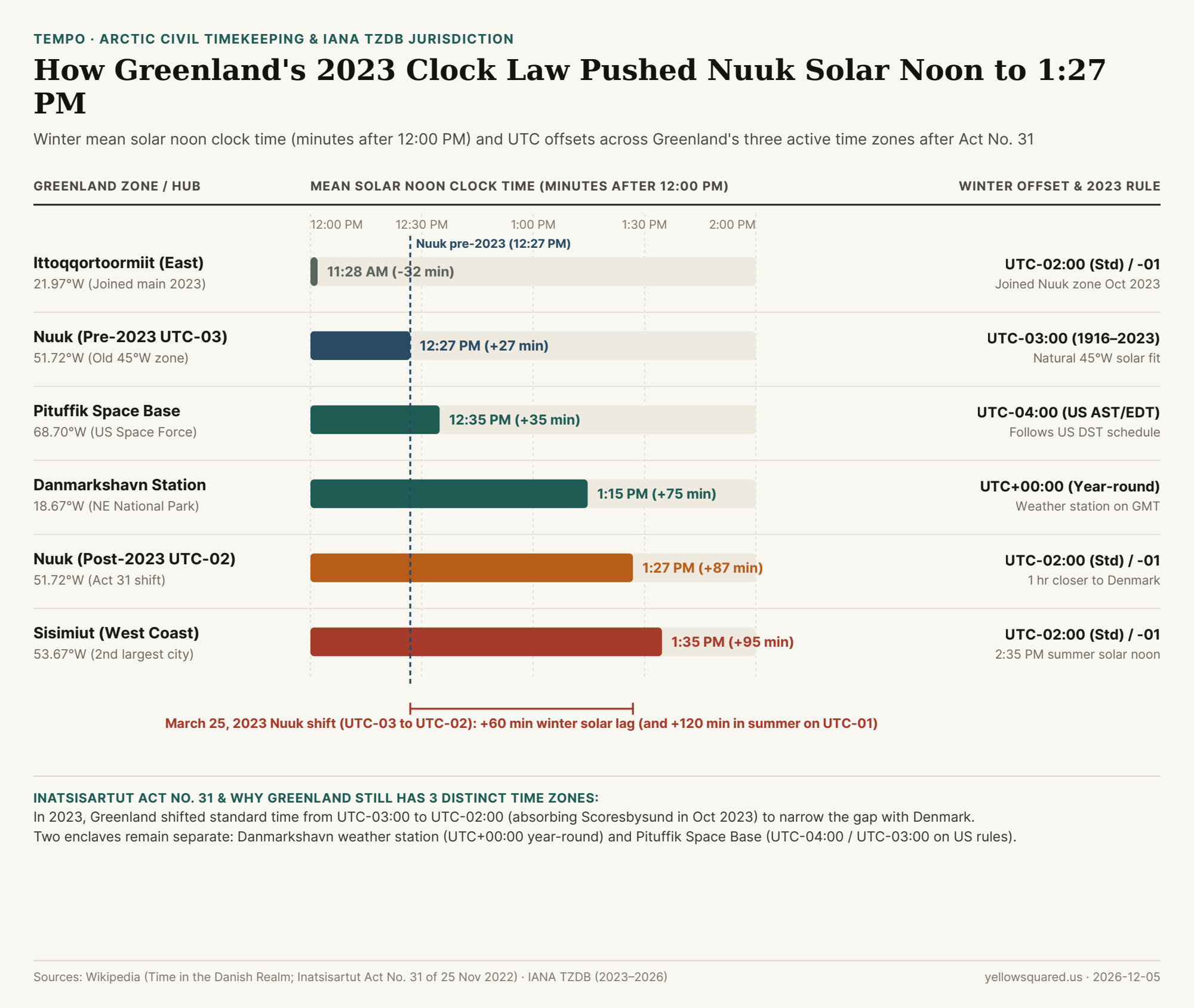
Horizontal bar chart comparing winter mean solar noon clock time and UTC offsets across Ittoqqortoormiit, pre-2023 Nuuk, Pituffik Space Base, Danmarkshavn, post-2023 Nuuk, and Sisimiut.
Figure 1: Winter mean solar noon clock time and longitude skew across Greenland's active time zones before and after the 2023 shift to UTC-02:00. Source: Wikipedia (Time in the Danish Realm) and Danish Wikipedia (Grønland).

Why Nuuk Moved From UTC-03:00 to UTC-02:00 (and UTC-01:00 in Summer)

From 1916 until March 2023, West Greenland—home to more than 90% of Greenland's residents, including the capital city of Nuuk (51°43'W = 51.72°W), Sisimiut (53.67°W), and Ilulissat (51.10°W)—observed UTC-03:00 as standard winter time and UTC-02:00 as summer Daylight Saving Time. Geographically, UTC-03:00 (centered on 45°W) was a natural fit for Nuuk: at 51.72°W, mean solar noon arrived at 12:27 PM (+26.9 minutes after clock noon).

However, sitting on UTC-03:00 placed Nuuk four hours behind Copenhagen (CET, UTC+01:00)—leaving only half an afternoon of overlapping business hours with Danish ministries, European export markets, and banking systems. By passing Inatsisartut Act No. 31, lawmakers shifted Greenland's standard meridian 15 degrees east to UTC-02:00 (30°W meridian) in winter and UTC-01:00 (15°W meridian) during EU summer Daylight Saving Time (March to October):

  • Winter Solar Skew in Nuuk (UTC-02:00): Because Nuuk (51.72°W) now sits 21.72 degrees west of its 30°W winter clock meridian (21.72° × 4 min/deg = 86.9 minutes), winter mean solar noon arrives at 1:27 PM (and 1:35 PM in Sisimiut).
  • Summer "Double DST" Skew in Nuuk (UTC-01:00): When Greenland advances its clocks another hour to UTC-01:00 on the last Sunday in March, Nuuk sits 36.72 degrees west of the 15°W clock meridian—pushing summer mean solar noon to 2:27 PM (+146.9 minutes behind the clock)!
  • Unifying East and West Greenland (October 29, 2023): Because East Greenland (Ittoqqortoormiit / Scoresbysund at 21.97°W and Tasiilaq at 37.63°W) was absorbed into the new UTC-02:00 / UTC-01:00 national clock in autumn 2023, all inhabited towns across Greenland now share a single civil time zone for the first time in history.

"By shifting Nuuk's standard clock to UTC-02:00 in winter and UTC-01:00 in summer—and merging East Greenland's Scoresbysund into the same zone—Greenland cut its time gap with Copenhagen to three hours and unified every civilian town under a single clock."

The Two Special Enclaves That Still Use Separate Time Zones

Why does Greenland still have three official time zones if every civilian town now uses America/Nuuk (UTC-02:00 / UTC-01:00)? Two specialized non-municipal enclaves are explicitly exempted from Act No. 31:

  1. Danmarkshavn Weather Station (America/Danmarkshavn — Permanent UTC+00:00): Located at 76°46'N, 18°40'W inside the uninhabited Northeast Greenland National Park, Danmarkshavn is a staffed radiosonde and synoptic weather station operated for international aviation and WMO meteorology. Because upper-air weather balloons must be launched simultaneously worldwide at 00:00 UTC and 12:00 UTC, Danmarkshavn remains locked to UTC+00:00 (GMT) year-round with zero Daylight Saving Time transitions.
  2. Pituffik Space Base, formerly Thule Air Base (America/Thule — UTC-04:00 / UTC-03:00): Located in far northwestern Greenland at 76°32'N, 68°42'W, the United States Space Force enclave at Pituffik sits near the 60°W (UTC-04:00) meridian. Pituffik observes Atlantic Standard Time (UTC-04:00) in winter and Atlantic Daylight Time (UTC-03:00) in summer—and crucially, it switches clocks on the U.S. DST schedule (second Sunday in March and first Sunday in November) rather than Greenland's EU schedule!
Greenland Location IANA TZDB Zone Longitude Winter Offset Summer Offset Winter Solar Noon
Ittoqqortoormiit (East Coast) America/Scoresbysund 21°58'W (21.97°W) UTC-02:00 UTC-01:00 (EU rule) 11:28 AM (-32.1 min)
Nuuk (Pre-2023 Historical) America/Nuuk (Old) 51°43'W (51.72°W) UTC-03:00 UTC-02:00 (EU rule) 12:27 PM (+26.9 min)
Pituffik Space Base (Thule) America/Thule 68°42'W (68.70°W) UTC-04:00 UTC-03:00 (US rule) 12:35 PM (+34.8 min)
Danmarkshavn Station America/Danmarkshavn 18°40'W (18.67°W) UTC+00:00 UTC+00:00 (No DST) 1:15 PM (+74.7 min)
Nuuk (Post-2023 Standard) America/Nuuk 51°43'W (51.72°W) UTC-02:00 UTC-01:00 (EU rule) 1:27 PM (+86.9 min)
Sisimiut (West Coast) America/Nuuk 53°40'W (53.67°W) UTC-02:00 UTC-01:00 (EU rule) 1:35 PM (+94.7 min)

How to Track Nuuk, Danmarkshavn, and Pituffik Without TZDB Bugs

Because Pituffik (America/Thule) follows North American DST dates while Nuuk (America/Nuuk) follows European Union DST dates (changing on the Saturday night before the last Sunday of March and October at 22:00 local time to match 01:00 UTC), the time gap between northwestern Greenland and Nuuk fluctuates between 1, 2, and 3 hours during March and November transition weeks. To verify exact Arctic time offsets before booking flights or scheduling calls, Open Tempo in your browser.

012 / 56

Why Does Morocco Pause Its UTC+01:00 Time Zone Every Year for Ramadan?

Most countries that observe Daylight Saving Time change their clocks on fixed solar-calendar rules—such as the second Sunday in March in North America or the last Sunday in March across the European Union. Morocco (Africa/Casablanca in the IANA time zone database) is the only country on Earth whose civil clock transitions are tied to the Islamic Hijri lunar calendar.

As documented in historical records of Time in Morocco and Time and Date's coverage of Morocco's Ramadan clock shifts, Moroccan law sets the national time zone to UTC+01:00 (matching Central European Time in Madrid and Paris), yet pauses that offset every single year for the holy month of Ramadan—turning clocks back one hour to UTC+00:00 (GMT) on the Sunday before Ramadan begins and springing back to UTC+01:00 on the Sunday after Eid al-Fitr. When coordinating flights, logistics, or remote team calls with Casablanca or Rabat, you can Open Tempo in your browser to check Morocco's live offset automatically.

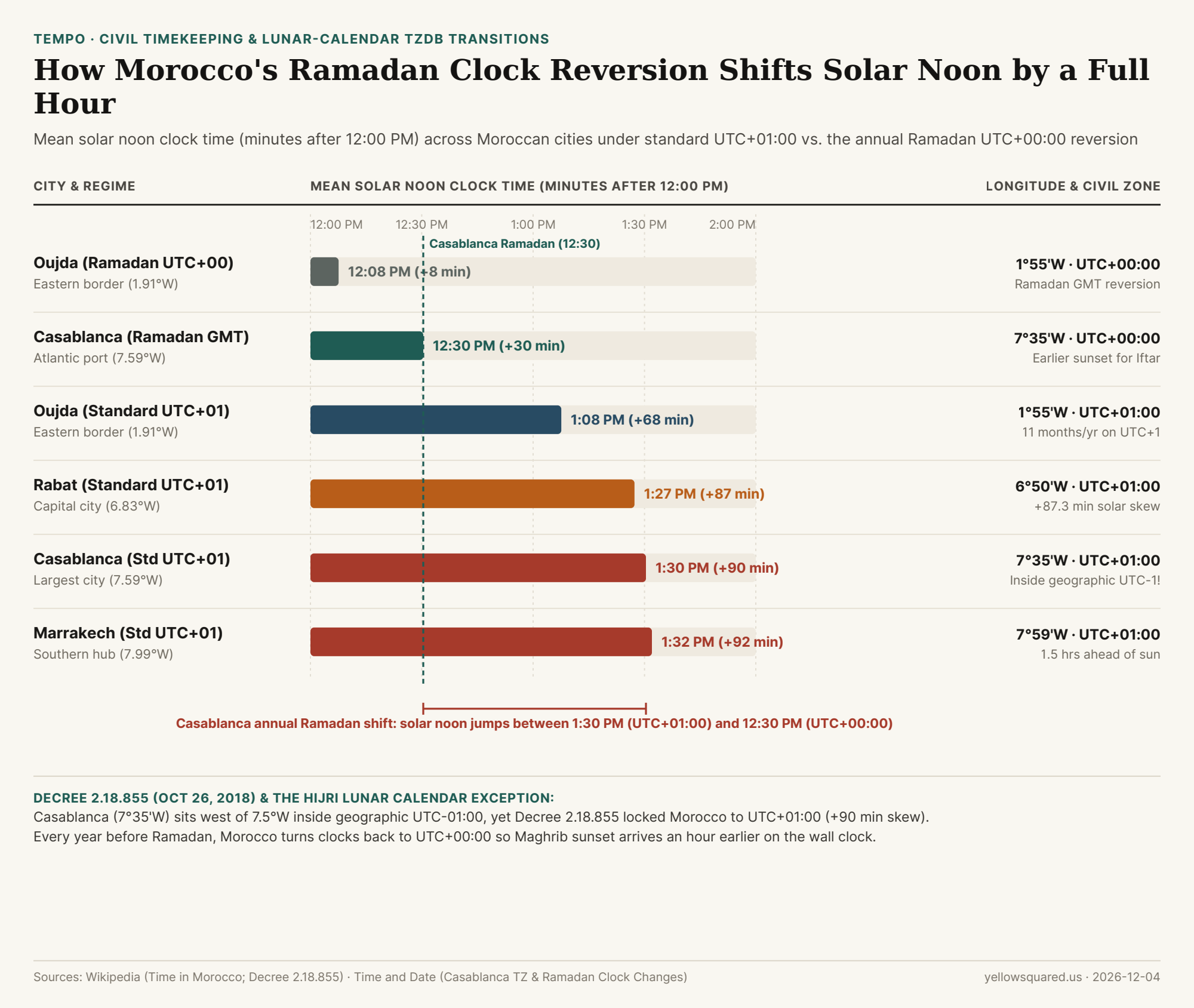
Horizontal bar chart comparing mean solar noon clock time across Oujda, Rabat, Casablanca, and Marrakech under Morocco's standard UTC+01:00 regime versus its annual Ramadan UTC+00:00 reversion.
Figure 1: Mean solar noon clock time and longitude skew across Moroccan cities during the 11-month UTC+01:00 regime versus the annual 1-month Ramadan reversion to UTC+00:00. Source: Wikipedia (Time in Morocco) and Time and Date (Morocco TZ Transitions).

Why Casablanca (7°35'W) Sits 90 Minutes Ahead of the Sun on UTC+01:00

To appreciate why Morocco's clock law is so unusual, look at where the country sits relative to the Greenwich Prime Meridian (0° longitude). Morocco's eastern border near Oujda sits at 1°55'W (1.91°W), the capital Rabat sits at 6°50'W (6.83°W), Casablanca sits at 7°35'W (7.59°W), and Marrakech sits at 7°59'W (7.99°W).

Because each 1-hour solar time zone spans 15° of longitude (7.5° on either side of its central meridian), the boundary between geographic UTC+00:00 (centered on 0°) and geographic UTC-01:00 (centered on 15°W) lies at exactly 7°30'W (7.50°W). That means Casablanca (7.59°W), Marrakech (7.99°W), and Agadir (9.60°W) actually lie inside geographic UTC-01:00! When the Moroccan government issued Decree No. 2.18.855 on October 26, 2018—locking the country to UTC+01:00 (15°E meridian) just 48 hours before clocks were scheduled to fall back—it placed Casablanca 22.59 degrees west of its legal clock meridian (22.59° × 4 min/deg = 90.4 minutes), pushing mean solar noon to 1:30 PM in Casablanca and 1:32 PM in Marrakech.

"Between 2012 and 2018, when Ramadan fell during the northern summer, Morocco actually changed its clocks four times in a single year: springing forward to UTC+01:00 in spring, falling back to UTC+00:00 for Ramadan, springing forward again after Eid al-Fitr, and falling back in autumn."

Why the Ramadan Exception Exists (and Why It Shifts 11 Days Earlier Every Year)

During the month of Ramadan, observant Muslims fast (Sawm) from dawn (Fajr) until sunset (Maghrib). Under UTC+01:00, the 90-minute artificial daylight saving skew pushes sunset in Casablanca and Marrakech an hour later on the wall clock—meaning families, students, and workers on standard 8:00 AM–5:00 PM schedules would have to wait an extra clock hour in the evening before breaking their fast at Iftar while commuting to work or school in darker morning hours.

By reverting national clocks back one hour from UTC+01:00 to UTC+00:00 (Greenwich Mean Time) for the duration of Ramadan, mean solar noon in Casablanca returns to a natural 12:30 PM and sunset arrives an hour earlier on the clock. As shown in Time and Date's Casablanca transition history, because the 12-month Islamic lunar calendar is 354 or 355 days long, the start and end dates of Morocco's annual UTC+00:00 month drift roughly 10 to 11 days earlier on the Gregorian calendar every single year.

Moroccan City & Regime Longitude Natural Solar Zone Observed Civil Zone Mean Solar Noon Solar-Clock Skew
Oujda (Ramadan Reversion) 1°55'W (1.91°W) UTC+00:00 (0°W) UTC+00:00 (GMT) 12:08 PM +7.6 min
Casablanca (Ramadan Reversion) 7°35'W (7.59°W) UTC-01:00 (>7.5°W) UTC+00:00 (GMT) 12:30 PM +30.4 min
Oujda (Standard 11-Month) 1°55'W (1.91°W) UTC+00:00 (0°W) UTC+01:00 (Decree 2018) 1:08 PM +67.6 min
Rabat (Standard 11-Month) 6°50'W (6.83°W) UTC+00:00 (0°W) UTC+01:00 (Decree 2018) 1:27 PM +87.3 min
Casablanca (Standard 11-Month) 7°35'W (7.59°W) UTC-01:00 (>7.5°W) UTC+01:00 (Decree 2018) 1:30 PM +90.4 min
Marrakech (Standard 11-Month) 7°59'W (7.99°W) UTC-01:00 (>7.5°W) UTC+01:00 (Decree 2018) 1:32 PM +92.0 min

Why Developers Should Never Hard-Code UTC Offsets for North Africa

Morocco's annual lunar-calendar shift—alongside its recent 2026 legislative reviews of permanent UTC+00:00 standard time—illustrates why software engineers and travel planners should never store fixed numeric offsets like UTC+1 in databases. Always reference the canonical IANA zone identifier Africa/Casablanca, and Open Tempo in your browser whenever you need to verify current local time and overlapping work hours across Casablanca, Paris, London, and New York.

013 / 56

Why Does Turkey Stay on UTC+03:00 Year-Round After Abolishing Daylight Saving Time in 2016?

Look at a standard longitudinal map of Europe and the eastern Mediterranean, and the 30°E meridian—the exact mathematical center of Eastern European Time (EET, UTC+02:00)—runs straight through Izmit, less than 90 kilometers east of downtown Istanbul (28°58'E). For decades, Turkey shared the exact same clock as Athens, Bucharest, Sofia, Cairo, and Helsinki: UTC+02:00 in winter and UTC+03:00 (Eastern European Summer Time, EEST) in summer. Yet if you fly from Athens to Istanbul in January, you cross a one-hour time boundary and land in UTC+03:00—the same winter offset as Moscow and Riyadh.

As documented in records of Time in Turkey and Time and Date's coverage of the September 2016 decree, the Turkish cabinet abolished winter clock returns on September 7, 2016, locking the country onto permanent Daylight Saving Time under the name Turkey Time (TRT, UTC+03:00). When scheduling cross-border calls between Istanbul, London, Berlin, and New York across autumn and spring transitions, you can Open Tempo in your browser to see how Turkey's fixed UTC+03:00 clock shifts relative to Europe and North America twice a year.

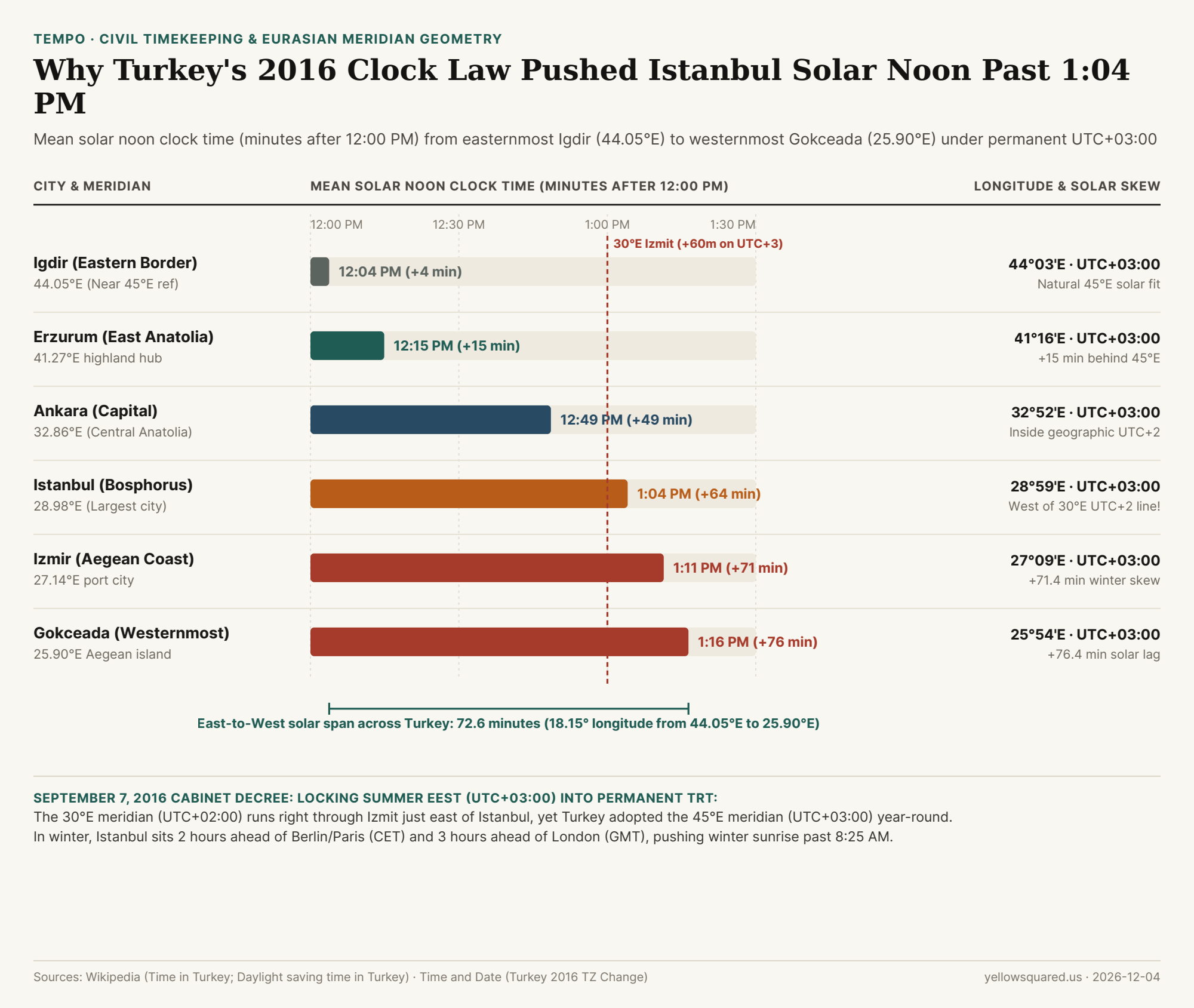
Horizontal bar chart comparing mean solar noon clock time and longitude skew across Igdir, Erzurum, Ankara, Istanbul, Izmir, and Gokceada under Turkey's permanent UTC+03:00 time zone.
Figure 1: Mean solar noon clock time and longitude skew across six Turkish locations under permanent UTC+03:00 (45°E meridian), showing a 72.6-minute east-to-west solar span. Source: Wikipedia (Time in Turkey) and Time and Date (TRT Overview).

The 18-Degree Longitudinal Span: From Igdir (44.05°E) to Gokceada (25.90°E)

To understand why Turkey's time zone triggers fierce debate every winter, look at the physical geometry of the Anatolian peninsula. Stretching 1,600 kilometers (1,000 miles) from the Armenian and Iranian borders in the east to the Aegean islands in the west, Turkey spans 18.15 degrees of longitude—which equals 18.15° × 4 minutes/degree = 72.6 minutes of solar rotation between its eastern and western borders:

  • Eastern Anatolia Fits UTC+03:00 Naturally: The reference meridian for UTC+03:00 is 45°E (3 hours × 15°/hour). In easternmost Igdir (44.05°E) and highland Erzurum (41.27°E), mean solar noon arrives at 12:04 PM and 12:15 PM. Under the old pre-2016 winter time (UTC+02:00), sunset in eastern Turkey occurred before 4:00 PM in December.
  • Western Turkey Sits Inside Geographic UTC+02:00: Nearly 70% of Turkey's population and industrial output lives in the western half of the country—including Ankara (32.86°E), Istanbul (28.98°E), and Izmir (27.14°E). Because Istanbul sits 1.02 degrees west of the 30°E (UTC+02:00) meridian—and 16.02 degrees west of the 45°E (UTC+03:00) meridian—locking Istanbul to UTC+03:00 pushes mean solar noon to 1:04 PM (+64.1 minutes), while Izmir (27.14°E) reaches solar noon at 1:11 PM (+71.4 minutes) and westernmost Gokceada (25.90°E) reaches solar noon at 1:16 PM (+76.4 minutes).

"Because Istanbul (28°58'E) sits slightly west of the 30°E meridian that anchors UTC+02:00, keeping Turkey on permanent UTC+03:00 places Istanbul more than a full hour ahead of local solar time—delaying late-December sunrise past 8:28 AM."

What Happened in October 2016 (and the Northern Cyprus Split)

As chronicled in Daylight saving time in Turkey, the country had already delayed its autumn clock fallback by two weeks in November 2015 to hold a national general election in brighter afternoon light. On September 7, 2016, Cabinet Decree No. 2016/9154 canceled the upcoming October 30, 2016 fallback permanently so that summer time (UTC+03:00) became year-round standard time.

The sudden switch caught operating systems, smartphones, and airlines off guard during the first week of November 2016 when automated tzdb rules briefly turned phones back an hour. Even more unusually, Northern Cyprus initially followed Turkey into permanent UTC+03:00 in autumn 2016—creating a physical time-zone border right through the divided capital of Nicosia (where the Republic of Cyprus in the south returned to EET UTC+02:00). After a year of commuter complaints and dark winter school mornings, Northern Cyprus reverted to standard UTC+02:00 / UTC+03:00 EU transitions in October 2017.

Turkish City / Landmark Longitude Natural Solar Zone Observed Zone (Since 2016) Mean Solar Noon Solar-Clock Skew
Igdir (Eastern Border) 44°03'E (44.05°E) UTC+03:00 (45°E) UTC+03:00 (TRT) 12:04 PM +3.8 min
Erzurum (East Anatolia) 41°16'E (41.27°E) UTC+03:00 (45°E) UTC+03:00 (TRT) 12:15 PM +14.9 min
Ankara (Capital) 32°52'E (32.86°E) UTC+02:00 (30°E) UTC+03:00 (TRT) 12:49 PM +48.6 min
Istanbul (Bosphorus) 28°59'E (28.98°E) UTC+02:00 (30°E) UTC+03:00 (TRT) 1:04 PM +64.1 min
Izmir (Aegean Coast) 27°09'E (27.14°E) UTC+02:00 (30°E) UTC+03:00 (TRT) 1:11 PM +71.4 min
Gokceada (Westernmost) 25°54'E (25.90°E) UTC+02:00 (30°E) UTC+03:00 (TRT) 1:16 PM +76.4 min

How Istanbul's Offset Against Europe Changes Every March and October

Because Turkey stays locked on UTC+03:00 (Europe/Istanbul) while the European Union and United Kingdom still shift their clocks on the last Sunday of March and the last Sunday of October, Istanbul's time difference with Western Europe expands and contracts every six months: from late March to late October, Istanbul is 1 hour ahead of Berlin/Paris (CEST UTC+02:00) and 2 hours ahead of London (BST UTC+01:00); from late October to late March, Istanbul jumps to 2 hours ahead of Berlin/Paris (CET UTC+01:00) and 3 hours ahead of London (GMT UTC+00:00). To avoid missed calendar invites during spring and autumn transitions, Open Tempo in your browser and compare Europe/Istanbul against your team's local zones.

014 / 56

Why Are Singapore and Malaysia on UTC+08:00 Instead of UTC+07:00 Like Bangkok and Jakarta?

Board a 90-minute flight from Changi Airport in Singapore (103°51'E) to Soekarno-Hatta International Airport in Jakarta (106°51'E), and you fly 3 degrees of longitude east—yet when you land in Jakarta, you have to set your watch back one hour from UTC+08:00 to UTC+07:00. Look north to Bangkok (100°30'E) and Ho Chi Minh City (106°40'E), and both cities also observe UTC+07:00. By spherical solar geometry, where every 15° band of longitude equals one hour of Earth's rotation (centered on 105°E for UTC+07:00 and 120°E for UTC+08:00), both Peninsular Malaysia (101.69°E at Kuala Lumpur) and Singapore (103.85°E) sit squarely inside the natural UTC+07:00 time zone.

Why, then, do Singapore and Kuala Lumpur share the UTC+08:00 clock of Manila (120.98°E), Taipei (121.56°E), Hong Kong (114.17°E), and Beijing? As documented in historical records of Time in Malaysia and Singapore Time, the answer traces back to a synchronized 30-minute clock jump at midnight on January 1, 1982. When scheduling cross-border engineering meetings or APAC market handoffs across Southeast Asia, you can Open Tempo in your browser to compare Asia/Singapore (UTC+08:00) against Asia/Bangkok and Asia/Jakarta (UTC+07:00) at a glance.

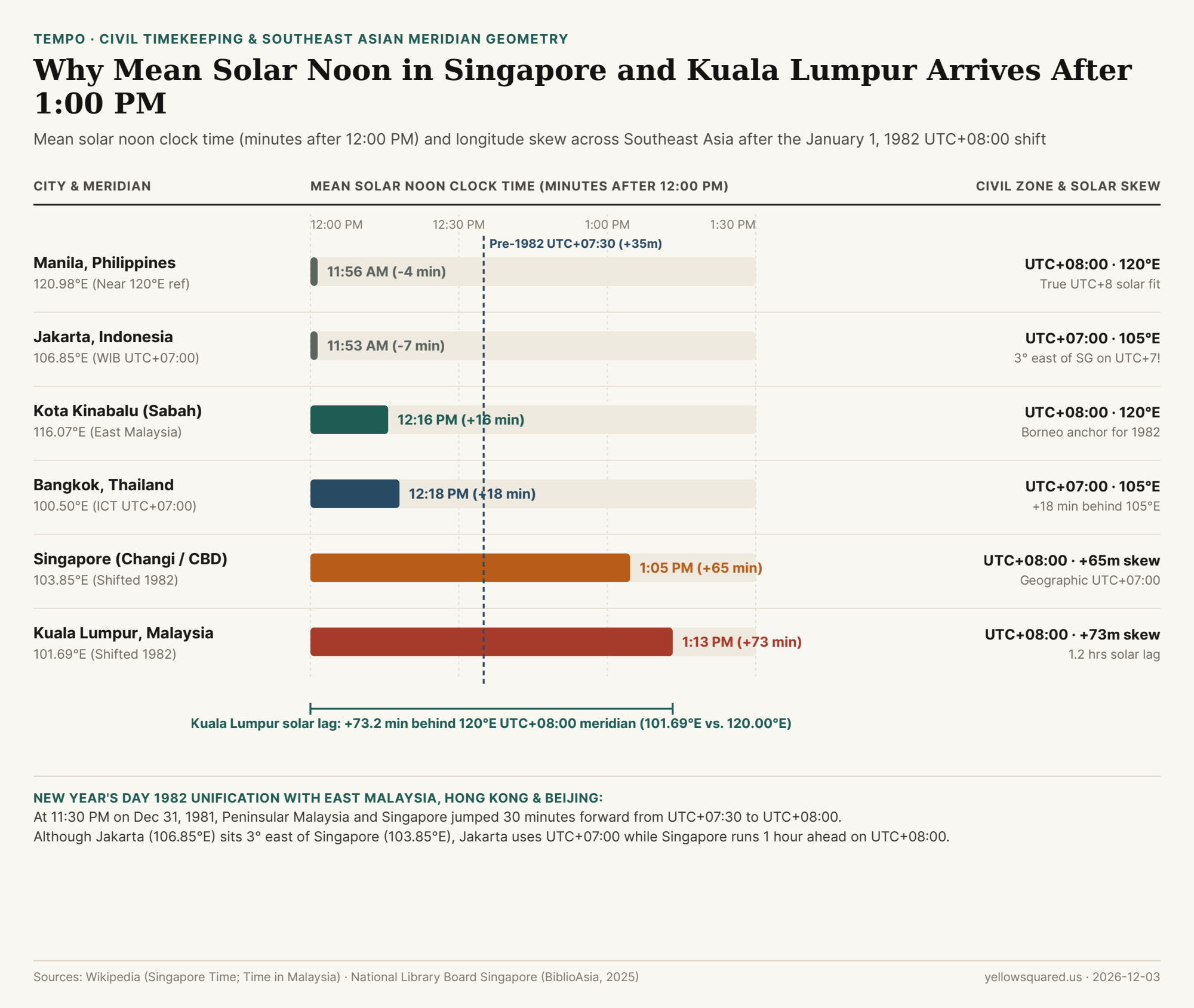
Horizontal bar chart comparing mean solar noon clock time and longitude skew across Manila, Jakarta, Kota Kinabalu, Bangkok, Singapore, and Kuala Lumpur.
Figure 1: Mean solar noon clock time and longitude skew across six Southeast Asian cities, showing Singapore's +64.6-minute lag and Kuala Lumpur's +73.2-minute lag behind the 120°E meridian. Source: Wikipedia (Singapore Time), Wikipedia (Time in Malaysia), and BiblioAsia (NLB Singapore).

Six Time Zones in Eighty Years: From GMT+06:55:25 to the 20-Minute Daylight Saving Bill

Because Singapore sits just 1.3° (85 miles) north of the Equator, day length barely fluctuates between December and June (12 hours and 3 minutes vs. 12 hours and 12 minutes). Yet despite its equatorial latitude, Singapore and the Malay Peninsula modified their civil clocks six times during the twentieth century, as chronicled by the National Library Board of Singapore in BiblioAsia's history of Singapore's shifting time zones:

  • Pre-1905 Local Mean Time (GMT+06:55:25): From January 1, 1901 to May 31, 1905, the Straits Settlements and Federated Malay States anchored their clocks to the Fort Canning time ball in Singapore (103°51'16"E), running 6 hours, 55 minutes, and 25 seconds ahead of Greenwich.
  • 1905–1932 Geographical Standard Time (GMT+07:00): On June 1, 1905, British Malaya and Singapore adopted the 105°E meridian (GMT+07:00), bringing solar noon to a natural 12:05 PM in Singapore and 12:13 PM in Kuala Lumpur.
  • 1933–1941 The 20-Minute Daylight Saving Compromise (GMT+07:20): After colonial legislators proposed a 30-minute summer-style clock shift so residents could play outdoor tennis and cricket after work, business opposition yielded an unusual compromise under the Daylight Saving Ordinance: on January 1, 1933, clocks moved forward by exactly 20 minutes to GMT+07:20.
  • 1941–1981 Half-Hour Standard Time & Wartime Occupation (GMT+07:30 and GMT+09:00): On September 1, 1941, the offset was rounded up by another 10 minutes to GMT+07:30. During the World War II Japanese Occupation (February 16, 1942 to September 11, 1945), clocks were forced 90 minutes further ahead to Tokyo Standard Time (GMT+09:00) before reverting to GMT/UTC+07:30 on September 12, 1945.

"When Peninsular Malaysia and Singapore jumped from UTC+07:30 to UTC+08:00 at 11:30 PM on December 31, 1981, New Year's Day 1982 arrived thirty minutes early—permanently locking both countries onto permanent equatorial Daylight Saving Time."

Why December 31, 1981 Moved Peninsular Malaysia and Singapore to UTC+08:00

Following the formation of the Federation of Malaysia in 1963, the country was split across two different time zones separated by the South China Sea: Peninsular (West) Malaysia observed UTC+07:30, while East Malaysia (Sabah and Sarawak on the island of Borneo, spanning 110°E to 119°E) observed UTC+08:00. Government offices, domestic Malaysia Airlines flights, and interbank transfers between Kuala Lumpur and Kota Kinabalu constantly lost half an hour to clock confusion.

In December 1981, Prime Minister Mahathir Mohamad introduced the Malaysian Standard Time Act 1981, decreeing that at 11:30 PM (23:30) on December 31, 1981, Peninsular Malaysia would advance its clocks by 30 minutes to 12:00 AM (00:00) on January 1, 1982—unifying the entire country on East Malaysia's UTC+08:00 (120°E) meridian. Because Singapore shares a massive daily commuter, aviation, and financial corridor with Malaysia—and saw an immediate strategic advantage in sharing the exact same UTC+08:00 trading hours as Hong Kong, Taipei, Manila, and Beijing—Singapore's cabinet matched the shift on the exact same night.

City & Region Longitude Natural Solar Zone Observed Civil Zone Mean Solar Noon Solar-Clock Skew
Manila, Philippines 120°59'E (120.98°E) UTC+08:00 (120°E) UTC+08:00 (PHT) 11:56 AM -3.9 min
Jakarta, Indonesia 106°51'E (106.85°E) UTC+07:00 (105°E) UTC+07:00 (WIB) 11:53 AM -7.4 min
Kota Kinabalu (East Malaysia) 116°04'E (116.07°E) UTC+08:00 (120°E) UTC+08:00 (MYT) 12:16 PM +15.7 min
Bangkok, Thailand 100°30'E (100.50°E) UTC+07:00 (105°E) UTC+07:00 (ICT) 12:18 PM +18.0 min
Singapore 103°51'E (103.85°E) UTC+07:00 (105°E) UTC+08:00 (SGT) 1:05 PM +64.6 min
Kuala Lumpur (West Malaysia) 101°41'E (101.69°E) UTC+07:00 (105°E) UTC+08:00 (MYT) 1:13 PM +73.2 min

Why Sunrise in Singapore and Kuala Lumpur Happens Around 7:00 AM All Year

Because Singapore (+64.6 minutes behind 120°E) and Kuala Lumpur (+73.2 minutes behind 120°E) live permanently one full hour ahead of their geographic solar zone, the equatorial 6:00 AM–6:00 PM solar day is shifted neatly to 7:00 AM–7:00 PM on the wall clock. In Singapore, earliest sunrise occurs around 6:46 AM in early November and latest sunrise occurs around 7:17 AM in mid-February, while sunset stays between 6:50 PM and 7:19 PM all year long. To coordinate team standups across Singapore (UTC+08:00), Jakarta (UTC+07:00), Tokyo (UTC+09:00), and US West Coast clocks, Open Tempo in your browser and build your multi-region overlap timeline.

015 / 56

Why Does Iceland Use GMT (UTC+00:00) Year-Round Despite Sitting at 22 Degrees West Longitude?

If you look at a globe and trace the Prime Meridian (0° longitude) straight north from London, it passes more than a thousand kilometers east of Iceland. The capital city of Reykjavik sits at 21°56'W longitude (`21.93°W`), while Keflavik International Airport (`22.61°W`) and the westernmost cliffs of Bjargtangar (`24°32'W`) extend even further into the North Atlantic. By spherical solar geometry—where each 15° band of longitude represents one hour of Earth's rotation (`4 minutes` per degree)—most of Iceland belongs in UTC-01:00, and everything west of 22.5°W belongs in UTC-02:00. Yet according to historical records of Time in Iceland, the entire country has observed Greenwich Mean Time (UTC+00:00) year-round without Daylight Saving Time since April 7, 1968.

Because Iceland's civil clock runs 1 hour and 28 minutes ahead of Reykjavik's local solar meridian (`21.93° × 4 min/deg = 87.8 minutes`), the Sun does not reach its highest point in the sky over Reykjavik at 12:00 PM. Instead, mean solar noon in Reykjavik arrives at 1:28 PM (`13:28`), and out on the western cliffs of Bjargtangar (`24.53°W`), solar noon arrives at 1:38 PM (`13:38`). When coordinating flights, transatlantic engineering sprints, or remote calls with Reykjavik, you can Open Tempo in your browser to compare Iceland's permanent UTC+00:00 clock against shifting North American and European daylight saving schedules.

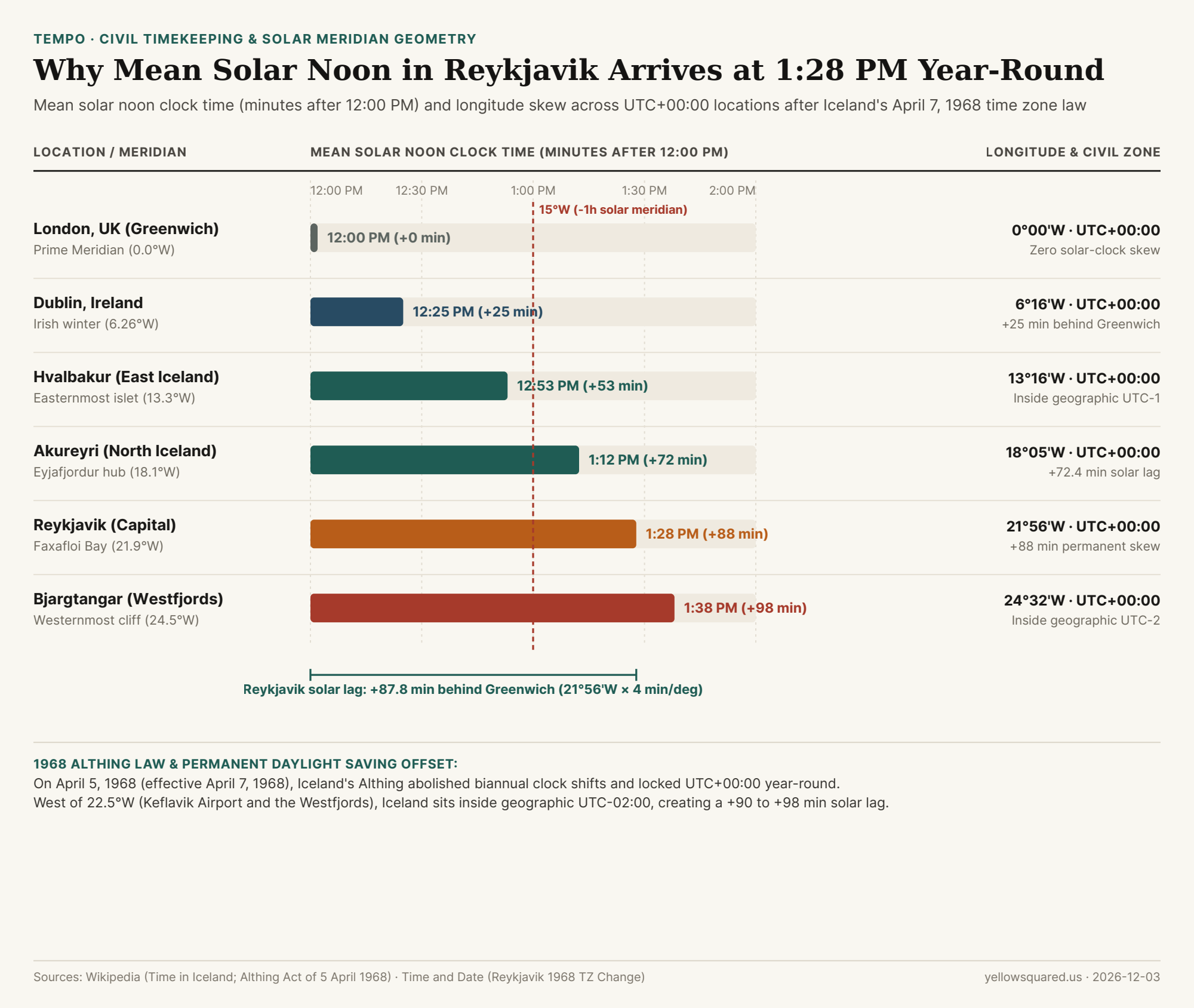
Horizontal bar chart comparing mean solar noon clock times across London, Dublin, East Iceland, Akureyri, Reykjavik, and Bjargtangar under UTC+00:00.
Figure 1: Mean solar noon clock time and longitude skew across UTC+00:00 locations, showing Reykjavik's +87.8-minute permanent offset and Bjargtangar's +98.1-minute lag. Source: Wikipedia (Time in Iceland) and Time and Date (1968 Reykjavik TZ Change).

How Telephone Lines Standardized Iceland at UTC-01:00 in 1907

Prior to the twentieth century, Iceland had neither international land borders nor a cross-country railway network, so individual towns and fishing ports set their clocks to local mean solar time. Because the longitudinal span between easternmost Hvalbakur (`13°16'W`) and westernmost Bjargtangar (`24°32'W`) covers 11°16' of arc, local solar clocks in eastern fjords ran roughly 45 minutes ahead of those in the Westfjords.

That fragmented patchwork ended in 1906 with the founding of Iceland's national telephone company, Landssiminn. Real-time telegraph and telephone switching required a single national clock. On November 16, 1907, Iceland's parliament (the Althing) passed legislation establishing UTC-01:00 (based on the 15°W meridian passing through eastern Iceland) as the country's first nationwide standard time zone. Under UTC-01:00, Reykjavik's mean solar noon occurred at a natural 12:28 PM (`28 minutes` after clock noon).

"By abolishing biannual clock transitions on April 7, 1968 and locking the nation to UTC+00:00 year-round, the Althing placed Iceland on permanent Daylight Saving Time—trading an 88-minute solar noon lag in Reykjavik for seamless year-round alignment with Greenwich and Western European commerce."

Why the Althing Locked UTC+00:00 on April 7, 1968

Iceland first experimented with wartime Daylight Saving Time (`UTC+00:00`) between 1917 and 1921, and reintroduced annual summer clock shifts in 1939. Between 1947 and 1967, Icelanders sprang forward one hour from UTC-01:00 to UTC+00:00 at 02:00 on the first Sunday in April and fell back in late October. However, at subarctic latitudes (`64°N` to `66.5°N`), shifting clocks by one hour in spring and autumn did little to change winter darkness (when Reykjavik receives barely 4 hours of daylight around the December solstice) or summer midnight sun (when twilight merges into nearly 21 to 24 hours of continuous light).

Meanwhile, resetting clocks twice a year scrambled transatlantic aviation schedules at Keflavik, disrupted infant sleep routines, and created a two-hour winter gap against London and continental European trading partners. Researchers at the University of Iceland Almanac proposed a clean compromise: eliminate the twice-yearly clock shift altogether, but keep the summer UTC+00:00 offset all year long. As documented by Time and Date's 1968 Reykjavik transition records, the Althing passed the law on April 5, 1968, and when clocks advanced from 01:00 to 02:00 on Sunday, April 7, 1968, they never turned back.

Location Longitude Geographic Zone Observed Zone Mean Solar Noon Solar Skew
London (Greenwich, UK) 0°00'W (0.00°W) UTC+00:00 UTC+00:00 (Winter) 12:00 PM 0.0 min
Dublin, Ireland 6°16'W (6.26°W) UTC+00:00 UTC+00:00 (Winter) 12:25 PM +25.0 min
Hvalbakur (East Iceland) 13°16'W (13.27°W) UTC-01:00 UTC+00:00 (Year-round) 12:53 PM +53.1 min
Akureyri (North Iceland) 18°05'W (18.09°W) UTC-01:00 UTC+00:00 (Year-round) 1:12 PM +72.4 min
Reykjavik (Capital) 21°56'W (21.93°W) UTC-01:00 UTC+00:00 (Year-round) 1:28 PM +87.8 min
Keflavik Int'l Airport 22°36'W (22.61°W) UTC-02:00 (>22.5°W) UTC+00:00 (Year-round) 1:30 PM +90.4 min
Bjargtangar (Westfjords) 24°32'W (24.53°W) UTC-02:00 (>22.5°W) UTC+00:00 (Year-round) 1:38 PM +98.1 min

Social Jet Lag and the 2020 Government Review

Because the boundary between geographic UTC-01:00 and UTC-02:00 lies at 22.5°W (`15°W + 7.5°`), western Iceland—including Keflavik International Airport (`22.61°W`), Isafjordur, and Bjargtangar (`24.53°W`)—is technically locked nearly two full hours ahead of its geographic zone (`+90.4` to `+98.1 minutes` past solar noon). Chronobiologists and sleep researchers have repeatedly petitioned the Althing since 1994 to revert to UTC-01:00, arguing that dark winter mornings (when sunrise in Reykjavik does not occur until 11:22 AM in late December) induce chronic social jet lag in adolescents and shift workers.

However, following a comprehensive public consultation and cabinet review in 2020, the Icelandic government voted to retain UTC+00:00 year-round, citing overwhelming public preference for brighter afternoon and evening hours from February through November and zero DST clock-change friction. To track Reykjavik's live offset against London, New York, or Seattle without mental math, Open Tempo in your browser and pin Atlantic/Reykjavik to your time-zone comparison board.

016 / 56

Why Does Saskatchewan Stay on Central Standard Time (UTC-06:00) Year-Round Without Daylight Saving Time?

Ask most travelers which time zone Saskatchewan is in and they will tell you that the province "doesn't believe in Daylight Saving Time." Mathematically, the exact opposite is true. Although Saskatchewan is bisected from north to south by the 105th meridian west (105.0°W)—the exact solar reference meridian for Mountain Standard Time (MST, UTC−07:00)—the province has kept its clocks permanently set one hour ahead at Central Standard Time (CST, UTC−06:00, IANA America/Regina) since the Saskatchewan Time Act of 1966 (Time in Saskatchewan - Wikipedia; Daylight saving time in Canada - Wikipedia).

Because UTC−06:00 is identical to Mountain Daylight Time (MDT), Saskatchewan effectively placed itself on permanent year-round Daylight Saving Time sixty years ago (Time in Canada - Wikipedia). When you coordinate cross-border meetings across Calgary, Regina, Winnipeg, and Chicago in Open Tempo in your browser, you can see how Saskatchewan shares Denver and Calgary's clock in summer and Chicago and Winnipeg's clock in winter without ever touching a wall clock.

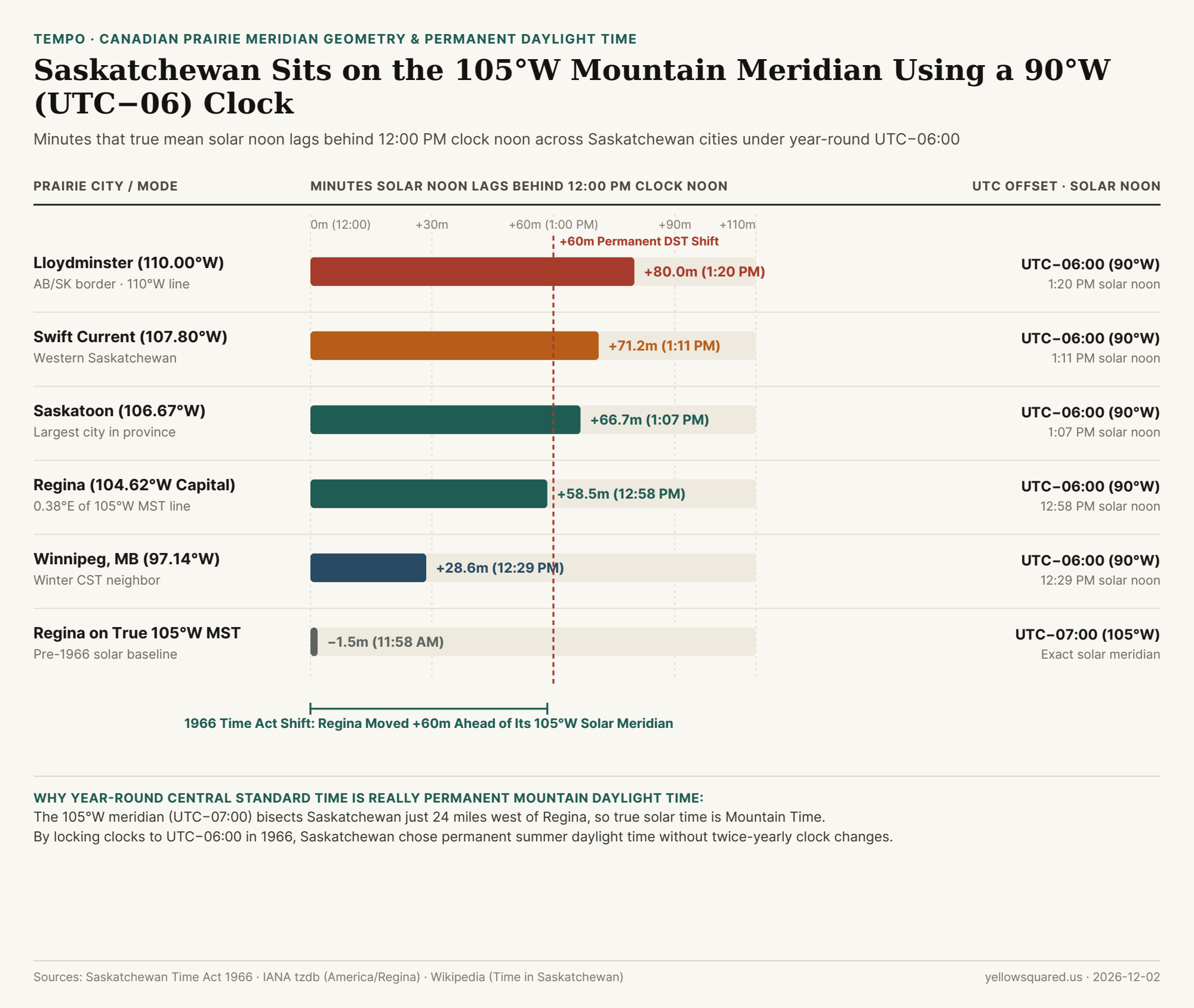
Chart showing minutes that mean solar noon lags behind 12:00 PM clock noon across Lloydminster, Swift Current, Saskatoon, Regina, and Winnipeg under UTC-06:00
Figure 1: Mean solar noon lag behind 12:00 PM clock noon across Saskatchewan cities under year-round UTC−06:00 compared to Winnipeg and a true 105°W solar clock. Data: saskatchewan-america-regina-utc-06-00-permanent-daylight-time-solar-noon.csv (Time in Saskatchewan - Wikipedia; Time in Canada - Wikipedia).

The 105°W Solar Math: Why Solar Noon Hits Saskatoon at 1:07 PM

Earth rotates 15° of longitude every hour, or 1° every 4 minutes. The governing meridian for UTC−06:00 (Central Standard Time) lies at 90.0°W (near Thunder Bay, Ontario, and Memphis, Tennessee), whereas Saskatchewan spans from roughly 101.5°W on the Manitoba border to 110.0°W on the Alberta border (Time in Saskatchewan - Wikipedia):

  • Regina (104.62°W under UTC−06:00): The provincial capital sits just 0.38° east of the 105.0°W Mountain meridian, but 14.62° west of the 90.0°W Central meridian. Multiplying 14.62° × 4 minutes/degree pushes mean solar noon to 12:58 PM CST (a +58.5 minute lag behind clock noon).
  • Saskatoon (106.67°W under UTC−06:00): Located 16.67° west of 90.0°W, mean solar noon arrives 66.7 minutes after 12:00 PM, at 1:07 PM CST year-round.
  • Swift Current (107.80°W under UTC−06:00): In southwestern Saskatchewan, solar noon lags clock noon by 71.2 minutes, occurring at 1:11 PM CST.
  • Lloydminster (110.00°W on the 50th Meridian): Sitting directly on the Alberta–Saskatchewan border (20.0° west of 90.0°W), a UTC−06:00 clock places mean solar noon 80.0 minutes after 12:00 PM (at 1:20 PM) (Time in Saskatchewan - Wikipedia).

"Saskatchewan did not abolish Daylight Saving Time in 1966—it locked its 105°W Mountain Time geography onto a permanent 90°W (UTC−06:00) summer clock 365 days a year."

Why the 1966 Time Act Ended Saskatchewan's Local Clock Chaos

Before 1966, timekeeping in Saskatchewan was a municipal free-for-all. Eastern towns near Manitoba used Central Time, western towns near Alberta used Mountain Time, and individual town councils voted independently on whether and when to adopt summer Daylight Saving Time (Time in Saskatchewan - Wikipedia). Because the boundary between local zones zig-zagged across rural highways, drivers traveling due north or south crossed multiple time changes within the same province.

A 1956 provincial plebiscite revealed a three-way deadlock: urban residents wanted Central Time, rural farmers wanted Mountain Standard Time, and voters were split 50/50 on seasonal clock changes. In 1966, Premier Ross Thatcher's government passed the Time Act of 1966, compromising by placing the entire province on year-round Central Standard Time (UTC−06:00) (Time in Saskatchewan - Wikipedia): urban centers got the UTC−06:00 offset and long summer evenings they wanted, while rural communities never had to reset their clocks twice a year.

Prairie City / Mode IANA Zone ID Active UTC Offset Clock Meridian Local Longitude Mean Solar Noon (Lag)
1. Lloydminster (Border) America/Regina UTC−06:00 90.00°W 110.00°W 1:20 PM (+80.0 min)
2. Swift Current (West SK) America/Regina UTC−06:00 90.00°W 107.80°W 1:11 PM (+71.2 min)
3. Saskatoon (Central SK) America/Regina UTC−06:00 90.00°W 106.67°W 1:07 PM (+66.7 min)
4. Regina (Capital) America/Regina UTC−06:00 90.00°W 104.62°W 12:58 PM (+58.5 min)
5. Winnipeg, MB (Winter) America/Winnipeg UTC−06:00 90.00°W 97.14°W 12:29 PM (+28.6 min)
6. Regina on True 105°W MST Solar 105°W UTC−07:00 105.00°W 104.62°W 11:58 AM (−1.5 min)

The Lloydminster Charter Exception & 2026 Western Canadian Alignment

The 1966 Time Act included a famous municipal carve-out for Lloydminster, a bi-provincial city whose main street (50th Avenue) runs directly along the 110.0°W border between Alberta and Saskatchewan. To prevent residents from changing time zones when crossing the street, Lloydminster's charter permitted the Saskatchewan half of the city to observe Mountain Standard Time (UTC−07:00) in winter and Mountain Daylight Time (UTC−06:00) in summer alongside Alberta—before Saskatchewan and western provinces aligned on permanent UTC−06:00 in 2026 (Time in Saskatchewan - Wikipedia; Time in Canada - Wikipedia). When configuring servers or calendar invites for Saskatchewan, always select America/Regina (or America/Swift_Current) rather than generic US Central Time (America/Chicago) so your software never applies a spring or autumn DST shift. To compare live working hours across Regina, Calgary, Toronto, and U.S. hubs, Open Tempo in your browser.